


As Bollywood Evolves, Women Find Deeper Roles

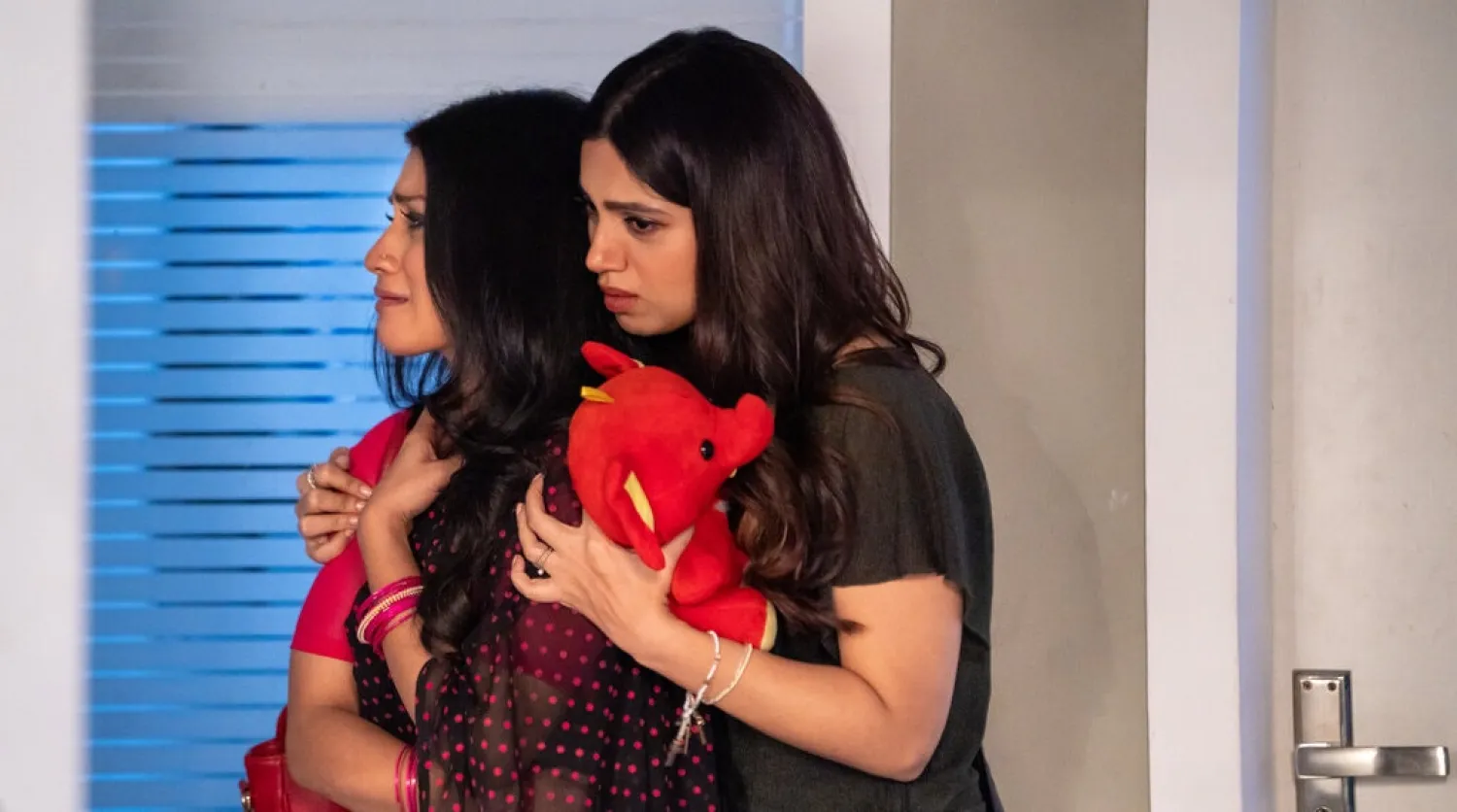
Motherhood is a theme in “Dolly Kitty Aur Woh Chamakte Sitare,” which tells the story of two women on parallel paths of self-discovery. In one scene, Konkona Sen Sharma (Dolly), left, is held by Bhumi Pednekar (Kitty).Credit...Netflix
TT

As Bollywood Evolves, Women Find Deeper Roles

Motherhood is a theme in “Dolly Kitty Aur Woh Chamakte Sitare,” which tells the story of two women on parallel paths of self-discovery. In one scene, Konkona Sen Sharma (Dolly), left, is held by Bhumi Pednekar (Kitty).Credit...Netflix

“Women are born to make sacrifices for men.”

This dialogue comes from the 1995 Bollywood film “Dilwale Dulhania Le Jayenge,” where the main character, Simran, has fallen in love but her family has already arranged for her to marry someone else. Her mother asks her to sacrifice that love in deference to her father’s wishes.

For Bollywood, the world’s largest film industry, the road to an authentic portrayal of women has been bumpy. In India’s Hindi film realm, onscreen mothers have long been depicted as passive housewives who bow to patriarchal pressures.

But this portrayal is being challenged. A number of movies in recent years have shown mothers, and women overall, as full and complex human beings — not melodramatic side characters, but outspoken, independent leads who are in charge of their own fates.

“Tribhanga,” which was released on Netflix in January, is one such film. The story follows Anuradha (Kajol), an actress and dancer, who must face the demons of her past when her estranged mother, Nayantara (Tanvi Azmi), ends up in the hospital. Nayantara, who is a highly accomplished writer, gets to tell her side of the story in flashbacks, through conversations with a disciple who is recording material for a biography.

Written and directed by the actress Renuka Shahane, “Tribhanga” covers topics not typical of Bollywood films, like single motherhood, sexual abuse and open relationships. Nayantara herself is shown leaving her husband so she can pursue a career, date as a single mother and casually drink when she feels like it. What she doesn’t realize is that one of her boyfriends sexually abused Anu — and the cycle of trauma repeats when Anu’s daughter gets bullied for being born outside marriage.

“My mother has always shared her fallibility with me,” Shahane said in a video interview last month. “The fun aspect of growing up with her was that I could see her as a human being.”

Shahane took this real-life inspiration and incubated it into a script she worked on for nearly six years. For the characters, she said, it was important to depict women as complex, if flawed, people. “They are individuals first, and they are very talented, beautiful, strong women, but they also have their feelings.”

But audiences, and the industry, haven’t always been so welcoming — women-led films in the past decade like “The Dirty Picture” (2011) and “Kahaani” (2012) did well at the box office, while others, like the 2018 film “Veere Di Wedding” did not. Still, mothers were often depicted adhering to traditional gender roles, doting on their families, and wholly focused on their children’s lives. In the 2001 family drama “Kabhi Khushi Kabhie Gham,” the mother (played by Jaya Bachchan) is shown as being telepathically aware of her son’s emotions and presence, whether he is physically near her or not. And the 1999 film “Hum Saath Saath Hain” placed the mother’s preference for her youngest son at the center of the story’s conflict.

The move toward having a more three-dimensional portrayal of onscreen mothers has been developing for decades. According to Beheroze Shroff, a professor of Asian-American Studies at the University of California, Irvine, it began in the 1950s, when post-independence India was breaking the shackles of colonialism. Shroff said that in the 1957 film “Mother India,” the ideal mother was depicted as a daughter of the nation, both committed to her domestic duties and to her country. But as India globalized, transnational trends and free-market capitalism proliferated, and by the 1990s, there was a growing need to address a then-burgeoning diaspora audience. This created a conflict between showing women as dutiful versus as they really are, when more viewers worldwide were petitioning for more accurate representation.

Regarding the recent, women-led movies like “Tribhanga,” Shroff said that the challenging of the mother figure role was necessary to make the characters more true to life. “A mother has to be three dimensional, especially when she is no longer dependent on financial assistance from the husband.”

In more recent years, the growing investment of global streaming platforms in India has also sped up the progress, Shroff said. “Somehow capitalism aids creativity and aids new voices.”

A lot of this comes back to the audience. International viewers on streaming platforms, especially in large markets like the United States, tends to be more open to seeing women in different roles — which makes catering to them more logical, and profitable.

Shroff said that streaming services “have a certain sensibility that they want to see in the kind of narratives that they are promoting on their platform. That has been a great boon for women filmmakers, women writers, women behind the camera and in front of the camera.”

Alankrita Shrivastava, the director of the 2019 film “Dolly Kitty Aur Woh Chamakte Sitare” (streaming on Netflix), agreed that the shift is happening now because of women who have worked their way up within the industry, but thinks change is also happening because of more eclectic audience interests. “I feel like the audience may also be opening up a little more to stories which don’t necessarily have the male, upper caste, cisgender heterosexual hero at the center of the universe," she said.

(The New York Times)


‘Godfather’ and ‘Apocalypse Now’ Actor Robert Duvall Dead at 95 

Actor Robert Duvall arrives at the 72nd Golden Globe Awards in Beverly Hills, California January 11, 2015. (Reuters)
TT

‘Godfather’ and ‘Apocalypse Now’ Actor Robert Duvall Dead at 95 

Actor Robert Duvall arrives at the 72nd Golden Globe Awards in Beverly Hills, California January 11, 2015. (Reuters)

Robert Duvall, who played the smooth mafia lawyer in "The Godfather" and stole the show with his depiction of a surfing-crazed colonel in "Apocalypse Now," has died at the age of 95, his wife said Monday.

His death Sunday was confirmed by his wife Luciana Duvall.

"Yesterday we said goodbye to my beloved husband, cherished friend, and one of the greatest actors of our time. Bob passed away peacefully at home," she wrote.

Blunt-talking, prolific and glitz-averse, Duvall won an Oscar for best actor and was nominated six other times. Over his six decades-long career, he shone in both lead and supporting roles, and eventually became a director. He kept acting in his 90s.

"To the world, he was an Academy Award-winning actor, a director, a storyteller. To me, he was simply everything," Luciana Duvall said. "His passion for his craft was matched only by his deep love for characters, a great meal, and holding court."

Duvall won his Academy Award in 1983 for playing a washed-up country singer in "Tender Mercies."

But his most memorable characters also included the soft-spoken, loyal mob consigliere Tom Hagen in the first two installments of "The Godfather" and the maniacal Lieutenant Colonel William Kilgore in Francis Ford Coppola's 1979 Vietnam War epic "Apocalypse Now."

"It was an honor to have worked with Robert Duvall," Oscar winner Al Pacino, who acted alongside Duvall in "The Godfather" films, said in a statement.

"He was a born actor as they say, his connection with it, his understanding and his phenomenal gift will always be remembered. I will miss him."

As Colonel Kilgore, Duvall earned an Oscar nomination and became a bona fide star after years playing lesser roles, in a performance where he utters what is now one of cinema's most famous lines.

"I love the smell of napalm in the morning," his war-loving character -- bare chested, cocky and sporting a big black cowboy hat -- muses as low-flying US warplanes bomb a beachfront tree line where he wants to go surfing.

That character was originally created to be even more over the top -- his name was at first supposed to be Colonel Carnage -- but Duvall had it toned down, demonstrating his meticulous approach to acting.

"I did my homework," Duvall told veteran talk show host Larry King in 2015. "I did my research."

Cinema giant Francis Ford Coppola -- who directed Duvall in "Apocalypse Now" and "The Godfather" -- called his loss "a blow."

"Such a great actor and such an essential part of American Zoetrope from its beginning," Coppola said in a statement on Instagram.

- A 'vast career' -

Duvall was sort of a late bloomer in Hollywood -- he was already 31 when he delivered his breakout performance as the mysterious recluse Boo Radley in the 1962 film adaptation of Harper Lee's novel "To Kill a Mockingbird."

He would go on to play myriad roles -- a bullying corporate executive in "Network" (1976), a Marine officer who treats his family like soldiers in "The Great Santini" (1979), and then his star turn in "Tender Mercies."

Duvall often said his favorite role, however, was one he played in a 1989 TV mini-series -- the grizzled, wise-cracking Texas Ranger-turned-cowboy Augustus McCrae in "Lonesome Dove," based on the novel by Larry McMurtry.

British actress Jane Seymour, who worked with Duvall on the 1995 film "The Stars Fell on Henrietta," took to Instagram to share a heartfelt tribute to the star.

"We were able to share in his love of barbecue and even a little tango," Seymour captioned a photo of herself with Duvall. "Those moments off camera were just as memorable as the work itself."

US actor Alec Baldwin made a short video tribute to Duvall, speaking about the star's "vast career."

"When he did 'To Kill A Mockingbird' he just destroyed you with his performance of Boo Radley, he used not a single word of dialogue, not a single word, and he just shatters you," Baldwin said.

Film critic Elaine Mancini once described Duvall as "the most technically proficient, the most versatile, and the most convincing actor on the screen in the United States."


Songwriter Billy Steinberg Dies at 75

Grammy-winning songwriter Billy Steinberg (L) was behind several top hits of the 1980s and 1990s including Madonna's 'Like A Virgin'. Paul A. Hebert / GETTY IMAGES NORTH AMERICA/AFP/File
TT

Songwriter Billy Steinberg Dies at 75

Grammy-winning songwriter Billy Steinberg (L) was behind several top hits of the 1980s and 1990s including Madonna's 'Like A Virgin'. Paul A. Hebert / GETTY IMAGES NORTH AMERICA/AFP/File

Award-winning US songwriter Billy Steinberg, who wrote several top hit songs including Madonna's "Like a Virgin," died Monday at age 75, according to media reports.

Steinberg wrote some of the biggest pop hits of the 1980s and 1990s and was behind songs performed by singers from Whitney Houston and Celine Dion to Madonna and Cyndi Lauper.

He died following a battle with cancer, his attorney told the Los Angeles Times and BBC News.

"Billy Steinberg's life was a testament to the enduring power of a well-written song -- and to the idea that honesty, when set to music, can outlive us all," his family said in a statement to the outlets.

Steinberg was born in 1950 and grew up in Palm Springs, California, where his family had a table grape business. He attended Bard College in New York and soon began his career in songwriting.

He helped write five number one singles on the Billboard Hot 100 list. Among those was "Like a Virgin," co-written with Tom Kelly, which spent six consecutive weeks at the top of the charts.

Steinberg won a Grammy Award in 1997 for his work on Celine Dion's "Falling Into You."

He was inducted into the Songwriters Hall of Fame in 2011.


'Train Dreams,' 'The Secret Agent' Nab Spirit Wins to Boost Oscars Campaigns

'Train Dreams' director Clint Bentley speaks to the audience after his film grabbed best feature at the Film Independent Spirit Awards, as it continues its best picture Oscars campaign. KEVIN WINTER / GETTY IMAGES NORTH AMERICA/AFP
TT

'Train Dreams,' 'The Secret Agent' Nab Spirit Wins to Boost Oscars Campaigns

'Train Dreams' director Clint Bentley speaks to the audience after his film grabbed best feature at the Film Independent Spirit Awards, as it continues its best picture Oscars campaign. KEVIN WINTER / GETTY IMAGES NORTH AMERICA/AFP

Period drama "Train Dreams" took home the Spirit Awards win for best feature Sunday, as both it and "The Secret Agent" gathered momentum ahead of the Academy Awards.

"The Secret Agent" notched best international film as its team hopes to win in the same category at the Oscars next month.

The annual Film Independent Spirit Awards ceremony only celebrates movies made for less than $30 million.

"Train Dreams," director Clint Bentley's adaptation of the Denis Johnson novella, follows a railroad worker and the transformation of the American northwest across the 20th century.

The film won three of its four categories, also grabbing wins for best director and best cinematography. The movie's lead, Joel Edgerton, however, did not take home best actor, which went to Rose Byrne for "If I Had Legs I'd Kick You."

"Train Dreams" producer Teddy Schwarzman told AFP the film "is a singular journey, but it hopefully helps bring people together to understand all that life entails: love, friendship, loss, grief, healing and hope."

"Train Dreams" will compete for best picture at the Oscars, among other honors.

Big win for Brazil

After "The Secret Agent" nabbed best international film, director Kleber Mendonca Filho hailed the win as one that hopefully "gives more visibility to Brazilian cinema."

The film follows a former academic pursued by hitmen amid the political turmoil of Brazil under military rule.

It prevailed Sunday over contenders including rave-themed road trip movie "Sirat," which will compete alongside "The Secret Agent" for best international feature film at the Oscars, capping Hollywood's awards season.

"The Secret Agent" will also be up for best picture, best actor and best casting.

Brazil's "I'm Still Here" won best international feature at the Oscars last year.

Other Spirit winners on Sunday included "Lurker," for best first screenplay and best first feature film.

"Sorry, Honey" nabbed best screenplay and "The Perfect Neighbor" scored best documentary.

The Academy Awards will be presented on March 15.
