

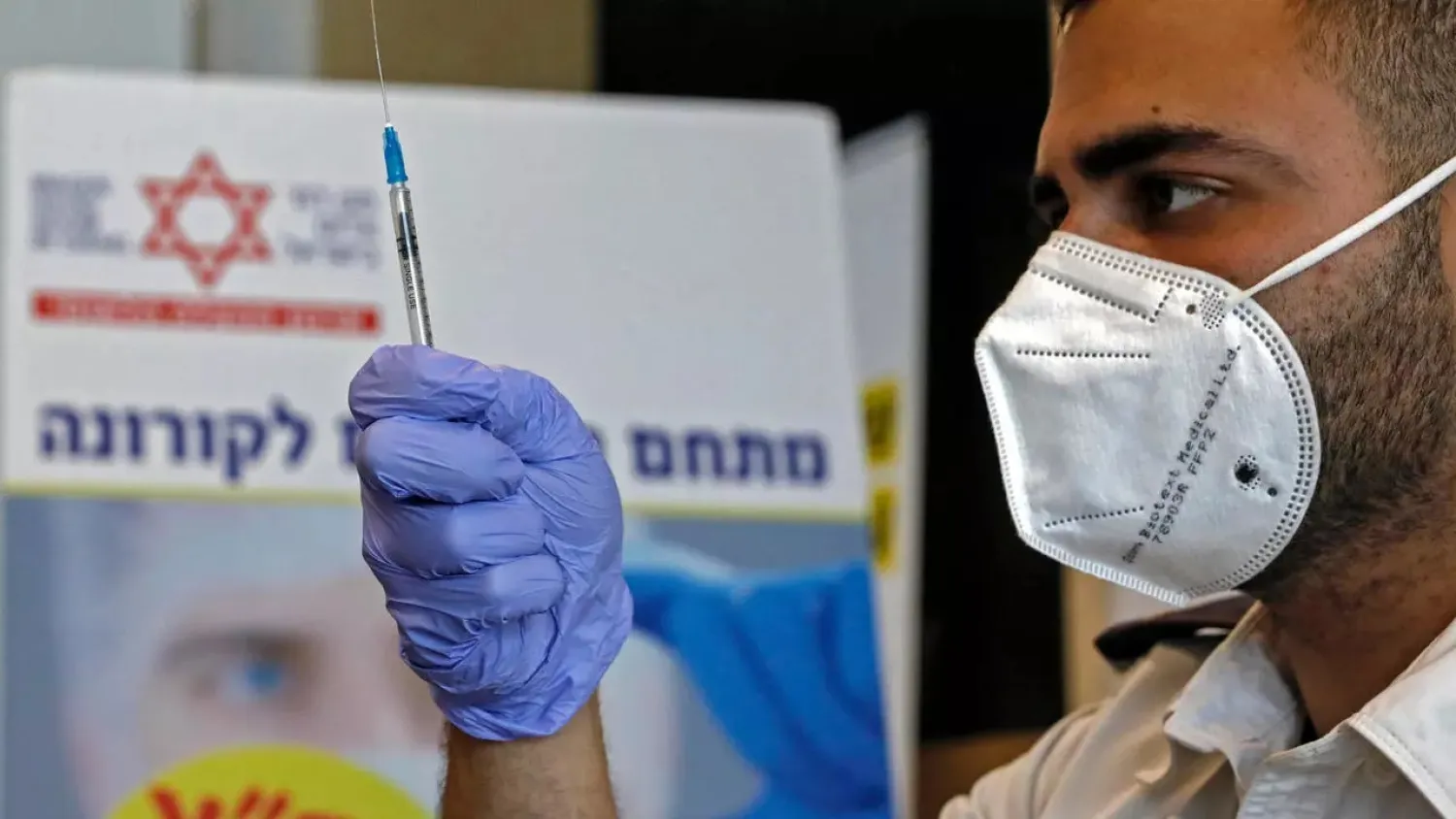

Israel Adopts Law Allowing Names of Unvaccinated to Be Shared

Israel has administered the two recommended jabs of the Pfizer/BioNTech Covid-19 vaccine to roughly a third of its nine million population. (AFP)
TT

Israel Adopts Law Allowing Names of Unvaccinated to Be Shared

Israel has administered the two recommended jabs of the Pfizer/BioNTech Covid-19 vaccine to roughly a third of its nine million population. (AFP)

Israel's parliament passed a law Wednesday allowing the government to share the identities of people not vaccinated against the coronavirus with other authorities, raising privacy concerns for those opting out of inoculation.

The measure, which passed with 30 votes for and 13 against, gives local governments, the director general of the education ministry and some in the welfare ministry the right to receive the names, addresses and phone numbers of unvaccinated citizens.

The objective of the measure -- valid for three months or until the Covid-19 pandemic is declared over -- is "to enable these bodies to encourage people to vaccinate by personally addressing them", a parliament statement said.

Israel, a country of nine million people, has administered the two recommended jabs of the Pfizer/BioNTech vaccine against the coronavirus to roughly a third of its population.

As it emerges from lockdown, the country is restricting certain services, including access to gyms and indoor dining, to the vaccinated only, giving a so-called green pass to the fully inoculated.

That too has raised concerns about unequal access for those exercising their right to not be vaccinated.

During debate on the measure, Labor party leader Merav Michaeli accused right-wing Prime Minister Benjamin Netanyahu of "denying citizens their right to the privacy of their medical information".

The statement from the parliament, or Knesset, said the personal information cannot be used for any purpose other than encouraging people to be vaccinated.

"The information will be deleted after its use within 60 days," according to the law, and "a person who was contacted can demand that his details be deleted and that they not be contacted again."

Haim Katz of Netanyahu's Likud party defended the law as a means to promote vaccination.

"I've been asked what about people's privacy: Is privacy more important than life itself?" Katz said in parliament, stressing the information would include nothing beyond the question of whether or not the person was vaccinated.

At a news conference, Netanyahu later called on Israeli citizens to be vaccinated in order to "return to normal life".

The prime minister deplored misleading news about the vaccine, and said Israel aimed to fully inoculate 6.2 million people before the beginning of April.

"More than a million adults are not yet vaccinated," he said, adding that "in the world, people are waiting for vaccines, (but) here vaccines are waiting for people".

Israel has officially recorded more than 760,000 coronavirus cases and over 5,600 deaths since the start of the pandemic.



Iran Says US Responsible for ‘Insecurity’ in Hormuz Strait

 Iranian Foreign Minister Abbas Araghchi, right, and Russian Foreign Minister Sergei Lavrov shake hands after their meeting at Iran's Foreign Ministry in Tehran, Iran, Monday, Oct. 19, 2026. (AP)
Iranian Foreign Minister Abbas Araghchi, right, and Russian Foreign Minister Sergei Lavrov shake hands after their meeting at Iran's Foreign Ministry in Tehran, Iran, Monday, Oct. 19, 2026. (AP)
TT

Iran Says US Responsible for ‘Insecurity’ in Hormuz Strait

 Iranian Foreign Minister Abbas Araghchi, right, and Russian Foreign Minister Sergei Lavrov shake hands after their meeting at Iran's Foreign Ministry in Tehran, Iran, Monday, Oct. 19, 2026. (AP)
Iranian Foreign Minister Abbas Araghchi, right, and Russian Foreign Minister Sergei Lavrov shake hands after their meeting at Iran's Foreign Ministry in Tehran, Iran, Monday, Oct. 19, 2026. (AP)

Iran's top diplomat on Monday accused the United States of being responsible for the "insecurity" in the Strait of Hormuz, which has been at the heart of the conflict between the foes.

"The war imposed by the United States and the Zionist regime (Israel), combined with the economic blockade, constitutes the principal source of insecurity in our region," said Iranian Foreign Minister Abbas Araghchi, having previously referred to "the Gulf and the Strait of Hormuz".

He was speaking during a joint press conference with his Russian counterpart Sergei Lavrov, who arrived in Tehran earlier Monday, in his first visit since the outbreak of the Middle East war as Moscow seeks to play a mediating role.

Iranian foreign ministry spokesman Esmaeil Baqaei said on Sunday that the trip would focus on "regional and international developments".

Lavrov was scheduled to meet Iranian President Masoud Pezeshkian and hold talks with his counterpart Abbas Araghchi, according to the Russian foreign ministry.

The veteran diplomat has said Moscow's efforts are "aimed at preventing the return of a large-scale war", with talks stalled between Tehran and Washington.

His visit comes after Russian President Vladimir Putin told Pezeshkian in early October that Moscow was prepared to contribute to mediation efforts.

Russia and Iran, two of the most heavily sanctioned nations in the world, maintain close ties. Their military and economic cooperation has only increased since the Russian invasion of Ukraine in 2022.

The Middle East war began in February with US-Israeli strikes on Iran. Despite a ceasefire in April, followed by a US-Iran memorandum of understanding in June, hostilities in and around the Strait of Hormuz have not stopped.

Iran claims control over the strategic waterway -- through which one-fifth of the world's hydrocarbons pass in normal times -- and regularly targets vessels that cross without its authorization.

In response, Washington has been maintaining a naval counter-blockade on Iranian ports.

The Russian foreign ministry said discussions during Lavrov's visit were expected to focus on "ways to resolve the acute international crisis triggered by the unlawful aggression of the US and Israel against Iran".

The ministry said the war had been a blow to stability and security "not only in the near and Middle East, but also on a global scale".


Carney Says Cause of Fire at Alberta Military Base Still Unknown

 Canadian Prime Minister Mark Carney speaks about the incident at CFB Wainwright as he rises in the House of Commons in Ottawa, Monday, Oct. 19, 2026. (Adrian Wyld/The Canadian Press via AP)
Canadian Prime Minister Mark Carney speaks about the incident at CFB Wainwright as he rises in the House of Commons in Ottawa, Monday, Oct. 19, 2026. (Adrian Wyld/The Canadian Press via AP)
TT

Carney Says Cause of Fire at Alberta Military Base Still Unknown

 Canadian Prime Minister Mark Carney speaks about the incident at CFB Wainwright as he rises in the House of Commons in Ottawa, Monday, Oct. 19, 2026. (Adrian Wyld/The Canadian Press via AP)
Canadian Prime Minister Mark Carney speaks about the incident at CFB Wainwright as he rises in the House of Commons in Ottawa, Monday, Oct. 19, 2026. (Adrian Wyld/The Canadian Press via AP)

Canada’s ‌Prime Minister Mark Carney said Monday the cause of a fire that killed at least four military members and injured dozens of others in Alberta on Saturday is still not known.

In an address to Parliament, Carney said soldiers and reserve members ‌were conducting ‌live-fire exercises at ‌an ⁠army base in Wainwright ⁠while a fire was burning in the training area.

“Driven by ferocious winds, the fire jumped nearly a kilometer in less than a minute to ⁠where soldiers were gathered,” Carney ‌said.

He ‌added 50 investigators are currently on the ‌ground, from the army and ‌the Royal Canadian Mounted Police, to determine how the disaster happened.

"This loss touches every corner of ‌the nation," Carney said.

Officials said 39 people remain hospitalized, with ⁠19 ⁠people in critical condition. The soldiers and reserve members were preparing to deploy to Latvia, where Canadian forces have their largest international military operation.

The incident comes as Albertans vote Monday in a referendum about whether residents want to pursue a legally binding vote on seceding from Canada.


France Wants Curfews in Some Areas after Weekend of Riots

A protester waving a French national flag walks past a fire during clashes prior to the start of a demonstration to protest against the "high cost of living", in Marseille, southern France, on October 17, 2026  (Photo by Thibaud MORITZ / AFP)
A protester waving a French national flag walks past a fire during clashes prior to the start of a demonstration to protest against the "high cost of living", in Marseille, southern France, on October 17, 2026 (Photo by Thibaud MORITZ / AFP)
TT

France Wants Curfews in Some Areas after Weekend of Riots

A protester waving a French national flag walks past a fire during clashes prior to the start of a demonstration to protest against the "high cost of living", in Marseille, southern France, on October 17, 2026  (Photo by Thibaud MORITZ / AFP)
A protester waving a French national flag walks past a fire during clashes prior to the start of a demonstration to protest against the "high cost of living", in Marseille, southern France, on October 17, 2026 (Photo by Thibaud MORITZ / AFP)

France's central government asked some local authorities to impose curfews and faced pressure over security failings on Monday after a weekend of riots and looting borne out of nationwide anti-government protests.

Prime Minister Sebastien Lecornu did not rule out declaring a state of emergency but said it was more appropriate for now to apply partial and localized curfews, without providing details of which cities would be affected.

"My determination to restore order is absolute," he said in a press conference, ruling out, however, a blanket curfew in Paris, Reuters reported.

The weekend of looting and violence between some protesters and police followed weeks of student demonstrations, rocking France six months ahead of its next presidential election and highlighting pressures from a weak economy and surging debt.

Lecornu blamed far-left groups for some of France's worst unrest in years. "There is, after all, a far-left movement that wants to cause — we can’t put it any more strongly — profound unrest in the country in the run-up to the presidential election," he said.

Hard-left presidential candidate Jean-Luc Melenchon urged him to provide evidence. "Otherwise, he should apologise, keep quiet and stop fanning the flames of unrest," he said on X.

The Federation of Trade and Retail said almost 3,000 shops had been affected over the weekend.

"Once again, the retail sector finds itself on the front line, at a time when it is already weakened by a succession of crises," it said.

"Behind every ransacked shop are business owners, employees and families who have seen years of work and effort wiped out in a matter of hours," it added, calling for relief from social security contributions and tax for those businesses affected.

Lecornu said the government would provide furlough measures from Tuesday.

Some 2,400 people were arrested and one protester died from a cardiac arrest on Saturday while nearly 1,000 officers were injured.

French assets were underperforming broader European markets on Monday, though moves were more contained than at some other moments of recent political friction.

Tensions in President Emmanuel Macron's fragile government over apparent security shortcomings — coming just as the government needs to pass a much-needed budget bill to rein in its finances — could further unsettle investors.

Macron's office said on Monday he had turned down his Interior Minister Laurent Nunez's offer to resign, telling him instead to put an end to barricades and looting and be transparent over what Macron called "intelligence and foresight failings".

Nunez told reporters that Tuesday evening's Champions League soccer match between Paris Saint-Germain and Barcelona would go ahead as planned, even though the capital was one of the worst-hit areas.

The mayors of Paris, Marseille and Lyon said in a joint op-ed published by the newspaper Liberation that they were used to demonstrations and protests.

"But on Saturday ... for the first time, we had the feeling that whole sections of our cities had been left without protection," the mayors — all from the centre-left — said. "We now need to patch the wounds of our cities and face up to the anger of our residents, aghast at this level of violence."

The start of school holidays on Monday may give the government some relief, but students were staging more gatherings and blockades in some places, including the Louvre gallery and Sciences Po university in central Paris.

Marseille, another city badly hit by the riots, banned gatherings and demonstrations. French unions meanwhile called for a new round of strikes and rallies on November 5.

INTELLIGENCE FAILURES

At the weekend, hundreds of thousands took to the streets to protest over what many say are declining and dysfunctional public services that leave citizens to fend for themselves amid cost-of-living pressures.

In Paris, at least 300 to 400 businesses were vandalised at the weekend, Dominique Restino, the head of the Paris chamber of commerce, told BFM television.

At the Place Vendome, home to luxury hotels and boutiques, most shops were shuttered and surrounded by security guards. The front door of a Dior boutique was smashed, while the windows were damaged in the stores of other luxury brands in central Paris, including Rolex, Louis Vuitton, Ralph Lauren and Gucci.

In Marseille, Ligue 1 club Olympique de Marseille said its official store on the city's historic main avenue had been looted, while a town hall in central France was torched.

France deployed 60,000 police and other security forces on Saturday, Nunez told France Inter radio, but he acknowledged that was not enough to control violent crowds.

European governments have advised citizens travelling to France to avoid large crowds and exercise caution.