
Hillary Clinton and Louise Penny to Write Political Thriller

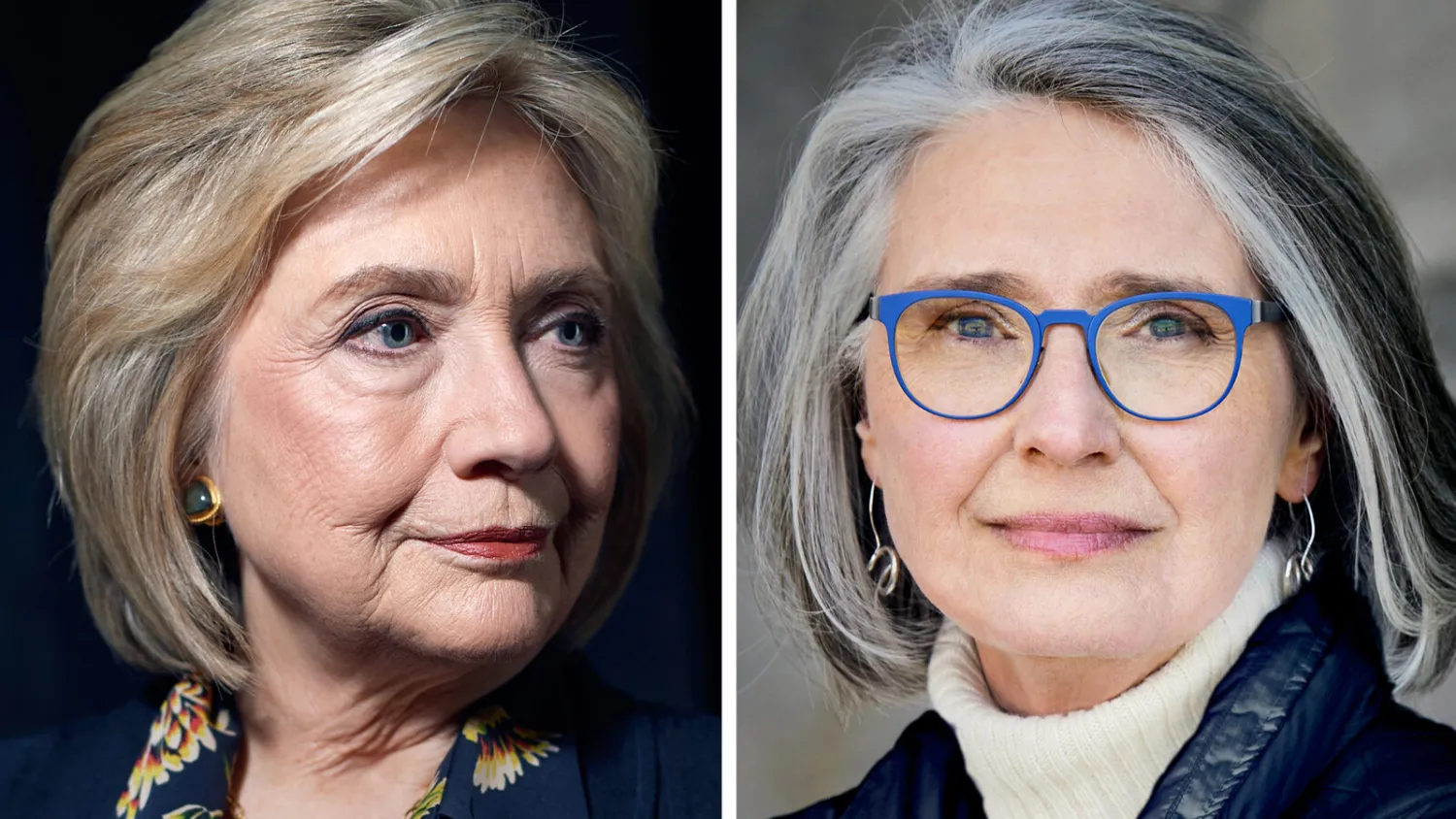
“Before we started, we talked about her time as secretary of state,” the mystery novelist Louise Penny, right, said of Hillary Clinton. “What was her worst nightmare? ‘State of Terror’ is the answer.”Credit...Left to right: Mike Cohen for The New York Times; Jean-François Bérubé
TT

Hillary Clinton and Louise Penny to Write Political Thriller

“Before we started, we talked about her time as secretary of state,” the mystery novelist Louise Penny, right, said of Hillary Clinton. “What was her worst nightmare? ‘State of Terror’ is the answer.”Credit...Left to right: Mike Cohen for The New York Times; Jean-François Bérubé

In Louise Penny’s upcoming thriller, a novice secretary of state faces the daunting task of rebuilding American leadership after years of diminishing influence abroad. She is immediately put to the test when a wave of terrorist attacks threatens to destabilize the world order.

A topical political thriller represents new territory for Penny, who is best known for intricate murder mysteries set in a quiet Canadian town. But she had a political veteran on hand to help her shape the plot: her co-author and friend, the former secretary of state and first lady Hillary Rodham Clinton.

Their new novel, “State of Terror,” will be published in October by Simon & Schuster and St. Martin’s Press, Clinton and Penny’s respective publishers. Jennifer Enderlin, the president and publisher of the St. Martin’s Publishing Group, will edit it.

“When it was suggested my friend Hillary and I write a political thriller together, I could not say yes fast enough,” Penny said in a statement. “Before we started, we talked about her time as secretary of state. What was her worst nightmare? ‘State of Terror’ is the answer.”

It is unusual for a prominent politician and a best-selling crime writer to team up on a novel, but it is not, of course, unprecedented. The subgenre has already been popularized by Clinton’s husband, former President Bill Clinton, who wrote a thriller, “The President Is Missing,” with James Patterson in 2018. The novel, which was published by both Knopf and Little, Brown, has sold more than 2 million copies in North America and was the top-selling adult fiction book of 2018. This summer, they are following up with a second novel, “The President’s Daughter,” about a former US president whose daughter is kidnapped, which will have a first print run of 1 million copies.

Both Clintons are fans of the thriller and mystery genres, and both are represented by the Washington lawyer Robert B. Barnett, who is known for his powerful clients, among them the Obamas and the Bushes. The literary agent David Gernert represented Penny.

The announcements for both Bill Clinton and Hillary Clinton’s debut thrillers stressed that they would draw on their decades of political experience. (A news release for “The President Is Missing” noted that the novel would “be informed by insider details that only a president can know,” while the announcement for “State of Terror” said it “features behind-the-scenes global drama informed by details only an insider could know.”)

Penny and Clinton have long been friends and mutual admirers. In her memoir, “What Happened,” the former presidential candidate wrote that she read Penny’s books after losing the election in 2016, a time when thrillers were sources of comfort along with yogic breathing and chardonnay.

The pair decided to work together on a novel that would be shaped by Clinton’s insider knowledge of the State Department and White House and by Penny’s penchant for crafting addictive plots.

“Writing a thriller with Louise is a dream come true. I’ve relished every one of her books and their characters as well as her friendship,” Clinton said in a statement. “Now we’re joining our experiences to explore the complex world of high-stakes diplomacy and treachery.”

(The Guardian)


Thousands of Animals, Rare Specimens Stolen from Sudan Museum

Skulls of several mammals before the destruction (Asharq Al-Awsat)
TT

Thousands of Animals, Rare Specimens Stolen from Sudan Museum

Skulls of several mammals before the destruction (Asharq Al-Awsat)

“Everything is over.” With that short and painful phrase, a Sudanese government official summed up the loss of nearly a century and a half of history after war destroyed the headquarters of the Sudan Natural History Museum in central Khartoum, stripping the country of thousands of taxidermied and live endangered animals, as well as rare reference specimens.

In the first days after fighting erupted in April 2023, activists on social media called for food and water to be provided to save the live animals. When that proved impossible, cages were opened, and the animals fled, even though some of the reptiles were venomous snakes.

The museum, officially affiliated with the University of Khartoum, lies about one kilometer from the Sudanese army’s general command headquarters in central Khartoum.

Its close proximity led to severe damage from clashes and shelling between the Sudanese army and the Rapid Support Forces, which later took control of the surrounding area for more than a year.

Dr. Othman Ali Haj Al-Amin, Dean of the Faculty of Science at the University of Khartoum, said: “We lost thousands of taxidermied animals, birds, and reptiles that are more than 150 years old.”

“It is most likely that the live animals were stolen or looted and did not die,” he added. “We did not find remains or skeletons of those animals inside the museum.”

Al-Amin broke down in tears as he described to Asharq Al-Awsat the scale of devastation inflicted on one of the world’s oldest natural history museums.

“We lost about 2,000 taxidermied animal specimens, in addition to more than 600 endangered reference specimens that were on display, and nearly all geological records, including animal, plant, and rock fossils,” he said.

“The greatest loss was around 100 species representing all families of animals, birds, and reptiles that had been cared for and preserved for decades.”

Among them were fossil bird specimens collected between 1885 and 1945 that cannot be replaced, as well as a Kordofan giraffe, an endangered subspecies.

The war also claimed “the oldest crocodile, which had lived in the museum for many years and had been cared for since it was an egg,” along with numerous reptiles, including venomous snakes, scorpions, and a Nile monitor lizard.

A taxidermied lioness was recovered and transferred to the university’s veterinary faculty.

Asharq Al-Awsat learned that the International Committee of the Red Cross attempted in those early days to evacuate civilians, including university students who were trapped inside the museum for weeks, as well as to move live and taxidermied animals. The effort failed due to intense fighting in the heart of Khartoum.

According to the Sudanese official, the preserved specimens were collected in the mid-19th century by British army officers.

During World War II, they were transferred from the Sudan National Museum to the Natural History Museum next to the University of Khartoum, which has managed them since its establishment in 1929.

Al-Amin said the museum housed specimens illustrating biodiversity from across Sudan, including South Sudan before its secession, as well as samples gifted to Sudan by international museums.

The Sudan Natural History Museum included multiple sections, among them halls displaying rare bird species, another devoted to animal skulls preserved for decades, a section for medicinal and aromatic plants, geological rock samples collected from ancient eras and environments, and enclosures for live animals.

The dean said restoring the museum to its original state would require many years of work and significant funding. He voiced pessimism about recovering the rare animals, historical specimens, and old records lost during the war.

Many live animals were likely deliberately killed or died of hunger and thirst, he said, while taxidermied animals and rare rock and herb specimens — painstakingly collected, sorted, and classified over many years by researchers — were looted.

The Natural History Museum was a scientific and cultural institution dedicated to the study of biodiversity and natural specimens, and one of the oldest museums in Sudan.


Once a National Obsession, Traditional Korean Wrestling Fights for Survival 

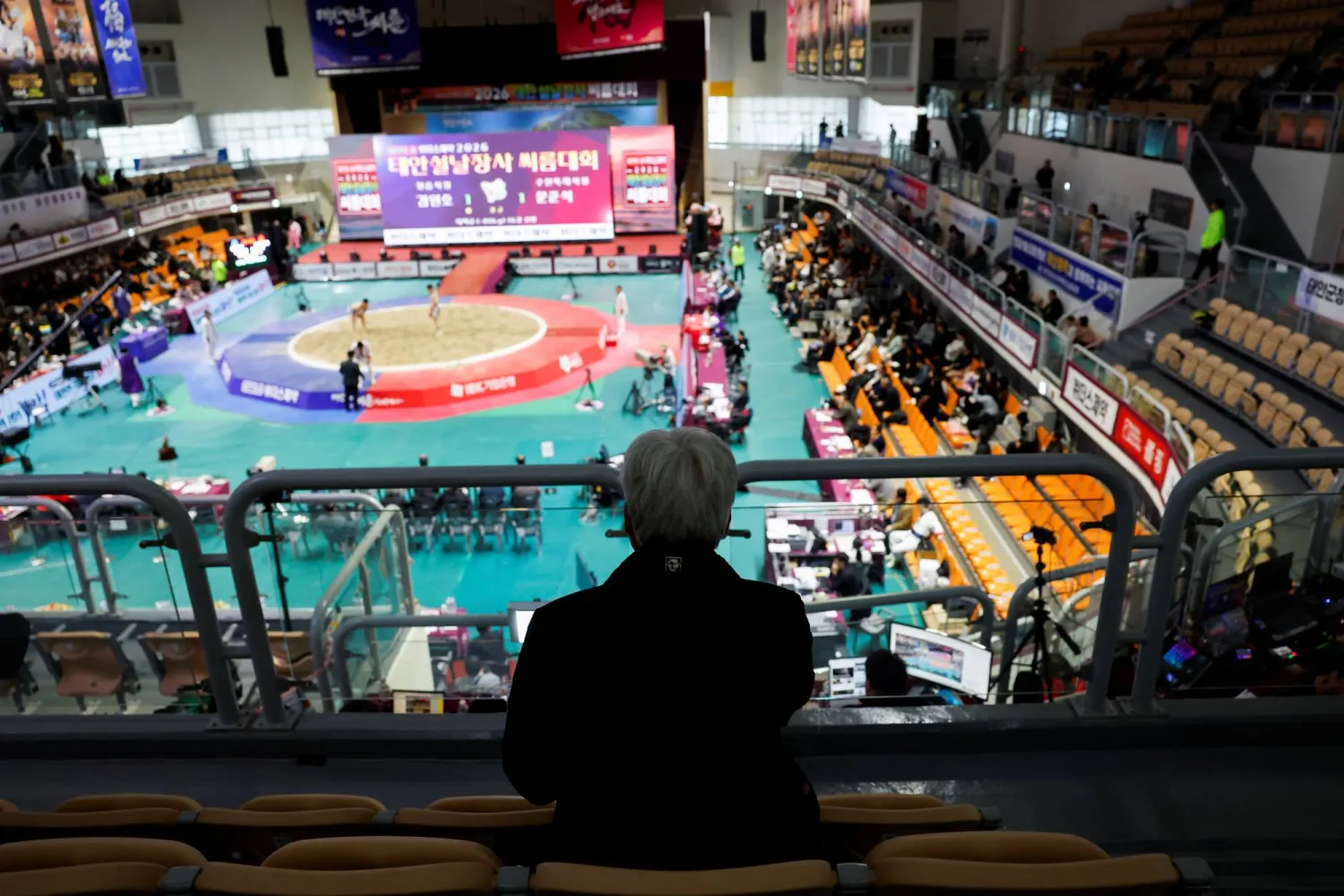
An elderly spectator watches a ssireum match during a Lunar New Year Ssireum championship at the Taean Complex Indoor Gymnasium in Taean, South Korea, February 14, 2026. (Reuters)
TT

Once a National Obsession, Traditional Korean Wrestling Fights for Survival 

An elderly spectator watches a ssireum match during a Lunar New Year Ssireum championship at the Taean Complex Indoor Gymnasium in Taean, South Korea, February 14, 2026. (Reuters)

As South Korea's global cultural influence expands in areas such as music, film and television, one form of entertainment struggling to attract attention even at home is Korea's traditional style of wrestling, known as ssireum.

Ssireum - pronounced like "see room" - had its heyday in the 1980s and early 1990s, when there were as many as eight professional teams and the top wrestlers became household names. Since then, it has been squeezed by tighter budgets and a public quick to move on to new trends.

Twenty-year-old Lee Eun-soo, who began training at the age ‌of nine, is ‌taking part in this year's Lunar New Year ‌tournament, ⁠the showcase event ⁠for the more than 1,500-year-old sport.

Lee lamented that at his former high school, the ssireum team currently has no members and there is talk of disbanding it.

"I once tried to imagine my life if I hadn’t done ssireum," Lee said. "I don’t think I could live without it."

A ssireum match involves two wrestlers facing off in an ⁠eight-meter (26.25 ft) sandpit ring, gripping each other by a ‌cloth belt called a "satba" and using ‌strength, balance, timing and stamina to force the opponent to the ground.

Ssireum ‌was inscribed on UNESCO's Representative List of the Intangible Cultural Heritage ‌of Humanity in 2018, but that international recognition has not translated into commercial success. Its relative obscurity contrasts with the high profile of Japan's sumo, another centuries-old form of wrestling.

Unlike sumo, which is supported by ‌a centralized professional ranking system and six major annual tournaments - or Olympic wrestling, with its global reach - ⁠ssireum remains ⁠largely domestic.

"Sport is something people won't come to watch if they don’t know the wrestlers or even the sport itself," said Lee Tae-hyun, a former ssireum wrestler and Professor of Martial Arts at Yong In University, who has promoted the sport overseas and believes it has commercial potential with the right backing.

Lee Hye-soo, 25, a spectator at the Lunar New Year tournament, said many Koreans are now unfamiliar with ssireum.

"My grandfather liked watching ssireum, so I watched it with him a lot when I was young," she said.

"I like it now too, but I think it would be even better if it became more famous."


Saudi Arabia Concludes Guest of Honor Role at Damascus International Book Fair 2026

The Kingdom’s pavilion, led by the commission, attracted strong attendance and active engagement through its cultural activities - SPA
TT

Saudi Arabia Concludes Guest of Honor Role at Damascus International Book Fair 2026

The Kingdom’s pavilion, led by the commission, attracted strong attendance and active engagement through its cultural activities - SPA

The Literature, Publishing and Translation Commission concluded the Kingdom’s Guest of Honor participation at the Damascus International Book Fair 2026, held in the Syrian capital from February 6 to 16, drawing strong attendance and engagement from visitors and cultural enthusiasts.

The Kingdom's pavilion was highly praised for its rich cultural content and high-quality programs, reflecting the vitality and growth of the Kingdom’s literary and cultural scene, SPA reported.

Literature, Publishing and Translation Commission CEO Dr. Abdullatif Abdulaziz Al-Wasel stated that the Kingdom’s role as Guest of Honor at the Damascus International Book Fair 2026, represented by a high-level cultural delegation led by Minister of Culture Prince Bader bin Abdullah bin Farhan, highlights the depth of Saudi-Syrian cultural relations based on partnership and mutual respect.

He noted that the participation demonstrates the Kingdom’s commitment to enhancing cultural exchange, a key objective of the National Culture Strategy under Saudi Vision 2030. Through this strategy, the commission emphasizes fostering constructive dialogue among peoples, exchanging knowledge and expertise, and consolidating the Kingdom’s active role in the Arab and international cultural landscape.

The Kingdom’s pavilion, led by the commission, attracted strong attendance and active engagement through its cultural activities. It showcased the commission’s programs and initiatives in literature, publishing, and translation, and featured a comprehensive cultural program, including literary seminars, cultural discussions, and poetry evenings with prominent Saudi writers and intellectuals.

These efforts enriched cultural dialogue with fair visitors and strengthened the presence of Saudi literature in the Arab cultural scene.

This edition of the Damascus International Book Fair marks a significant cultural milestone, reaffirming the value of books as carriers of meaning, spaces for dialogue, and starting points for a cultural journey that reflects the aspirations of the Arab cultural landscape toward a more open and aware phase.