


‘WandaVision,’ a Sitcom Sendup, Was a Pandemic Parable, Too

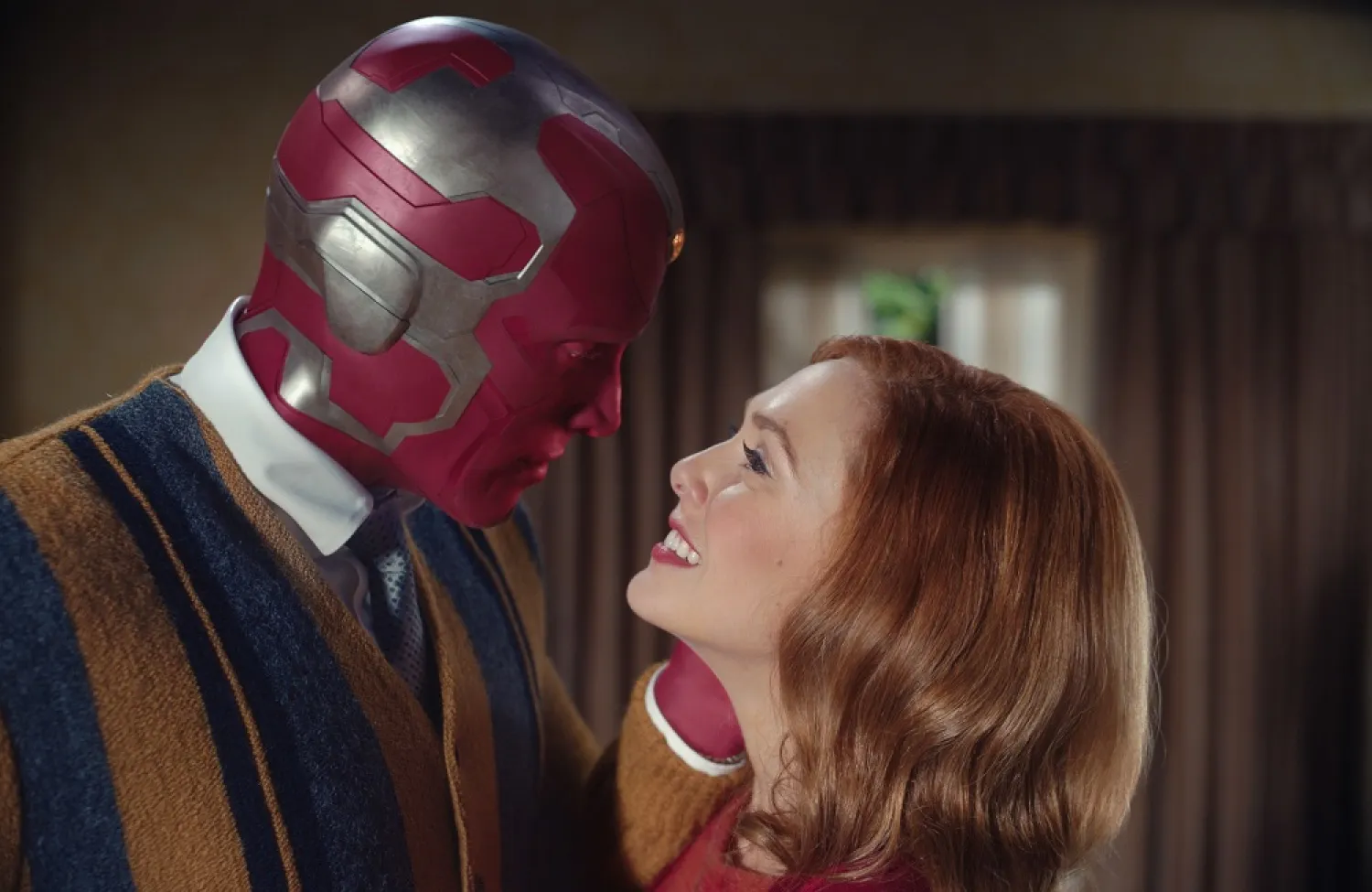
"WandaVision" is Marvel’s latest foray into the intricate, immersive universe first cobbled together in the comics by Stan Lee six decades ago. (Marvel)
TT

‘WandaVision,’ a Sitcom Sendup, Was a Pandemic Parable, Too

"WandaVision" is Marvel’s latest foray into the intricate, immersive universe first cobbled together in the comics by Stan Lee six decades ago. (Marvel)

Imagine being trapped in the confines of your own neighborhood, losing a sense of the outside world — and of yourself — with each passing day.

Things are seeming kind of flat lately, and sometimes downright colorless. Everything looks reasonably placid, but something’s not quite right with reality. The days feel … episodic. Does the world taper off at the end of the block? Does life loop back on itself? Are your neighbors with you, or against you?

This has been the premise of “WandaVision,” Marvel’s latest foray into the intricate, immersive universe first cobbled together in the comics by Stan Lee six decades ago. Not incidentally, it’s also an apt description of life in many corners of America during this pandemic micromoment.

In an era when meticulously crafted fictional universes are entertainment’s billion-dollar baby, “WandaVision,” whose inaugural and probably only season concludes Friday, took it all a step further, turning the seven-decade tradition of the American sitcom into a decade-hopping suburban prison.

Episode by TV-homage episode, it pinballed through unsettling sendups of “The Dick Van Dyke Show,” “Bewitched,” “The Brady Bunch,” “Family Ties,” “Malcolm in the Middle” and “Modern Family,” swallowing an entire New Jersey town and its people and, along the way, serving up a darker version of Marvel’s already dysfunctional funhouse mirror.

The pitch-perfect result: a distorted reflection not merely of America, but of the way it has seen itself through its broadly drawn television comedy across three generations.

How did this show manage (inadvertently, of course, since it was conceived before the virus arrived) to match the tenor of its comfort-craving moment? Because it reached so lovingly into the mannered, structured lore of sitcoms, which were comfort food for the American TV watcher’s brain long before the word “streaming” ever tumbled into the lexicon.

The television scholar Robert Thompson once described the contentment that people find in old sitcoms as “the aesthetic of the anesthetic” — a style of narrative that reset itself every week, making sure society’s norms were reinforced by presenting nonthreatening communities populated with nonthreatening characters doing nonthreatening things.

“WandaVision” coopted that vision and upended it. It used, as foils, those landscapes of assuagement and the way they morphed over the decades to match the times. Their surface tranquility and amiable conflict were backdrops for a slowly unfolding Marvel plot that, in its wink-nudge bubblegum darkness, was pure 21st century.

There’s irony, too, in the fact that Marvel has been owned for the past 12 years by Disney, a conglomerate built by self-described “imagineers” who were instrumental in stamping the sensibility of immersive fantasy onto more than a half century’s worth of American children — and onto the landscape itself.

Wanda Maximoff, the world-building witch at the show’s nucleus, is a stand-in for Walt Disney himself, who built his gauzy childhood memories of early 20th-century Midwestern life into theme parks and an entertainment empire. Like the world of “WandaVision,” Disney’s creations reflected not quite reality but its saccharine stepsibling, recognizable and appealing but hardly real life.

By the time “WandaVision” got to its take on 1980s television, the gentle opening credits of that “very special episode” sang this to us, revealing the theme of the show (and of pandemic life too): “We’re making it up as we go along.”

Yet like those 1980s horror movies in which the dreamer of the nightmare awakens, only to find out that he or she is still asleep, in “WandaVision” the “real” world is still the fantastic one of the Marvel Universe. The “Inception” model is at play: You’re still in the layered matrix, still separated from actual reality by several strata of Marvel and a robust layer of Disney.

In one of its later episodes, “WandaVision” offers its take on the “Malcolm in the Middle” opening credits of the early 2000s. This theme song, more aggressive and insolent than its predecessors, offers up the following lyrics: “What if it’s all illusion? Sit back. Enjoy the show.”

As the first storyline of its astonishingly extensive streaming lineup of shows concludes, that could be Marvel’s overall tagline. Because — first in comic books, then in theaters, now on all our assorted screens — Marvel IS the universe. It is comics and movies and video games, TV and toys and collectibles, cosplayers and party favors and an entire pantheon of secular gods.

You could even argue that its seamlessly cross-marketed cosmos is the new American suburb — a completely immersive neighborhood, interconnected and self-perpetuating, privileged and complex and, sometimes, brimming with the emptiness of the industrially manufactured Technicolor narrative. It is us, but amplified.

“Thousands of people under your thumb, all interacting with each other, according to complex storylines?” one character, who will remain nameless for spoiler-avoidance purposes, says to Wanda as her magic-powered dream microverse begins to fray. “Well, that’s something special, baby.”

Does life imitate Marvel, then? Maybe just a little. One day, after the blip that was the pandemic finally ends, we’ll all be back — well, most of us. We’ll re-emerge into the real world, blink hard, look around, reconnect with our neighbors and take stock of what we all missed.

We’ll say to each other: What a weird and all-encompassing dream this was. And then we’ll dream again. Roll credits. Rinse. Repeat.



‘Godfather’ and ‘Apocalypse Now’ Actor Robert Duvall Dead at 95 

Actor Robert Duvall arrives at the 72nd Golden Globe Awards in Beverly Hills, California January 11, 2015. (Reuters)
TT

‘Godfather’ and ‘Apocalypse Now’ Actor Robert Duvall Dead at 95 

Actor Robert Duvall arrives at the 72nd Golden Globe Awards in Beverly Hills, California January 11, 2015. (Reuters)

Robert Duvall, who played the smooth mafia lawyer in "The Godfather" and stole the show with his depiction of a surfing-crazed colonel in "Apocalypse Now," has died at the age of 95, his wife said Monday.

His death Sunday was confirmed by his wife Luciana Duvall.

"Yesterday we said goodbye to my beloved husband, cherished friend, and one of the greatest actors of our time. Bob passed away peacefully at home," she wrote.

Blunt-talking, prolific and glitz-averse, Duvall won an Oscar for best actor and was nominated six other times. Over his six decades-long career, he shone in both lead and supporting roles, and eventually became a director. He kept acting in his 90s.

"To the world, he was an Academy Award-winning actor, a director, a storyteller. To me, he was simply everything," Luciana Duvall said. "His passion for his craft was matched only by his deep love for characters, a great meal, and holding court."

Duvall won his Academy Award in 1983 for playing a washed-up country singer in "Tender Mercies."

But his most memorable characters also included the soft-spoken, loyal mob consigliere Tom Hagen in the first two installments of "The Godfather" and the maniacal Lieutenant Colonel William Kilgore in Francis Ford Coppola's 1979 Vietnam War epic "Apocalypse Now."

"It was an honor to have worked with Robert Duvall," Oscar winner Al Pacino, who acted alongside Duvall in "The Godfather" films, said in a statement.

"He was a born actor as they say, his connection with it, his understanding and his phenomenal gift will always be remembered. I will miss him."

As Colonel Kilgore, Duvall earned an Oscar nomination and became a bona fide star after years playing lesser roles, in a performance where he utters what is now one of cinema's most famous lines.

"I love the smell of napalm in the morning," his war-loving character -- bare chested, cocky and sporting a big black cowboy hat -- muses as low-flying US warplanes bomb a beachfront tree line where he wants to go surfing.

That character was originally created to be even more over the top -- his name was at first supposed to be Colonel Carnage -- but Duvall had it toned down, demonstrating his meticulous approach to acting.

"I did my homework," Duvall told veteran talk show host Larry King in 2015. "I did my research."

Cinema giant Francis Ford Coppola -- who directed Duvall in "Apocalypse Now" and "The Godfather" -- called his loss "a blow."

"Such a great actor and such an essential part of American Zoetrope from its beginning," Coppola said in a statement on Instagram.

- A 'vast career' -

Duvall was sort of a late bloomer in Hollywood -- he was already 31 when he delivered his breakout performance as the mysterious recluse Boo Radley in the 1962 film adaptation of Harper Lee's novel "To Kill a Mockingbird."

He would go on to play myriad roles -- a bullying corporate executive in "Network" (1976), a Marine officer who treats his family like soldiers in "The Great Santini" (1979), and then his star turn in "Tender Mercies."

Duvall often said his favorite role, however, was one he played in a 1989 TV mini-series -- the grizzled, wise-cracking Texas Ranger-turned-cowboy Augustus McCrae in "Lonesome Dove," based on the novel by Larry McMurtry.

British actress Jane Seymour, who worked with Duvall on the 1995 film "The Stars Fell on Henrietta," took to Instagram to share a heartfelt tribute to the star.

"We were able to share in his love of barbecue and even a little tango," Seymour captioned a photo of herself with Duvall. "Those moments off camera were just as memorable as the work itself."

US actor Alec Baldwin made a short video tribute to Duvall, speaking about the star's "vast career."

"When he did 'To Kill A Mockingbird' he just destroyed you with his performance of Boo Radley, he used not a single word of dialogue, not a single word, and he just shatters you," Baldwin said.

Film critic Elaine Mancini once described Duvall as "the most technically proficient, the most versatile, and the most convincing actor on the screen in the United States."


Songwriter Billy Steinberg Dies at 75

Grammy-winning songwriter Billy Steinberg (L) was behind several top hits of the 1980s and 1990s including Madonna's 'Like A Virgin'. Paul A. Hebert / GETTY IMAGES NORTH AMERICA/AFP/File
TT

Songwriter Billy Steinberg Dies at 75

Grammy-winning songwriter Billy Steinberg (L) was behind several top hits of the 1980s and 1990s including Madonna's 'Like A Virgin'. Paul A. Hebert / GETTY IMAGES NORTH AMERICA/AFP/File

Award-winning US songwriter Billy Steinberg, who wrote several top hit songs including Madonna's "Like a Virgin," died Monday at age 75, according to media reports.

Steinberg wrote some of the biggest pop hits of the 1980s and 1990s and was behind songs performed by singers from Whitney Houston and Celine Dion to Madonna and Cyndi Lauper.

He died following a battle with cancer, his attorney told the Los Angeles Times and BBC News.

"Billy Steinberg's life was a testament to the enduring power of a well-written song -- and to the idea that honesty, when set to music, can outlive us all," his family said in a statement to the outlets.

Steinberg was born in 1950 and grew up in Palm Springs, California, where his family had a table grape business. He attended Bard College in New York and soon began his career in songwriting.

He helped write five number one singles on the Billboard Hot 100 list. Among those was "Like a Virgin," co-written with Tom Kelly, which spent six consecutive weeks at the top of the charts.

Steinberg won a Grammy Award in 1997 for his work on Celine Dion's "Falling Into You."

He was inducted into the Songwriters Hall of Fame in 2011.


'Train Dreams,' 'The Secret Agent' Nab Spirit Wins to Boost Oscars Campaigns

'Train Dreams' director Clint Bentley speaks to the audience after his film grabbed best feature at the Film Independent Spirit Awards, as it continues its best picture Oscars campaign. KEVIN WINTER / GETTY IMAGES NORTH AMERICA/AFP
TT

'Train Dreams,' 'The Secret Agent' Nab Spirit Wins to Boost Oscars Campaigns

'Train Dreams' director Clint Bentley speaks to the audience after his film grabbed best feature at the Film Independent Spirit Awards, as it continues its best picture Oscars campaign. KEVIN WINTER / GETTY IMAGES NORTH AMERICA/AFP

Period drama "Train Dreams" took home the Spirit Awards win for best feature Sunday, as both it and "The Secret Agent" gathered momentum ahead of the Academy Awards.

"The Secret Agent" notched best international film as its team hopes to win in the same category at the Oscars next month.

The annual Film Independent Spirit Awards ceremony only celebrates movies made for less than $30 million.

"Train Dreams," director Clint Bentley's adaptation of the Denis Johnson novella, follows a railroad worker and the transformation of the American northwest across the 20th century.

The film won three of its four categories, also grabbing wins for best director and best cinematography. The movie's lead, Joel Edgerton, however, did not take home best actor, which went to Rose Byrne for "If I Had Legs I'd Kick You."

"Train Dreams" producer Teddy Schwarzman told AFP the film "is a singular journey, but it hopefully helps bring people together to understand all that life entails: love, friendship, loss, grief, healing and hope."

"Train Dreams" will compete for best picture at the Oscars, among other honors.

Big win for Brazil

After "The Secret Agent" nabbed best international film, director Kleber Mendonca Filho hailed the win as one that hopefully "gives more visibility to Brazilian cinema."

The film follows a former academic pursued by hitmen amid the political turmoil of Brazil under military rule.

It prevailed Sunday over contenders including rave-themed road trip movie "Sirat," which will compete alongside "The Secret Agent" for best international feature film at the Oscars, capping Hollywood's awards season.

"The Secret Agent" will also be up for best picture, best actor and best casting.

Brazil's "I'm Still Here" won best international feature at the Oscars last year.

Other Spirit winners on Sunday included "Lurker," for best first screenplay and best first feature film.

"Sorry, Honey" nabbed best screenplay and "The Perfect Neighbor" scored best documentary.

The Academy Awards will be presented on March 15.