


Pope, Starting Risky Trip, Urges Iraq to End Violence

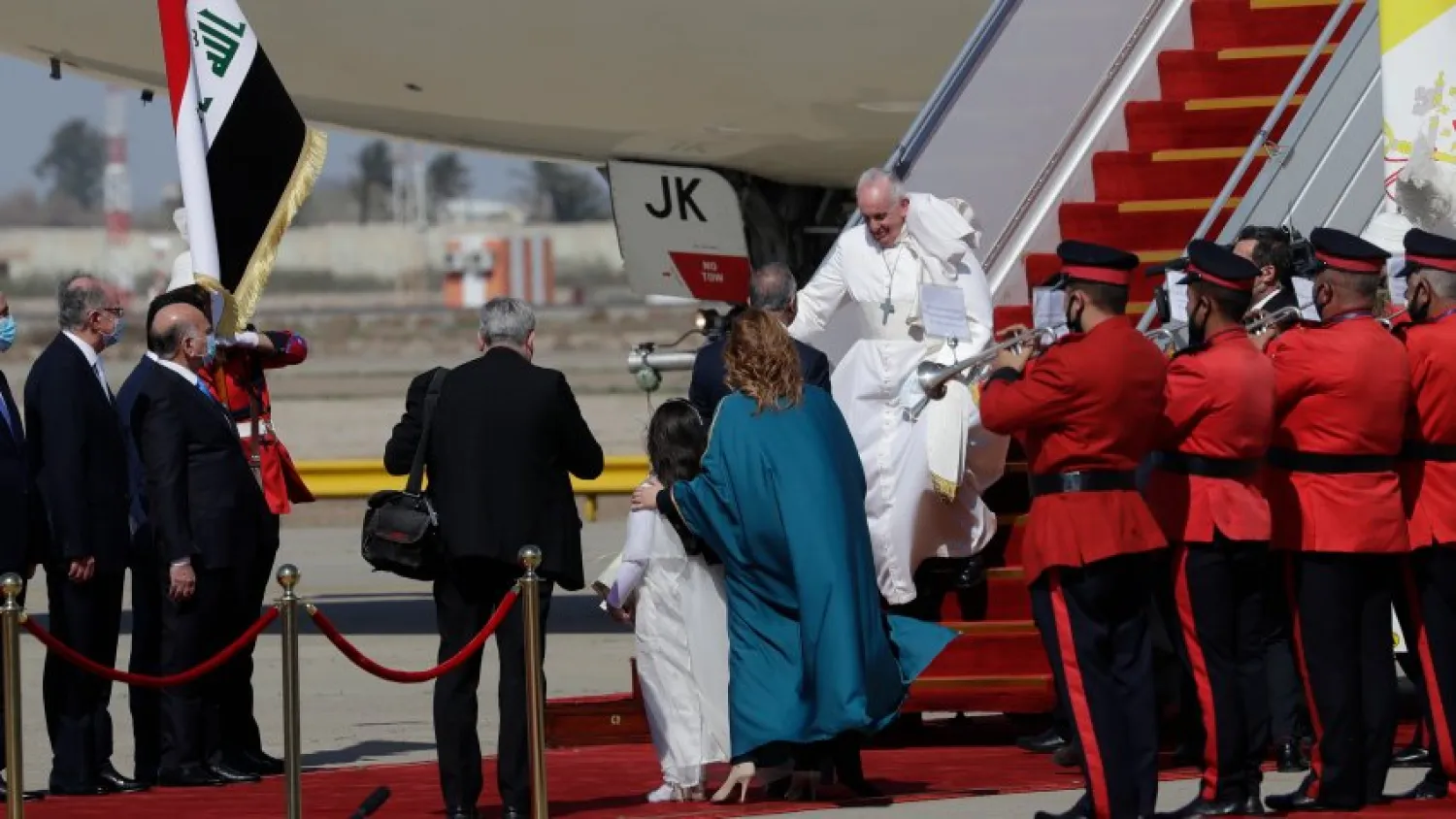
Pope Francis walks down the steps of an airplane as he arrives at Baghdad international airport, Iraq, Friday, March 5, 2021. (AP Photo/Andrew Medichini)
TT

Pope, Starting Risky Trip, Urges Iraq to End Violence

Pope Francis walks down the steps of an airplane as he arrives at Baghdad international airport, Iraq, Friday, March 5, 2021. (AP Photo/Andrew Medichini)

Pope Francis began his most risky foreign trip on Friday, flying into Iraq amid the tightest security ever seen for a papal visit to appeal to the country’s leaders and people to end militant violence and religious strife.

The country has deployed thousands of security personnel to protect him during the visit, which comes after a spate of rocket and suicide bomb attacks and a spike in COVID-19 cases.

Even before he landed, Francis told reporters on his plane that he felt duty-bound to make what he called an “emblematic” trip despite the difficulties because the country “has been martyred for so many years”.

At the official welcome in the presidential palace, the 84-year-old Francis, limping from what appeared to be a fresh flare-up of his painful sciatica, made an impassioned call for Iraqi to finally give peacemakers chance.

“May the clash of arms be silenced ... may there be an end to acts of violence and extremism,” he said.

President Barham Salih thanked the pope for making the first-ever papal visit to Iraq “despite the many recommendations to delay” because of the pandemic and other challenges in “our wounded country”.

The fact that the pope came anyway “multiplies the value of this visit for the Iraqi people”, the president said.

Hundreds of people gathered in small clusters to see him being driven into Baghdad in bulletproof BMW, a departure for a pope who normally insists on using small, normal cars.

A motorcade of dozens of vehicles accompanied him out of the airport compound, which recently came under rocket fire from militia groups.

In his speech at the palace, Francis, looking tired at the start of his first foreign trip in 16 months, criticized factional and foreign interests that have destabilized Iraq and the wider region and hit ordinary people the hardest.

“Iraq has suffered the disastrous effects of wars, the scourge of terrorism and sectarian conflicts often grounded in a fundamentalism incapable of accepting the peaceful coexistence of different ethnic and religious groups,” Francis said.

He later paid tribute to people killed in attacks motivated by religion, visiting a Baghdad church where extremist gunmen killed about 50 worshippers in 2010.

Their deaths were a reminder that “violence or the shedding of blood are incompatible with authentic religious teachings”, he said.

Iraq’s security has improved since the defeat of ISIS in 2017, but the country continues to be a theater for global and regional score-settling, especially a bitter US-Iran rivalry that has played out on Iraqi soil.

The US invasion of 2003, after years of international sanctions and a devastating war with Iran instigated by former leader Saddam Hussein in the 1980s, plunged Iraq into sectarian conflict and chronic mismanagement that has plagued it since.

‘We all need this visit’
The pope’s whirlwind four-day tour will take him by plane, helicopter and cars to four cities, including areas that most foreign dignitaries are unable to reach, let alone in such a short space of time.

“This visit is one of a kind. We are excited, and we all need this visit, all Iraqis do,” said an Iraqi Christian from Baghdad, Magin Derius.

Iraq’s Christian community, one of the oldest in the world, has fallen to about 300,000 from about 1.5 million about 20 years ago.

On Saturday the pope will hold an unprecedented meeting with Iraq’s top Shiite cleric, Ali al-Sistani, in the southern city of Najaf. He will also visit Ur, birthplace of the Prophet Abraham, who is revered by Christians, Muslims and Jews, and will return to say Mass in Baghdad.

On Sunday Francis travels north to Mosul, a former stronghold of ISIS, where churches and other buildings there still bear the scars of conflict.

Since the defeat of ISIS in 2017, Iraq has seen a greater degree of security, though violence persists, often in the form of rocket attacks by Iran-aligned militias on US targets, and US military action in response.

ISIS remains a threat. In January, a suicide attack claimed by the militant group killed 32 people in Baghdad’s deadliest such attack for years.



Israeli Army Sets Gaza-style ‘Yellow Line’ in Lebanon amid Differences with Govt

The rubble of a destroyed building, seen from inside a heavily damaged building, after an Israeli strike, amid escalating hostilities between Israel and Hezbollah, as the U.S.-Israeli conflict with Iran continues, in Tyre, Lebanon, April 2, 2026. (Reuters)
TT

Israeli Army Sets Gaza-style ‘Yellow Line’ in Lebanon amid Differences with Govt

The rubble of a destroyed building, seen from inside a heavily damaged building, after an Israeli strike, amid escalating hostilities between Israel and Hezbollah, as the U.S.-Israeli conflict with Iran continues, in Tyre, Lebanon, April 2, 2026. (Reuters)

Israeli forces have advanced into Lebanon’s Ras al-Bayada area, a hilly region about 14 kilometers from the Galilee border overlooking the Litani River, with the army saying it plans to remain there for an extended, though temporary, period.

The move comes as tensions emerge between the military and the government over the scope of operations in southern Lebanon.

Families of several soldiers from the Nahal Infantry Brigade have written to Prime Minister Benjamin Netanyahu, Defense Minister Israel Katz and senior commanders, urging a reassessment of their sons’ deployment.

They warned that the “risks are unjustified due to a lack of air support” and cited rising casualties. “Remaining in Lebanon, under current conditions, exposes soldiers to danger in an extremely unreasonable way,” they said, calling for an urgent review and alternative strategies.

The government has advocated full control of South Lebanon and making the Litani River Israel’s new border. The army has rejected that approach, saying it will instead treat the Litani as a “line of fire,” monitored from what it calls a “yellow line” — a concept previously applied to the Gaza Strip border and viewed as temporary pending a withdrawal decision.

Tens of thousands of troops have been deployed to Lebanon under this framework.

The soldiers’ families said 13 people have been killed so far — 10 soldiers and three civilians — and 20 soldiers wounded. They added that “since most air force resources are currently devoted to Iran, soldiers in Lebanon are not receiving sufficient air support,” which they said was likely a key factor behind the casualties.

Debate over protecting northern civilians

Citing military sources, the families said one objective of the ground incursion is to draw Hezbollah fire toward Israeli troops rather than civilians in northern Israel.

While stressing the importance of protecting border communities, they argued this should not come at the direct expense of soldiers’ lives. “It is not legitimate to define drawing fire toward fighters as a war objective... without using all available tools to ensure their safety,” they wrote.

They suggested temporary alternatives, including evacuations or expanding shelters and fortified rooms in threatened areas.

“Exploiting our sons — young men who have been fighting for three years in a multi-front war — is a grave injustice,” they added, calling for accountability and an immediate review of operational decisions.

An Israeli report on Wednesday said Hezbollah is not currently capable of launching mass daily barrages toward central Israel, and that many recent projectiles have missed their targets.

However, it retains the ability to wage guerrilla warfare and target Israeli forces in southern Lebanon, where four divisions are operating.

According to Haaretz military analyst Amos Harel, Hezbollah is firing around 200 rockets and drones daily toward northern Israel and Israeli forces — more than many Israelis had expected at the start of the war.

He said the situation is “more complex” than official narratives suggest, adding that Hezbollah has used months of fighting and a ceasefire period since November 2024 to regroup and rebuild its capabilities.

A report in Maariv cited a senior officer who fought in the 2006 Lebanon war as saying current troop levels are insufficient for the political objectives being set.

“Promises of a decisive victory over Hezbollah do not match the reality on the ground,” he stated, warning of a repeat of past scenarios in which Israeli forces come under sustained anti-tank fire in exposed positions.

“A decisive outcome would require greater effort and larger forces,” he added, noting that the war with Iran and ongoing operations in the West Bank continue to stretch military resources.


Russia, Egypt Discuss Means to Secure Energy, Food Supplies

Russian President Vladimir Putin receives Egyptian Foreign Minister Badr Abdelatty in Moscow on Thursday. (Egyptian Foreign Ministry)
TT

Russia, Egypt Discuss Means to Secure Energy, Food Supplies

Russian President Vladimir Putin receives Egyptian Foreign Minister Badr Abdelatty in Moscow on Thursday. (Egyptian Foreign Ministry)

Egypt stressed on Thursday its keenness on developing its bilateral ties and strategic partnership with Russia, along with coordinating over regional and international affairs, most notably the impact of the war on Iran.

Russian President Vladimir Putin received in Moscow on Thursday Egyptian Foreign Minister Badr Abdelatty, who handed him a message from President Abdel Fattah al-Sisi that tackled bilateral ties and the strategic partnership between their countries.

The FM had arrived in Moscow on Wednesday on a visit aimed at exploring means to develop bilateral cooperation and exchange views on several regional issues.

Experts said the visit aimed at “bolster balances in alliances and secure energy and food supplies.”

During his talks with Abdelatty, Putin hailed the depth of Egyptian-Russian ties and the fruitful cooperation in all fields.

He praised the role Sisi is playing in leading mediation to ease the escalation, support security and stability in the Middle East and prevent the conflict from expanding, said the Egyptian Foreign Ministry.

Abdelatty and Putin discussed the “intense diplomatic efforts aimed at de-escalation in the Middle East.” They also tackled the outcomes of the ministerial meeting that was held in Pakistan earlier this week that brought together the foreign ministers of Saudi Arabia, Egypt, and Türkiye to discuss the conflict.

Calm and diplomacy are the best choices to avoid the expansion of the conflict, they stressed.

Sisi and Putin held telephone talks on Tuesday during which the former stressed the need for de-escalation in the Middle East.

Russia, with its international standing, can use its influence to end the war, he added.


UN Resumes Operations in Sudanese Capital after 3 Years of War

Officials are seen at the reopening ceremony in Khartoum. (Asharq Al-Awsat)
TT

UN Resumes Operations in Sudanese Capital after 3 Years of War

Officials are seen at the reopening ceremony in Khartoum. (Asharq Al-Awsat)

The United Nations announced on Thursday that it was officially resuming operations in the Sudanese capital Khartoum after three years of war.

UN Resident Coordinator and Humanitarian and Development Coordinator in Sudan Denise Brown said the move was significant and allows UN agencies to reach all areas that were previously inaccessible.

Speaking at a press conference at the UN mission in central Khartoum, she added that the organization will continue its support to the state and individuals to end the war and reconstruct Sudan.

The UN quit Khartoum for Port Sudan shortly after the eruption of the war between the army and Rapid Support Forces in April 2023.

Sudanese Foreign Minister Mohi El-Din Salem said the UN’s return to Khartoum was an important message to internal partners that “we are working side by side to restore peace and stability in Sudan.”

“As we have reclaimed Khartoum from the rebel RSF, we will reclaim the regions of Darfur and Kordofan,” he told a press conference.

“We will work with the UN through the initiative proposed by Prime Minister Kamil Idris to the Security Council in December to end the war and restore peace and stability in Sudan,” he stressed.

Moreover, he said that Sudan was “open to all initiatives to reach sustainable peace,” while also rejecting any truce that allows the RSF to return to the Sudanese scene.

Sudan and the UN will work together to restore stability through intra-Sudanese dialogue, declared the FM. “Only the Sudanese people will decide the fate of their country.”