


PIF Executive: Saudi Women Are Partners in the Kingdom’s Development

A recent meeting of the Board of Directors of the Public Investment Fund (PIF), chaired by Saudi Crown Prince Mohammed bin Salman. In the framework, the PIF Secretary General and the Legal Adviser. (Photo: Asharq Al-Awsat)
TT

PIF Executive: Saudi Women Are Partners in the Kingdom’s Development

A recent meeting of the Board of Directors of the Public Investment Fund (PIF), chaired by Saudi Crown Prince Mohammed bin Salman. In the framework, the PIF Secretary General and the Legal Adviser. (Photo: Asharq Al-Awsat)

Shihana Alazzaz is one of the most prominent Saudi female figures. Today, she occupies a remarkable position in one of the most vital sectors in the country, as the General Legal Counsel and Secretary General of the Board of Directors of the Public Investment Fund (PIF).

In an interview with Asharq Al-Awsat, Alazzaz talked about women’s empowerment in Saudi Arabia and the qualitative shift brought about by the Kingdom’s Vision 2030.

“Today, the Saudi woman is walking at a steady pace and firm determination behind the Custodian of the Two Holy Mosques, an inspiring Crown Prince and an ambitious vision, after overcoming the challenges of the past, with the acceleration of the development of laws and procedures that guarantee her rights and ensure her participation in both economic and societal progress,” she said.

She encouraged Saudi women to actively engage in the development of their country.

“We must continue the march and work with determination without any delay or retreat, to seize the opportunities and enter the labor market with competence, pioneering spirit and open-mindedness that accepts competition and risk,” she underlined.

Asked about the achievements of Saudi female leaders, Alazzaz stressed that societies flourish with the effectiveness of their members, women and men.

“Undoubtedly, the success of women is positively reflected on the family and the entire community, and is considered one of the foundations for advancement and prosperity. Human civilizations, throughout history, have witnessed the positive and inevitable role of women,” she affirmed.

Underlining the importance of Saudi women’s engagement in the Kingdom’s march towards achieving Vision 2030, Alazzaz called on female leaders and entrepreneurs to consolidate their successes and aim for broader horizons.

“Let us imagine what our societies can achieve by stimulating other aspects of women’s engagement in the labor market, economy, entrepreneurship, science, education and research, in addition to their participation in decision-making, drawing strategies, setting policies, strengthening international relations and diplomacy, and other contributions in which women can have a leadership, effective and positive role,” she stated.

According to the PIF secretary-general, the successes of Saudi women in some areas have surpassed their counterparts from all over the world. She emphasized that their names have emerged in the fields of medicine, engineering, literature and others, adding that some of them have received international patents, awards and certificates of appreciation.

Alazzaz told Asharq Al-Awsat that the qualitative shift brought about by Vision 2030 was based on an important strategic principle: “The human being is the change maker in economic and social development. Accordingly, the vision adopted fundamental principles for empowering women socially and economically, making them an efficient partner in the development of the homeland.”

Asked about her role in PIF, she said: “My work in the Public Investment Fund is a professional and patriotic duty in the first place, and a proof of the confidence of our leaders in the national women cadres and the availability of opportunities based on competence without discrimination.”

“We always strive to achieve more, fulfill the aspirations of our leaders, and efficiently cooperate with every colleague and official,” Alazzaz concluded.


QatarEnergy Declares Force Majeure on LNG Contracts

QatarEnergy's liquefied natural gas (LNG) production facilities, amid the US-Israeli conflict with Iran, in Ras Laffan Industrial City, Qatar March 2, 2026. (Reuters)
TT

QatarEnergy Declares Force Majeure on LNG Contracts

QatarEnergy's liquefied natural gas (LNG) production facilities, amid the US-Israeli conflict with Iran, in Ras Laffan Industrial City, Qatar March 2, 2026. (Reuters)

QatarEnergy declared on Tuesday force ‌majeure ‌on some ‌of ⁠its affected long-term ⁠LNG ⁠supply contracts, ‌with ‌counterparties including ‌customers in ‌Italy, Belgium, ‌South Korea, and ⁠China.

It said it was ‌continuing ‌to assess ‌the ⁠full impact of ⁠these recent events on its operations.

It added that it was assessing the impact ⁠and repair ‌timeline ‌for damaged facilities.

Missile ‌attacks on QatarEnergy's Ras Laffan production ‌hub on March 18 and 19 ⁠⁠caused significant damage.


Saudi Arabia Says World Economic Forum Postpones Jeddah Meeting

A World Economic Forum (WEF) logo. AFP
TT

Saudi Arabia Says World Economic Forum Postpones Jeddah Meeting

A World Economic Forum (WEF) logo. AFP

The World Economic Forum ⁠has postponed its Global ⁠Collaboration and Growth Meeting, originally ⁠set for April 22–23 in Jeddah, following consultations with the Saudi Ministry of Economy and ⁠Planning, citing ⁠current regional developments.

Saudi Minister of Economy and Planning Faisal Alibrahim stressed in January the need for sustained dialogue to accelerate global growth, calling on participants to engage actively in the meeting.

The Ministry of Economy and Planning affirmed Tuesday that the Kingdom has made comprehensive preparations to host the meeting and remains fully equipped to convene it, reflecting its continued role as a global platform for dialogue and agenda setting.

Building on its proven track record of convening major international gatherings, including the World Economic Forum Special Meeting in Riyadh in 2024, the ministry said it looks forward to hosting the Global Collaboration and Growth Meeting at a date to be announced in due course.

The World Economic Forum said: “The Global Collaboration and Growth Meeting will serve as a leading platform for shaping constructive global dialogue. Following coordination between the World Economic Forum and the Ministry of Economy and Planning of Saudi Arabia, it has been agreed to reschedule the meeting to maximize its global impact.”


IMF: Conflict Casts Shadow on Morocco's Economic Growth

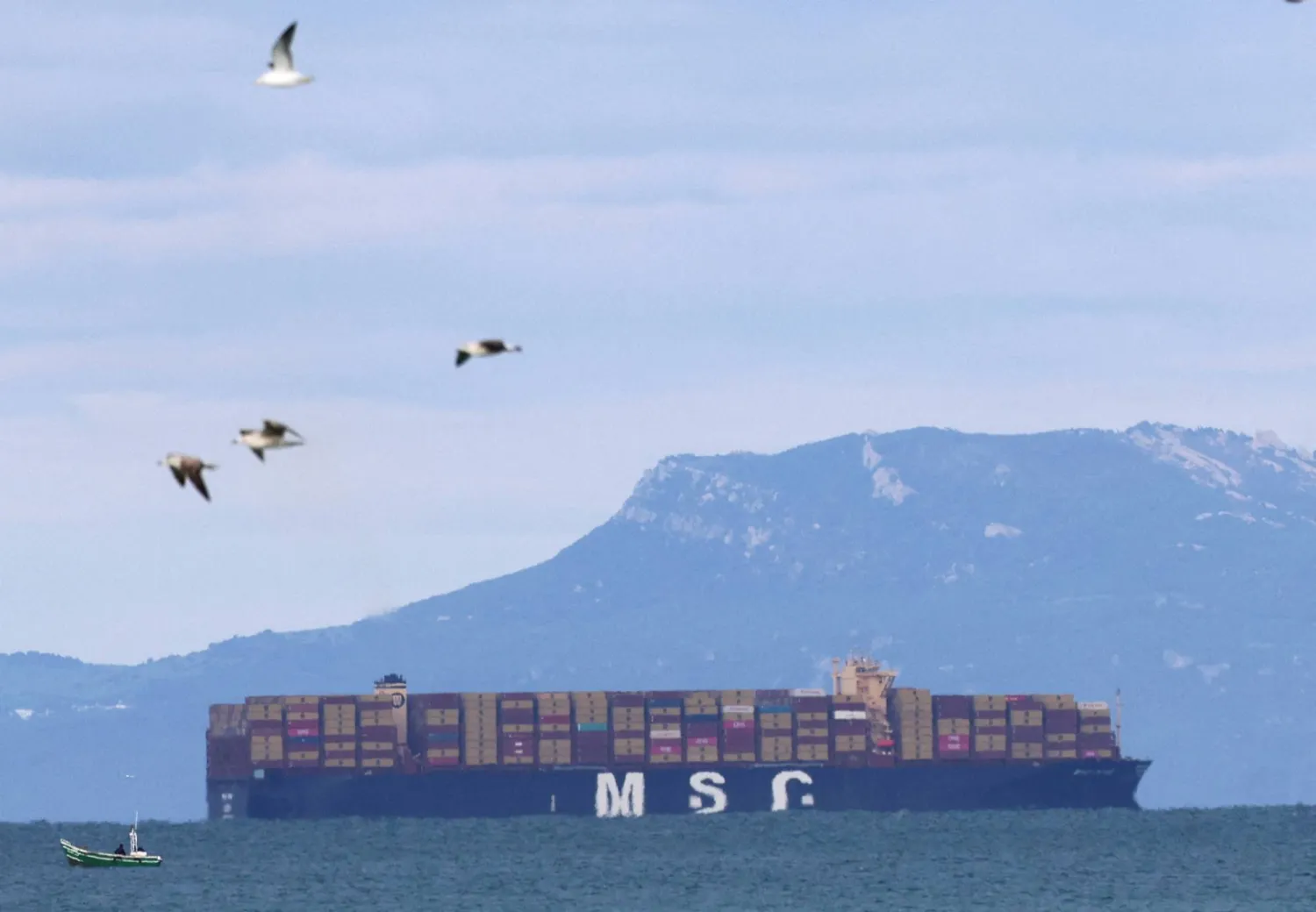
FILE PHOTO: An MSC container ship crosses the Strait of Gibraltar from the Atlantic Ocean to the Mediterranean Sea, near the northern tip of the port of Tangier, Morocco, January 8, 2026. REUTERS/Amr Abdallah Dalsh
TT

IMF: Conflict Casts Shadow on Morocco's Economic Growth

FILE PHOTO: An MSC container ship crosses the Strait of Gibraltar from the Atlantic Ocean to the Mediterranean Sea, near the northern tip of the port of Tangier, Morocco, January 8, 2026. REUTERS/Amr Abdallah Dalsh

The International Monetary Fund has warned that in the near term, growth in Morocco would be impacted by the ongoing conflict in the Middle East.

The Executive Board of the IMF concluded last week the 2026 Article IV consultation with Morocco and completed the Mid-Term Review under the Flexible Credit Line Arrangement (FCL), which was approved on April 2, 2025.

The Staff Report issued on Monday said that real GDP growth is projected at 4.4 percent for 2026, 4.5 percent for 2027, and 4 percent over the medium term, assuming normalized agriculture production and continued infrastructure investment with greater private sector participation.

Real GDP growth in 2025 accelerated to an estimated 4.9 percent, supported by a rebound in agricultural output and a surge in large-scale infrastructure projects, the IMF said.

Nonetheless, high unemployment remains a significant challenge. Average inflation remained low at 0.8 percent, allowing Bank Al-Maghrib to maintain a neutral policy stance after earlier rate cuts.

The IMF lauded strong revenue performance that facilitated a smaller than anticipated overall fiscal deficit at 3.5 percent of GDP.

The overall fiscal deficits for 2026 and the medium term are consistent with a gradual reduction in debt to GDP to 60.5 percent by 2031.

The current account widened to 2.1 percent of GDP as imports rose with investment, partly offset by buoyant tourism.

“Sustainable job creation remains a pressing priority, and calls for a more dynamic private sector, leveling the playing field between public and private entities, and further reforms in the labor market,” the IMF said.

“Morocco continues to meet the qualification criteria for the Flexible Credit Line arrangement. Morocco has a sustained track record of implementing very strong macroeconomic policies and remains committed to maintaining such policies in the future, and continues to have very strong economic fundamentals and institutional policy frameworks. The authorities intend to continue treating the FCL arrangement as precautionary and to gradually exit it, depending on the evolution of external risks,” said IMF Deputy Managing Director and Chair Kenji Okamura.