


Neanderthals Disappeared from Europe Earlier than Thought, Says Study

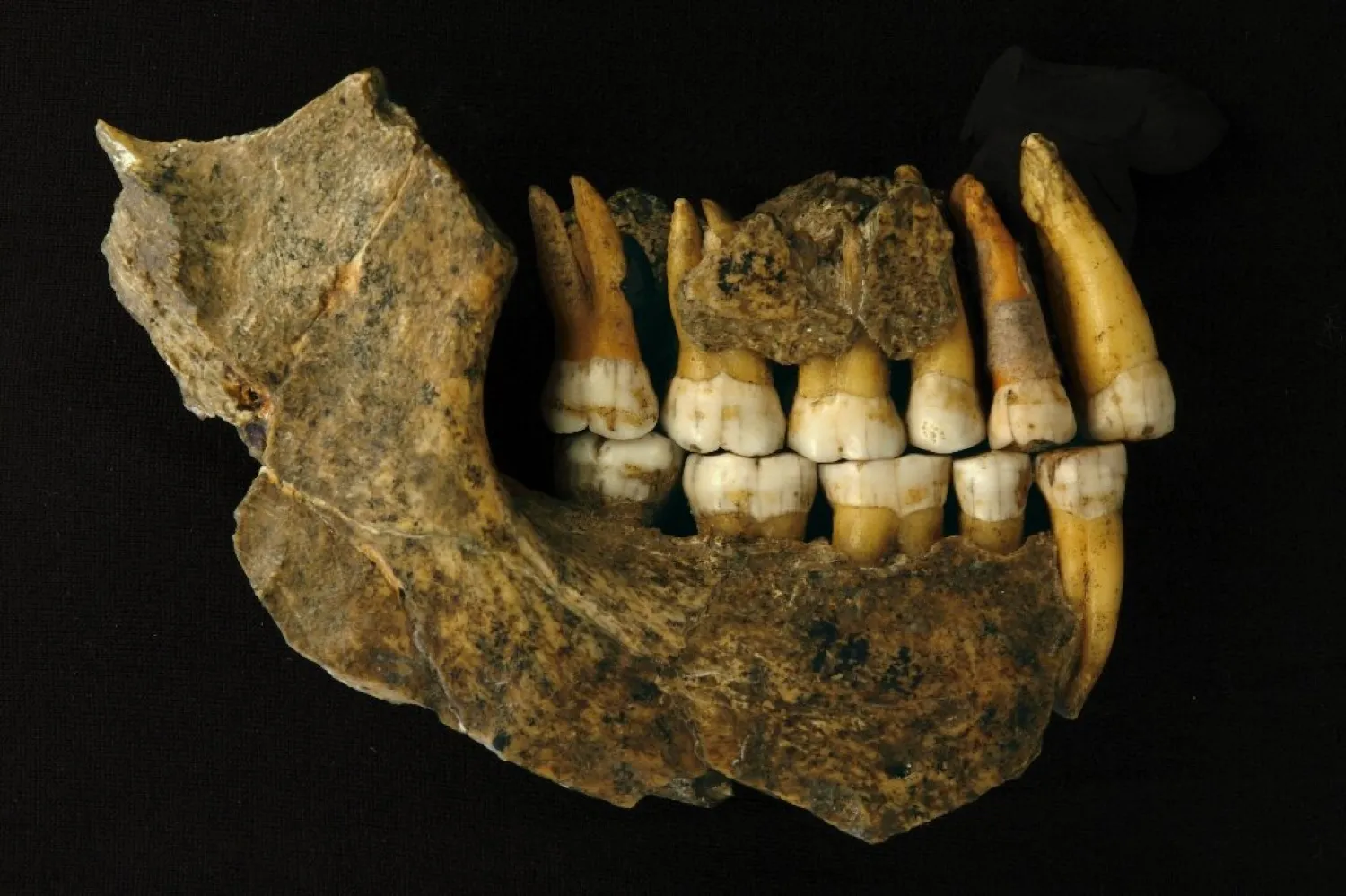
The remains of the upper and lower jaw of a Neanderthal from the Spy Cave in Belgium. (AFP)
TT

Neanderthals Disappeared from Europe Earlier than Thought, Says Study

The remains of the upper and lower jaw of a Neanderthal from the Spy Cave in Belgium. (AFP)

Neanderthal fossils from a cave in Belgium believed to belong to the last survivors of their species ever discovered in Europe are thousands of years older than once thought, a new study said Monday.

Previous radiocarbon dating of the remains from the Spy Cave yielded ages as recent as approximately 24,000 years ago, but the new testing pushes the clock back to between 44,200 to 40,600 years ago.

The research appeared in the Proceedings of the National Academy of Sciences and was carried out by a team from Belgium, Britain and Germany.

Co-lead author Thibaut Deviese from the University of Oxford and Aix-Marseille University told AFP he and colleagues had developed a more robust method to prepare samples, which was better able to exclude contaminants.

Having a firm idea of when our closest human relatives disappeared is considered a key first step toward understanding more about their nature and capabilities, as well as why they eventually went extinct while our own ancestors prospered.

The new method still relies on radiocarbon dating, long considered the gold standard of archeological dating, but refines the way specimens are collected.

All living things absorb carbon from the atmosphere and their food, including the radioactive form carbon-14, which decays over time.

Since plants and animals stop absorbing carbon-14 when they die, the amount that remains when they are dated tells us how long ago they lived.

When it comes to bones, scientists extract the part made up of collagen because it is organic.

"What we have done is to go one step further," said Deviese, since contamination from the burial environment or through glues used for museum work can spoil the sample.

Instead, the team looked for the building blocks of collagen, molecules called amino acids, and in particular selected specific single amino acids they could be sure were part of the collagen.

'Reliable framework'
The authors also dated Neanderthal specimens from two additional Belgian sites, Fonds-de-Foret and Engis, finding comparable ages.

"Dating all these Belgian specimens was very exciting as they played a major role in the understanding and the definition of Neanderthals," said co-lead author Gregory Abrams, of the Scladina Cave Archaeological Centre in Belgium.

"Almost two centuries after the discovery of the Neanderthal child of Engis, we were able to provide a reliable age."

Genetic sequencing was meanwhile able to show that a Neanderthal shoulder bone previously dated at 28,000 years ago was heavily contaminated with bovine DNA, suggesting the bone had been preserved with a glue made from cattle bones.

"Dating is crucial in archaeology. Without a reliable framework of chronology we can't really be confident in understanding the relationships between Neanderthals and Homo sapiens," added co-author Tom Higham of the University of Oxford.

Certain stone tool use has been attributed to Neanderthals and has been interpreted as a sign of their cognitive evolution, said Deviese.

But if the timeline for Neanderthals' existence is being pushed back, Deviese added, then Paleolithic industries should be re-examined to determine if they really were the work of the extinct hominid species.



Winter Storm Bears Down on US Northeast, Disrupting Airline Travel

 Workers clear snow from the ice rink at Bryant Park during a winter storm in New York City, US, December 26, 2025. (Reuters)
Workers clear snow from the ice rink at Bryant Park during a winter storm in New York City, US, December 26, 2025. (Reuters)
TT

Winter Storm Bears Down on US Northeast, Disrupting Airline Travel

 Workers clear snow from the ice rink at Bryant Park during a winter storm in New York City, US, December 26, 2025. (Reuters)
Workers clear snow from the ice rink at Bryant Park during a winter storm in New York City, US, December 26, 2025. (Reuters)

A winter storm packing a frosty mix of snow and ice bore down on the US Northeast early on Saturday, disrupting post-holiday weekend airline traffic and prompting officials in New York and New Jersey to issue weather emergency declarations.

The National Weather Service posted ice storm and winter storm warnings throughout New York state and Connecticut, forecasting some of the heaviest snowfall totals - up to a foot in localized areas - for Long Island and the Hudson Valley.

New York City could see its highest accumulations since 2022, with peak snowfall ‌rates of 2 ‌or more inches per hour, according to an ‌emergency ⁠declaration on Friday ‌from Governor Kathy Hochul, warning of treacherous road conditions.

In many areas snow was forecast to be mixed or glazed over with sleet and freezing rain.

"The safety of New Yorkers is my top priority, and I continue to urge extreme caution throughout the duration of this storm," Hochul said in a statement, admonishing residents to "avoid unnecessary travel."

Ice storm warnings and winter weather advisories were likewise posted for ⁠most of Pennsylvania, much of Massachusetts, and most of New Jersey, where a state of emergency ‌also was declared. High winds were forecast as part ‍of the storm.

Snow began falling ‍in western New York state and the New York City area on Friday ‍evening and was expected to intensify on Saturday.

More than 1,600 commercial airline flights within the United States and into or out of the country were canceled on Friday, and 7,800-plus were delayed as weather conditions began to worsen, according to the flight-tracking service FlightAware.

The three major airports serving the New York City area - John F. Kennedy, Newark Liberty International and LaGuardia Airport - accounted for ⁠the bulk of Friday's flight cancellations. All three issued alerts on social media platform X warning travelers of potential disruptions.

Another 650 flights that had been scheduled to depart or land in the US on Saturday were canceled, FlightAware reported.

Representatives from American Airlines, United Airlines and JetBlue Airways told Reuters those carriers had waived change fees normally charged to re-book for passengers whose travel plans may be affected by weather-related disruptions.

New Jersey and Pennsylvania issued commercial vehicle restrictions for some roads, including many interstate highways.

"This storm will cause dangerous road conditions and impact holiday travel," New Jersey's acting governor Tahesha Way said in a statement. "We are urging travelers to ‌avoid travel during the storm and allow crews to tend to roads."


Cypriot Fishermen Battle Invasive Lionfish and Turn Them into a Delicacy

 A cat stands next to a table with fried lionfish at Stefanos restaurant in Larnaca, Cyprus, in the eastern Mediterranean, Thursday, Dec. 18, 2025. (AP)
A cat stands next to a table with fried lionfish at Stefanos restaurant in Larnaca, Cyprus, in the eastern Mediterranean, Thursday, Dec. 18, 2025. (AP)
TT

Cypriot Fishermen Battle Invasive Lionfish and Turn Them into a Delicacy

 A cat stands next to a table with fried lionfish at Stefanos restaurant in Larnaca, Cyprus, in the eastern Mediterranean, Thursday, Dec. 18, 2025. (AP)
A cat stands next to a table with fried lionfish at Stefanos restaurant in Larnaca, Cyprus, in the eastern Mediterranean, Thursday, Dec. 18, 2025. (AP)

Photis Gaitanos’ rough fingers adroitly untangle the venomous spikes of a lionfish from a net, throwing the exotic-looking creature into an ice-filled rubber bin along with other fish from the day’s catch.

Unlike a few years ago when he would have mostly caught local staples as sea bream, red mullet or bass, the veteran fisherman now hunts for the invasive species that made its way from the Red Sea to the warming waters of the Mediterranean,

Lionfish, with their red and orange-hued stripes and antennae-like barbs that menacingly ward off enemies, threaten to decimate indigenous fish stocks, wreaking havoc on the livelihoods of the roughly 150 professional fishermen in Cyprus.

The prickly fish has even made its way as far north as the Ionian Sea, where Italian authorities have asked the public to photograph and report sightings.

The East Mediterranean has also seen another invasive Red Sea fish in the last decade: the silver-cheeked toadfish. Known as an eating machine whose powerful jaws cut through fishing nets, decimating fishermen’s catch, it has no natural predators off Cyprus, allowing its population to explode.

That toadfish also produces a lethal toxin, making it inedible.

Warmer waters are the culprit

Gaitanos, the 60-year-old fisherman, has fished for years in an area a few kilometers off the coastal town of Larnaca, once famous for its fishing bounty. Now, he says, it’s been more than two years since he’s caught a red mullet, a consumer favorite.

"I have been practicing this profession for 40 years. Our income, especially since these two foreign species appeared, has become worse every year. It is now a major problem (affecting) the future of fishing," he said. "How can it be dealt with?"

Europe’s General Fisheries Commission for the Mediterranean says with the sea warming some 20% faster than the global average, the presence of invasive species "is progressively increasing in the western basin."

Models show that warmer seas as a result of climate change could see lionfish swarm the entire Mediterranean by the century’s end. Warmer waters and an expanded Suez Canal "have opened the floodgates" to Indo-Pacific species in general, according to Cyprus’ Fisheries Department.

Lionfish, center, are seen at Stefanios restaurant in Larnaca, Cyprus, in the eastern Mediterranean, Thursday, Dec. 18, 2025. (AP)

The European Union’s Fisheries Commissioner Costas Kadis, a Cypriot himself, told The Associated Press that more frequent and intense extreme weather, often linked to climate change, could make the Mediterranean more hospitable to invasive species.

And that’s taking a heavy toll on Europe’s fishing industry as fishermen’s catches diminish while their costs shoot up as a result of repairs to fishing gear damaged by the powerful intruders.

"The native marine biodiversity of a specific region, as in the case of Cyprus, faces heightened competition and pressure, with implications for local ecosystems and industries dependent on them," said Kadis.

Fishermen cry for help

Gaitanos, who inherited his father’s boat in 1986, is not sure the fishermen’s grievances are being handled in a way that can stave off the profession’s decline.

"We want to show the European Union that there’s a big problem with the quantity of the catch as well as the kind of fish caught, affected by the arrival of these invasive species and by climate change," he said.

Some EU-funded compensation programs have been enacted to help fishermen. The latest, enforced last year, pays fishermen about 4.73 euros ($5.5) per kilogram (2.2 pounds) to catch toadfish to control their number. The toadfish are then sent to incinerators.

Another project, RELIONMED, which began in 2017, recruits some 100 scuba divers to cull lionfish around wrecks, reefs and marine protected areas. The Cyprus Fisheries Department says surveys show that frequent culls could buy time for native species to recover, but it’s not a permanent fix.

Some try eating the problem

What local fishermen are hoping will catch on with the fish-loving public is a new campaign to serve lionfish as a delicacy after its poisonous spines are carefully removed.

Kadis, the EU Fisheries commissioner, said a social media campaign that began in 2021, #TasteTheOcean, had top European chefs and influencers plugging invasive species as a tasty alternative to the more commonly consumed fish. Renowned Cypriot chef Stavris Georgiou worked up a lionfish recipe of his own.

For most Cypriots, local taverns with their rich meze menus that feature numerous plates different fish is the way to go. Although eating lionfish has been slow to catch on, many tavernas and fish restaurants have started to introduce it as part of their menu.

The bonus is that lionfish is now priced competitively compared to more popular fish like sea bass. At the Larnaca harbor fish market, lionfish cost less than half as much as more popular fish like sea bass.

"By incorporating invasive species such as lionfish into our diet, we can turn this challenge into an opportunity for the fisheries sector and at the same time help limit the environmental threat caused by these species," Kadis said

Stephanos Mentonis, who runs a popular fish tavern in Larnaca, has included lionfish on his meze menu as a way to introduce the fish to a wider number of patrons.

Mentonis, 54, says most of his customers aren’t familiar with lionfish. But its meat is fluffy and tender, and he says it can hold up against perennial tavern favorites like sea bream.

"When they try it, it’s not any less tasty than any other fish," he said.


Massive Crash on Highway in Japan Kills 1 Person, Injures 26 as Holiday Season Starts

 Burnt vehicles are seen after a massive crash on an expressway, in Minakami, northwest of Tokyo, Saturday, Dec. 27, 2025. (Kyodo News via AP)
Burnt vehicles are seen after a massive crash on an expressway, in Minakami, northwest of Tokyo, Saturday, Dec. 27, 2025. (Kyodo News via AP)
TT

Massive Crash on Highway in Japan Kills 1 Person, Injures 26 as Holiday Season Starts

 Burnt vehicles are seen after a massive crash on an expressway, in Minakami, northwest of Tokyo, Saturday, Dec. 27, 2025. (Kyodo News via AP)
Burnt vehicles are seen after a massive crash on an expressway, in Minakami, northwest of Tokyo, Saturday, Dec. 27, 2025. (Kyodo News via AP)

A massive crash in snowy weather killed one person and injured 26 on an expressway in Japan late on Friday as the country kicked off its end-of-the-year holiday season.

The Gunma prefectural highway police said Saturday that the pileup on the Kan-etsu Expressway started with a collision between two trucks in the town of Minakami, about 160 kilometers (100 miles) northwest of Tokyo.

A 77-year-old woman from Tokyo died, police said. Out of the 26 injured, five were reported to be in serious condition.

The crash of the trucks blocked parts of the expressway, and cars coming from behind them were unable to brake on the snowy surface. More than 50 vehicles were involved in the pileup, police said.

A fire erupted at the far end of the pileup, spreading to more than a dozen vehicles, some of which were completely burned. Nobody was injured from the fire, which was extinguished about seven hours later, police said.

A warning about heavy snow was in effect late Friday, when many Japanese started their year-end and New Year holidays.

Parts of the expressway remained closed for police investigation, removal and cleaning of the wreckage.