


Rights Group: Syria Crisis Could See 6 Mn More Displacements

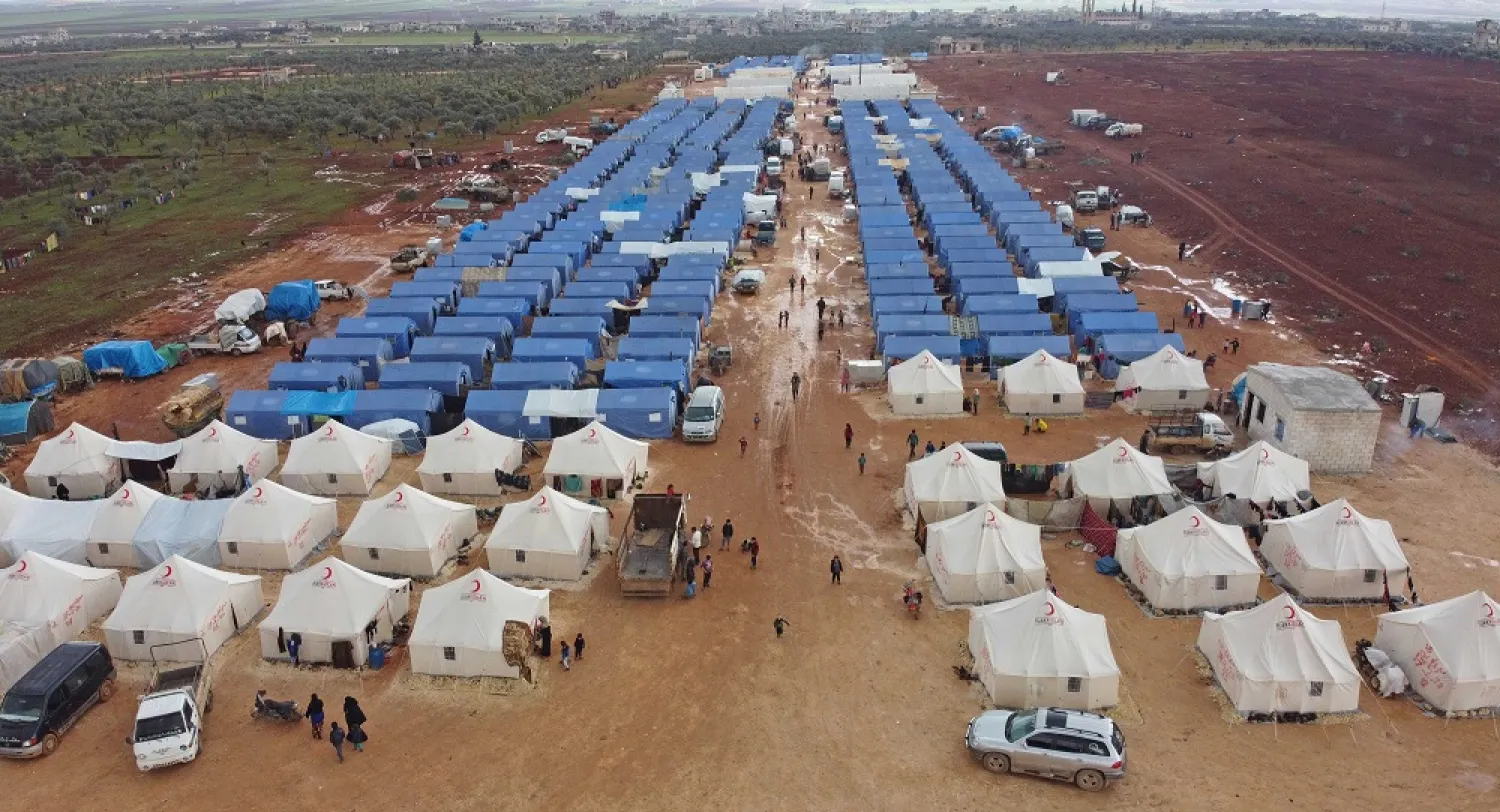
A camp for internally displaced people is shown near Maarrat Misrin, in Syria's Idlib province. (AFP)
TT

Rights Group: Syria Crisis Could See 6 Mn More Displacements

A camp for internally displaced people is shown near Maarrat Misrin, in Syria's Idlib province. (AFP)

The Syria crisis could see at least six million more displacements over yet another decade if the conflict, insecurity, and economic deterioration continue unabated, according to a new report by the Norwegian Refugee Council (NRC).

Ten years since the start of the biggest displacement crisis since World War II, analysis by NRC shows that on average, an estimated 2.4 million displacements occurred in and outside Syria every year since the start of the conflict in 2011.

In 2020, only 467,000 returned home, while 1.8 million were newly displaced inside Syria, meaning that for every person who managed to return home, nearly four were displaced.

NRC Secretary-General Jan Egeland said this was a “decade of shame for humanity,” indicating that the callous indifference towards the millions of Syrian children, mothers, and fathers “bereft of their homes and their lives is a damning indictment of the parties to this cruel war, their sponsors, and the entire international community.”

Egeland warned that unless urgent action is taken to reverse this stalemate, the next decade will continue to bring suffering and displace several million more.

Displaced Syrians across the Middle East overwhelmingly say that they have lost hope of returning home in the next five to ten years, even as they face deteriorating living conditions while displaced inside and outside the country.

However, a few expressed a desire to return home saying they would only do so if there was a political settlement, and their safety was guaranteed.

Syrians were more concerned about how they will put food on the table for their families, pay the rent, or take care of medical expenses than envisioning a future back home, according to the report.

The total number of people displaced inside Syria stands at 6.5 million, and around 70 percent of them have now been displaced for over five years. Nearly a quarter of them have been displaced at least four times, with every displacement further eroding their ability to cope.

While conflict is still the number one driver of displacement, assessments show that economic deterioration has forced Syrians to flee inside the country.

Of the 23,100 newly displaced in January, 32 percent said it was due to lack of access to basic services, and 28 percent due to economic deterioration. Despite the growing humanitarian needs, international aid to Syria could face further cuts.

Egeland said the longer this crisis is left unsolved, the more economic destitution is expected to become the prominent push factor for further displacement.

“We know that more countries with influence are turning their back on Syria. They need to step out of their complacency and constructively step in to support the millions of Syrians who depend on vital aid and are clamoring for an end to the conflict.”

NRC warned that the nearly 5.6 million Syrian refugees in neighboring countries face protracted displacement, with little prospect of them being able to return to Syria in the foreseeable future, or fully integrate where they are currently based.

In addition, about one million Syrian children have been born in exile where their future appears grim and filled with uncertainty.

Meanwhile, Save the Children warned Tuesday that after ten years of war, the vast majority of Syria’s children cannot imagine a future in their country.

Save the Children’s Regional Director for the Middle East and Eastern Europe Jeremy Stoner warned that Syrian children affected by this conflict are still struggling to feel at home where they are.

“This ten-year war has cost Syria’s young people their childhoods, but the world should not allow it to rob them of their future.”

For its report “Anywhere but Syria,” Save the Children interviewed over 1,900 displaced children and their caregivers inside and outside Syria.

On average, 86 percent of Syrian refugee children surveyed in Jordan, Lebanon, Turkey and the Netherlands said they would not want to return to their country of origin. Of children displaced inside Syria, one in three would rather be living in another country.

Children who fled their homes are struggling to feel safe where they are now, as around two in five children of those surveyed said they face discrimination and a lack of education.

The study showed that only three percent of the children surveyed in Turkey, nine percent in Jordan and the Netherlands, and 29 percent in Lebanon want to return to Syria.

The United Nations Children's Fund reported that more than 8.5 million Syrian children depend on aid inside Syria and neighboring countries.

The UN indicated that 60 percent of children in Syria suffer from food insecurity, and more than half of them lack education.



Israeli Strikes Damage Hospital in Lebanon

File photo: Destroyed houses that were hit in an Israeli airstrike in Saksakiyeh village, south Lebanon, Friday, April 3, 2026. (AP Photo/Hussein Malla)
TT

Israeli Strikes Damage Hospital in Lebanon

File photo: Destroyed houses that were hit in an Israeli airstrike in Saksakiyeh village, south Lebanon, Friday, April 3, 2026. (AP Photo/Hussein Malla)

A hospital in the coastal Lebanese city of Tyre was damaged by Israeli airstrikes on nearby buildings that wounded 11 people, the health ministry said on Saturday.

The director of the Lebanese Italian Hospital told the state-run National News Agency (NNA) that it would "remain open to provide the necessary medical care" despite the damage.

Strikes destroyed two buildings nearby, an AFP correspondent saw, shattering windows and causing suspended ceilings to collapse in the hospital, the facility's management said.

A series of attacks hit the Tyre region on Saturday, including one on its port that struck a small boat and damaged others moored nearby, the AFP correspondent said.

Israel has been carrying out strikes across Lebanon and launched a ground invasion in the south after Hezbollah entered the war in the Middle East on the side of its backer Iran on March 2.

Tens of thousands of people have left Tyre, but around 20,000 remain, including 15,000 displaced from surrounding villages, despite Israeli evacuation warnings covering most of the city and a broad swathe of southern Lebanon.

The NNA also reported that Israeli forces abducted a man in Shebaa, near the Israeli border in the east, at around 3:00 am on Saturday.


Indonesia Slams 'Unacceptable' Peacekeeper Casualties in Lebanon

FILE PHOTO: UNIFIL vehicles drive on a main road in Qlayaa, amid escalating hostilities between Israel and Hezbollah, as the US-Israel conflict with Iran continues, in Qlayaa, southern Lebanon, March 27, 2026. REUTERS/Karamallah Daher/File Photo
TT

Indonesia Slams 'Unacceptable' Peacekeeper Casualties in Lebanon

FILE PHOTO: UNIFIL vehicles drive on a main road in Qlayaa, amid escalating hostilities between Israel and Hezbollah, as the US-Israel conflict with Iran continues, in Qlayaa, southern Lebanon, March 27, 2026. REUTERS/Karamallah Daher/File Photo

The Indonesian government on Saturday slammed as "unacceptable" an explosion that injured three of its peacekeepers in Lebanon within days of three other blue helmets from the Southeast Asian nation being killed.

The United Nations Interim Force in Lebanon (UNIFIL) said three peacekeepers were wounded in a blast that occurred inside a UN facility near Adaisseh on Friday afternoon, and rushed to hospital.

Two were seriously wounded.

The UN Information Center in Jakarta said the "origin of the explosion" was unknown but identified the injured soldiers as Indonesian.

"Repeated attacks or incidents of this kind are unacceptable," the Indonesian foreign ministry said in a statement.

"Regardless of their cause, these events underscore the urgent need to strengthen protection for UN peacekeeping forces amid an increasingly dangerous conflict situation."

The government urged the UN Security Council to investigate the events and "to immediately convene a meeting of troop-contributing countries to UNIFIL to conduct a review and take measures to enhance the protection of personnel serving with UNIFIL".

Friday's incident came just days after an Indonesian peacekeeper died when a projectile exploded on March 29 in southern Lebanon, where Israel and Hezbollah have been fighting since Lebanon was drawn into the Middle East war.

A UN security source told AFP on condition of anonymity Tuesday that fire from an Israeli tank was responsible for that attack.

A day later, two more Indonesian peacekeepers died after an explosion struck a UNIFIL logistics convoy, also in southern Lebanon.

The father of one of the two fallen soldiers, 33-year-old Zulmi Aditya Iskandar, said this week he was shocked that peacekeepers were losing their lives in the conflict.

"We were really sad and regretful, because this is a UN troop, a peacekeeping troop, not deployed for war," 60-year-old Iskandarudin told reporters at his house in West Java province.

The bodies of the three peacekeepers are scheduled to arrive in Jakarta on Saturday evening, according to the military.

The Indonesian National Armed Forces has said it will deploy more than 750 personnel to Lebanon next month as part of the scheduled UNIFIL peacekeeping troop rotation.


Strike Kills One Iraqi Fighter near Syria Border

Mourners attend the funeral of members of Iraq's Hashed al-Shaabi, who were killed in an airstrike in the town of al‑Qaim near the Syrian border, amid heightened regional tensions due to the US-Israel conflict with Iran, in Baghdad, Iraq, March 12, 2026. REUTERS/Stringer
TT

Strike Kills One Iraqi Fighter near Syria Border

Mourners attend the funeral of members of Iraq's Hashed al-Shaabi, who were killed in an airstrike in the town of al‑Qaim near the Syrian border, amid heightened regional tensions due to the US-Israel conflict with Iran, in Baghdad, Iraq, March 12, 2026. REUTERS/Stringer

An attack killed one fighter from the former paramilitary coalition Hashed al-Shaabi on Saturday, the alliance said, blaming the US and Israel.

Iraq has been dragged into the war between the United States, Israel and Iran, with strikes targeting both US interests and pro-Iran groups in the country, reported AFP.

"This treacherous attack resulted in the martyrdom of one PMF fighter and the wounding of four others, as well as a member of the ministry of defense," said a short statement from the group, which is also known as the Popular Mobilization Forces (PMF), adding it was a "Zionist-American attack".

The PMF is a coalition of armed groups -- formed in 2014 to fight extremists-- that is now part of Iraq's regular army, but also contains pro-Iran factions who have a reputation for acting independently.

PMF positions have been repeatedly targeted since the outbreak of war, with the group consistently blaming the attacks on the US and Israel.

According to the group's statement, the latest attack targeted a position in western Anbar province of the 45th Brigade, which belongs to the US-blacklisted, pro-Iran Kataeb Hezbollah group.

Kataeb Hezbollah is part of the umbrella movement known as the Islamic Resistance in Iraq, which has been claiming daily attacks since the start of the war on US interests in Iraq and the region.

The Pentagon has said helicopters have carried out strikes against pro-Iran armed groups in Iraq during the war.

Washington has strongly denied claims it has targeted Iraqi security forces.