


Former US Official: Trump Administration Tried to Engage Houthis before their Terror Designation

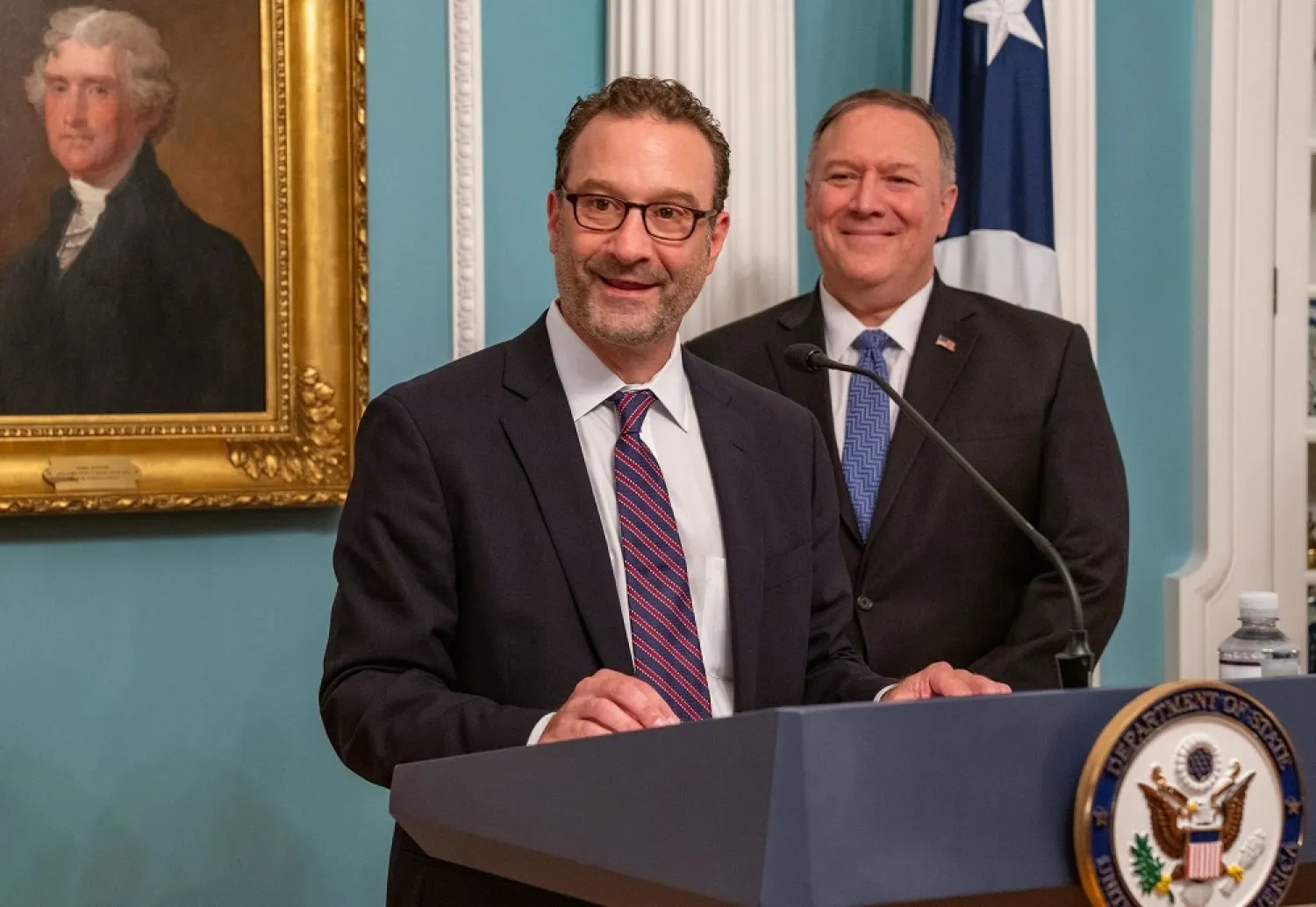
Former Assistant Secretary of State for Near Eastern Affairs David Schenker and ex-Secretary of State Mike Pompeo. (US Department of State)
TT

Former US Official: Trump Administration Tried to Engage Houthis before their Terror Designation

Former Assistant Secretary of State for Near Eastern Affairs David Schenker and ex-Secretary of State Mike Pompeo. (US Department of State)

Former US assistant secretary of Near Eastern Affairs, David Schenker revealed that the administration of ex-President Donald Trump had tried to hold direct talks with the Iran-backed Houthis in Yemen before designating the militias a terrorist in January.

In an interview with Robert Sotloff for the Washington Institute, he said that the administration tried to hold the talks with the Houthis, through an Omani mediator, in late December 2020. The militias, however, rejected the proposal.

“As to the controversy surrounding the designation of the Houthis, as of December 30, [then US Secretary of State Mike] Pompeo was I believe still considering the designation and was engaged with the ngo community,” which expressed concern over the designation, said Schenker.

“We felt we could mitigate the impact of the sanctions through waivers. The US Department of Justice would never prosecute humanitarian organizations for inadvertent leakage to the Houthis,” he added.

“And then on December 30 the Houthis carried out a missile attack against Aden airport in an attempt to kill the entire new Yemeni government just then arriving my plane. And that was it. They were designated,” he stressed.

“The Houthis meet the criteria of a foreign terrorist organization,” he said, citing the direct support they receive from the Iranian Revolutionary Guards, targeting of Yemeni civilians, Saudi infrastructure and oilfields and members of the legitimate Yemeni government, abduction of officials and civilians, recruitment of children and killing of innocents.

He said Yemen has suffered several tragedies due to the Iranian support for the Houthis, adding that he has worked tirelessly, during his time at the State Department, with Saudi officials, including Ambassador to the US Princess Reema bint Bandar bin Sultan bin Abdulaziz and Deputy Defense Minister Prince Khalid bin Salman.

“Along the way, Saudi Arabia announced a few unilateral ceasefires (…) and also donated several hundred million dollars to help feed Yemenis. The problem wasn’t the Saudis, it was and remains the Houthis, who one, lie, two, don’t keep agreements, and three, are committed to winning this war militarily,” Schenker stated.

On the designation, he remarked: “This was not about Secretary Pompeo salting the earth. I tried to meet with the Houthis during my trip to Oman in December. Abdulmalek al-Houthi gave the Omanis the message to me that they were not interested in engaging directly at that time with the administration.”

“As for critics who warned that the designation would drive the Houthis into the arms of Iran, it is a little late. The Houthis are already firmly in bed with the IRGC and for those keeping score, the Houthis have responded to their delisting by increasing escalation exponentially their operational tempo of their attacks on Saudi Arabia. Get ready, they eventually may look to target Israel,” he revealed.

He cited the constant optimism of UN envoy to Yemen Martin Griffiths, noting that he is now joined newly-appointed US envoy and veteran diplomat Tim Lenderking.

“I am optimistic about the combination,” said Schenker.

Meanwhile, Jonathan Schanzer, senior vice president for research at the Foundation for Defense of Democracies, said that President Joe Biden’s measures will not help end the war in Yemen “because the US does not have concessions to offer to the Houthis, who now have less incentive than before to make compromises.”

In televised remarks, he noted: ““What the Biden administration has done is, it has taken the military option off the table for the United States, even by way of proxy through the Saudis.”

The US also removed the Houthis from being designated as a foreign terrorist organization, and took them off the Specially Designated Global Terrorist list.

“What is left right now is diplomacy,” Schanzer said, according to CNBC.

“The reality that we are now facing is that we’ve taken really all of our other leverage off the table, and we’re simply going to hope that an Iran-backed militia will come to the table and act reasonably,” he said. “Unfortunately, I think this is wishful thinking.”

He noted that the Houthis have stepped up strikes even though the US special envoy to Yemen, Timothy Lenderking, has implored them to negotiate.

Schanzer said Saudi Arabia’s continued military operations could be “one of the few pieces of leverage” that the US could use in discussions with the Houthis.

Still, he acknowledged that there is an aversion to being involved in the conflict. “It looks … as if the Biden administration has itself tied in knots a bit,” he added.



Germany Moves Troops Out of Iraq, Citing Mideast 'Tensions'

FILE PHOTO: German Defense Minister Ursula von der Leyen visits the Transport Helicopter Regiment 30 (Transporthubschrauberregiment 30) at the Hermann-Koehl-Kaserne in Niederstetten, Germany, August 20, 2018. REUTERS/Ralph Orlowski
TT

Germany Moves Troops Out of Iraq, Citing Mideast 'Tensions'

FILE PHOTO: German Defense Minister Ursula von der Leyen visits the Transport Helicopter Regiment 30 (Transporthubschrauberregiment 30) at the Hermann-Koehl-Kaserne in Niederstetten, Germany, August 20, 2018. REUTERS/Ralph Orlowski

Germany's military has "temporarily" moved some troops out of Erbil in northern Iraq because of "escalating tensions in the Middle East," a German defense ministry spokesman told AFP on Thursday.

Dozens of German soldiers had been relocated away from the base in Erbil, capital of Iraq's autonomous Kurdistan region.

"Only the personnel necessary to maintain the operational capability of the camp in Erbil remain on site," the spokesman said.

The spokesman did not specify the source of the tensions, but US President Donald Trump has ordered a major build-up of US warships, aircraft and other weaponry in the region and threatened action against Iran.

German troops are deployed to Erbil as part of an international mission to train local Iraqi forces.

The spokesman said the German redeployment away from Erbil was "closely coordinated with our multinational partners".


UN: At Least 15 Children Killed in Sudan Drone Strike

The war in Sudan, ongoing since mid-April 2023, has caused extensive destruction across the country (AFP)
TT

UN: At Least 15 Children Killed in Sudan Drone Strike

The war in Sudan, ongoing since mid-April 2023, has caused extensive destruction across the country (AFP)

A drone strike on a displacement camp in Sudan killed at least 15 children earlier this week, the United Nations reported late on Wednesday.

"On Monday 16 February, at least 15 children were reportedly killed and 10 wounded after a drone strike on a displacement camp in Al Sunut, West Kordofan," the UN children's agency said in a statement.

Across the Kordofan region, currently the Sudan war's fiercest battlefield, "we are seeing the same disturbing patterns from Darfur -- children killed, injured, displaced and cut off from the services they need to survive," UNICEF's Executive Director Catherine Russell said.


MSF Will Keep Operating in Gaza 'as Long as We Can'

(FILES) A Palestinian man walks on his crutches to the Doctors Without Borders or Medecins Sans Frontieres (MSF) clinic, in the al-Rimal neighborhood of Gaza City on new year's Eve, December 31, 2025. (Photo by Omar AL-QATTAA / AFP)
TT

MSF Will Keep Operating in Gaza 'as Long as We Can'

(FILES) A Palestinian man walks on his crutches to the Doctors Without Borders or Medecins Sans Frontieres (MSF) clinic, in the al-Rimal neighborhood of Gaza City on new year's Eve, December 31, 2025. (Photo by Omar AL-QATTAA / AFP)

The head of Doctors Without Borders in the Palestinian territories told AFP the charity would continue working in Gaza for as long as possible, following an Israeli decision to end its activities there.

In early February, Israel announced it was terminating all the activities in Gaza by the medical charity, known by its French acronym MSF, after it failed to provide a list of its Palestinian staff.

MSF has slammed the move, which takes effect on March 1, as a "pretext" to obstruct aid.

"For the time being, we are still working in Gaza, and we plan to keep running our operations as long as we can," Filipe Ribeiro told AFP in Amman, but said operations were already facing challenges.

"Since the beginning of January, we are not anymore in the capacity to get international staff inside Gaza. The Israeli authorities actually denied any entry to Gaza, but also to the West Bank," he said.

Ribeiro added that MSF's ability to bring medical supplies into Gaza had also been impacted.

"They're not allowed for now, but we have some stocks in our pharmacies that will allow us to keep running operations for the time being," he said.

"We do have teams in Gaza that are still working, both national and international, and we have stocks."

In December, Israel announced it would prevent 37 aid organizations, including MSF, from working in Gaza from March 1 for failing to submit detailed information about their Palestinian employees, drawing widespread condemnation from NGOs and the United Nations.

It had alleged that two MSF employees had links with Palestinian militant groups Hamas and Islamic Jihad, which the medical charity has repeatedly and vehemently denied.

MSF says it did not provide the names of its Palestinian staff because Israeli authorities offered no assurances regarding their safety.

Ribeiro warned of the massive impact the termination of MSF's operations would have for healthcare in war-shattered Gaza.

"MSF is one of the biggest actors when it comes to the health provision in Gaza and the West Bank, and if we are obliged to leave, then we will create a huge void in Gaza," he said.

The charity says it currently provides at least 20 percent of hospital beds in the territory and operates around 20 health centers.

In 2025 alone, it carried out more than 800,000 medical consultations, treated more than 100,000 trauma cases and assisted more than 10,000 infant deliveries.