'Worse than a Jungle': The Cartel Controlling Iraqi Borders

This picture taken on March 14, 2021 shows an aerial view of imported livestock waiting on the pier at the port of Umm Qasr, south of Iraq's southern city of Basra. (Photo by Hussein FALEH / AFP)
TT

'Worse than a Jungle': The Cartel Controlling Iraqi Borders

This picture taken on March 14, 2021 shows an aerial view of imported livestock waiting on the pier at the port of Umm Qasr, south of Iraq's southern city of Basra. (Photo by Hussein FALEH / AFP)

Along Iraq's borders, a corrupt customs-evasion cartel is diverting billions of dollars away from state coffers to line the pockets of armed groups, political parties and crooked officials.

The prime beneficiaries are Iran-linked Shiite paramilitaries that intimidate federal officials who dare obstruct them, sometimes through chillingly specific death threats, a six-month AFP investigation has found.

The network is so well-oiled and entrenched that revenues are parceled out among rival groups with remarkably little friction, part of a parallel system that Iraq's finance minister has described as "state plunder".

"It's indescribable," said one Iraqi customs worker. "Worse than a jungle. In a jungle, at least animals eat and get full. These guys are never satisfied."

Like most of the government officials, port workers and importers interviewed for this story, this worker cited threats to his life and asked to speak anonymously.

The network they described arises from Iraq's glacially slow bureaucracy, fractious politics, limited non-oil industry and endemic corruption that is itself largely a product of years of chaos in the wake of the 2003 US invasion to topple dictator Saddam Hussein.

Customs provide one of the few sources of state revenues, and to keep disparate groups and tribes happy, many of them close to Iran, entry points are divvied up among them and federal duties largely supplanted by bribes.

"There's a kind of collusion between officials, political parties, gangs and corrupt businessmen," Iraq's Finance Minister Ali Allawi told AFP.

- 'Designed to fail' -

Iraq imports a vast majority of its goods -- from food and electronics to natural gas -- mostly from neighbors Iran and Turkey and from China.

Officially, the country of 40 million brought in $21 billion worth of non-oil goods in 2019, the latest year for which full government data is available.

Iraq has five official crossings along its 1,600-kilometer (1,000-mile) border with Iran and one on the nearly 370-km frontier with Turkey, while the single biggest and most lucrative gateway is the port of Umm Qasr in the southern province of Basra.

Duties on imports at these points of entry are meant to supplement state revenues from Iraq's huge oil sector -- but they don't.

Iraq's import system is infamously outdated and cumbersome, with a 2020 World Bank report citing frustrating delays, high compliance fees and frequent exploitation.

"If you want to do it the right way, you end up paying in the four figures for demurrage (docking fees) for a single month" in dollar terms, said an importer based in the region.

"It's designed to fail," he said.

An informal parallel system rose in its stead, in which parties and paramilitary groups have divided up Iraq's land and sea crossings, said officials, port workers, importers and analysts.

- Paramilitary groups -

Many of Iraq's entry points are informally controlled by groups within the Popular Mobilization Forces, a powerful state-sponsored armed network close to Iran, as well as other armed factions, officials confirmed to AFP.

The PMF's members, their allies or their relatives work as border agents, inspectors or police, and are paid by importers who want to skip the official process entirely or get discounts.

"If you want a shortcut, you go to the militias or parties," said an Iraqi intelligence agent who has investigated customs evasion.

He said importers effectively tell themselves: "I'd rather lose $100,000 (on a bribe) than lose my goods altogether."

The PMF publicly denies the claims. But sources close to its hardline member groups Asaib Ahl al-Haq and Kataeb Hezbollah acknowledged that customs posts are indeed parceled out in the manner alleged.

They cited specific harbor berths, land crossings and products that matched what customs officials and the intelligence agent told AFP.

- $10,000 a day in bribes -

The Mandali crossing on the Iranian border, for example, is run by the Badr Organization, an Iraqi movement founded in Iran, port workers, officials and analysts confirmed.

An official there boasted to AFP that a border operative can rake in $10,000 per day in bribes, the bulk of which is distributed to the overseeing armed group and complicit officials.

In other cases, an armed group controls a particular kind of trade.

"If I'm a cigarette trader," he said, "I go to Kataeb Hezbollah's economic office in the Jadriyah neighborhood (of Baghdad), knock on the door, and say: 'I want to coordinate with you'."

One key figure is always the "mukhalles" -- the state customs agent assigned to an incoming shipment who often doubles as a middleman for an armed group.

"There's no such thing as a neutral mukhalles. They're all backed by parties," the intelligence agent said.

Once paid -- in cash for smaller operations, and by bank wire for larger deals -- the mukhalles tampers with paperwork.

By misrepresenting the type or amount of goods imported or their value, the customs fee is sharply reduced.

One importer told AFP that under-declaring quantities could score a trader discounts of up to 60 percent.

- Right connections -

For high-tariff goods, meanwhile, the favored trick is to declare them as something else altogether.

Cigarette imports are taxed with a regular import tariff of 30 percent, plus a further 100 percent to encourage consumers to buy local brands.

To cut those fees, cigarettes are often recorded as tissues or plastic goods.

Facilitators also tamper with a shipment's estimated total value, which is first marked on the import license but re-evaluated at the point of entry.

In one case described to AFP by an Umm Qasr official, metal reinforcements were valued by the customs agent so cheaply that the importer was charged $200,000 in duties, when he should have paid over $1 million.

With the right connections, some cargo slips through with no inspection at all.

"I'm not corrupt, but even I have had to wave through cargo I didn't actually inspect because the shipment was linked to a powerful party," said the customs worker quoted earlier.

One importer told AFP he paid $30,000 to a customs agent at Umm Qasr to allow through prohibited refurbished electrical equipment.

He said he also regularly bribed port police to warn him of surprise inspections. For an additional fee, the officer offered an extra service -- to send patrols to hold up rival imports.

- 'A real mafia' -

With points of entry seen as cash cows, public servants pay their superiors for postings, especially at Umm Qasr.

"Minor clerks' jobs in some outposts change hands for $50,000 to $100,000, and sometimes it goes up to multiples of that," Allawi, the finance minister, lamented.

The subterfuge around the import system "contributes to state plunder," he told AFP.

To protect their pillaging, parties and armed groups use their political influence and threats of violence.

A worker at Mandali told AFP he once delayed a shipment from Iran because of missing paperwork, but then allowed it through, duty-free, after the mukhalles handling the cargo brandished his credentials as a PMF member.

The intelligence officer said an informant at Zerbatiya crossing, which likewise borders Iran and is managed by Asaib Ahl al-Haq, was repeatedly put on leave for blocking efforts to import Iranian produce customs-free and eventually relented.

"We came back later to talk to him again and found he had joined Asaib," the intelligence officer said.

A senior member of Iraq's border commission told AFP he receives regular calls from private numbers threatening his relatives by name, in an effort to intimidate him into halting cargo inspections.

The customs worker was among others who also said they contended with death threats.

"We can't say anything because we'll be killed," he said. "People are afraid. This is a real mafia."

- Spoil-sharing -

This parallel system has become the lifeblood of Iraqi parties and armed groups, including Iran-backed PMF factions, said Renad Mansour of the Chatham House think tank.

They professionalized this financing stream after Iraq's defeat of ISIS in 2017.

That victory ended the allocation of large defense budgets to the anti-ISIS military campaign, which included the PMF, sparking the need to find alternative funding sources.

They latched on tighter after Iran came under crippling sanctions imposed by former US president Donald Trump.

In March 2020, the US blacklisted Al Khamael Maritime Services (AKMS), a shipping company in Umm Qasr, for using Shiite paramilitary groups to help the Iranian Revolutionary Guard Corps "evade Iraqi government inspection protocol".

It also sanctioned two Iraqis and two Iranians linked to AKMS for financing Kataeb and the Lebanese Shiite movement Hezbollah.

The spoil-sharing is surprisingly smooth, given the rivalries among parties and armed groups.

"One border point can make up to $120,000 a day," said Mansour. "This doesn't go only to one group, but is shared by many, which at times may even seem to be enemies when you zoom out."

Turf wars are rare, but do happen. In February, the separate killings of two members of Asaib Ahl al-Haq were described to AFP by two PMF sources as "economically motivated".

But usually, the cartel operates smoothly.

"There's no competition," said the Iraqi intelligence agent. "They know if one of them goes down, they all will."

- Trickling down -

The parallel system starves the state of a funding resource for schools, hospitals and other public services at a time when the poverty rate in Iraq has reached 40 percent.

"We should get seven billion dollars (a year) from customs," Allawi told AFP. "In fact, just 10-12 percent of the customs resources reach the finance ministry."

The cost of bribes ultimately also trickles down to the consumer, an Iraqi official said. "As a consumer, you're the one who ends up paying for that corruption in the store."

Prime Minister Mustafa al-Kadhemi, within weeks of taking office in May 2020, prioritised border reform, to shore up government revenues hit hard by depressed oil prices.

In highly-publicized trips to Umm Qasr and Mandali, he vowed to send new troops to each entry point and regularly swap senior customs staff to break up corrupt circuits.

There have been some modest victories. The border commission now reports daily seizures of cargo in cases where importers tried to evade customs fees.

And Iraq collected $818 million in duties in 2020, the commission said, slightly higher than the previous year's $768 million, despite imports being hit by the coronavirus downturn.

- Stuttering reforms -

But importers, facilitators and even officials have laughed off the premier's measures.

They told AFP that while some importers were now paying government tariffs, they also still paid facilitators to stop goods being arbitrarily held up.

"In the end, we're paying double," said an Arab businessman, who has imported into Iraq for over a decade.

The well-connected, meanwhile, were not affected.

"Nothing changed," said an Iraqi importer, noting he brought in construction materials through Mandali without paying tariffs.

Security forces described chaos.

"The police there is all involved in the bribery," a soldier, whose unit had been briefly deployed to Mandali, told AFP.

"The traders drop money like crazy. We arrested one guy but they got him out the next day."

The senior border commission official admitted some promised deployments never happened.

"Other times, it's a joke of a unit" consisting only of "about two dozen guys," he told AFP.

But the main issue, importers and officials agreed, was that staff rotations did not extend to a crucial cog in the corruption machine: the mukhalles.

"The main facilitator of corruption is still there," said the customs official. "One rotten apple will spoil the rest."

- Threat of violence -

A US defense official told AFP that Kataeb Hezbollah, accused recently of firing rockets at the US embassy, was ordered to close its office inside Baghdad Airport's arrivals terminal to stop it from smuggling in high-value goods.

"Now they've got a position just outside the airport, but they can still drive up to the plane and do what they need to do," the official said. "Corruption still happens."

Instead of brazenly phoning each other, facilitators have moved to WhatsApp and other encrypted messaging apps.

"Our work has actually become harder because they're taking more precautions," the intelligence agent said.

The cartel remains intact.

Officials said they expect traders to react by increasingly avoiding official border crossings, relying on smuggling instead, or importing goods unofficially through Iraq's northern Kurdish region.

Trying to dismantle the lucrative network completely, they warned, would bring violence Kadhemi may be unprepared for.

"A single berth at Umm Qasr is equivalent to a state budget," the intelligence agent said, using deliberate exaggeration to emphasize the point.

"They won't compromise easily."


Worn Banknotes, Tobacco Taxes: How Hamas Pays Its Members

Palestinians shop amid the rubble in Khan Younis in southern Gaza, February last year (DPA)
TT

Worn Banknotes, Tobacco Taxes: How Hamas Pays Its Members

Palestinians shop amid the rubble in Khan Younis in southern Gaza, February last year (DPA)

More than two months after a fragile ceasefire between Israel and Hamas took effect in Gaza, the group has steadily reasserted some security control in areas under its authority. Yet for Gaza’s residents, daily economic hardship and deteriorating living conditions show little sign of easing.

Hamas’s popular base, made up of its members, their families, and supporters, remains a key pillar of its strength. Nearly two years of war with Israel have partially disrupted the group’s ability to consistently pay salaries.

During the war, Israel sought to dry up Hamas’s financial network by killing figures responsible for transferring money inside Gaza, as well as raiding currency exchange companies in the occupied West Bank that Israeli authorities said were linked to Palestinian factions.

According to field sources and Hamas officials who spoke to Asharq Al-Awsat, the group faced difficulties and delays in paying salaries regularly at leadership, field and other levels due to security conditions.

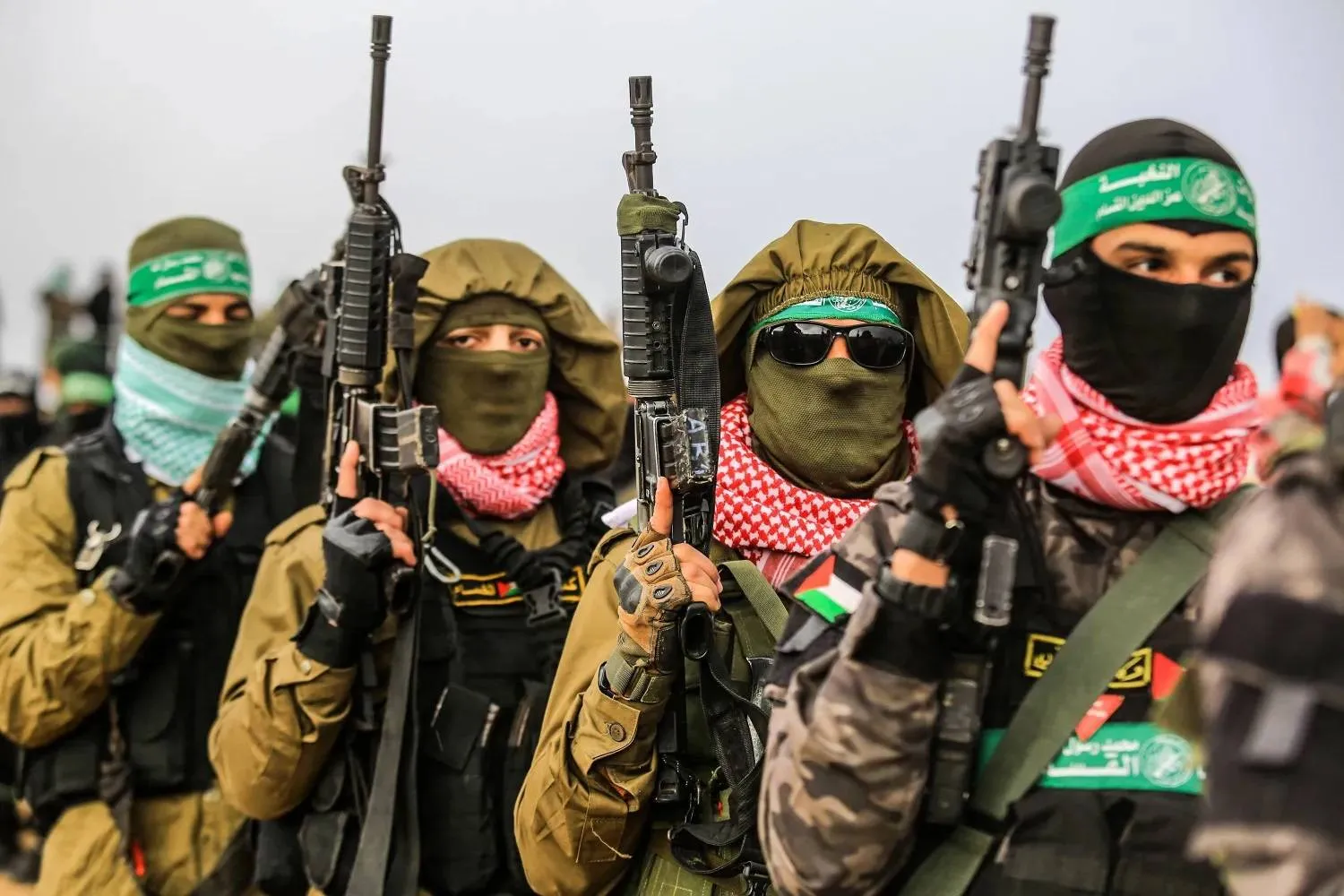
It has since resumed partial payments to all its members, including leaders and fighters from the Izz al-Din al-Qassam Brigades, Hamas’s armed wing, while paying lower rates to its preaching and social apparatus, described as civilian elements.

Where does Hamas get its money?

Sources agree that Hamas has managed to preserve some of its financial resources, including commercial activities inside and outside Gaza. One Hamas source said these business revenues generate income for the group alongside funds received from supporting parties such as Iran and others.

They added that such external support fluctuates, sometimes declining, increasing or arriving with delays for reasons related to the donors.

The source said Hamas faces growing difficulties in transferring funds into Gaza, forcing those overseeing salary payments to rely on whatever cash remains accessible in their reserves or to collect revenues from their own commercial sources.

How are salaries paid?

Sources who receive some of these payments told Asharq Al-Awsat, on condition of anonymity, that salaries and stipends were sometimes paid regularly each month but were also delayed by periods ranging from six weeks to two months.

A Hamas source said salary rates varied and did not exceed 80 percent at best, particularly for leaders and operatives in the Qassam Brigades and at the political level.

Lower percentages were paid to the preaching and social apparatus and other bodies, alongside allocations for activities aimed at supporting the population and what the group calls its popular base.

The source said the lowest rates were paid to government employees at both civilian and military levels, reaching 60 percent at most before declining in recent months to around 35 percent.

Several sources said Hamas continues to pay stipends to the families of its members and leaders killed over decades of its activities, as well as to prisoners and wounded fighters.

They added that the group also supports families whose salaries were cut by the Palestinian Authority, continues to provide social assistance and allocates funds to projects aimed at supporting its popular base, including food aid, water provision and communal kitchens, in coordination with foreign institutions.

Asked how salaries are delivered, Hamas sources said payments are made through tight networks and by hand to avoid Israeli monitoring of electronic wallets and banks.

Worn banknotes and tobacco taxes

As Hamas relies on manual delivery, questions remain over how it secures cash under Israel’s blockade. A Hamas source said the process was complex and could not be disclosed for security reasons.

Local sources outside Hamas said the group depends heavily on traders to obtain cash, alongside its existing cash reserves and revenues from businesses it operates.

One source said Hamas often pays worn banknotes to government employees in particular, and to a lesser extent to Qassam fighters and political figures. This forces recipients to manage on their own as most traders refuse to accept damaged or worn currency.

Hamas has encouraged some small traders, especially fruit and vegetable sellers, to accept such notes in exchange for continued support and access to goods at lower prices.

Another source said Hamas has imposed taxes on certain goods, such as tobacco products, to raise funds, noting that most cigarette traders deal in cash rather than electronic wallets, which many Gaza residents now rely on.

Israeli accusations against Iran

On Dec. 7, Israel accused Iran of supporting what it described as a banking network transferring hundreds of thousands of dollars to Hamas. Israel said the network consisted of Gaza-based money changers residing in Türkiye who exploit the country’s financial infrastructure for what it called terrorist purposes.

According to Israel, the network operated in full cooperation with the Iranian regime, transferring funds to Hamas and its leaders and managing wide ranging economic activity involving receiving money from Iran, storing it and transferring it to Hamas via Türkiye.

Israel published the identities of three individuals, including an official in Hamas’s financial apparatus and two money changers from Gaza, claiming they worked under the direction of Khalil al-Hayya.

Sources familiar with the two men told Asharq Al-Awsat they have lived outside Gaza for many years.

One was known to work with various Palestinian factions and had previously smuggled funds for them, including through tunnels along the Egyptian border, while also operating as a businessman in multiple fields beyond currency exchange.

Hamas sources dismissed the accusations as baseless, saying the group has its own methods for transferring funds.

They said Hamas often faces difficulties moving money from abroad into Gaza, a problem that also affects the West Bank due to Israeli pursuit and Palestinian Authority security pressure, though conditions there are better than in Gaza for transferring funds.

Sources from other Palestinian factions said they are also suffering financial crises and difficulties paying salaries and stipends to their members and leaders.

They said they sometimes distribute food aid and other assistance to help their members and families cope with harsh economic conditions, with most of the support coming through institutions backed by Iran or other parties.


Shadow Battles in Syria: Fighting ISIS, Rebuilding the State 

An aerial photograph shows thousands of people celebrating the first anniversary since the ousting of longtime ruler Bashar al-Assad near The Damascus Sword monument in Umayyad Square, in the Syrian capital Damascus on December 8, 2025. (AFP)
TT

Shadow Battles in Syria: Fighting ISIS, Rebuilding the State 

An aerial photograph shows thousands of people celebrating the first anniversary since the ousting of longtime ruler Bashar al-Assad near The Damascus Sword monument in Umayyad Square, in the Syrian capital Damascus on December 8, 2025. (AFP)

At the entrances to Damascus branching off the Mezzeh highway, just before Umayyad Square, young men with a quasi-military appearance line both sides of the road, selling flags and banners for “Liberation Day.”

In narrower streets and at intersections leading deeper into the city, they are met by women in long dresses, some with headscarves pulled halfway across their faces. The women drag one or two children behind them and carry loaves of bread for sale, stacking them openly and thrusting them toward passersby and car windows — unwrapped, exposed to diesel fumes and the dust rising from the rubble encircling the capital.

Selling bread in this manner has gradually become a “profession,” largely female, expanding as poverty deepens. Women queue at bakeries to purchase their ration, resell it for a small margin, then return to the lines, repeating the cycle late into the night.

This scene is not confined to Damascus; it recurs across Syrian cities and regions I visited, from Homs and Idlib to Aleppo. Over time, this female presence has become woven into the landscape of a prolonged crisis, a quiet pillar of daily survival.

Widespread destruction

If women’s exhausted faces and roughened hands are the clearest witnesses to a catastrophe now nearing its fifteenth year, the unrelenting destruction bears equally stark testimony. Entire neighborhoods and suburbs, flattened to the ground, ring Damascus, choking it in dust and debris.

The same gray desolation dominates major cities and their surrounding countryside, stretching across vast expanses of the country. Driving more than 350 kilometers without encountering a single intact tree, neighborhood, or home offers a visceral sense of what over a decade of killing, destruction, and vengeance has left behind.

The scale of devastation reflects not only military confrontations or the superiority of one side, but a deliberate effort to annihilate people and livelihoods, to extinguish even the faintest hope of return. What bombs spared was often burned, looted, or rendered uninhabitable. And yet, returns are taking place slowly, haltingly, through sheer individual persistence.

Only a few enclaves have endured in Damascus and its markets, or beyond in certain towns and districts, some even prospering, driven by sectarian calculations or political and commercial interests, most notably those tied to the production and trafficking of captagon.

A view of Damascus, Syria. (Asharq Al-Awsat)

Damascus: The polished façade

Damascus was preparing for exceptional celebrations marking the first anniversary of Bashar al-Assad’s ouster. Preparations were extensive: stages erected, loudspeakers installed, traffic rerouted, and banners raised proclaiming national unity, “One people... one nation”, and announcing that “the dark era has ended.”

Programs circulated via text messages urging citizens to participate and “celebrate freedom and hope... and complete the story.” But which story? The question reverberates through streets where bread is sold on bare asphalt while victory celebrations unfold.

Here, narratives multiply and diverge, sometimes to the point of contradiction, like neighboring bubbles that coexist without touching. A sharp vertical divide in perspectives remains, recalling 2011, when Syrians split to the brink between supporters and opponents, even as official discourse insists on projecting a seamless image of a new phase.

Silent security battle

Behind the celebratory façade, another battle is underway, which is quieter and more complex. “ISIS, especially the muhajireen [foreign fighters], poses our most serious challenge,” a senior Syrian security source who requested anonymity told Asharq Al-Awsat, noting that arrests and “neutralizations” are carried out regularly.

Another source explained that “security operations are conducted with precision and professionalism. Lists of those affiliated with extremist organizations under the broad ISIS umbrella are already in the hands of the security services.”

He added: “We know them individually. We monitor them closely. The former regime left behind an extremely detailed surveillance system that we continue to rely on.”

I met both sources days before the recent Palmyra incident. When it occurred, it appeared unsurprising; officials and those in sensitive positions had anticipated such scenarios as among several looming security risks, especially after Syria formally joined the counterterrorism coalition.

One source summarized these risks as three simultaneous confrontations: “First, the fight against ISIS and its offshoots, handled with extreme caution because it poses a personal threat to President Ahmed al-Sharaa. Second, the confrontation with the Syrian Democratic Forces (SDF), which threatens the emerging state and its identity over the long term. Third, a colder, less intense standoff with Israel linked to developments in Sweida.”

In a semi-official assessment, the security source did not rule out that those released from al-Hol camp could become “time bombs,” exploited to destabilize internal security and serve the agendas of extremists rejecting the current transition of power.

Such incidents could also signal abroad that stripping the SDF of its “counterterrorism” duties would be futile, potentially “opening the door to packs of lone wolves.”

Destruction from fighting between the regime forces and opposition is seen in the Yarmuk camp on the outskirts of Damascus. (EPA)

Is a security approach enough?

The challenge confronting the state is not purely a security one, and a strictly securitized approach lacks consensus even within governing circles.

Contrary to those who view ISIS and extremism as a “technical problem” solvable through force alone, a figure close to the political leadership argues that “the core issue lies in absorbing a massive human bloc that spent years outside any normal social framework, without education, stable families, or organized structures of life.”

“The real challenge,” he added, “is integrating them into the idea of the state and rehabilitating them accordingly. Just as these adolescents were once pulled toward a specific form of extremism, today we must work to move them toward a middle ground.”

“If the president says we are leaving a factional phase and entering a state-based one, how does that happen at the grassroots level? Is it merely individual and security-driven, or is it societal as well?” he wondered.

In this light, one observer interpreted al-Sharaa’s statement — “Obey me so long as I obey God among you” — delivered from the Umayyad Mosque on the night of the grand celebration and widely criticized by civil and secular circles, as a message aimed at a different audience: a segment the state seeks to reassure through a religious call to obedience and rejection of rebellion.

If words come easily, lived reality does not.

Security is tightly enforced in major cities, such as Damascus and Aleppo, through heavy deployments and modern technologies, including drones, especially during sensitive periods like mass anniversary celebrations.

Beyond the cities, however, vast rural areas remain largely neglected, marked by immense destruction, extreme poverty, and rampant unemployment. Checkpoints line major inter-provincial roads, but side towns and village alleys are often left to fend for themselves.

Idlib, once cited as an exception for its services and administrative capacity, has lost much of that distinction since liberation. Opening to the rest of Syria exposed the city and its devastated countryside to the demands of ordinary life, revealing governance that had amounted largely to crisis management. That legacy persists even in everyday language: soldiers addressing civilians as “sheikh,” or telling them to “seek God’s help” as shorthand for “move along.”

Between Idlib’s countryside and Aleppo, villages and small towns are known for particular loyalties and affiliations — some far removed from the moderation celebrated on Damascus stages. Their reputations lead drivers to take longer routes considered “safer.”

In this belt, young men, especially the youngest, have long served as fuel for armed factions. In recent years, only Hayat Tahrir al-Sham maintained dominance on the ground.

After the fall of the regime, thousands joined the general security forces or the army, often for lack of alternatives. Many cannot afford to rebuild destroyed homes or recover looted livelihoods; barracks, offering food and shelter, remain preferable to civilian life.

A fabric of clashing identities

These identities crystallized during years of militarization, particularly after 2013, though their social roots run deeper. Today, anyone associated with the new authority is often labeled “Idlibi,” after Idlib — the stronghold of Hayat Tahrir al-Sham for nine years — a term frequently tinged with condescension in Damascus and Aleppo. Understanding the social and economic distinctions among these rural communities helps explain their divergent political and military choices.

Some towns, organized around extended families, land ownership, and later labor migration beginning in the mid-1980s, invested in education and professional paths while maintaining a socially rooted religiosity. These communities had previously experienced nationalist and Arabist currents before Baathist authoritarianism took hold.

Others, smaller towns built around sub-clans, relied on seasonal agriculture and service in the police and security apparatus of the former regime. They welcomed their sons’ joining the Nusra Front when it began recruiting, seeing in it both as an organized military path against Assad and a religious identity long suppressed.

Added to this are vast desert regions governed by tribal structures and shifting systems of mutual aid.

Though all are Arab Sunnis, their behaviors, loyalties, and alignments differed, shaping how radical factions penetrated some communities while failing in others, often setting one group against another.

Syrian security forces detain a suspect during an anti-ISIS operation in the Idlib countryside on December 1. (Syrian Interior Ministry)

Idlib and the keys to Damascus

When security officials say today they know extremists “one by one,” they rely partly on Hayat Tahrir al-Sham’s security apparatus and its accumulated knowledge of radical factions it fought in recent years, such as Jund al-Aqsa and the al-Qaeda-aligned Hurras al-Din, along with informant networks.

Idlib remains, to a significant extent, a secure stronghold holding key levers of power. Courts, administrative bodies, and civil registries still operate under the “Sharia courts” established in mid-2013, unlike other regions, especially Damascus, where transactions are centralized.

Sources identify three main recruitment pathways used by ISIS and its offshoots: ideological recruitment, the fastest and most effective, especially among youth who embraced extremism and have yet to absorb Syria’s rapid changes; recruitment driven by money and revenge amid pervasive poverty and lost status; and recruitment among foreign fighters, embittered by abandonment and with little left to lose.

The emerging state and the ‘Sahwa’ model

When President al-Sharaa returned from Washington, he carried a daunting mandate: to “confront and dismantle terrorist networks” linked to remnants of ISIS, Iran’s Revolutionary Guard, Hezbollah, and Hamas, according to US envoy to Syria Tom Barrack.

While Israel has targeted Hezbollah in Lebanon and Hamas in Gaza, Syria must contend with their residual networks. Yet the greater challenge remains ISIS and its offshoots, fighters who, until recently, were close “brothers in arms” to Hayat Tahrir al-Sham.

As observers await the form this confrontation will take, particularly in the absence of a unified army with a clear doctrine, Washington’s earlier experiment in post-Saddam Iraq looms large: the Sunni-on-Sunni “Awakening” (Sahwa).

The Sahwa rested on what an informed Iraqi source described as a “coalition of the harmed” from al-Qaeda, centered in Anbar province with its Sunni Arab identity and traditional religiosity. A similar model could emerge in Syria through an alliance of communities damaged by ISIS in the north and northeast, led by the emerging state that wants to fight extremism.

The Iraqi source, who closely followed the Sahwa’s rise and subsequent decline under then Prime Minister Nouri al-Maliki, noted that tribes around Ramadi, especially al-Bourisha, al-Buallwan, al-Bou Fahd, and to a lesser extent al-Dulaim, formed the backbone of the fight after al-Qaeda devastated their trade and social fabric.

Syria's interim president, Ahmed al-Sharaa, greets people as he attends celebrations marking the first anniversary of the ousting of former President Bashar al-Assad in Damascus, Syria, Monday, Dec. 8, 2025. (AP)

Though some were coerced into allegiance, clashes never fully ceased, culminating in atrocities such as the massacre of the al-Bu Nimr tribe, where nearly 2,000 men were executed. A Syrian parallel is the al-Shaitat tribe, which resisted ISIS and suffered one of the largest massacres, with around 1,800 young men killed.

Those who joined the Sahwa were required to publicly renounce al-Qaeda and integrate into security forces coordinated with US troops, in hopes of transforming that tribal bloc into a political actor.

From arms to politics

The Iraqi source highlighted a central lesson: despite the Sahwa’s security successes, it failed to transition into meaningful political participation. When its leaders entered elections, they achieved little representation and failed to build durable popular support.

That failure mirrors Syria’s core dilemma today: the collective transition from a factional, militarized reality confined to limited geography toward a state defined by broader political and administrative principles — and, militarily, by the monopoly of force within a single national army.

Between a woman selling bread on a street corner, a young man dancing in a public square, and institutions struggling to impose order and define the state, Syria appears as a country of overlapping bubbles: a glossy façade prepared for celebration, like a carefully designed postcard, and beneath it a fragile social and security depth whose battles remain unresolved.


Iraq’s Dreams of Wheat Independence Dashed by Water Crisis 

A drone view shows a circular wheat field in the desert of Basra, Iraq, November 27, 2025. (Reuters)
TT

Iraq’s Dreams of Wheat Independence Dashed by Water Crisis 

A drone view shows a circular wheat field in the desert of Basra, Iraq, November 27, 2025. (Reuters)

Iraqi wheat farmer Ma'an al-Fatlawi has long depended on the nearby Euphrates River to feed his fields near the city of Najaf. But this year, those waters, which made the Fertile Crescent a cradle of ancient civilization 10,000 years ago, are drying up, and he sees few options.

"Drilling wells is not successful in our land, because the water is saline," al-Fatlawi said, as he stood by an irrigation canal near his parched fields awaiting the release of his allotted water supply.

A push by Iraq - historically among the Middle East's biggest wheat importers - to guarantee food security by ensuring wheat production covers the country's needs has led to three successive annual surpluses of the staple grain.

But those hard-won advances are now under threat as the driest year in modern history and record-low water levels in the Tigris and Euphrates rivers have reduced planting and could slash the harvest by up to 50% this season.

"Iraq is facing one of the most severe droughts that has been observed in decades," the UN Food and Agriculture Organization's Iraq representative Salah El Hajj Hassan told Reuters.

VULNERABLE TO NATURE AND NEIGHBORS

The crisis is laying bare Iraq's vulnerability.

A largely desert nation, Iraq ranks fifth globally for climate risk, according to the UN's Global Environment Outlook. Average temperatures in Iraq have risen nearly half a degree Celsius per decade since 2000 and could climb by up to 5.6 C by the end of the century compared to the period before industrialization, according to the International Energy Agency. Rainfall is projected to decline.

But Iraq is also at the mercy of its neighbors for 70% of its water supply. And Türkiye and Iran have been using upstream dams to take a greater share of the region's shared resource.

The FAO says the diminishing amount of water that has trickled down to Iraq is the biggest factor behind the current crisis, which has forced Baghdad to introduce rationing.

Iraq's water reserves have plunged from 60 billion cubic meters in 2020 to less than 4 billion today, said El Hajj Hassan, who expects wheat production this season to drop by 30% to 50%.

"Rain-fed and irrigated agriculture are directly affected nationwide," he said.

EFFORTS TO END IMPORT DEPENDENCE UNDER THREAT

To wean the country off its dependence on imports, Iraq's government has in recent years paid for high-yield seeds and inputs, promoted modern irrigation and desert farming to expand cultivation, and subsidized grain purchases to offer farmers more than double global wheat prices.

It is a plan that, though expensive, has boosted strategic wheat reserves to over 6 million metric tons in some seasons, overwhelming Iraq's silo capacity. The government, which purchased around 5.1 million tons of the 2025 harvest, said in September that those reserves could meet up to a year of demand.

Others, however, including Harry Istepanian - a water expert and founder of Iraq Climate Change Center - now expect imports to rise again, putting the country at greater risk of higher food prices with knock-on effects for trade and government budgets.

"Iraq's water and food security crisis is no longer just an environmental problem; it has immediate economic and security spillovers," Istepanian told Reuters.

A preliminary FAO forecast anticipates wheat import needs for the 2025/26 marketing year to increase to about 2.4 million tons.

Global wheat markets are currently oversupplied, offering cheaper options, but Iraq could once again face price volatility.

A person walks along the edge of uncultivated farmland on the outskirts of Najaf, where dry soil stretches across fields left unplanted due to water shortages, in Najaf, Iraq, November 29, 2025. (Reuters)

Iraq's trade ministry did not respond to a request for comment on the likelihood of increased imports.

In response to the crisis, the ministry of agriculture capped river-irrigated wheat at 1 million dunams in the 2025/26 season - half last season's level - and mandated modern irrigation techniques including drip and sprinkler systems to replace flood irrigation through open canals, which loses water through evaporation and seepage.

A dunam is a measurement of area roughly equivalent to a quarter acre.

The ministry is allocating 3.5 million dunams in desert areas using groundwater. That too is contingent on the use of modern irrigation.

"The plan was implemented in two phases," said Mahdi Dhamad al-Qaisi, an advisor to the agriculture minister. "Both require modern irrigation."

Rice cultivation, meanwhile, which is far more water-intensive than wheat, was banned nationwide.

RURAL LIVELIHOODS AT RISK

One ton of wheat production in Iraq requires about 1,100 cubic meters of water, said Ammar Abdul-Khaliq, head of the Wells and Groundwater Authority in southern Iraq. Pivoting to more dependence on wells to replace river water is risky.

"If water extraction continues without scientific study, groundwater reserves will decline," he said.

Basra aquifers, he said, have already fallen by three to five meters.

Groundwater irrigation systems are also expensive due to the required infrastructure like sprinklers and concrete basins. That presents a further economic challenge to rural Iraqis, who make up around 30% of the population.

Some 170,000 people have already been displaced in rural areas due to water scarcity, the FAO's El Hajj Hassan said.

"This is not a matter of only food security," he said. "It's worse when we look at it from the perspective of livelihoods."

At his farm in Najaf, al-Fatlawi is now experiencing that first-hand, having cut his wheat acreage to a fifth of its normal level this season and laid off all but two of his 10 workers.

"We rely on river water," he said.