

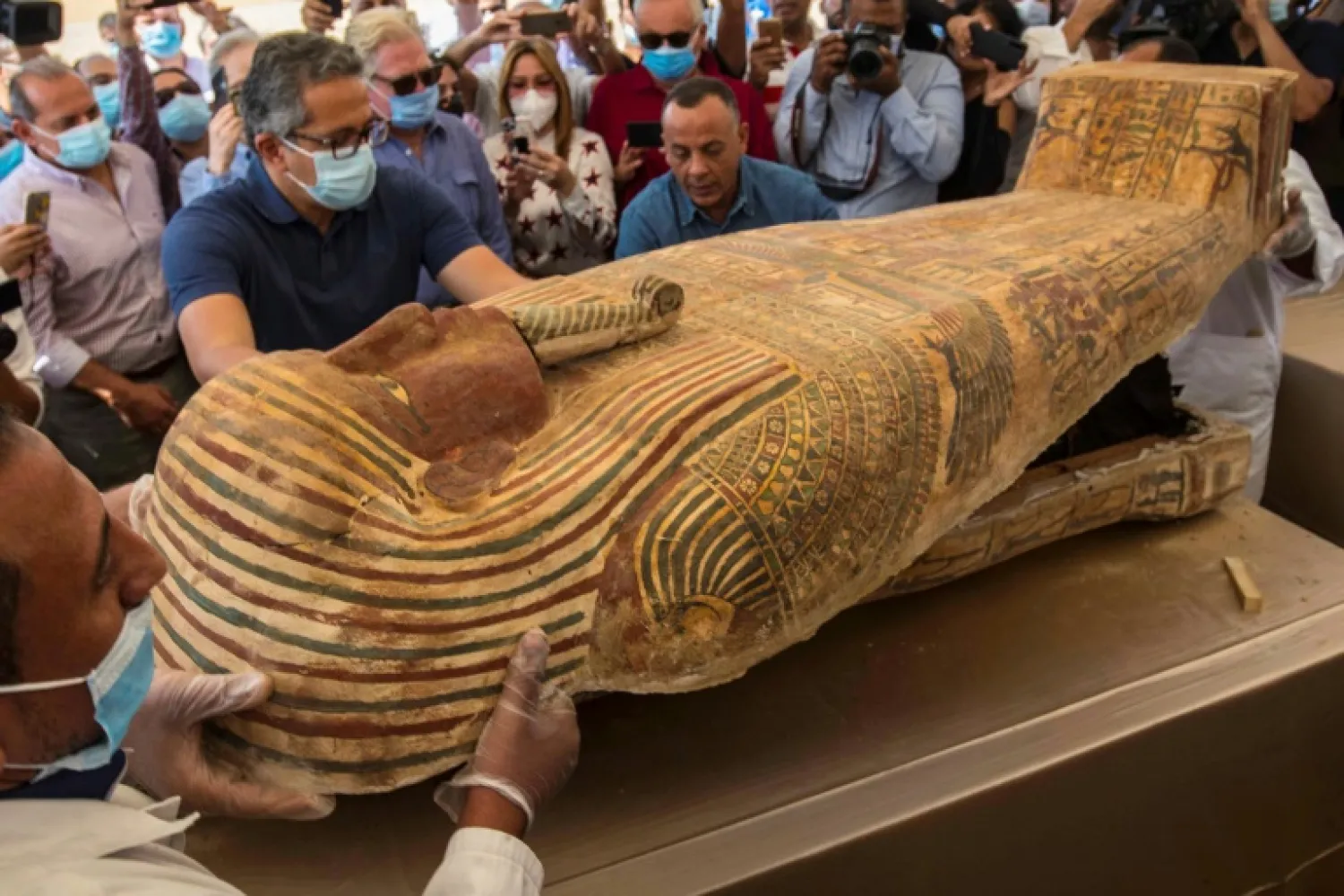

March of the Mummies: Egypt Readies for Pharaohs' Parade

Egypt continues to unearth ancient remains - - this photograph from October 2020 shows the opening of a sarcophagus excavated by the Egyptian archaeological mission at the Saqqara necropolis near Cairo - AFP
TT

March of the Mummies: Egypt Readies for Pharaohs' Parade

Egypt continues to unearth ancient remains - - this photograph from October 2020 shows the opening of a sarcophagus excavated by the Egyptian archaeological mission at the Saqqara necropolis near Cairo - AFP

The mummified remains of 22 ancient Egyptian kings and queens will be paraded through the streets of Cairo Saturday, in an eye-catching royal procession to a new resting place.

Dubbed the Pharaohs' Golden Parade, the 18 kings and four queens will travel in order, oldest first, each aboard a separate float decorated in Ancient Egyptian style.

They are being moved from a decades-long residency at the Egyptian Museum in central Cairo to be put on display at the National Museum of Egyptian Civilization, which first opened in 2017, in the south of the capital.

Upon arrival, they will occupy "slightly upgraded cases," said Salima Ikram, professor of Egyptology at the American University in Cairo.

"The temperature and humidity control will be even better than it was in the old museum," added Ikram, a mummification specialist.

Emblazoned with the name of their allocated sovereign, each of the gold-colored carriages will be fitted with shock absorbers for the 40-minute journey through Cairo, to ensure none of the precious cargos are accidentally disturbed by uneven surfaces.

Seqenenre Tao II, "the Brave", who reigned over southern Egypt some 1,600 years before Christ, will be on the first chariot, while Ramses IX, who reigned in the 12th century BC, will be at the rear.

Ramses II and Queen Hatshepsut, the most powerful female pharaoh, will also make the journey.

Beginning at 6.00 pm (1600 GMT) on Saturday, the procession will take place under the watchful eyes of hefty deployments of security forces.

The parade will be spurred on by music and performances from Egyptian artists, all broadcast live on state television.

Discovered near Luxor from 1881 onwards, most of the 22 mummies have lain since the early 1900s in the Egyptian Museum, on the capital's iconic Tahrir Square.

From the 1950s, they were put on display in a small room, one next to the other, unaccompanied by explanatory blurbs.

Ahead of their departure onto Cairo's streets, the mummies will be placed in special containers filled with nitrogen, under conditions similar to their regular exhibition boxes.

In their new home, they will be showcased individually, each next to a sarcophagus -- and in some cases, a statue -- in an environment redolent of underground royal tombs.

Exhibits will be signposted by a brief biography and, in some cases, copies of computerized tomography (CT) scans.

"The mummies will be shown for the first time in a beautiful way, for education, not for a thrill," another Egyptologist, Zahi Hawass, told AFP.

The 22 mummies will be on display to the general public at the National Museum of Egyptian Civilization for 15 days after the parade.

The macabre appearance of the mummies has over the decades put off many visitors.

Among the most prominent was a fellow royal -- Princess Margaret, sister to British monarch Queen Elizabeth II.

"I will never forget when I took Margaret to the museum," said Hawass, a former antiquities minister.

"In the gallery was the mummy of Ramses II... (Princess Margaret) closed her eyes and ran away -- she couldn't stand" what she saw before her.

The National Museum of Egyptian Civilization was completed in 2010, and "I was planning to open this museum in 2012," Hawass said.

"But because of what happened in Egypt we could not," he added, referring to the country's 2011 popular revolution and subsequent turmoil.

In the coming months, the country is due to inaugurate another new facility, the Grand Egyptian Museum (GEM), near the Giza pyramids.

It will also house pharaonic collections, including the mummified remains of Tutankhamun.

Discovered in 1922, the tomb of the young ruler, who took the throne briefly in the 14th century BC, contained treasures including gold and ivory.

A so-called "curse of the pharaoh" emerged in the wake of Tutankhamun's unearthing in 1922-23.

A key funder of the British dig, Lord Carnarvon, died of blood poisoning months after the tomb was opened, while an early visitor died abruptly in 1923.



Spider-Like Scar Haunts Jupiter's Moon Europa

A dendritic “lab star” formed by liquid water flowing through Europa ice simulant at NASA JPL, modeling how features like Damhán Alla could form on Jupiter's icy moon, similar to how lake stars form on Earth. (Image credit: Prof. Lauren Mc Keown.)
TT

Spider-Like Scar Haunts Jupiter's Moon Europa

A dendritic “lab star” formed by liquid water flowing through Europa ice simulant at NASA JPL, modeling how features like Damhán Alla could form on Jupiter's icy moon, similar to how lake stars form on Earth. (Image credit: Prof. Lauren Mc Keown.)

Scientists have explored a strange, spider-like scar on Jupiter's icy moon Europa, suggesting the feature might have formed from briny water eruptions beneath the moon's ice.

NASA's Galileo spacecraft, whose mission ended in 2003, spotted the unique feature - officially named Damhán Alla, an Irish word meaning “spider” or “wall demon” - within Europa's Manannán crater.

The starburst-like pattern first appeared in images captured by the spacecraft in the late 1990s, but scientists are only now piecing together how it may have formed, according to a statement from Trinity College Dublin.

“The significance of our research is really exciting,” Lauren Mc Keown, lead author of a study published in The Planetary Science Journal.

“Surface features like these can tell us a lot about what's happening beneath the ice. If we see more of them with Europa Clipper, they could point to local brine pools below the surface.”

On Earth, lake stars emerge when snow falls on frozen lakes and holes form in the ice, allowing water to flow upwards and melt surrounding snow, carving radial, branching channels as it spreads.

Such patterns are common in nature, from lightning scars to tidal channels, illustrating the movement of fluids and energy through different surfaces.

The researchers suggest that Europa's version might form the same way - except the liquid in this case would be salty brine forced upward after an impact disrupted the ice shell.

“Lake stars are really beautiful, and they are pretty common on snow or slush-covered frozen lakes and ponds,” McKeown said in the statement. “It is wonderful to think that they may give us a glimpse into processes occurring on Europa and maybe even other icy ocean worlds in our solar system.”


‘Like Skiing’: First Urban Cable Car Unveiled Outside Paris

This photograph shows the first urban cable car "C1" in Ile-de-France region during its official launch, in between Creteil Pointe du Lac and Villeneuve-Saint-Georges, on the outskirts of Paris on December 13, 2025. (AFP)
TT

‘Like Skiing’: First Urban Cable Car Unveiled Outside Paris

This photograph shows the first urban cable car "C1" in Ile-de-France region during its official launch, in between Creteil Pointe du Lac and Villeneuve-Saint-Georges, on the outskirts of Paris on December 13, 2025. (AFP)

Gondolas floated above a cityscape in the southeastern suburbs of Paris on Saturday as officials unveiled the first urban cable car in the French capital's region.

Authorities inaugurated the C1 line in the suburb of Limeil-Brevannes in the presence of Valerie Pecresse, the head of the Ile-de-France region, and the mayors of the towns served by the cable car.

The 4.5-kilometer route connects Creteil to Villeneuve-Saint-Georges and passes through Limeil-Brevannes and Valenton.

Historically used to cross rugged mountain terrain, such systems are increasingly being used to link up isolated neighborhoods.

"It's like skiing!" joked Ibrahim Bamba, a 20-year-old student who lives in Limeil-Brevannes which is not served by the Paris metro or any rail network.

"It's the Alps on the Marne!" said Pecresse, referring to the department of Val-de-Marne located in the Grand Paris metropolis.

The cable car will carry some 11,000 passengers per day in its 105 gondolas, each able to accommodate ten passengers.

The total journey will take 18 minutes, including stops along the way, compared to around 40 minutes by bus or car, connecting the isolated neighborhoods to the Paris metro line 8. A ride requires a bus ticket or travel pass used for the Paris metro.

"This is a great step forward in terms of transportation. The roads are often congested in the morning," said Salimatou Bah, 52, who has lived in Limeil-Brevannes for thirteen years.

"We wondered if people would be hesitant, but I think it just takes a little time to adapt."

- 'Urban divides' -

Pecresse said the project was the result of "a 10-year obstacle course."

"We had to find the funding, convince local residents," she said. "For the inhabitants of Val-de-Marne, it's a sign of consideration."

The 138-million-euro project was cheaper to build than a subway, officials said.

"An underground metro would never have seen the light of day because the budget of more than billion euros could never have been financed," said Gregoire de Lasteyrie, vice-president of the Ile-de-France regional council in charge of transport.

Each cabin can accommodate ten seated passengers as well as wheelchairs, bicycles, and strollers. Inside, video surveillance and emergency call buttons have been installed to ensure passenger safety in addition to staff at each station.

The cable car is a response to "urban divides" in neighborhoods that were "lacking in terms of public transport," said Metin Yavuz, mayor of Valenton, a town of 16,000 inhabitants.

It is France's seventh urban cable car, with aerial tramways already operating in cities including Brest, Saint-Denis de La Reunion and Toulouse.

France's first urban cable car was built in Grenoble, nestled at the foot of the Alps, in 1934. The iconic "bubbles" have become one of the symbols of the southeastern city.

Cable cars are considered one of the safest means of transport in the world.

In France, the last fatal accident occurred in 1999 in the Hautes-Alpes, when 20 people lost their lives.


Before Megalodon, Researchers Say a Monstrous Shark Ruled Ancient Australian Seas

 A illustration made in Sept. 3, 2025, of a gigantic 8 meter (26 foot) long mega-predatory lamniform shark swimming beside a long-necked plesiosaur in the seas off Australia 115 million years ago. (Pollyanna von Knorring/Swedish Museum of Natural History via AP)
A illustration made in Sept. 3, 2025, of a gigantic 8 meter (26 foot) long mega-predatory lamniform shark swimming beside a long-necked plesiosaur in the seas off Australia 115 million years ago. (Pollyanna von Knorring/Swedish Museum of Natural History via AP)
TT

Before Megalodon, Researchers Say a Monstrous Shark Ruled Ancient Australian Seas

 A illustration made in Sept. 3, 2025, of a gigantic 8 meter (26 foot) long mega-predatory lamniform shark swimming beside a long-necked plesiosaur in the seas off Australia 115 million years ago. (Pollyanna von Knorring/Swedish Museum of Natural History via AP)
A illustration made in Sept. 3, 2025, of a gigantic 8 meter (26 foot) long mega-predatory lamniform shark swimming beside a long-necked plesiosaur in the seas off Australia 115 million years ago. (Pollyanna von Knorring/Swedish Museum of Natural History via AP)

In the age of dinosaurs — before whales, great whites or the bus-sized megalodon — a monstrous shark prowled the waters off what's now northern Australia, among the sea monsters of the Cretaceous period.

Researchers studying huge vertebrae discovered on a beach near the city of Darwin say the creature is now the earliest known mega-predator of the modern shark lineage, living 15 million years earlier than enormous sharks found before.

And it was huge. The ancestor of today’s 6-meter (20-foot) great white shark was thought to be about 8 meters (26 feet) long, the authors of a paper published in the journal Communications Biology said.

“Cardabiodontids were ancient, mega-predatory sharks that are very, very common from the later part of the Cretaceous, after 100 million years ago,” said Benjamin Kear, the senior curator in paleobiology at the Swedish Museum of Natural History and one of the study’s authors. “But this has pushed the time envelope back of when we’re going to find absolutely enormous cardabiodontids.”

Sharks have a 400-million-year history but lamniforms, the ancestors of today’s great white sharks, appear in the fossil record from 135 million years ago. At that time they were small — probably only a meter in length — which made the discovery that lamniforms had already become gigantic by 115 million years ago an unexpected one for researchers.

The vertebrae were found on coastline near Darwin in Australia’s far north, once mud from the floor of an ancient ocean that stretched from Gondwana — now Australia — to Laurasia, which is now Europe. It’s a region rich in fossil evidence of prehistoric marine life, with long-necked plesiosaurs and ichthyosaurs among the creatures discovered so far.

The five vertebrae that launched the quest to estimate the size of their mega-shark owners were not a recent discovery, but an older one that had been somewhat overlooked, Kear said. Unearthed in the late 1980s and 1990s, the fossils measured 12 centimeters (4.7 inches) across and had been stored in a museum for years.

When studying ancient sharks, vertebrae are prizes for paleontologists. Shark skeletons are made of cartilage, not bone, and their fossil record is mostly made up of teeth, which sharks shed throughout their lives.

“The importance of vertebrae is they give us hints about size,” Kear said. “If you’re trying to scale it from teeth, it’s difficult. Are the teeth big and the bodies small? Are they big teeth with big bodies?”

Scientists have used mathematical formulas to estimate the size of extinct sharks like megalodon, a massive predator that came later and may have reached 17 meters (56 feet) in length, Kear said. But the rarity of vertebrae mean questions of ancient shark size are difficult to answer, he added.

The international research team spent years testing different ways to estimate the size of the Darwin cardabiodontids, using fisheries data, CT scans and mathematical models, Kear said. Eventually, they arrived at a likely portrait of the predator’s size and shape.

“It would’ve looked for all the world like a modern, gigantic shark, because this is the beauty of it,” Kear said. “This is a body model that has worked for 115 million years, like an evolutionary success story.”

The study of the Darwin sharks suggested that modern sharks rose early in their adaptive evolution to the top of prehistoric food chains, the researchers said. Now, scientists could scour similar environments worldwide for others, Kear said.

“They must have been around before,” he said. “This thing had ancestors.”

Studying ancient ecosystems like this one could help researchers understand how today’s species might respond to environmental change, Kear added.

“This is where our modern world begins,” he said. “By looking at what happened during past shifts in climate and biodiversity, we can get a better sense of what might come next.”