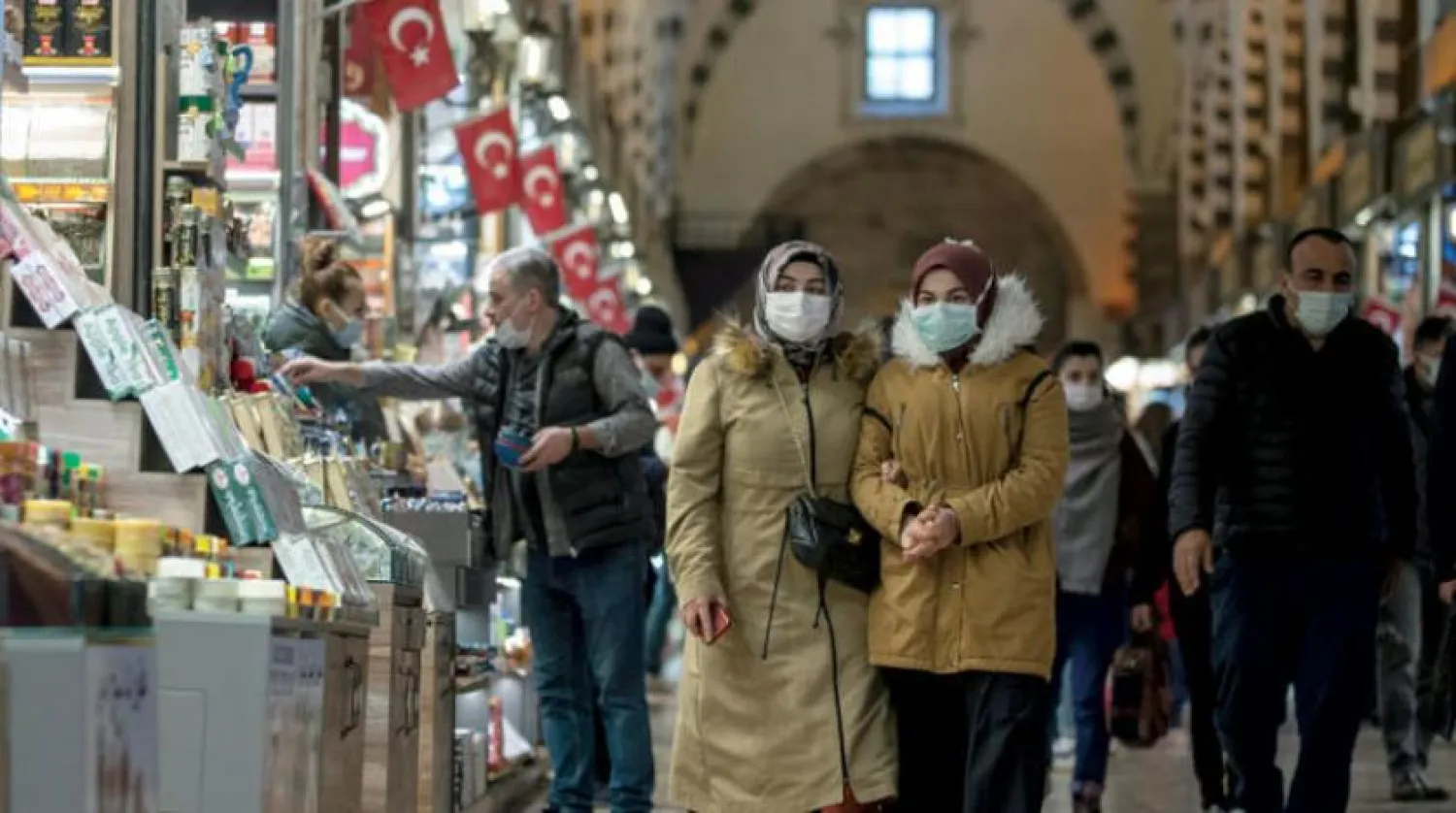
Egypt Tests Ankara over Security Issues

Shoppers at the Egyptian Bazaar in Istanbul (EPA)
TT

Egypt Tests Ankara over Security Issues

Shoppers at the Egyptian Bazaar in Istanbul (EPA)

Turkish Foreign Minister Mevlut Cavusoglu and his Egyptian counterpart Sameh Shoukry exchanged a phone call, in yet another sign of rapprochement between the two countries.

Earlier, Egyptian Prime Minister Mostafa Madbouly thanked President Recep Tayyip Erdogan for Turkey's efforts during its presidency of the Developing 8 Countries (D8).

An Egyptian informed source said the last two developments are part of a slow response to the process.

Cairo did not comment on the “Turkish signals” for reaching an understanding or holding meetings, which began last September, however, Shoukry said last month that his country wants "actions, not words" to restore full ties with Ankara.

The Egyptian source told Asharq Al-Awsat that his country wants to start discussing security and not political issues with Turkey.

The source stated that Egypt has set two conditions to enhance ties with Ankara.

First, Turkey must ban Muslim Brotherhood-affiliated channels from airing criticisms against Cairo or change their rhetoric, and negotiations must cover security issues first, a matter that requires political will.

Political Science professor at Cairo University Tarek Fahmy believes there is a complete set of measures that Turkey must fulfill before considering rapprochement, including the East Mediterranean Gas Forum, and the agreement on demarcation of maritime borders between Cyprus, Greece, and Libya, which is not recognized by Cairo.

Fahmy believes that the new approach between Cairo and Ankara must be based on parity and transparency with calculated caution between the two parties.

It is difficult to limit negotiations to the issue of the Muslim Brotherhood because it is not as important as the rest of the matters, which both Cairo and Ankara realize, according to the professor.

Fahmy estimates that Egypt has not shut the door completely on the negotiations, and it is trying to maintain a tactical and strategic approach, as Cairo believes Turkey is an important country and must deal with it, but with established foundations.

Researcher at al-Ahram Center for Strategic Studies Karam Saeed asserted that there won’t be any rapprochement between Cairo and Ankara in the EastMed region before Egypt consults with its allies such as Greece and Cyprus.

Saeed believes both countries have a common desire for reaching an understanding, and if it is not possible to normalize relations now, they will seek calm.


Iraq Seeks Exemption from US Ban on Iran Airlines

People walk near a giant billboard depicting portrayals of Iran's slain supreme leader Ali Khamenei through various periods in his life, in Baghdad's central Tahrir Square on September 22, 2026. (Photo by AHMAD AL-RUBAYE / AFP)
TT

Iraq Seeks Exemption from US Ban on Iran Airlines

People walk near a giant billboard depicting portrayals of Iran's slain supreme leader Ali Khamenei through various periods in his life, in Baghdad's central Tahrir Square on September 22, 2026. (Photo by AHMAD AL-RUBAYE / AFP)

The Iraqi government said Saturday it was holding talks with the United States to secure exemptions from sanctions on Iranian airlines, which has disrupted travel for patients, students and pilgrims.

All Iraqi airports enforced the ban this week, resulting in major disruption at the airport of the holy city of Najaf, the main destination for Iranian flights to Iraq.

"The Iraqi government is holding direct talks with the American side to exempt certain Iraqi airports from these measures," the prime minister's media office said.

An exemption would allow flights to resume "for humanitarian reasons, including medical treatment, education, religious visits, and for the interest of civilians," it added.

Iranian airlines mainly carry Iraqi Shiite pilgrims to Iran's holy cities or Iranians visiting sacred sites in Iraq. The flights also serve Iraqi students studying in Iran and patients seeking medical treatment there.

Iraq has joined several countries in enforcing the US ban, after Treasury Secretary Scott Bessent said Iranian airlines would be "shut down" on Wednesday.


Golan Spat Exposes One Reason Israel-Syria Talks Stalled

A lake near the Druze village of Majdal Shams in the Israeli-occupied Golan Heights, with Mount Hermon in the background (AFP)
TT

Golan Spat Exposes One Reason Israel-Syria Talks Stalled

A lake near the Druze village of Majdal Shams in the Israeli-occupied Golan Heights, with Mount Hermon in the background (AFP)

The exchange over the Golan Heights between Israeli Prime Minister Benjamin Netanyahu and Syrian President Ahmed al-Sharaa at the UN General Assembly exposed part of what has stalled talks between Israel and Syria.

The negotiations began two years ago but stopped after an Israeli attack on Abu al-Duhur airport in Idlib province a few weeks ago.

To Netanyahu’s critics, his hard-line stance at the United Nations revealed how wary Israel’s current leadership is of peace with Damascus.

Al-Sharaa told the General Assembly in New York that Syria wants peace, but at a price: the return of the Golan Heights, which Israel has occupied since 1967.

Knowing Israel is not ready to pay that price today, he pressed instead for security agreements that would pull Israeli forces out of areas they occupied after Bashar al-Assad’s fall in December 2024 and restore the framework of the 1974 disengagement agreement.

Israel knows Syria’s position from the talks held so far. Al-Sharaa’s government has signaled its willingness to keep negotiating, rebuild trust and eventually reach a full peace agreement, with embassies, good-neighborly relations, trade and cooperation across various fields, according to accounts circulating in Tel Aviv.

Israel’s leadership, unwilling to pay a price for peace, responded sharply. Defense Minister Israel Katz said that the Golan under Israeli sovereignty is an inseparable part of the State of Israel forever.”

Israel, he added, will not withdraw from Mount Hermon or the security zone. He also warned: “Any territory we take this time will remain ours forever, in accordance with the laws of war.”

Netanyahu followed from the UN podium with what appeared to be a history lesson for al-Sharaa, according to his own reading of that history.

“Mr. al-Sharaa, you should know the Jews have been on the Golan Heights since the days of Moses,” he said. “You can read it in the Bible.”

But the region’s history does not establish the claim Netanyahu sought to make. His remarks gave a religious and historical cast to Katz’s statements about occupation. Archaeological sites show that people inhabited the Golan long before the time of Moses and the Israelites.

Evidence of settlement dates to the Copper and Bronze Ages, alongside stone structures, burial sites and other remains left by communities that lived there thousands of years ago.

Critics of Netanyahu’s account say that even if Jews lived in the Golan, they did not live there alone; others may have outnumbered them.

Those critics also accuse Israeli governments of hiding a central fact about the Golan’s occupation: Israel displaced as much as 90% of the Syrian plateau’s population in 1967.

They say 140,000 people lived there at the time, compared with just 8,000 today. Israel still prevents disclosure of the reasons for their displacement, while people from the Golan recount crimes and massacres that drove them out, the critics say.

Under Assad, the Syrian government agreed to lease the Golan to Israel for 15 years, with an option to extend the lease.

Netanyahu now rejects even proposals he once accepted. He wants to use what he sees as a new balance of power and what Katz calls the laws governing the outcome of war. Yet al-Sharaa’s Syria did not start a war with Israel.

The Israeli military, instead, took advantage of Assad’s fall to launch thousands of strikes on Syria, destroy 85% of the Syrian military’s defensive capabilities and occupy new areas in the south.

Israelis confirm al-Sharaa’s assertion that the two sides had agreed on 90% of the issues in a proposed security arrangement.

They explain Israel’s retreat from the talks by claiming that Syria is becoming a sphere of Turkish influence and that Syrian territory could be used to attack Israeli settlements in the Golan, as Hamas attacked communities around Gaza on Oct. 7, 2023.

Syrians offered far-reaching security guarantees in the negotiations: demilitarization in southern Syria and a secure trade corridor that would allow Druze communities in Israel and the Golan to send aid to Sweida province.

They also agreed to joint security coordination under US supervision, including intelligence sharing and Jordanian participation in monitoring the entire border area.

Israel wanted more: to keep Mount Hermon’s peaks and parts of a security belt, and to retain the freedom to enter Syria in pursuit of armed cells.

The prevailing sense is that Israel has little interest in successful talks and entered them only because US President Donald Trump wanted it to. Trump alone is seen as stopping Netanyahu from using the situation in Syria to launch further military attacks.

The US president appears to be waiting for the Israeli election results before deciding where he stands on the government’s policies.

Trump issued a presidential proclamation in March 2019 recognizing Israeli sovereignty over the Golan Heights.

UN resolutions, however, affirm that the Golan is occupied territory and reject Israel’s declaration that it has imposed its laws and administration on the Syrian plateau.


Palestinian Election Nominations Open, Unsettling Gaza Factions

A Palestinian woman waves a Fatah flag at the movement’s eighth conference at Al-Azhar University in Gaza City on May 14, 2026 (Reuters)
TT

Palestinian Election Nominations Open, Unsettling Gaza Factions

A Palestinian woman waves a Fatah flag at the movement’s eighth conference at Al-Azhar University in Gaza City on May 14, 2026 (Reuters)

Palestinian factions face difficult choices over how to take part in legislative elections set for November 28, the first in 20 years.

A Hamas delegation has held a series of meetings in recent days with leaders of other factions in Cairo.

The group said the talks were part of continuing political consultations on developments affecting the Palestinian cause, including the elections, efforts to end the political split and plans to rebuild and reactivate the Palestine Liberation Organization on democratic, inclusive and national foundations.

A Hamas source and a source from another faction involved in the meetings told Asharq Al-Awsat that they had again discussed the possibility of running on a single national list led by technocrats and academics acceptable internationally, with the aim of representing the broadest possible coalition.

Another factional source said the Hamas delegation had offered nothing new on which to build.

Sources said the Fatah Democratic Reform Current, led by Mohammed Dahlan, had put a proposal concerning the national list to Hamas at a bilateral meeting and was awaiting a response. None disclosed its details, citing the sensitivity surrounding the elections.

Hamas also hopes the elections will be postponed, despite publicly insisting they should take place on schedule. At the same time, it continues to seek the broadest possible national list to compete with Fatah.

The uncertainty is adding to confusion among the factions, which will have 12 days from Saturday to settle their plans.

Islamic Jihad has decided to support such a list without fielding candidates of its own. But the Palestinian left, particularly the Popular Front and the Democratic Front, remains undecided about joining Hamas and other factions on a common list.

Both fronts have called for the elections to be postponed while the factions seek common ground to end the split and rebuild the PLO, a position supported by some other factions.

The Democratic Front has sought to form a list of leftist parties that would include the Popular Front, keeping a broad national list with Hamas as its last option. A Democratic Front source told Asharq Al-Awsat that, as the opening of nominations approaches, it may ultimately decide to join the wider national list.

Fatah insists the elections should go ahead. Palestinian President Mahmoud Abbas reaffirmed that position in his address to the United Nations General Assembly, saying the vote was part of a process to renew the institutions of the Palestinian National Council before holding a presidential election.

He said it formed part of a comprehensive national reform program for the Palestinian Authority that would strengthen governance, transparency and accountability.

The stance has left several factions still weighing how to participate. The Popular Front had been awaiting a positive response from Fatah to its call to postpone the elections and begin national steps, including a broad meeting to discuss the Palestinian situation.

Fatah has given neither a positive nor a negative response, leaving the Popular Front undecided. The front considers the timing unsuitable for any election.

Fatah appears to see an opportunity to win as many votes as possible while Hamas’s popularity has declined following the war in Gaza and the destruction it has caused there. But internal disagreements also pose challenges for Fatah, amid calls within the movement to hold all elections, including the presidential vote, at once.

The Palestinian Central Elections Commission said it would begin accepting candidate-list applications for the 2026 legislative elections at 8 a.m. on Saturday at its headquarters in Al-Bireh and its regional office in Deir al-Balah in the Gaza Strip.

Nominations will remain open for 12 days, including public holidays, and close at 4 p.m. on Wednesday, October 7. Applications submitted outside that period will not be accepted.

Candidates for the Palestinian Legislative Council must run on lists under a full proportional representation system; individual candidacies are not permitted. A list’s coordinator and authorized representative must submit its application.

The commission urged prospective lists to complete their applications and supporting documents and check that they meet the legal requirements before filing.

Each list must have between 16 and 132 candidates. At least one woman must appear among its first three names, with at least one woman in every subsequent group of three. A list must also submit signatures from 3,000 eligible voters supporting its candidacy, its electoral program and its symbol or logo.

Other requirements include proof of a $20,000 bank payment, a sealed list of candidates in order, and an application and supporting documents for each candidate.

Candidates must be Palestinian, at least 23 years old on election day, permanent residents of the Palestinian territories and listed on the final voter register. They must also meet the remaining legal requirements.

The nomination period is the third stage of the electoral process, following voter registration and the publication and objections stage.

The commission said 2.97 million Palestinians were eligible to vote: 1.24 million in Gaza, 1.59 million in the West Bank and 140,000 Jerusalem ID holders in the city.

Its data showed that people who have not voted in a general election before make up a majority of eligible voters. It said 1.50 million voters are under 38, representing 53% of those eligible.

That age group is especially significant after nearly two decades without a legislative election.

Women account for 49.9% of eligible voters and men for 50.1%, the data showed.