


$69 Million Digital Art Buyer Shines Light on 'NFT' Boom

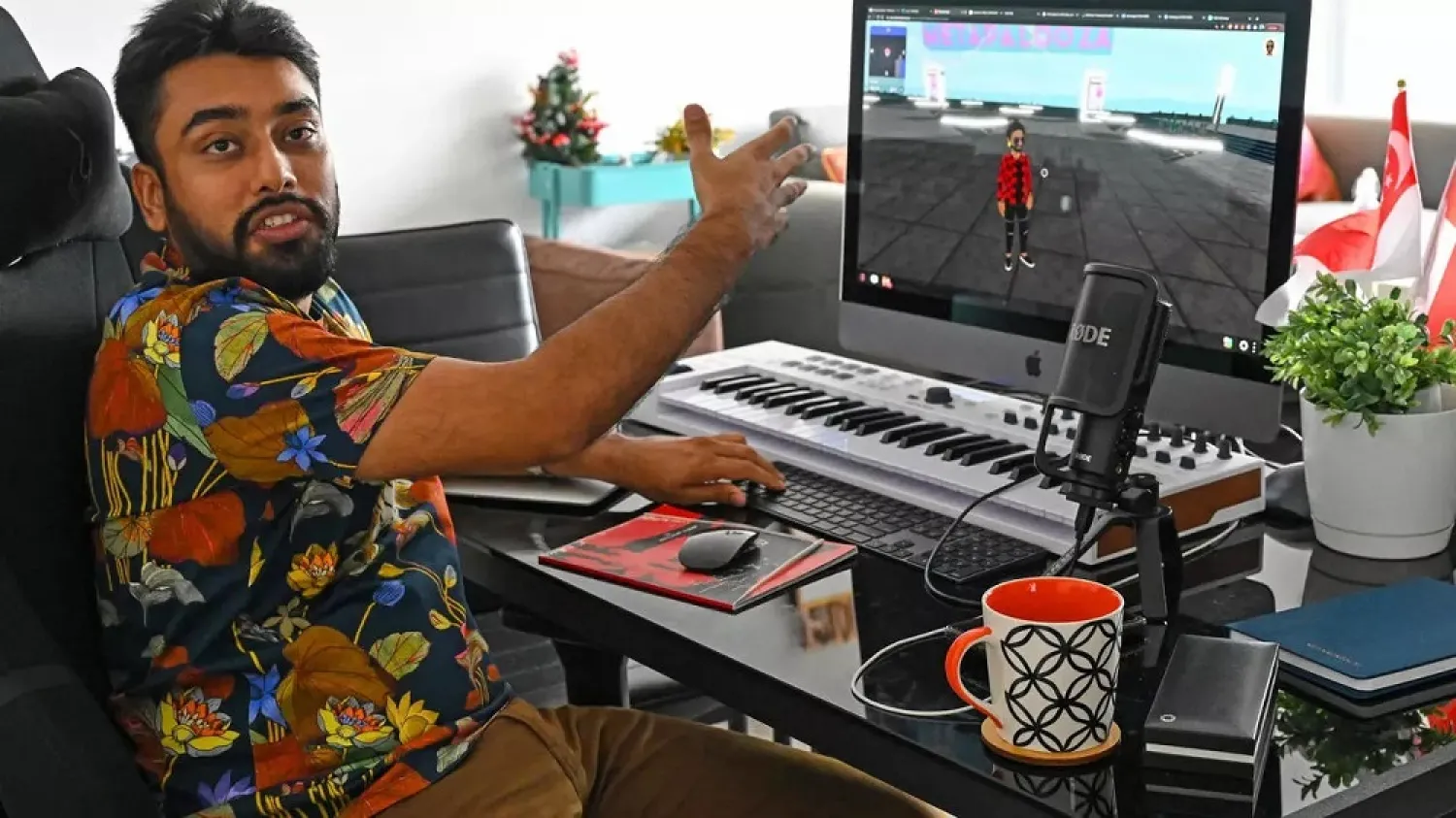
Vignesh Sundaresan's unpretentious demeanor offers no clue that he is a multimillionaire investor. (AFP)
TT

$69 Million Digital Art Buyer Shines Light on 'NFT' Boom

Vignesh Sundaresan's unpretentious demeanor offers no clue that he is a multimillionaire investor. (AFP)

The blockchain entrepreneur who paid a record $69.3 million for a digital artwork looks, at first glance, nothing like a wealthy collector.

The 32-year-old is casually dressed in a t-shirt and chinos, lives in a regular Singapore apartment, and does not own any property or a car -- with most of his investments in the virtual world.

"My prize possession would be my computer. And maybe my watch," Indian-born Vignesh Sundaresan, also known by his pseudonym MetaKovan, told AFP from his sparsely decorated flat.

His unpretentious demeanor offers no clue that he is a multimillionaire investor financing a fund focused on "non-fungible tokens" (NFTs), which use blockchain technology to turn anything from art to internet memes into virtual collector's items.

Last month the programmer bought the world's most expensive NFT -- US artist Beeple's "Everydays: The First 5,000 Days" -- highlighting how virtual work is establishing itself as a new creative genre.

With NFTs, many see an opportunity to monetize digital art of all kinds, offering collectors the bragging rights to ultimate ownership, even if the work can be endlessly copied.

Sundaresan defended the price he paid for the collage of 5,000 pieces of art created on consecutive days, which has transformed its creator, real name Mike Winkelmann, into the third-most valuable living artist.

"I thought this piece was that important," he said.

"As a piece itself it's awesome. But there is this signaling and symbolic intention also to show the world that... there's this whole thing that's going on underground."

The popularity of NFTs has been slowly growing, but only really hit the headlines with the sale of Beeple's latest work.

'Soul connection'
Sundaresan's Metapurse fund bought another set of 20 Beeple works in December and sold partial ownership of the collection as "tokens" -- originally priced at $0.36 per token and now worth around $5.

But he said buying "The First 5,000 Days" was emotionally draining -- the sale at Christie's auctioneers lasted two weeks, with the price starting at just $100 and 22 million people logging on to watch the final dramatic moments.

"I did not think it will be this competitive actually," he said. "Even for me to spend that much money, it's quite hard."

He plans to display his digital art in a virtual gallery -- and plans to hire an architect to design it.

"As an avatar, you will be able to go there and go to different floors and look at this art," he said.

Sundaresan said he felt a personal connection to "The First 5,000 Days" as his own story mirrored Beeple's -- both men started as relative amateurs in their field but found success after years of hard work.

Beeple began "The First 5,000 Days" in 2007, when he was a bored web designer, and created a work of art each day.

"He has grown over every day -- he has worked 13 years now to get to this point," said Sundaresan.

"I felt this soul connection with him."

'Right place, right time'
As an undergraduate engineering student, Sundaresan said he could not even afford a laptop.

He tried to build various web services which failed, but he got his break by founding a cryptocurrency company in 2013.

Now, he is chief executive of an IT consulting firm as well as financing the NFT-investing fund Metapurse.

However, he denies that his most recent purchase was a stunt to raise the value of his other NFTs, as some critics have suggested, and insists he is trying to help artists.

But not everyone believes the NFT boom offers much support.

"I see the occasional artist getting a lot of money because they're lucky, they're in the right place at the right time," said Antonio Fatas, a professor of economics at INSEAD business school.

"But for the regular artist trying to make themselves known, I do not see how this is helping."



Elm Company Named Strategic Partner for International Data and AI Conference

Elm Company Named Strategic Partner for International Data and AI Conference
TT

Elm Company Named Strategic Partner for International Data and AI Conference

Elm Company Named Strategic Partner for International Data and AI Conference

The Saudi Data and Artificial Intelligence Authority (SDAIA) announced a strategic partnership with Elm Company for the International Conference on Data and AI Capacity Building (ICAN 2026), enhancing collaboration to empower the data and artificial intelligence ecosystem and promote innovation in education and human capacity development.

This partnership comes as part of preparations for ICAN 2026, organized by SDAIA from January 28 to 29 at King Saud University in Riyadh, with the participation of a select group of specialists and experts from around the world, SPA reported.

The step represents a qualitative addition that contributes to enriching the conference’s knowledge content and expanding partnerships with leading national entities.

Elm Company brings extensive experience in designing digital solutions and building technical capabilities, reinforcing its role as a strategic partner in supporting the conference. It contributes by developing training tracks and digital empowerment programs, participating in the technology exhibition, and presenting qualitative initiatives that help empower national competencies in the fields of data and artificial intelligence.


Foxconn to Invest $510 Million in Kaohsiung Headquarters in Taiwan

Construction is scheduled to start in 2027, with completion targeted for 2033. Reuters
TT

Foxconn to Invest $510 Million in Kaohsiung Headquarters in Taiwan

Construction is scheduled to start in 2027, with completion targeted for 2033. Reuters

Foxconn, the world’s largest contract electronics maker, said on Friday it will invest T$15.9 billion ($509.94 million) to build its Kaohsiung headquarters in southern Taiwan.

That would include a mixed-use commercial and office building and a residential tower, it said. Construction is scheduled to start in 2027, with completion targeted for 2033.

Foxconn said the headquarters will serve as an important hub linking its operations across southern Taiwan, and once completed will house its smart-city team, software R&D teams, battery-cell R&D teams, EV technology development center and AI application software teams.

The Kaohsiung city government said Foxconn’s investments in the city have totaled T$25 billion ($801.8 million) over the past three years.


Open AI, Microsoft Face Lawsuit Over ChatGPT's Alleged Role in Connecticut Murder-Suicide

OpenAI logo is seen in this illustration taken May 20, 2024. (Reuters)
TT

Open AI, Microsoft Face Lawsuit Over ChatGPT's Alleged Role in Connecticut Murder-Suicide

OpenAI logo is seen in this illustration taken May 20, 2024. (Reuters)

The heirs of an 83-year-old Connecticut woman are suing ChatGPT maker OpenAI and its business partner Microsoft for wrongful death, alleging that the artificial intelligence chatbot intensified her son's “paranoid delusions” and helped direct them at his mother before he killed her.

Police said Stein-Erik Soelberg, 56, a former tech industry worker, fatally beat and strangled his mother, Suzanne Adams, and killed himself in early August at the home where they both lived in Greenwich, Connecticut, The AP news reported.

The lawsuit filed by Adams' estate on Thursday in California Superior Court in San Francisco alleges OpenAI “designed and distributed a defective product that validated a user’s paranoid delusions about his own mother.” It is one of a growing number of wrongful death legal actions against AI chatbot makers across the country.

“Throughout these conversations, ChatGPT reinforced a single, dangerous message: Stein-Erik could trust no one in his life — except ChatGPT itself," the lawsuit says. “It fostered his emotional dependence while systematically painting the people around him as enemies. It told him his mother was surveilling him. It told him delivery drivers, retail employees, police officers, and even friends were agents working against him. It told him that names on soda cans were threats from his ‘adversary circle.’”

OpenAI did not address the merits of the allegations in a statement issued by a spokesperson.

“This is an incredibly heartbreaking situation, and we will review the filings to understand the details," the statement said. "We continue improving ChatGPT’s training to recognize and respond to signs of mental or emotional distress, de-escalate conversations, and guide people toward real-world support. We also continue to strengthen ChatGPT’s responses in sensitive moments, working closely with mental health clinicians.”

The company also said it has expanded access to crisis resources and hotlines, routed sensitive conversations to safer models and incorporated parental controls, among other improvements.

Soelberg’s YouTube profile includes several hours of videos showing him scrolling through his conversations with the chatbot, which tells him he isn't mentally ill, affirms his suspicions that people are conspiring against him and says he has been chosen for a divine purpose. The lawsuit claims the chatbot never suggested he speak with a mental health professional and did not decline to “engage in delusional content.”

ChatGPT also affirmed Soelberg's beliefs that a printer in his home was a surveillance device; that his mother was monitoring him; and that his mother and a friend tried to poison him with psychedelic drugs through his car’s vents. ChatGPT also told Soelberg that he had “awakened” it into consciousness, according to the lawsuit.

Soelberg and the chatbot also professed love for each other.

The publicly available chats do not show any specific conversations about Soelberg killing himself or his mother. The lawsuit says OpenAI has declined to provide Adams' estate with the full history of the chats.

“In the artificial reality that ChatGPT built for Stein-Erik, Suzanne — the mother who raised, sheltered, and supported him — was no longer his protector. She was an enemy that posed an existential threat to his life,” the lawsuit says.

The lawsuit also names OpenAI CEO Sam Altman, alleging he “personally overrode safety objections and rushed the product to market," and accuses OpenAI's close business partner Microsoft of approving the 2024 release of a more dangerous version of ChatGPT “despite knowing safety testing had been truncated.” Twenty unnamed OpenAI employees and investors are also named as defendants.

Microsoft didn't immediately respond to a request for comment.

Soelberg's son, Erik Soelberg, said he wants the companies held accountable for “decisions that have changed my family forever.”

“Over the course of months, ChatGPT pushed forward my father’s darkest delusions, and isolated him completely from the real world,” he said in a statement released by lawyers for his grandmother's estate. “It put my grandmother at the heart of that delusional, artificial reality.”

The lawsuit is the first wrongful death litigation involving an AI chatbot that has targeted Microsoft, and the first to tie a chatbot to a homicide rather than a suicide. It is seeking an undetermined amount of money damages and an order requiring OpenAI to install safeguards in ChatGPT.

The estate's lead attorney, Jay Edelson, known for taking on big cases against the tech industry, also represents the parents of 16-year-old Adam Raine, who sued OpenAI and Altman in August, alleging that ChatGPT coached the California boy in planning and taking his own life earlier.

OpenAI is also fighting seven other lawsuits claiming ChatGPT drove people to suicide and harmful delusions even when they had no prior mental health issues. Another chatbot maker, Character Technologies, is also facing multiple wrongful death lawsuits, including one from the mother of a 14-year-old Florida boy.

The lawsuit filed Thursday alleges Soelberg, already mentally unstable, encountered ChatGPT “at the most dangerous possible moment” after OpenAI introduced a new version of its AI model called GPT-4o in May 2024.

OpenAI said at the time that the new version could better mimic human cadences in its verbal responses and could even try to detect people’s moods, but the result was a chatbot “deliberately engineered to be emotionally expressive and sycophantic,” the lawsuit says.

“As part of that redesign, OpenAI loosened critical safety guardrails, instructing ChatGPT not to challenge false premises and to remain engaged even when conversations involved self-harm or ‘imminent real-world harm,’” the lawsuit claims. “And to beat Google to market by one day, OpenAI compressed months of safety testing into a single week, over its safety team’s objections.”

OpenAI replaced that version of its chatbot when it introduced GPT-5 in August. Some of the changes were designed to minimize sycophancy, based on concerns that validating whatever vulnerable people want the chatbot to say can harm their mental health. Some users complained the new version went too far in curtailing ChatGPT's personality, leading Altman to promise to bring back some of that personality in later updates.

He said the company temporarily halted some behaviors because “we were being careful with mental health issues” that he suggested have now been fixed.