Foreign Firms Vie to Rebuild Beirut Port

A view shows the grain silo that was damaged during Beirut port explosion, in Beirut, Lebanon February 4, 2021. REUTERS
TT

Foreign Firms Vie to Rebuild Beirut Port

A view shows the grain silo that was damaged during Beirut port explosion, in Beirut, Lebanon February 4, 2021. REUTERS

Eight months after a massive blast ripped through Beirut port and nearby districts of the Lebanese capital, a host of foreign companies with different national interests are competing to rebuild it.

"Everyone has their eyes on the port: The Russians, the Chinese, the Turks, the French and now the Germans," interim port director Bassem al-Kaissi said.

"But for the moment these are only declarations of intent,” AFP quoted him as saying.

The August 4 explosion of hundreds of tons of ill-stored fertilizers devastated the dockside and large swathes of the capital, killing more than 200 people.

A German delegation last Friday unveiled a spectacular $30-billion project to rebuild the port and adjacent areas, in the presence of their ambassador.

The ambitious plan, drawn up by companies including Hamburg Port Consulting, seeks to move the port east, and remodel the nearby area to include social housing, a "central park" and even beaches.
France has also been positioning itself to take on the port's reconstruction.

When French President Emmanuel Macron made a second visit to Beirut in September after the monster explosion, the Lebanese-born head of French shipping giant CMA-CGM, Rodolphe Saade, was in his delegation.

During the trip, his company presented Lebanon with a three-phase project to rebuild, expand and modernize the seaside location to become a "smart port", its regional director Joe Dakkak told AFP.

The first two phases would cost between $400 million to $600 million and the firm would fund half, while around 50 companies and international organizations had also shown interest in participating, he said.

CMA-CGM has already obtained a concession to run the container terminal in Lebanon's second city Tripoli until 2041, and hopes to soon win a bid for container operations in Beirut.

Beyond the commercial interests, political analyst Imad Salamey says geopolitical influence is also at play.

The appeal includes ongoing "offshore gas exploration in the Mediterranean", "Russian expansionism" in the region, and "future economic collaboration between Israel and Arab countries" in the wake of several normalization accords, he said.

In 2018, Lebanon signed its first contract for offshore oil and gas drilling in two blocks with a consortium comprising French, Italian and Russian energy giants, Total, ENI and Novatek, respectively.

And further north, Damascus ally Russia has started drilling off the coast of war-torn Syria, Salamey said.

The port is likely small fry for China, Salamey said.

But it could attract the Chinese "to strengthen their alliance with the Iranians", who hold sway in Syria and Lebanon, where it sponsors Hezbollah.

The former US envoy for Near Eastern affairs, David Schenker, has warned against China winning the bid.

"Beijing's aversion to transparency and its ambivalence toward Hezbollah would make a Chinese role in reconstruction a worst-case outcome," he wrote.

He said Washington should work closely with whichever country wins the port bid to ensure the project is "bound to the principle of reform".

The international community is insisting on sweeping reforms, including at the port, before pumping in foreign aid to rescue the country from its worst economic crisis in decades.

But for eight months, deeply divided politicians have failed to agree on a new cabinet to launch them.

Despite this, Kaissi said port authorities were working on an action plan to reconstruct and revamp the facility, to be submitted to any new government.

There is an obstacle to the German proposal.

Lebanese activists fear its plan for a park and beaches could spell a repeat of the Beirut center’s post-war transformation.

The neighborhood was once a historic and vibrant commercial center where people of all social and religious backgrounds mixed.

But Lebanese company Solidere privatized downtown Beirut, converting it into grandiose real estate unaffordable to the average Lebanese.

"We will not accept a new Solidere with a foreign touch," civil society group Nahnoo has said.

Economist Jad Chaaban said that any project as huge as the port would require "national consultation".

"Foreign companies alone should not decide. Neither should the Lebanese state."


Israel's Netanyahu Says No Reconstruction of Gaza before Demilitarization

Israel’s Prime Minister Benjamin Netanyahu - File Photo/AFP
TT

Israel's Netanyahu Says No Reconstruction of Gaza before Demilitarization

Israel’s Prime Minister Benjamin Netanyahu - File Photo/AFP

Israeli Prime Minister Benjamin Netanyahu said on Thursday there would be no reconstruction of war-shattered Gaza before the disarmament of Hamas, as the "Board of Peace" convened for its inaugural meeting in Washington.

Around two dozen world leaders and senior officials met for the first meeting of the board, which was set up after the United States, Qatar and Egypt negotiated a ceasefire in October to halt two years of war in the Gaza Strip.

"We agreed with our ally the US there will be no reconstruction of Gaza before the demilitarization of Gaza," Netanyahu said during a televised speech at a military ceremony on Thursday, AFP reported.

The meeting in Washington will also look at how to launch the International Stabilization Force (ISF) that will ensure security in Gaza.

One of the most sensitive issues before the board is the future of the Islamist movement Hamas, which fought the war with Israel and still exerts influence in the territory.

Disarmament of the group is a central Israeli demand and a key point in negotiations over the ceasefire's next stage.

US officials including Steve Witkoff, Trump's friend and roving negotiator, have insisted that solid progress is being made and that Hamas is feeling pressure to give up weapons.

Israel has suggested sweeping restrictions including seizing small personal rifles from Hamas.

It remains unclear whether, or how, the Palestinian technocratic committee formed to handle day-to-day governance of Gaza will address the issue of demilitarization.

The 15-member National Committee for the Administration of Gaza (NCAG) will operate under the supervision of the "Board of Peace", and its head, Ali Shaath, is attending the meeting in Washington on Thursday.


Trump Tells First Meeting of Board of Peace that $7 billion Raised for Gaza

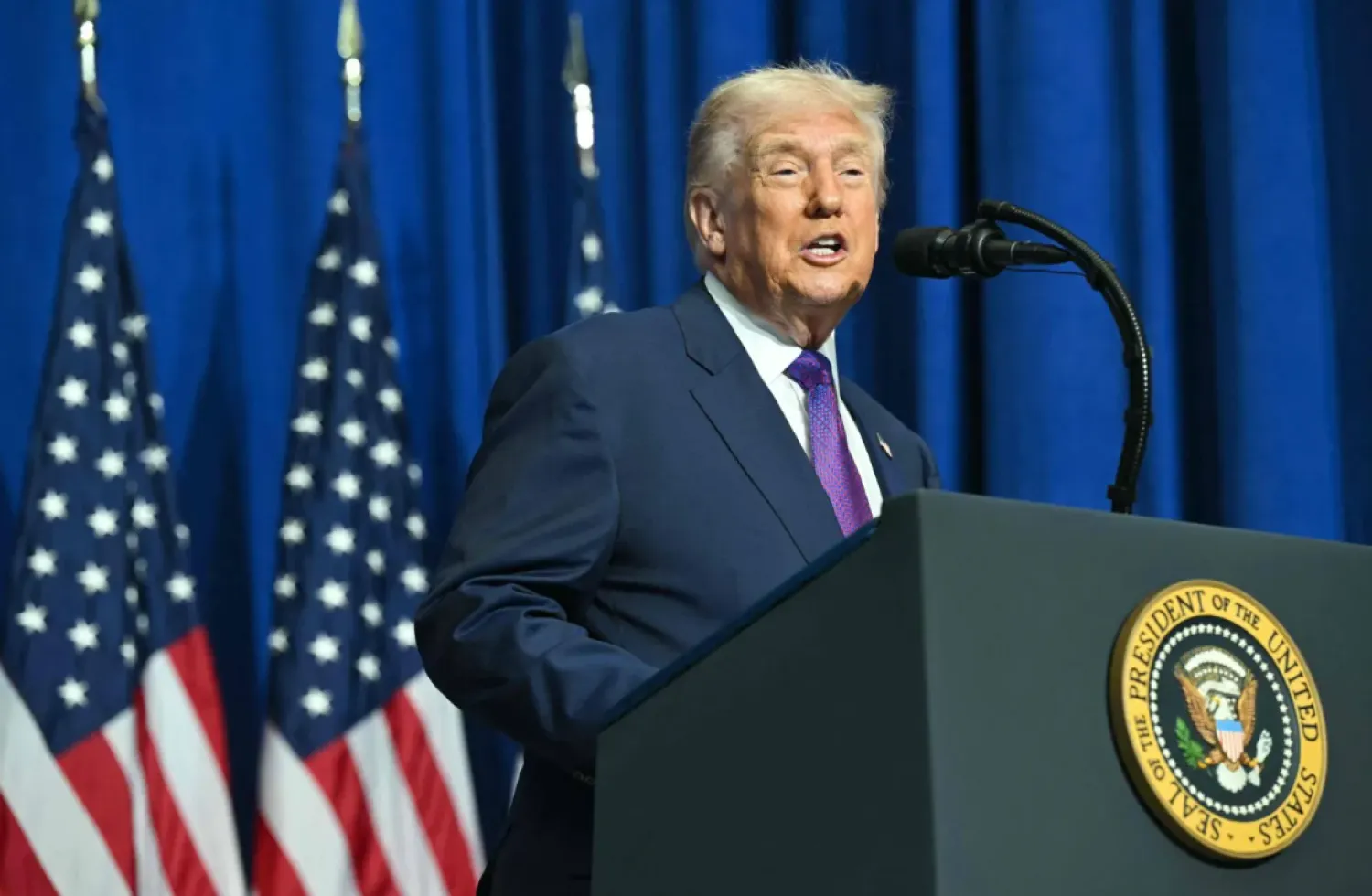
US President Donald Trump speaking in Washington - AFP
TT

Trump Tells First Meeting of Board of Peace that $7 billion Raised for Gaza

US President Donald Trump speaking in Washington - AFP

US President Donald Trump told the first meeting of his Board of Peace on Thursday that $7 billion has been contributed to a Gaza reconstruction fund that aims to rebuild the enclave once Hamas disarms, an objective that is far from becoming a reality.

The disarmament of Hamas militants and accompanying withdrawal of Israeli troops, the size of the reconstruction fund and the flow of humanitarian aid to the war-battered populace of Gaza are among the major questions likely to test the effectiveness of the board in the weeks and months ahead.

In a flurry of announcements at the end of a long, winding speech, Trump said the United States will make a contribution of $10 billion to the Board of Peace. He said contributing nations had raised $7 billion as an initial down payment for Gaza reconstruction.

Trump first proposed the board last September when he announced his plan to end Israel's war in Gaza. He later made clear the board's remit would be expanded beyond Gaza to tackle other conflicts worldwide.

Trump also said FIFA will raise $75 million for soccer-related projects in Gaza and that the United Nations will chip in $2 billion for humanitarian assistance.

TRUMP SAYS ANY IRAN DEAL MUST BE MEANINGFUL, PROSPECTS SHOULD BE CLEAR IN 10 DAYS

The Board of Peace includes Israel but not Palestinian representatives and Trump's suggestion that the Board could eventually address challenges beyond Gaza has stirred anxiety that it could undermine the UN's role as the main platform for global diplomacy and conflict resolution.

"We're going to strengthen the United Nations," Trump said, trying to assuage his critics. "It's really very important."

The meeting came as Trump threatens war against Iran and has embarked on a massive military buildup in the region in case Tehran refuses to give up its nuclear program.

Trump said he should know in 10 days whether a deal is possible. "We have to have a meaningful deal," he said.

The event had the feel of a Trump campaign rally, with music blaring from his eclectic playlist from Elvis Presley to the Beach Boys. Red Trump hats were given to participants.

Senior US officials said Trump will also announce that several nations are planning to send thousands of troops to participate in an International Stabilization Force that will help keep the peace in Gaza when it eventually deploys.

Hamas, fearful of Israeli reprisals, has been reluctant to hand over weaponry as part of Trump's 20-point Gaza plan that brought about a fragile ceasefire last October in the two-year Gaza war.

Trump said he hoped use of force to disarm Hamas would not be necessary. He said Hamas had promised to disarm and it "looks like they're going to be doing that, but we'll have to find out."


Few People Left at Syria Camp that Held ISIS Families, Former Director Says

Children, part of a group of detainees, look through a fence at al-Hol camp after the Syrian government took control of it following the withdrawal of Syrian Democratic Forces (SDF), in Hasaka, Syria, January 21, 2026. REUTERS/Khalil Ashawi
TT

Few People Left at Syria Camp that Held ISIS Families, Former Director Says

Children, part of a group of detainees, look through a fence at al-Hol camp after the Syrian government took control of it following the withdrawal of Syrian Democratic Forces (SDF), in Hasaka, Syria, January 21, 2026. REUTERS/Khalil Ashawi

Fewer than 1,000 families remain at a camp where relatives of suspected ISIS militants had been held in Syria's northeast, the camp's former director said on Wednesday, with thousands having fled last month as government forces seized control of the area from Kurdish-led fighters.

Al-Hol, near the Iraqi border, was one of the main detention camps for relatives of suspected ISIS militants who were detained during the US-backed campaign against the terrorist group in Syria.

Control of the camp changed hands last month when government forces under President Ahmed al-Sharaa seized swathes of the northeast from the Kurdish-led Syrian Democratic Forces, including several jails holding ISIS militants. The US military said last week it had completed a mission to transfer 5,700 adult male ISIS detainees to Iraq.

Jihan Hanna, the former director who still coordinates with international agencies and the Syrian government, told Reuters the remaining families were Syrian nationals and were being transferred to a camp in Aleppo. Most of the camp’s foreign nationals had fled, she said.

The Syrian government did not immediately respond to requests for comment.

According to the latest camp data obtained by Reuters, dated January 19 - a day before the government took control of the camp - its population was 6,639 families comprising 23,407 people, mostly Syrians and Iraqis, as well as 6,280 foreigners from more than 40 nationalities.

UNHCR, the UN refugee agency, said it had observed "a significant decrease in the number of residents in al-Hol camp in recent weeks," adding in a statement to Reuters that there were no confirmed figures on the remaining population.

"Over the weekend the camp administration advised UNHCR not to enter the camp due to the unrest and anxiety in the camp," UNHCR added.

The Syrian government accused the SDF of withdrawing from al-Hol on January 20 without any coordination.

The SDF, in a statement that day, said its forces had been "compelled to withdraw from al-Hol camp and redeploy to areas surrounding cities in northern Syria that are facing increasing risks and threats."

A Syrian government security source said most people in the camp fled that day during a five-hour period when it was unguarded, and that some had left with men who came to take their relatives to unknown destinations.

The security source and a source from a non-governmental organization working there said a section of the camp that housed its most dangerous residents, known as the annex, was empty.

The security source said the escapees had spread throughout Syria and that security authorities, working in cooperation with international partners, had established a unit to "follow up on the matter and pursue those who are wanted."

Some have left Syria.

In Lebanon, the army has questioned more than a dozen Lebanese who crossed illegally from Syria after leaving al-Hol, a Lebanese security source said.

The Syrian government’s Directorate of International Cooperation said on Tuesday that hundreds of people, mostly women and children, had been transferred from al-Hol to a newly prepared camp near the town of Akhtarin in northern Aleppo.