Syria Court Gets 1st Applications for Presidential Vote

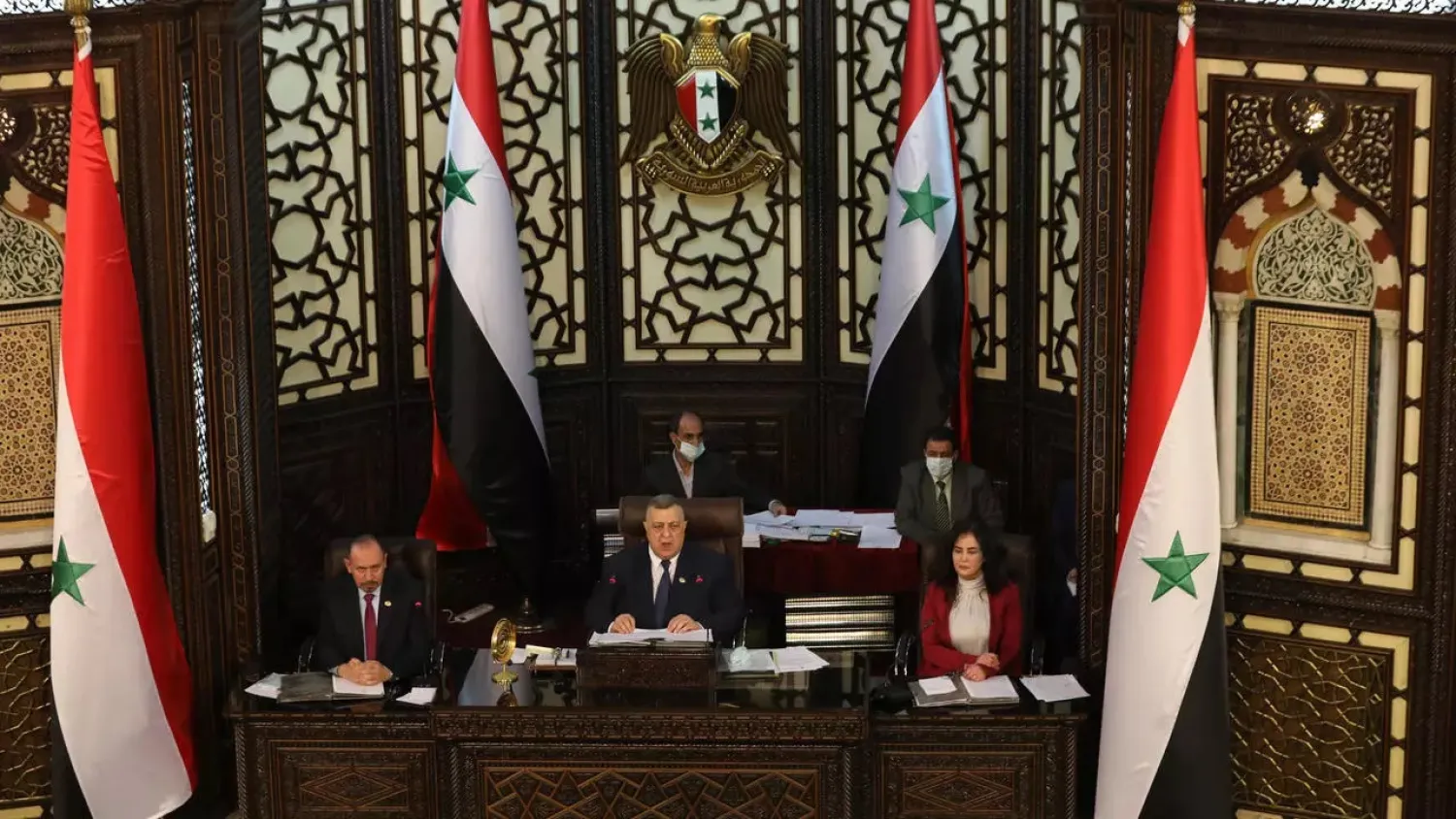
Hammouda Al-Sabbagh (C), head of the Syrian People's Assembly, presides over a parliamentary session to discuss upcoming presidential elections, in the capital Damascus, on April 18, 2021. (AFP)
TT

Syria Court Gets 1st Applications for Presidential Vote

Hammouda Al-Sabbagh (C), head of the Syrian People's Assembly, presides over a parliamentary session to discuss upcoming presidential elections, in the capital Damascus, on April 18, 2021. (AFP)

A Syrian court Monday started receiving applications from presidential hopefuls, the state news agency said, for polls next month expected to keep Bashar al-Assad in power in the war-torn country.

Two candidates filed applications with the high constitutional court, state news agency SANA said, a day after the speaker of parliament announced the poll will take place on May 26.

The first was a former lawmaker, while the other had applied for the last presidential elections in 2014, but did not meet the criteria.

They will now have to garner support from at least 35 members of the 250-seat parliament, which is dominated by Assad's Baath party.

Fifty-five-year-old Assad, who succeeded his father in 2000 and has managed to cling on to power through a decade of conflict, has not yet announced his own candidacy.

Presidential hopefuls have until April 28 to put forth their candidacy for the second such vote to be held during the war.

They must have lived continuously in Syria for at least 10 years, meaning that opposition figures in exile are barred from running.

The last presidential elections in 2014 were the first such multi-candidate polls in Syria, but only two other candidates were approved and Assad won with an official 88 percent of the vote.

The government has since won back large parts of the country from opposition and extremist factions.

But Syria is also battling a dire economic crisis compounded by Western sanctions and a financial crisis in neighboring Lebanon.

The war has killed more than 388,000 people since it started in 2011 with the brutal repression of anti-government protests, but endless rounds of talks have failed to find a political solution.


Iraq Seizes Millions of Dollars at Deputy Oil Minister’s Home

A photo released by Iraq’s judiciary shows cash and valuables that were hidden in the home of Deputy Oil Minister Ali Maarij al-Bahadly.
TT

Iraq Seizes Millions of Dollars at Deputy Oil Minister’s Home

A photo released by Iraq’s judiciary shows cash and valuables that were hidden in the home of Deputy Oil Minister Ali Maarij al-Bahadly.

Iraqi authorities arrested Deputy Oil Minister Ali Maarij al-Bahadly, a US-sanctioned official accused of using his post to help Iran-linked networks smuggle oil.

Iraq’s Supreme Judicial Council said initial questioning of al-Bahadly led to the seizure of $11 million and 4 billion Iraqi dinars, about $3 million, as well as several properties. It said investigations were continuing.

Al-Bahadly was arrested before dawn on Sunday at his home in Baghdad’s upscale Zayouna district. Later, state media published images showing security forces pulling bags of cash from inside the walls of the house.

From politics to oil

Al-Bahadly entered Iraq’s oil sector in the early years after 2003, working as head of drilling operations at the Maysan oil fields authority. He later became director general and chairman of Maysan Oil Company.

His career also reflected shifting political loyalties. He won a parliamentary seat in 2014 with the State of Law Coalition and chaired parliament’s oil and energy committee.

He later moved toward the Reconstruction and Development coalition led by former Prime Minister Mohammed Shia al-Sudani, which backed him for the oil ministry before he hit a US veto and, later, arrest.

The US Treasury Department sanctioned al-Bahadly in May under Executive Order 13902.

Washington accused him of using his position to facilitate oil smuggling for Iran-linked networks by falsifying certificates of origin, mixing Iranian oil with Iraqi oil and exporting it.

It also accused him of providing financial support to sanctioned figures and groups, including smuggler Salim Ahmed Said and the Asaib Ahl al-Haq faction.

Accountability

A former Oil Ministry official told Asharq Al-Awsat that al-Bahadly “works within an integrated system in which most of the powerful, dominant political forces take part while remaining beyond accountability.”

The former official, who asked not to be named, did not clear al-Bahadly of corruption allegations.

But he said any serious fight against corruption would have to strike at “the powerful parties under whose protection and umbrella some officials in the Oil Ministry and other ministries operate.”

Observers see “US fingerprints” behind the pursuit of senior Oil Ministry officials, including deputy ministers Adnan al-Jumaili who was arrested recently.

Analysts say Washington views Baghdad’s latest “anti-corruption” campaign as a way to contain Iranian influence and a necessary step toward dismantling it.

Public support for the campaign is broad. But some Iraqis fear its momentum could fade, and that authorities may avoid the “big heads” that are widely blamed for corruption across Iraq over the past two decades.

On the street, Iraqis remain stunned by the methods corruption suspects allegedly used to hide cash, from underground pits to sealed rooms that security forces had to break open to reach the money.

Observers are also struck by the scale of the sums allegedly stolen and by the failure of oversight bodies to uncover them in recent years. Many believe what has emerged so far is only a tiny fraction of the public money looted.

Prison sentences

In the latest corruption cases, the Supreme Judicial Council said on Tuesday that the Diyala Criminal Court sentenced three people to 10 years in prison for embezzling funds allocated to compensate martyrs and people wounded in terrorist attacks.

It said the convicts exploited their jobs at the Diyala governorate office to issue 301 fake checks and transfer money from the compensation account to the governorate office’s operating advances account.

In other developments, authorities released former lawmaker Mohammed al-Sayhood on bail on Tuesday.

Sayhood, a cousin of former PM al-Sudani, was arrested on Sunday as part of a wider campaign targeting lawmakers and officials over suspected corruption.

A security source said he was released for health reasons.


UN Chief Warns Cash Crunch Threatens Palestinian Refugee Agency

Displaced Palestinians gather to receive hot meals distributed by a charity kitchen in the Khan Younis refugee camp in the southern Gaza Strip on June 29, 2026. (AFP)
TT

UN Chief Warns Cash Crunch Threatens Palestinian Refugee Agency

Displaced Palestinians gather to receive hot meals distributed by a charity kitchen in the Khan Younis refugee camp in the southern Gaza Strip on June 29, 2026. (AFP)

UN chief Antonio Guterres warned Tuesday of the "increasingly precarious" situation of the UN agency for Palestinian refugees known as UNRWA, saying that millions of people's livelihoods were at risk.

The secretary-general said that further funding cuts for UNRWA -- which Israel has criticized as politically biased -- could "push conditions beyond breaking point."

Because of insufficient funding, UNRWA has scaled back its operations since the start of the year.

"As we meet here today, the safety and welfare of millions of Palestine refugees hangs in the balance," Guterres told a donor conference for the UN agency.

He noted the "utterly appalling" living conditions in Gaza, violence by Israeli settlers in the West Bank and Israeli strikes on Lebanon.

"It [UNRWA] faces sweeping restrictions throughout the Occupied Palestinian Territory. And a cash shortfall that imperils its work across the region," Guterres said.

"I am appalled by continuing efforts to marginalize and undermine UNRWA through disinformation, smear campaigns, legislative actions, operational restrictions, diplomatic roadblocks and more," he said.

Israel has long opposed UNRWA, created by the UN General Assembly in 1949, and intensified its criticism after October 7, alleging that employees participated in the deadly 2023 attack on Israel.


Hundreds of Thousands of Lebanese Head Home as Fighting Eases, Many Still Stranded

Lebanese people drive a vehicle loaded with mattresses as they return to their village in the town of Nabatieh, southern Lebanon, 23 June 2026, amid a ceasefire between Israel and Hezbollah. (EPA)
TT

Hundreds of Thousands of Lebanese Head Home as Fighting Eases, Many Still Stranded

Lebanese people drive a vehicle loaded with mattresses as they return to their village in the town of Nabatieh, southern Lebanon, 23 June 2026, amid a ceasefire between Israel and Hezbollah. (EPA)

Some 400,000 Lebanese uprooted by war have returned to southern Lebanon, with more expected to follow in the coming week, a government minister said on Tuesday, encouraged by a lull in the four-month-long conflict between Israel and Hezbollah.

Yet many remain unable to go back. Since March, around 1 million people have been forced to flee their homes, and large numbers are still in shelters or temporary housing because their homes are destroyed or uninhabitable, said Hanine ‌El Sayed, Minister of Social Affairs.

Roughly 40% ‌of those displaced have now returned to their towns ‌and ⁠villages. The number ⁠of people staying in collective shelters has fallen sharply, to about 13,000 from 37,000, she said.

While some shelters will remain open for families who cannot return, aid programs — including emergency cash support — will continue. The number of shelters has dropped from 692 at the height of the crisis to 479, with additional centers opened in Nabatieh for those wanting to stay near their home ⁠areas.

El Sayed said the headline figures conceal a ‌gap between those able to return and ‌those still displaced.

"These are families that are able to return to something, at least ‌the basic minimum," she told Reuters. "The fact that the others have ‌not returned means they have a much harder situation."

Authorities expect further returns in the coming days and hope within about a week to better gauge how many families cannot go back at all.

"In about a week's time ... we would really know ‌the size of the problem - how many absolutely cannot return because their homes have been totally damaged," she said.

CHALLENGES ⁠OF GOING ⁠HOME

For many, returning home does not mean a return to normal life. Families are often finding damaged houses, scarce electricity and water, and destroyed businesses and livelihoods, as the government works to restore basic services and expand cash assistance, rental support and employment programs.

Yet despite these hardships, many are choosing to return.

"Many of the people of the south are very attached to their land and they want to rightfully make a claim back to it," El Sayed said.

The government estimates Lebanon will need billions of dollars to rebuild damaged homes and infrastructure, funding that it does not currently have, El Sayed said.

Nearly 90,000 housing units have been totally or partially destroyed in the latest conflict, adding to widespread damage from earlier fighting.