

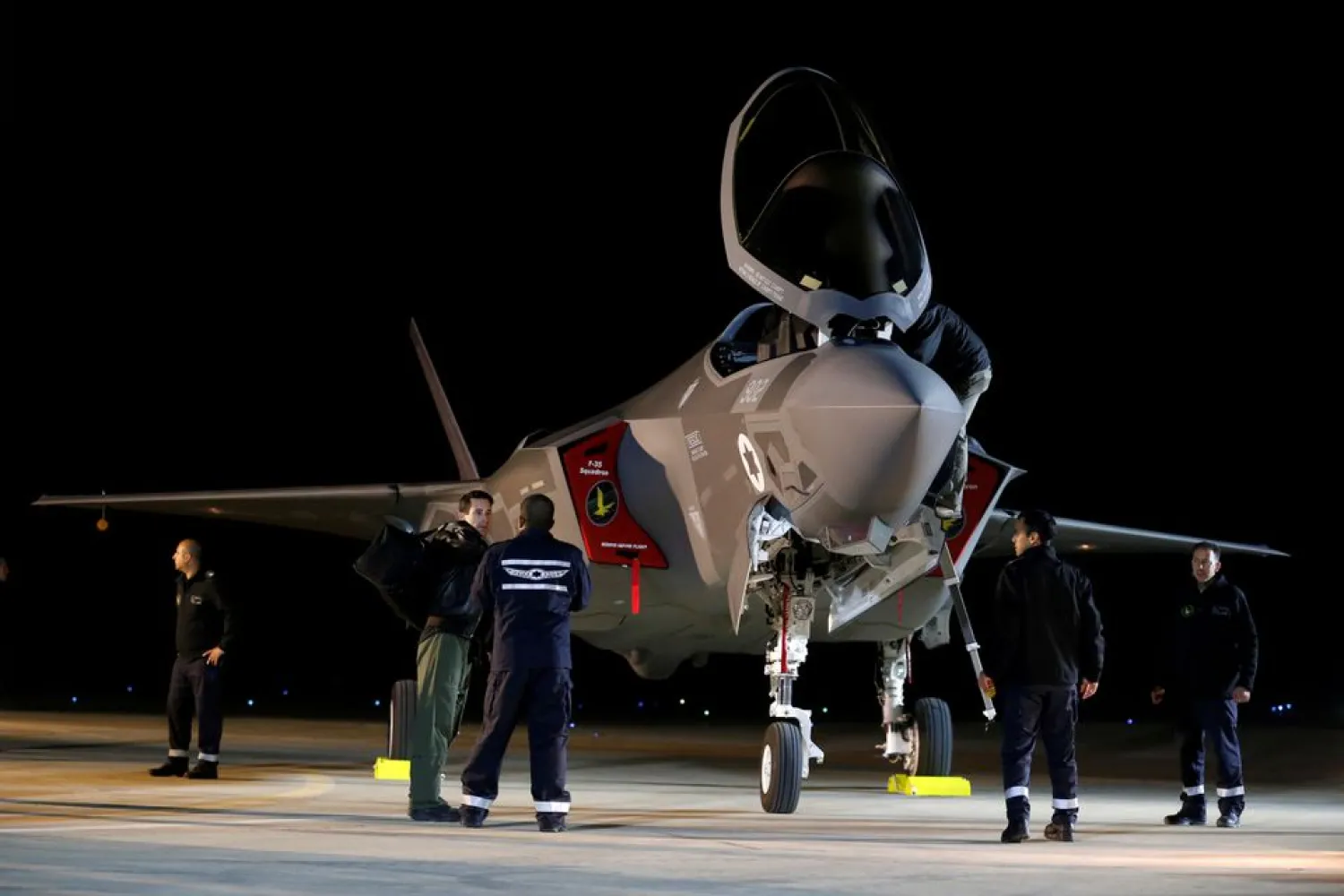

Israeli Minister: Our Warplanes Can Reach Iran

Israeli soldiers walk near a F-35 fighter jet after it landed in Israel at Nevatim air base in southern Israel December 12, 2016. REUTERS/Amir Cohen/File Photo
TT

Israeli Minister: Our Warplanes Can Reach Iran

Israeli soldiers walk near a F-35 fighter jet after it landed in Israel at Nevatim air base in southern Israel December 12, 2016. REUTERS/Amir Cohen/File Photo

An Israeli cabinet minister sharpened his country's warnings against what it would deem a bad new nuclear deal between Iran and world powers, saying war with Tehran would be sure to follow.

As President Joe Biden explores a possible US return to the 2015 deal to contain Iran's nuclear program that his predecessor Donald Trump abandoned, Israel has stepped up calls for more sweeping curbs to be imposed on sensitive Iranian technologies and projects.

Iran, which this week resumed indirect talks with US envoys in Vienna on reversing its retaliatory violations of the deal in exchange for the removal of sanctions reimposed by Trump, has ruled out any further limitations on Iranian actions.

Reiterating Israel's position that it does not consider itself bound by the diplomacy, Intelligence Minister Eli Cohen said: "A bad deal will send the region spiraling into war."

"Anyone seeking short-term benefits should be mindful of the longer-term," he told Reuters. "Israel will not allow Iran to attain nuclear arms. Iran has no immunity anywhere. Our planes can reach everywhere in the Middle East - and certainly Iran."

Cohen said that in addition to denying Iran the means of enriching uranium and developing ballistic missiles, world powers should make it stop "destabilizing other countries" and funding militants.

Israel sent senior delegates to Washington this week to discuss Iran with US counterparts. The White House said the allies agreed on the "significant threat" posed by Iran's regional behavior.

The Israeli ambassador to the United States, Gilad Erdan, said the Biden administration would consult with Israel about any new nuclear deal - the prospects for which he deemed hazy.

"We assess, to our regret, that the Iranians will refuse such a discussion," he told Israel's public radio station Kan, alluding to Iran's insistence on restoring the original deal.

"But if it emerges that we were mistaken, and the Americans succeed in securing a discussion of a different, better deal, we will certainly be part of that discussion. We made that clear and the (Biden) administration welcomes this, of course."



CNN Blocked from Trump Trip on Saturday

CNN Senior Reporter Betsy Klein reports from the White House, Thursday, Sept. 24, 2026, in Washington. (AP Photo/Alex Brandon)
TT

CNN Blocked from Trump Trip on Saturday

CNN Senior Reporter Betsy Klein reports from the White House, Thursday, Sept. 24, 2026, in Washington. (AP Photo/Alex Brandon)

CNN reporters have been barred from traveling with US President Donald Trump as planned on Saturday, in a new move by the White House to limit the news network's access.

The president last week sought to ban three US outlets -- CNN, MS NOW and Politico -- from the White House, accusing them of providing only negative coverage on him.

After journalists with the three outlets were blocked from entering the White House complex, a judge ordered their access to be temporarily restored, saying Trump's move was likely unconstitutional.

For Trump's trip on Saturday to Tennessee, CNN had been scheduled to be the TV network in the press "pool" traveling with him.

However, a schedule released by the White House on Friday evening did not list CNN or any of the TV networks in the TV pool rotation.

The pool is a rotating group of journalists that travel with the president and provide coverage to other outlets, due to limited space.

The White House schedule only listed a "Secondary TV" correspondent and crew: Lindell TV -- a staunchly pro-Trump outlet run by his close ally, businessman Mike Lindell.

Earlier this week, when CNN's White House access was still revoked, the top five US broadcasters made a rare joint move to halt pool coverage of the White House in solidarity.

"The public has a vital interest in receiving accurate, independent information about its government. No administration should restrict a news organization because it objects to its reporting," ABC, CBS, CNN, Fox and NBC said.

CNN declined to comment when reached Friday by AFP. The White House did not respond to a request for comment.


Iran Proposes Hormuz Plan, Trump Reportedly Refuses

A motorist rides a scooter near a giant billboard erected on the facade of a building depicting a member of Iran's Revolutionary Guards Corps (IRGC) placing his foot on a US sea drone, reportedly seized by Iran in the Strait of Hormuz, in Vanak Square in Tehran on September 24, 2026. (Photo by AFP)
TT

Iran Proposes Hormuz Plan, Trump Reportedly Refuses

A motorist rides a scooter near a giant billboard erected on the facade of a building depicting a member of Iran's Revolutionary Guards Corps (IRGC) placing his foot on a US sea drone, reportedly seized by Iran in the Strait of Hormuz, in Vanak Square in Tehran on September 24, 2026. (Photo by AFP)

Iran offered a plan to reopen the strategic Strait of Hormuz, Tehran said Friday, but within hours reports indicated that US President Donald Trump rejected the proposal.

The waterway key to the world's oil supply is central to the conflict between the United States and Iran, which is at a stalemate after nearly seven months.

But new mediation efforts at the UN's gathering of world leaders in New York this week offered some optimism of progress toward a deal.

Iran's Foreign Minister Abbas Araghchi met for talks on Tuesday with Trump's envoy Steve Witkoff, and previously set out conditions for ending the war and reopening the vital shipping channel.

"Iran has conveyed to the United States, through Qatar, a concrete seven-day plan. If the necessary conditions are met, the strait can be reopened, and normal maritime passage restored within seven days," Araghchi said at the UN, according to AFP.

"The choice now rests with the United States. Iran does not accept coercion, threats, or intimidation, and Iran will not surrender its sovereign rights under pressure.

However, with hours of his comments The Wall Street Journal reported Trump had rejected the proposal, citing US officials familiar with the matter.

The report noted that the US president was skeptical Tehran would meet his demands and added he sees a renewed bombing campaign as likely.

Trump also posted an image to his Truth Social platform of a map showing the Strait of Hormuz circled and labelled "Trump Strait."

Earlier media reports suggested the new plan calls for a cessation of all hostilities in the Middle East for seven days, including in Lebanon.

It also reportedly calls for the release of frozen Iranian assets estimated to be worth at least $12 billion, as well as the lifting of sanctions on Iranian oil and an end to the US naval blockade of Iran.

On the seventh day of the truce, Iran would reopen Hormuz.

Iranian President Masoud Pezeshkian said in an interview with broadcaster CBS that the ceasefire "process will begin from the very day they accept it."

"We had previously reached an agreement based on the MOU that was signed in Pakistan...if the United States agrees to proceed in that way, everything will return to the way it was before," he added.

Hossein Mohebi, a spokesman for the Revolutionary Guards, told AFP in an exclusive interview on Tuesday that ending hostilities in Yemen was also among Tehran's demands.

The US and Iran signed a memorandum of understanding in June that aimed to end the war, reopen the strait and launch talks on Iran's nuclear program.

But the deal broke down shortly afterward when Iran fired on commercial ships in Hormuz that it accused of deviating from its approved route through the waterway.

Iran requires ships to obtain authorization before passage, citing security and sovereignty reasons.

Ships that refuse to comply are regularly targeted, while the United States sporadically bombs Iranian coastal areas in retaliation.


Trump Says Xi Visit 'Very Positive for both Countries'

 China's President Xi Jinping and US President Donald Trump speak on the North Portico steps of the White House ahead of a State Dinner in Washington, DC, on September 24, 2026. President Xi is on a State visit to the United States from September 23 to 25. (Photo by SAUL LOEB / AFP)
China's President Xi Jinping and US President Donald Trump speak on the North Portico steps of the White House ahead of a State Dinner in Washington, DC, on September 24, 2026. President Xi is on a State visit to the United States from September 23 to 25. (Photo by SAUL LOEB / AFP)
TT

Trump Says Xi Visit 'Very Positive for both Countries'

 China's President Xi Jinping and US President Donald Trump speak on the North Portico steps of the White House ahead of a State Dinner in Washington, DC, on September 24, 2026. President Xi is on a State visit to the United States from September 23 to 25. (Photo by SAUL LOEB / AFP)
China's President Xi Jinping and US President Donald Trump speak on the North Portico steps of the White House ahead of a State Dinner in Washington, DC, on September 24, 2026. President Xi is on a State visit to the United States from September 23 to 25. (Photo by SAUL LOEB / AFP)

President Donald Trump said Friday that he and Xi Jinping had made progress for the United States and China, as the Chinese leader wrapped up a state visit to Washington.

"I think we've made tremendous strides, we've made great strides, very positive for both countries," Trump told reporters as he and his wife Melania had tea at the White House with Xi and his wife Peng Liyuan.

For his part, Chinese President Xi Jinping floated the possibility of two more meetings with Trump, saying: "Looking ahead to the remainder of this year, there will be two more opportunities for us to meet each other -- firstly the APEC meeting in China and then the G20 summit in the United States."

"I do welcome you, Mr President and the First Lady, to visit China."