Russia Refutes Reports on Suspension of Military Agreements with Sudan

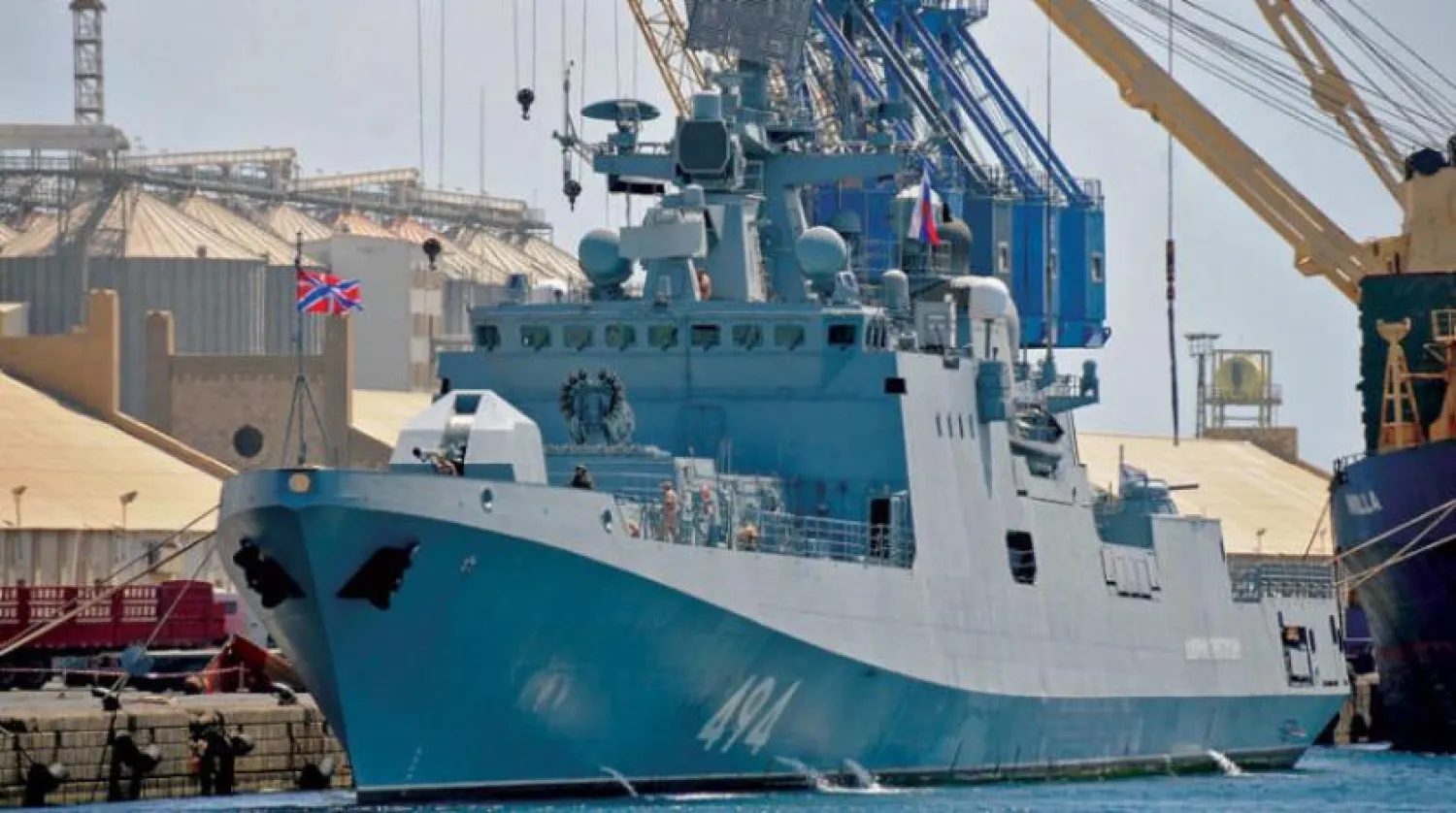
The Russian frigate Admiral Grigorovich during a past stop at Port Sudan. (AFP)
TT

Russia Refutes Reports on Suspension of Military Agreements with Sudan

The Russian frigate Admiral Grigorovich during a past stop at Port Sudan. (AFP)

The Russian Embassy in Khartoum dismissed as “unfounded” media reports that said Sudan has suspended military agreements signed with Moscow by the regime of ousted President Omar al-Bashir.

In a statement on Facebook page on Thursday, the embassy said it has not received any notification from Sudanese officials about the alleged suspension.

It stressed that such reports aim to harm the traditionally friendly bilateral relations between Russia and Sudan.

The former regime had agreed with Moscow to establish a logistics support center for Russia’s navy in Sudan.

In November 2020, the Russian government published a document of the agreement, stating that the maximum number of personnel at the facility in Sudan would not exceed 300, and no more than four Russian ships would deploy there at the same time.

According to the agreement, the base would reportedly be constructed near the Sudanese Navy's main base at Flamingo Bay, which is situated north of Port Sudan, the country’s main port city on the Red Sea.

The document stipulates that the naval logistics base is designed for repairing, replenishing supplies and for the crewmembers of Russian naval ships to rest.

“It (the agreement) is effective for 25 years with the automatic extension for 10 years if neither side notifies the other that the agreement is terminated at least a year prior.”

In return, Sudan would obtain weapons and military equipment from Russia.

On Wednesday, Sudanese political, military and civil senior sources said the Sovereign Council has suspended the deal “until it is approved by the parliament, the Sudanese Sovereign Council or the transitional government.”

They pointed to the Council’s rejection of any new deployment of Russian troops at the Flamingo naval base, adding that Moscow has not respected the agreed upon details.

Earlier this month, it was reported that Russian military ships started to bring equipment and radars to build the naval facility.


Israel Fears SDF-Like Agreement in South Syria

A resident greets Syrian government forces south of Hasakah, in northeastern Syria, on Jan. 20, 2026. (Credit: Omar Haj Kadour/AFP) 
TT

Israel Fears SDF-Like Agreement in South Syria

A resident greets Syrian government forces south of Hasakah, in northeastern Syria, on Jan. 20, 2026. (Credit: Omar Haj Kadour/AFP) 

As the United States seeks to activate the joint Syrian-Israeli Mechanism Committee and invite it to meet again within the next two weeks, political sources in Tel Aviv revealed that the government of Benjamin Netanyahu is further disputing with Washington over Damascus.

The government considers the US policy in Syria as “silly and not compatible with the nature of the broiling Middle East,” the sources said.

According to far-right newspaper Makor Rishon, “Israel expressed frustration with the US administration's policy in Syria, including Washington’s support and confidence in the rule of Syrian President Ahmad al-Sharaa, who has not yet proven he cleared his past associated to the Hay’at Tahrir al-Sham.”

Misgav Institute Fellow, Dr. Elie Klutstein, wrote that Washington is looking out for its own interests in Syria while placing Israel's security interests on the sidelines.

Klutstein said the Israeli government should confront Washington to insist on its interests at any cost.

Israel fears the new regime in Syria succeeds at consolidating itself. Tel Aviv bets on an ethnically and sectarian fragmented country and could not support the idea of a “united Syria.”

Israel is particularly angered by an agreement between the Syrian Democratic Forces (SDF) and the Syrian government in the north, that would guarantee the unity of the Syrian territory.

Today, Israel also fears al-Sharaa government will reach a similar agreement with the Druze in the province of Sweida, south of the country.

The majority of Druze leaders in the south are concerned with the unity of Syria, and are ready to ink an agreement with the government in return of guarantees that attacks by its forces will not be repeated.

The leaders also argue that only a small Druze community opposes al-Sharaa regime and therefore, will eventually succumb to an agreement if the government is serious in granting them minority rights.

Last week, Hebrew media outlets said the comprehensive agreement between Kurdish-led Syrian SDF factions and the Syrian government to integrate with the Syrian army is not an arrangement between two equal parties.

“This is a Kurdish submission to Ahmed al-Sharaa that happened after government supporters dismantled the SDF from the inside, and brought several factions closer to the regime,” the Hebrew media wrote.

Earlier, US sources said Türkiye informed the US administration it supports a centralized Syrian state and rejects any Kurdish canton in the northeast.

In return, Israel’s government conveyed to Washington its opposition to a centralized Syria, preferring a federal model.

Sources said Netanyahu is angered by the outcome in northeastern Syria and considers US Special Envoy to Syria tom Barrack biased toward Ankara.

The Israeli circles see Türkiye as the 'biggest winner' from the collapse of the SDF.

Therefore, the Israeli government reiterated that it will not accept Turkish troop presence in Syria and insists on protecting Druze communities in southern Syria.

Tel Aviv’s response to the agreement between SDF forces and al-Sharaa’s government was translated on Friday, when Israeli forces entered two locations in southern Syria: the Saida al-Hanout village in the southern Quneitra countryside and the village of Samdaniya al-Sharqiya in the northern Quneitra countryside.

An Israeli patrol, consisting of seven military vehicles, erected a barrier west the village of Saida in Hanout, before withdrawing from the area.

This development came while the US plans to invite the joint Syrian-Israeli Mechanism Committee to again meet in Amman within the next two weeks and resume direct official talks between the two countries.

The joint fusion mechanism -- a dedicated communication cell -- aims to facilitate immediate and ongoing coordination on the two countries’ intelligence sharing, military de-escalation and diplomatic engagement under the supervision of the United States.


Hezbollah Slams the 'Mechanism' Committee and Lebanese President's Envoy

A view of the damage on the site a day after a series of Israeli airstrikes struck a large piece of industrial machinery in the southern Lebanese village of Al-Marwanieh, Lebanon, on 31 January 2026. (EPA)
TT

Hezbollah Slams the 'Mechanism' Committee and Lebanese President's Envoy

A view of the damage on the site a day after a series of Israeli airstrikes struck a large piece of industrial machinery in the southern Lebanese village of Al-Marwanieh, Lebanon, on 31 January 2026. (EPA)

Hezbollah slammed the "mechanism" committee and head of Lebanon's delegation Ambassador Simon Karam, deeming his recent statements a violation of the committee's duties and a precursor to Israel intervening in Lebanon beyond the November 2024 ceasefire agreement.

Hezbollah accused Karam of violating the "technical role" of the committee and of making political statements that "undermine Lebanon's sovereignty and the rights of the Lebanese people and resistors."

The accusations are the latest in a campaign the Iran-backed party has been waging since the beginning the year over efforts to hand over its weapons north of the Litani River. The disarmament is part of a government decision to impose state monopoly over weapons across the country.

The first phase of the plan covered regions south of the Litani and focus has now shifted to areas north of it.

Hezbollah has refused to lay down its weapons in defiance of the state, notably President Joseph Aoun whose recent statements confirming that authorities are forging ahead with the plan have put him at odds with the party and made him a target of its attacks.

A Hezbollah statement on Sunday said the "mechanism" has a purely technical role that is limited to south of the Litani.

"Any improvised proposals only allow the Israeli enemy to meddle in issues not covered in the ceasefire," it added.

The party said appointing a diplomat - Karam - as head of the Lebanese delegation in the mechanism was "a second sin no less significant than the sin of" imposing state monopoly over arms, "especially amid the Zionist occupation of Lebanese territories and continued daily violations against the people and nation."

Hezbollah expressed its "categorical rejection" of attempts to expand the authority of the committee under various diplomatic or political excuses.

The statement also slammed remarks by Karam who cast doubt over Hezbollah's cooperation with the army's disarmament efforts south of the Litani.

Karam's remarks contradict Aoun and other official statements that asserted that the party had indeed cooperated with the military in line with the ceasefire, added Hezbollah.

Ministerial sources told Asharq Al-Awsat, however, that the party was not cooperative with the army, but chose to simply not stand in its way as it implemented the disarmament plan.

The army itself was discovering Hezbollah tunnels and weapons caches, while the party never offered to give it the locations of these sites, they stressed.

Residents of the South were actually notably cooperative with the army, who often pointed them in the direction of caches, they revealed.

The sources rejected Hezbollah's accusations against Karam, dismissing them as an attempt to rally support among its own supporters.

Moreover, they stressed that the authorities will continue with the disarmament plan north of the Litani, noting however the delicate task demands a balanced political and security approach, which officials, led by the president, are working on.


Egypt's Sisi, King of Jordan Stress Need for Full Implementation of Gaza Ceasefire

A handout picture released by Jordanian Royal Palace on February 1, 2026, shows Jordan's King Abdullah II meeting with Egypt's President Abdel Fattah al-Sisi (R) at the al-Ittihadiya Presidential Palace in Cairo. (Handout / Jordanian Royal Palace / AFP)
TT

Egypt's Sisi, King of Jordan Stress Need for Full Implementation of Gaza Ceasefire

A handout picture released by Jordanian Royal Palace on February 1, 2026, shows Jordan's King Abdullah II meeting with Egypt's President Abdel Fattah al-Sisi (R) at the al-Ittihadiya Presidential Palace in Cairo. (Handout / Jordanian Royal Palace / AFP)

Egyptian President Abdel Fattah al-Sisi and Jordan's King Abdullah II stressed on Sunday the need for the full implementation of the Gaza ceasefire and US President Donald Trump's peace plan.

The leaders met in Cairo for talks on the developments in Gaza, said the Egyptian Presidency.

They reiterated Egypt and Jordan's firm rejection of any attempts to displace the Palestinian people and Israel's "violations and arbitrary practices" against Palestinians in the occupied West Bank, said a presidency spokesman.

They underlined the need to establish an independent Palestinian state with East Jerusalem as its capital, saying it is the only way to achieve peace and stability in the Middle East.

Sisi and King Abdullah also discussed regional developments, urging the need for de-escalation and to resolve disputes through peaceful means, added the spokesman.