Lebanese Interior Minister: Smuggling to Saudi Arabia Threatens National Security

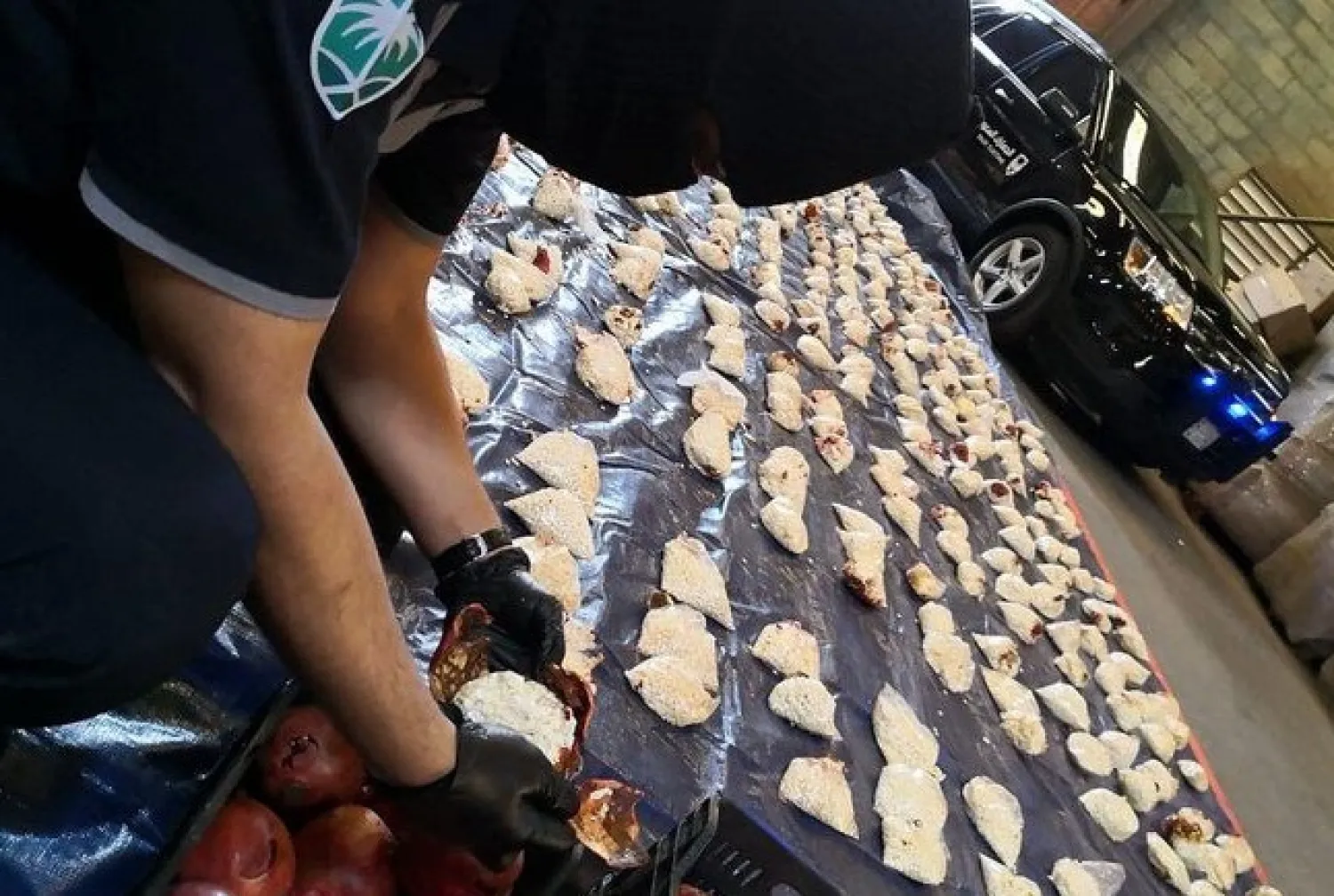
A Saudi Custom officer opens imported pomegranates, as customs foiled a attempt to smuggle millions of Captagon pills, which came from Lebanon. (SPA)
TT

Lebanese Interior Minister: Smuggling to Saudi Arabia Threatens National Security

A Saudi Custom officer opens imported pomegranates, as customs foiled a attempt to smuggle millions of Captagon pills, which came from Lebanon. (SPA)

Lebanon’s Interior Ministry said Wednesday that investigations conducted with arrested Hassan Duqo revealed that he was involved in smuggling the largest drug shipment in the world, estimated at about 94 million Captagon pills, which were seized in Malaysia before being smuggled to the Kingdom of Saudi Arabia.

The Ministry has distributed documents on the most prominent operations carried out in the framework of combating drugs in 2021.

Caretaker Interior and Municipalities Minister Mohammad Fahmi warned Wednesday that drug smuggling to Saudi Arabia threatens the stability of the Lebanese society, pledging to exert necessary efforts to combat such operations.

“This issue is a serious threat to the national security of the Lebanese society, and we must work to combat it,” he said, adding that the Lebanese state is against destabilizing its relations with brotherly and friendly countries, especially Saudi Arabia, saying Lebanon cannot forget the Kingdom’s support over the years.

“The Information Division and the Central Drug Control Office at the ISF Judicial Police Unit are constantly exerting efforts in this regard."

Last month, Saudi Arabia banned the import of Lebanese fruits and vegetables or their transit through the Kingdom’s territories after Jeddah Islamic Port’s customs officers seized more than 5 million Captagon pills expertly hidden in a pomegranate consignment from Lebanon.


UN Says Yemen’s Houthis Removed Its Assets, Equipment in Latest Restrictions

People walk along a street at sunset in Sanaa, Yemen, 21 January 2026. (EPA)
TT

UN Says Yemen’s Houthis Removed Its Assets, Equipment in Latest Restrictions

People walk along a street at sunset in Sanaa, Yemen, 21 January 2026. (EPA)

Houthi militants in Yemen removed UN equipment and assets and took them to an undisclosed location without explanation, the world body said Friday, the latest in a series of restrictions by the Iran-backed group.

Julien Harneis, the United Nations' resident and humanitarian coordinator for Yemen, said the Houthis entered at least six unstaffed UN offices in Sanaa on Thursday and removed most of the telecommunications equipment and several UN vehicles without UN authorization.

The move will likely further hinder urgently needed humanitarian assistance in Houthi-controlled areas and marks the latest escalation in the Houthis’ crackdown on UN staff and aid groups.

The equipment removed Thursday was essential to carrying out UN programs and had been brought into Yemen in compliance with local protocols and with the necessary permissions, the UN said.

The Houthis, without explanation, have also not authorized United Nations Humanitarian Air Service flights to Sanaa for more than a month, or to the legitimate government-controlled Marib province for over four months, the UN said Friday.

The flights are the only means for international nonprofits to enter and leave Houthi-controlled areas to operate and deliver aid.

The Houthi decisions were made without discussion or an opportunity to reach a mutual agreement to set arrangements for aid delivery, Harneis said.

“This confiscation of UN assets and the blocking of UNHAS flights by the Sana’a DFA (Houthis), comes at a time when humanitarian needs in Yemen, particularly in areas under their control, are increasing. This will make the humanitarian situation worse in those parts of Yemen controlled by the DFA,” the Friday statement read.

UN officials said Thursday that the World Food Program will shut down operation in Houthi-controlled areas in Yemen due to Houthi restrictions and 365 staffers will lose their jobs by the end of March.

Aid operations in northern Yemen have long been hindered by Houthi-imposed constraints. Seventy-three UN staffers have been detained in recent years as well as staffers from other nonprofits and civil society groups in areas controlled by the militants. The detentions have severely restricted aid delivery in areas that account for around 70% of humanitarian needs nationwide, the UN said.

They intensified their crackdown by storming into UN facilities in Sanaa and elsewhere accusing staffers, without evidence, of espionage, allegations the UN rejected.


Report: US Slows Transfers of ISIS Detainees to Iraq

 A woman looks out from a tent at Roj camp, one of the detention facilities holding thousands of ISIS group members and their families, in the al-Malikiyah area of northeastern Syria, Thursday, Jan. 29, 2026. (AP)
A woman looks out from a tent at Roj camp, one of the detention facilities holding thousands of ISIS group members and their families, in the al-Malikiyah area of northeastern Syria, Thursday, Jan. 29, 2026. (AP)
TT

Report: US Slows Transfers of ISIS Detainees to Iraq

 A woman looks out from a tent at Roj camp, one of the detention facilities holding thousands of ISIS group members and their families, in the al-Malikiyah area of northeastern Syria, Thursday, Jan. 29, 2026. (AP)
A woman looks out from a tent at Roj camp, one of the detention facilities holding thousands of ISIS group members and their families, in the al-Malikiyah area of northeastern Syria, Thursday, Jan. 29, 2026. (AP)

Transfers of ISIS detainees from Syria to Iraq by the US military have slowed this week, seven sources familiar with the matter said, following calls by Baghdad for other countries to repatriate thousands of foreign extremists.

The US military said on January 21 it had started to transfer the detainees. Its announcement followed the rapid collapse of the Kurdish-led Syrian Democratic Forces in northeast Syria, which caused uncertainty about the security of prisons and detention camps they were guarding.

The United States had expected to transfer up to 7,000 fighters to Iraq within days. But more than a week later, only about 500 have been moved, according to two Iraqi judicial officials, two Iraqi security officials and three diplomats, some from countries whose nationals are among those transferred.

An Iraqi foreign ministry official put the number at under 500 so far.

Baghdad asked the US to slow the influx to make time for negotiations with other countries on repatriating their own nationals among the detainees and to prepare additional facilities to host the fighters, the Iraqi officials and a Western diplomat told Reuters.

Those moved to Iraqi facilities so far include about 130 Iraqis ‌and some 400 foreigners, ‌the Iraqi judicial sources, the Iraqi security officials and a Western diplomat said.

The slowdown, which has ‌not ⁠previously been reported, is linked ‌to Western governments' reservations about bringing home their own citizens who joined the ISIS’ brutal control of swathes of Syria and Iraq from 2014.

Most foreign fighters were subsequently captured in Syria and held in prisons in the northeast for years without trial.

The US State Department and the Pentagon did not immediately respond to Reuters requests for comment on the transfers.

IRAQ BALKS AT MASS TRANSFER

Iraq agreed to host the detainees being moved by the US military after a brief escape by dozens of fighters from one facility in Syria prompted concerns that more could flee, Iraqi government officials said.

But although it has already tried and sentenced dozens of foreign fighters in recent years, Baghdad balked at the prospect of having the full 7,000 in its custody, the officials said.

The influx could overwhelm Iraq’s courts and prisons, and sentencing detainees to death ⁠would prompt criticism from Western countries and rights groups, they said.

"It's a trap," one of the senior Iraqi judicial sources said. "These Western countries object to the death penalty, but refuse to receive their terrorists. Why ‌should we bear the burden of being seen as the butcher?"

Responding to questions from Reuters, Hisham ‍al-Alawi, Undersecretary of Iraq's Foreign Ministry for Political Planning, said fewer than 500 detainees ‍had been transferred to Iraq so far.

"For years, Iraq has been urging foreign states to assume their responsibilities by taking back their citizens and ‍dealing with them in accordance with their own laws. While some countries have taken the initiative, a large number of states have not responded to our requests," Alawi said.

The dilemma of what to do with foreign nationals who joined ISIS has plagued Western countries for the last decade.

Securing guilty verdicts against such detainees in their home countries could be harder than in Iraq, said four diplomats from countries whose nationals were captured in Syria, citing a greater need to prove direct participation in violent crimes.

Governments in such countries could face a public backlash if ISIS fighters were repatriated and then freed, the diplomats said.

The return of an ISIS-linked woman to Norway in 2020 caused a cabinet crisis that ultimately brought down the government.

As a result of Western nations' hesitations, ⁠thousands of foreign fighters detained in Syria and Iraq remained there for nearly a decade - even though the US, which repatriated and tried its nationals, urged other countries to do the same.

REPATRIATION THE ONLY ANSWER, EXPERT SAYS

The senior Iraqi judicial source said Baghdad was working with the US State Department on increasing pressure on other countries to begin repatriations.

Secretary of State Marco Rubio said after transfers had begun that foreign ISIS members would be in Iraq temporarily. "The United States urges countries to take responsibility and repatriate their citizens in these facilities to face justice," he said.

Two diplomats from countries with nationals now in Iraq said their governments faced an uncomfortable choice between repatriation - which would be unpopular domestically - and the possibility that their nationals would face the death penalty if tried in Iraq, an outcome that could outrage voters at home.

One of the diplomats said Baghdad had begun conversations with their country about repatriations, but that their government's policy was unchanged.

"It would be difficult for us to accept that they are transferred to Iraq if they are then going to get their head chopped off," the second diplomat said.

Letta Tayler, an associate fellow at the International Centre for Counter-Terrorism, said the mass transfer of detainees to Iraq "has mind-boggling legal implications, none of them positive."

It could prolong their indefinite detention without trial and place detainees at risk ‌of torture and executions based on flawed convictions, Tayler said. The US has raised concerns about unfair trials of ISIS detainees in Iraq.

"The only viable solution is for countries with fair justice systems to repatriate their nationals," Tayler said.


Israel Denies Accepting Gaza Health Ministry War Toll

A forensic expert examines one of the bodies of Palestinians returned by Israel the previous day, as part of the Gaza ceasefire deal, in a morgue at al-Shifa hospital in Gaza City on January 30, 2026. (AFP)
TT

Israel Denies Accepting Gaza Health Ministry War Toll

A forensic expert examines one of the bodies of Palestinians returned by Israel the previous day, as part of the Gaza ceasefire deal, in a morgue at al-Shifa hospital in Gaza City on January 30, 2026. (AFP)

Israel's military denied on Friday having accepted the Palestinian health ministry's death toll for the war in Gaza of 71,000 killed since October 2023, as was reported in Israeli media.

"The (Israeli military) clarifies that the details published do not reflect official ... data", military spokesman Lieutenant Colonel Nadav Shoshani posted on social media.

"Any publication or report on this matter will be released through official and orderly channels."

Israel's left-leaning daily Haaretz had reported Thursday that the military "accepted the estimate of the Hamas-run Gaza Health Ministry that approximately 71,000 Palestinians were killed during the Israel-Gaza war," sparked by Hamas' unprecedented attack on Israel on October 7, 2023.

Haaretz added that the military "said it is currently analyzing the data on the dead to see how many of them are combatants and how many are civilians".

Hamas took power in the Gaza Strip in 2007 after winning elections and violently ousting the Palestinian Authority, which had administered the territory since Israel unilaterally withdrew in 2005, after more than 38 years of military occupation.

Its October 7, 2023 attack resulted in the deaths of 1,221 people on the Israeli side, mostly civilians, according to an AFP tally that includes hostages who died or were killed during their captivity in the Gaza Strip.

Since then, at least 71,667 Palestinians have been killed in the small coastal territory by Israel's retaliatory military campaign, according to Gaza's health ministry.

Israeli authorities have repeatedly questioned the credibility of these figures or sought to discredit them by saying one cannot trust an administration under Hamas authority -- a movement Israel, the United States and the European Union designate as a "terrorist organization."

The ministry's figures are nevertheless considered reliable by the United Nations.

While they do not specify the share of armed Palestinian fighters among the dead, the ministry says more than half of those killed are children and women.

Its statistics only record people killed in Israeli bombardments or fighting. They do not take into account deaths whose bodies have not yet been pulled from the rubble of a territory devastated by Israeli strikes, nor indirect deaths caused by the war.

According to the ministry, 492 people have been killed by Israeli fire or bombardments since October 10 and the entry into force of a truce that the two sides accuse each other of violating daily.