


South's Moon Hopes to Restart N. Korean Diplomacy with Biden

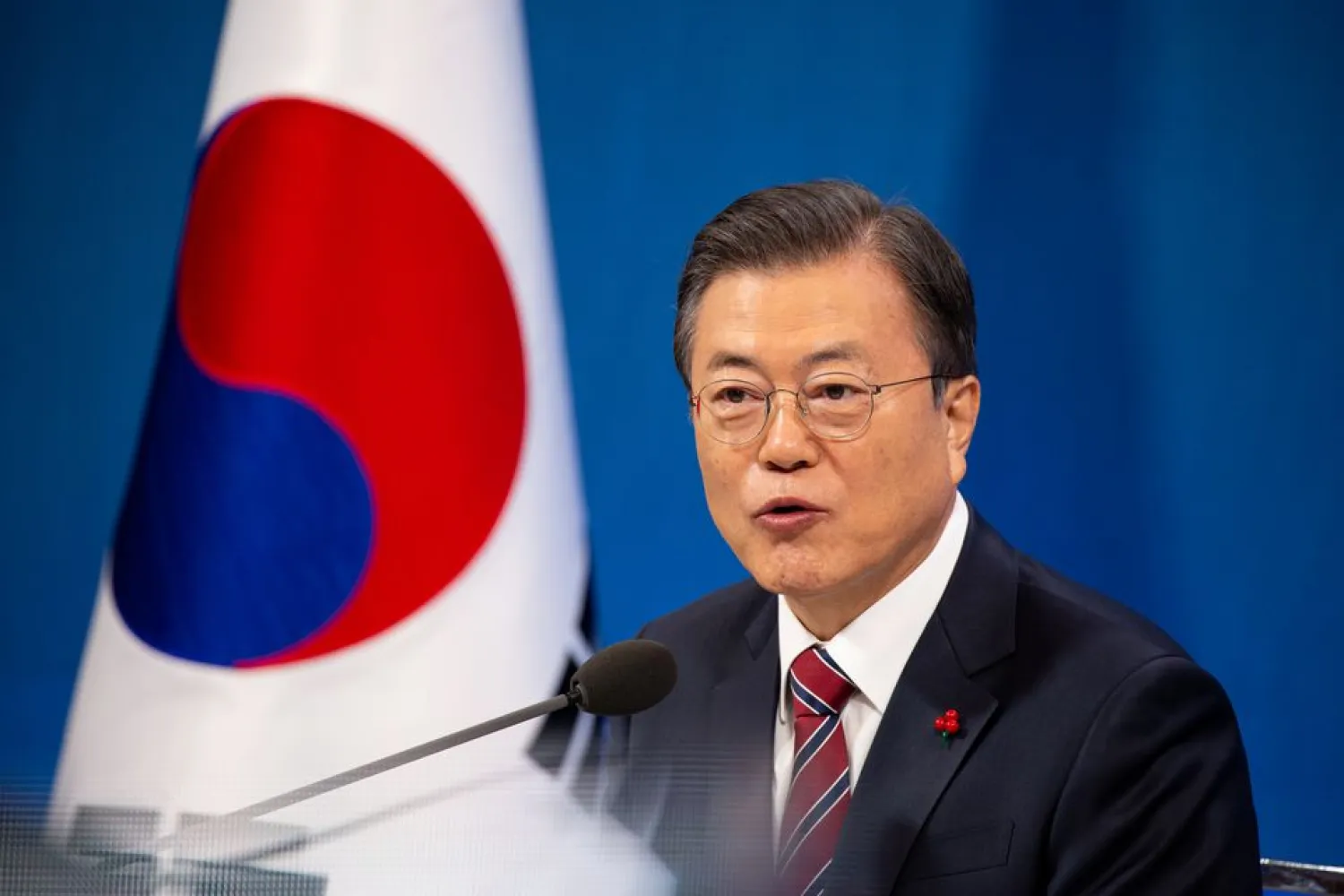
South Korean President Moon Jae-in speaks during an online New Year news conference with local and foreign journalists at the Presidential Blue House in Seoul, South Korea, January 18, 2021. Jeon Heon-Kyun/Pool via REUTERS
TT

South's Moon Hopes to Restart N. Korean Diplomacy with Biden

South Korean President Moon Jae-in speaks during an online New Year news conference with local and foreign journalists at the Presidential Blue House in Seoul, South Korea, January 18, 2021. Jeon Heon-Kyun/Pool via REUTERS

South Korea’s leader said Monday he’ll use his upcoming summit with President Joe Biden to push to restart diplomacy with North Korea, saying that the US has opted for a diplomatic, phased approach to resolve the North Korean nuclear crisis.

The White House recently said officials completed a review of North Korea policy and suggested the Biden administration would seek a middle ground between Donald Trump’s “grand bargain” and Barack Obama’s “strategic patience” approaches as a way to curb the North’s nuclear ambitions.

In a nationally televised news conference, President Moon Jae-in said he welcomes the direction of the Biden administration’s North Korea policy, which he said was finalized after consultations with South Korea.

Moon said Biden's North Korea policy aims to achieve “the Korean Peninsula’s complete denuclearization through diplomacy with a flexible, gradual and practical approach.”

The Biden administration hasn't disclosed details of its North Korea policy review. But administration officials have signaled they are trying to set the stage for incremental progress, in which denuclearization steps by the North would be met with corresponding actions, including sanctions relief, rather than a Trump-style push for an immediate, comprehensive deal through a leader-to-leader summit.

Some experts oppose a step-by-step denuclearization process because North Korea could derail negotiations while keeping much of its nuclear arsenal, after some of the most crippling international sanctions are lifted, The Associated Press reported.

Moon said when he meets Biden for their first summit talks in Washington on May 21, he’ll try to bolster the bilateral military alliance, boost policy coordination on North Korea and find ways to resume stalled talks between Washington and Pyongyang and between Seoul and Pyongyang.

Moon, whose single five-year term is to end next May, said he’ll focus on establishing lasting peace on the Korean Peninsula during his final year in office.

“I will not be pressed by time or become impatient during the remainder of my term. However, if there is an opportunity to restart the clock of peace and advance the peace process on the Korean Peninsula, I will do everything I can,” Moon said.

“I look forward to North Korea responding positively."


US Denies Iran Struck a Military Vessel during New Effort to Reopen Strait of Hormuz

Vessels in the Strait of Hormuz near Bandar Abbas, Iran, May 4, 2026. Amirhosein Khorgooi/ISNA/WANA (West Asia News Agency) via REUTERS
TT

US Denies Iran Struck a Military Vessel during New Effort to Reopen Strait of Hormuz

Vessels in the Strait of Hormuz near Bandar Abbas, Iran, May 4, 2026. Amirhosein Khorgooi/ISNA/WANA (West Asia News Agency) via REUTERS

The US military on Monday denied claims that Iran struck a Navy vessel as US forces now offer to guide commercial ships through the Strait of Hormuz, where hundreds have been stuck since the Iran war began. Tehran over the past two months has attacked some vessels and blocked others that don’t receive its authorization.

The US military’s Central Command also said two American-flagged merchant ships have “successfully transited through the Strait of Hormuz" and that that Navy guided-missile destroyers in the Arabian Gulf are helping to restore commercial shipping traffic.

The statement on X said the destroyers transited the Strait of Hormuz “in support of Project Freedom” and that the merchant ships are "safely headed on their journey." It did not say when the Navy ships arrived or when the merchant vessels departed.

Meanwhile, Iranian news agencies had earlier claimed that Iran struck a US vessel near an Iranian port southeast of the strait, accusing it of “violating maritime security and navigation norms.” The reports said the vessel was forced to turn back.

Also, Iran's state television reported that the Iranian navy fired cruise missiles, rockets and combat drones near US destroyers crossing the Strait of Hormuz on Monday,

It said the navy had identified US destroyers in the Strait of Hormuz and fired multiple warning shots, adding, "following the Zionist American destroyers' disregard for the initial warning, the Navy issued a warning shot by firing cruise missiles, rockets, and combat drones around the aggressor enemy vessels".


Top EU, US Trade Officials to Meet in Paris after Trump Threat

FILE PHOTO: US President Donald Trump takes questions from media at a press briefing at the White House - April 25, 2026. REUTERS/Jonathan Ernst/File Photo
TT

Top EU, US Trade Officials to Meet in Paris after Trump Threat

FILE PHOTO: US President Donald Trump takes questions from media at a press briefing at the White House - April 25, 2026. REUTERS/Jonathan Ernst/File Photo

The European Union's trade chief Maros Sefcovic will hold talks with his US counterpart on Tuesday in Paris, an EU spokesman said, following President Donald Trump's latest tariffs threat.

Trump said Friday that he will hike US levies on EU cars and trucks from this week to 25 percent, accusing the bloc of not complying with a tariff agreement reached last summer.

US Trade Representative Jamieson Greer told CNBC on Monday that EU officials have not adjusted their tariffs or rules yet despite the pact: "They've moved a tariff bill along in the European Parliament. It's been very slow."

He noted the move also had some amendments that would "limit the deal".

"After discussing this with our European colleagues over many, many months, the president decided that if the Europeans aren't implementing the deal right now, then we don't have to implement all of it either at this time," Greer added.

The EU dismissed the claim and insisted it remained committed to the deal.

"Since day one, we are implementing the joint statement, and we're fully committed to delivering on our shared commitments," EU spokesman Thomas Regnier said.

Sefcovic will meet Greer on the margins of a G7 ministerial meeting in Paris on Tuesday, the spokesman added, as he noted talks between the two sides continued at different levels.

The trade deal struck last summer lowered the US tariff on EU autos to 15 percent, which is below the 25-percent duty that Trump imposed on vehicles from many other trading partners.

The European Parliament has given its conditional approval to the EU-US trade pact, but under EU procedures, before the deal is implemented by the bloc, a final version still needs to be negotiated with member states.

Regnier said the EU kept Washington "fully informed throughout the process" and sought to "reassure the other side of the Atlantic, work is ongoing. Progress is being made".

While the EU has warned it is keeping its options open, Regnier refused to speculate on how the EU would act if the tariffs kick in.

"We will not escalate any threats. We focus on the implementation phase," he said.


Pakistan Facilitates Return of Iranian Crew from US-Seized Ship

 Ships and boats in the Strait of Hormuz, Musandam, Oman, May 1, 2026. (Reuters)
Ships and boats in the Strait of Hormuz, Musandam, Oman, May 1, 2026. (Reuters)
TT

Pakistan Facilitates Return of Iranian Crew from US-Seized Ship

 Ships and boats in the Strait of Hormuz, Musandam, Oman, May 1, 2026. (Reuters)
Ships and boats in the Strait of Hormuz, Musandam, Oman, May 1, 2026. (Reuters)

Pakistan said Monday it had facilitated the transfer of 22 Iranian crew members from a US-seized vessel, describing the move as a "confidence-building measure" amid fragile diplomatic contacts between Washington and Tehran.

The sailors, who had been held aboard the container ship Touska, were flown into Islamabad late Sunday and were due to be handed over to Iranian authorities, according to a statement from Pakistan's foreign ministry.

The handover follows a tense maritime standoff in the Gulf of Oman, where US forces intercepted the Iranian-flagged vessel.

President Donald Trump said the ship carried "a gift from China", an allegation Beijing rejected, insisting it opposed "any malicious association and speculation".

Iran has condemned the seizure as "piracy" and a violation of an April ceasefire, urging the United Nations to intervene.

Pakistan has positioned itself as a mediator for the war in the Middle East, hosting talks aimed at reducing friction between the United States and Iran.

The transfer of the crew was coordinated with both sides, Pakistan said, reflecting a rare instance of practical cooperation despite wider tensions over sanctions, shipping routes and regional security.

The vessel itself is expected to be returned after repairs.

Islamabad said it would continue to facilitate dialogue and diplomacy in pursuit of regional stability, as the Strait of Hormuz remains volatile and indirect US-Iran engagement politically sensitive.
