

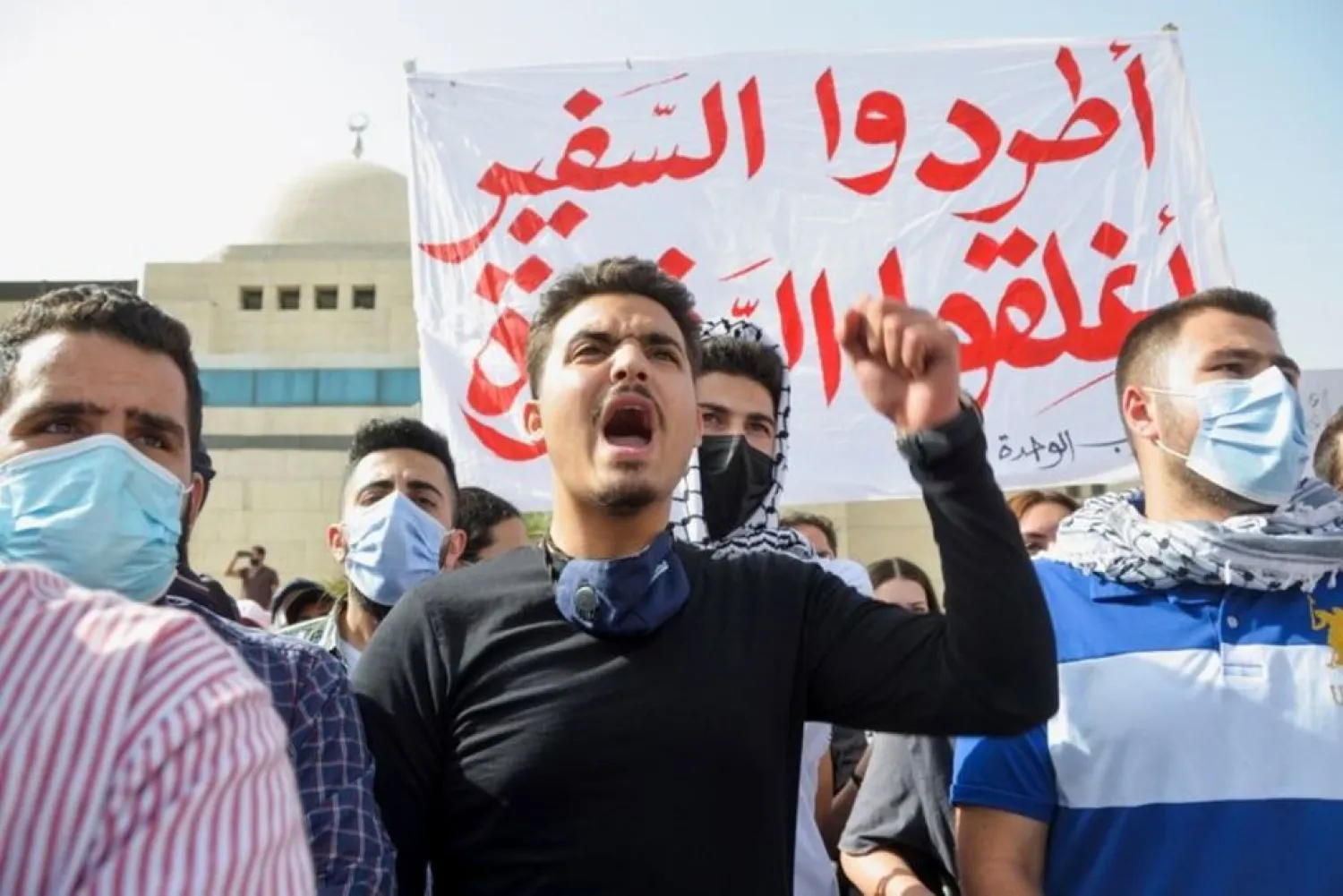

Jordanians Protest Against Israel over Al-Aqsa Violence

Jordanians demonstrate to express solidarity with the Palestinian people, near the Israeli embassy in Amman, Jordan May 10, 2021. (Reuters)
TT

Jordanians Protest Against Israel over Al-Aqsa Violence

Jordanians demonstrate to express solidarity with the Palestinian people, near the Israeli embassy in Amman, Jordan May 10, 2021. (Reuters)

Several thousand Jordanians protested near Israel's embassy in Amman on Monday, calling on their government to scrap its peace deal with Israel in the face of serious Israeli-Palestinian clashes around Jerusalem's Al-Aqsa Mosque.

Riot police blocked roads leading to the fortified embassy complex to keep back demonstrators who gathered around the Kaloti mosque in the capital near the Israeli mission.

"No Jewish embassy on Arab land!" protesters chanted. Others clapped when they heard that the Palestinian group Hamas, which rules the Gaza Strip, had fired rockets toward the Jerusalem area and southern Israel on Monday.

"Revenge...revenge...Oh, Hamas, bomb Tel Aviv!" they chanted.

Jordan which established diplomatic relations with Israel in 1994, summoned the Israeli charge d'affaires in Amman on Sunday to voice the kingdom's condemnation over what it said were Israeli "attacks on worshippers" around the Al-Aqsa compound, which is in the walled Old City of Jerusalem.

King Abdullah, whose Hashemite family has custodianship of Muslim and Christian holy sites in East Jerusalem, said Israel should respect worshippers and international law safeguarding Arab rights.

Al-Aqsa, Islam's third holiest site, has been a focal point of violence in Jerusalem throughout the Muslim holy month of Ramadan. Tensions have been especially high due to the planned evictions of several Palestinian families from a neighborhood in East Jerusalem to make way for Jewish settlers.

Most of Jordan's 10 million citizens are of Palestinian origin. They or their parents were expelled or fled to Jordan in the fighting that accompanied the creation of Israel in 1948.

They have close family ties with their kin on the other side of the Jordan River in the West Bank and East Jerusalem, both captured by Israel in the 1967 Arab-Israeli war.



Extensive Power Cuts Hamper Life in Sudan

A blacksmith attempts to operate a welding machine at his workshop in Omdurman, Sudan, August 20, 2026. (Reuters)
TT

Extensive Power Cuts Hamper Life in Sudan

A blacksmith attempts to operate a welding machine at his workshop in Omdurman, Sudan, August 20, 2026. (Reuters)

Sudanese welder Shannan Mohammed has been building furniture for a family in Omdurman little by little as constant blackouts interrupt his work.

Pointing to half-built doors, chairs, and tables in the courtyard of a home, he says, "All this is money that has been frozen because of lack of electricity stopping the work."

Army-controlled areas of Sudan have been plagued by blackouts that have worsened recently due to a combination of targeting of the power grid by the ‌rival Rapid Support ‌Forces (RSF) and meager government funding to carry out ‌repairs.

The ⁠blackouts have impeded ⁠the lives of hundreds of thousands who have returned to Khartoum since the army retook it last year and have undermined attempts to rebuild the devastated economy.

"They give you five hours [of power], and then it cuts. It comes back the next day. And it has no benefit for a working person because it comes at night," ⁠Mohammed said.

Even household tasks have become impossible, Mohammed's sister ‌Awatef told Reuters.

"Every time I ‌do the laundry, I don't get to finish it because the power cuts ‌off," she said. "We only eat take-out from the street, so ‌that nothing is left over for us to put in the refrigerator."

High gas prices put generators out of reach for many. Earlier this month, Sudan's prime minister exempted solar panels for personal use from customs and fees.

The conflict ‌in Sudan has increasingly turned into a drone war, with both sides targeting key civilian infrastructure ⁠in addition to ⁠military targets. The war has devastated livelihoods and spread famine in multiple parts of the country.

"The targeting of the electricity sector in particular was very significant," said a spokesperson for the Khartoum state government, Altayeb Saadeldin, listing looting of copper wires and fuel and other components, as well as drone attacks, as reasons for the outages.

Sudan's main power source, the Merowe dam, had been among targets hit, he said, adding that the delay of annual rains had also impacted power generation in other dams.

Asked for comment, an RSF source said allegations that the RSF had targeted the power grid were "incorrect and army propaganda".


US Ambassador: Hezbollah Ties to Iran Affect Lebanon and the Course of Talks

President Joseph Aoun presiding over a ceremony marking the 81st anniversary of General Security (Lebanese Presidency)
TT

US Ambassador: Hezbollah Ties to Iran Affect Lebanon and the Course of Talks

President Joseph Aoun presiding over a ceremony marking the 81st anniversary of General Security (Lebanese Presidency)

The stalled US-Iranian negotiations remain uncertain, and their direct or indirect impact on Lebanon continues to loom over efforts to achieve tangible results in talks with Israel, meanwhile President Joseph Aoun reaffirmed the state's commitment to its institutions and role.

US Ambassador to Lebanon Michel Issa made notable remarks, linking developments in southern Lebanon to events unfolding between Washington and Tehran. He also stressed that any engagement with Hezbollah would take place only through the Lebanese state.

Aoun: State moving forward

Aoun said the state was continuing to strengthen its presence and institutions, alongside the negotiations.

"We are engaged in an internal struggle between people who do not want state institutions, who are the antithesis of the state and live at its expense in its absence, and between us and you, who want the state and its institutions," Aoun said during a ceremony marking the 81st anniversary of the General Security.

He added: “We here tell them, whatever you do, we will continue. Not for your sake, but for the sake of citizens to whom we owe a duty."

Issa: Southern Lebanon talks tied to Washington-Tehran Tension

US Ambassador to Lebanon Michel Issa said negotiations over southern Lebanon cannot be separated from regional developments, particularly talks between Washington and Tehran.

He said Hezbollah must surrender its weapons to the state, adding that continued links between the group and Iranian decision-making are affecting Lebanon and the course of negotiations.

Ministerial sources said US-Lebanese-Israeli talks would continue, with a new round expected in Rome in September, but acknowledged that progress hinges partly on the outcome of US-Iranian negotiations and Tehran’s ties with Hezbollah.

Issa clarifies US position: Any Contact with Hezbollah to Go Through the State

US Ambassador Michel Issa clarified that any US engagement with Hezbollah would take place through the Lebanese state, saying Washington could help bridge differences through negotiations. He reiterated that Hezbollah must surrender its weapons and accused the group of taking orders from Iran.

Issa also said talks with Israel are between the Lebanese and Israeli states, with Washington seeking to narrow differences while pressing Israel to reduce strikes in southern Lebanon. He added that Hezbollah’s future would depend partly on whether Iran maintains its support for the group.


Arms Embargo: Can Washington Breach the Wall of Sudan’s War?

Massad Boulos, senior adviser to the US president for Arab and African affairs (AFP) 
TT

Arms Embargo: Can Washington Breach the Wall of Sudan’s War?

Massad Boulos, senior adviser to the US president for Arab and African affairs (AFP) 

The United States has stirred the stagnant waters of Sudan’s war by announcing plans to expand an arms embargo imposed on Darfur for more than two decades to cover the entire country.

The move appears aimed at shifting from limited sanctions to a direct attempt to reduce the warring parties’ ability to keep fighting and force them to reconsider the cost of seeking a military victory compared with returning to negotiations. It is a risky step, but one that also signals Washington’s determination to make a breakthrough in a war described as one of the world’s largest and most severe humanitarian crises.

Massad Boulos, senior advisor to the US president for Arab and African affairs, told the UN Security Council days ago that the US proposal would cover drones, related technologies and components, while strengthening the work of the sanctions panel of experts tasked with monitoring violations.

The current Darfur arms embargo expires Sept. 12, making the coming weeks a test of Washington’s ability to build consensus in the Security Council. Russia has voiced clear reservations, saying it would not accept measures affecting the Sudanese army’s capabilities, while China has taken a cautious position on expanding sanctions, leaving adoption of the proposal in its current form uncertain.

Washington views the proposed embargo as a pressure tool rather than merely a punitive measure. According to The Associated Press, the US administration believes restricting the flow of weapons to the belligerents could push them back to the negotiating table. UN political affairs chief Rosemary DiCarlo has meanwhile warned against the parties’ continued reliance on a military solution and the steady influx of sophisticated weapons.

Sudan’s Sovereignty Council chairman and army chief Gen. Abdel Fattah al-Burhan, however, has played down the possible impact of sanctions, saying they would neither affect Sudan nor weaken the armed forces’ resolve. He insisted the army would continue fighting until it retakes all areas controlled by the Rapid Support Forces.

The contrast shows the political struggle surrounding the US proposal. Washington wants to convince both sides that the flow of weapons cannot remain open-ended, while Sudan’s military leadership continues to speak in terms of retaking territory by force. The RSF is likewise reinforcing its positions and relying on supply networks, weapons and drones.

The US premise is that the ability to rearm prolongs the war: As long as each side believes it can replace its losses and obtain more drones, ammunition, fuel and financing, its incentive to compromise remains limited. If supplies become more difficult and costly, military calculations could gradually shift toward a settlement.

Drone use has expanded significantly in recent months, with attacks extending beyond front lines to cities, markets, electricity and water facilities and health infrastructure. Rosemary DiCarlo, the UN's under secretary-general for political and peacebuilding affairs, said sophisticated weapons, including drones, have become a major factor in increasing the war’s toll on civilians.

Restricting drones and their components, ammunition and heavy weapons could therefore yield an immediate humanitarian benefit by reducing long-range attacks, civilian casualties, displacement and disruption to hospitals and electricity and water networks, while improving humanitarian access.

But the plan’s success will depend on enforcement. The Darfur embargo, in place since 2005, failed to stop weapons from entering the region, exposing the limits of UN resolutions without effective monitoring and enforcement mechanisms.

Opposition Welcomes Proposal

Sudanese civilian opposition forces welcomed the US proposal while stressing that it should be linked to a comprehensive political process.

Khalid Omer Yousif, a leader in the Sumoud alliance, said pressure on both warring parties should be part of an “integrated package” to end the fighting and restore the civilian political process, rather than an isolated punitive measure.

Yasir Arman, head of the Sudan People’s Liberation Movement–Revolutionary Democratic Current, warned that piecemeal measures could lead to “managing the war rather than ending it,” calling for a joint African Union-UN roadmap to halt the fighting and preserve Sudan’s unity.

The real test of Washington’s seriousness will be whether it can move from a Security Council resolution to pursuing supply networks, including flights, land routes, brokers, companies and individuals facilitating the purchase and transfer of weapons to Sudan.

Washington does not appear to be relying on the embargo alone to end the war. Rather, the proposal is likely part of a broader effort to raise the cost of continued fighting while pushing for negotiations. US officials say the goal is not to hand victory to one side over the other, but to reduce both sides’ ability to wage an open-ended war.

Ultimately, the seriousness of the US effort will be measured by its willingness to pressure the parties’ backers, not only the Sudanese belligerents themselves. If weapons continue to flow, expanding the embargo will amount to little more than a legal framework with limited effect. But if combined with monitoring, sanctions and simultaneous diplomatic pressure to reopen negotiations, it could become one of the strongest international tools of pressure deployed since the war began.

At its core, the US proposal brings two opposing calculations into direct confrontation: Washington wants to make continuing the war harder and more costly, while both sides insist on fighting until they recover all territory. Between them, civilians stand to benefit most from any measure that genuinely reduces the flow of instruments of war, even before a comprehensive political settlement is reached.