

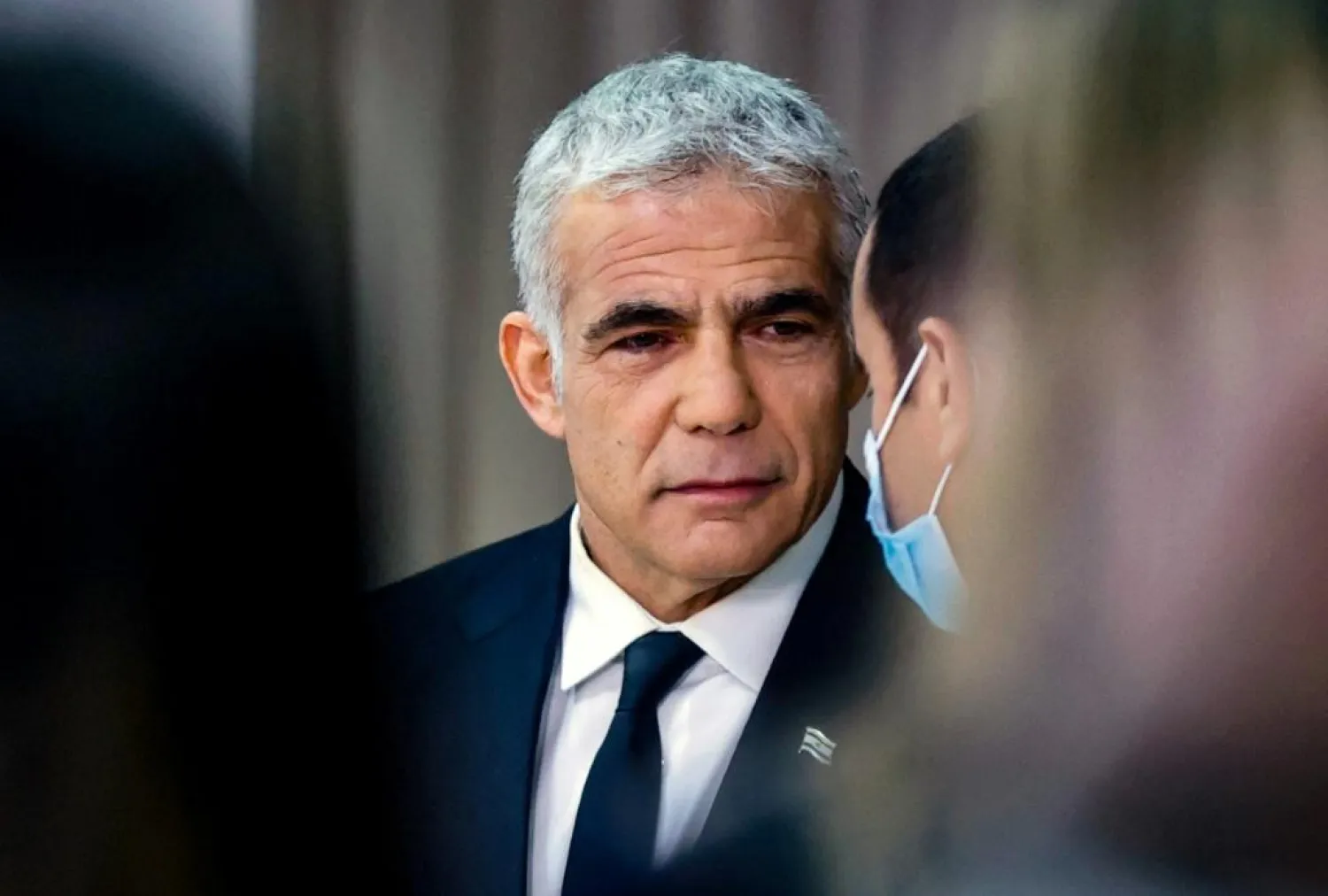

Gaza Violence and Unrest at Home Raise Specter of New Israel Election

Israel's centrist opposition leader Yair Lapid has until June 3 to form a government - AFP
TT

Gaza Violence and Unrest at Home Raise Specter of New Israel Election

Israel's centrist opposition leader Yair Lapid has until June 3 to form a government - AFP

Israel's battle with Gaza militants and unprecedented inter-communal violence at home have further complicated efforts to form a government, raising the specter of yet another general election, experts say.

That could be a political boon to Prime Minister Benjamin Netanyahu, whose best hope of extending his record 12 straight years in office could hang on a fifth Israeli election since April 2019.

But the ideologically divided anti-Netanyahu camp still has a narrow window to reach a deal that would oust the hawkish premier: centrist opposition leader Yair Lapid's 28-day mandate to form a government expires on June 3.

"Most analysts regard a fifth election as the most probable outcome," said Toby Greene, a political scientist at Bar Ilan University.

"But we have 10 days left, and that's a very long time in Israeli politics."

A Lapid-Bennett deal would have required at least some support from pro-Palestinian and non-Zionist Arab lawmakers, which was already uncomfortable political terrain both for them and for Bennett, a Jewish nationalist.

The chances of such a deal took a severe blow earlier this month as Gaza militants launched rockets into Israel and Arab rioters torched synagogues in multiple mixed communities inside Israel.

That forced Bennett to "reconsider his choice to form a government together with Arab-supported parties," said Yohanan Plesner, president of the Israel Democracy Institute think-tank.

Before conflict flared with armed Palestinian groups Hamas and Islamic Jihad on May 10, Netanyahu's political future looked precarious.

On trial for bribery, fraud and breach of trust, the premier had failed in a March 23 vote to secure enough seats with his allies to build a majority in Israel's 120-seat parliament.

His mandate to form a government expired on May 4, handing Lapid a chance to try.

But Yonatan Freeman, a political scientist at the Hebrew University of Jerusalem, said it was in Israel's "political DNA to support the incumbent" when conflict flares.

As Israel ramped up its air strikes in Gaza in response to Palestinian rocket attacks, Netanyahu made joint appearances with his bitter political enemy, Defense Minister Benny Gantz.

Crisis leadership, experts say, may have helped Netanyahu reinforce an image that has helped him endure in politics for decades: the security-focused statesman who defends Israel against external threats.

The crisis also "caused a fissure among the opposing camp," Plesner said.

Lapid's best, and possibly only, hope of forming a government involved a prospective deal with Naftali Bennett, leader of the right-wing religious Yamina party.

Bennett and Lapid are ideological opponents, but both have prioritized averting a fifth election and ending the divisive Netanyahu era.

A deal would have seen Bennett serving as prime minister in a rotation, a move that could harm his standings among some rightwing supporters.

But at the same time, it would constitute a "huge opportunity for Bennett to present himself as prime ministerial material" as part of his efforts to become Netanyahu's successor, Greene said.

And without Bennett, centrist former television anchor Lapid has little space to make a deal to unite the splintered anti-Netanyahu camp.

After the Gaza crisis, "it's unlikely, but not impossible," Plesner said.

He added that Netanyahu, "as Israel's most seasoned politician," may be now able to coax rivals into his camp.

He listed Gantz and Gideon Saar, a right-winger who defected from Netanyahu's Likud last year, as possible candidates.

But with all blocs struggling to build a coalition, "the most likely outcome at this point is that Israel is headed to a fifth election," Plesner said.

After Israel agreed a mutual ceasefire with Hamas and Islamic Jihad and the inter-communal violence eased, Lapid's Yesh Atid party said coalition talks would resume Monday.

It said Bennett's Yamina would not attend.

Yet Freeman of the Hebrew University said the crisis could actually drive momentum towards a unity government.

The inter-communal violence saw both Arab and Jewish rioters attack religious sites, among other targets.

Freeman told AFP the Arab violence in solidarity with Gaza raised profound concern across Israel's security establishment: if the Hamas conflict were to flare again, so could the internal strife.

He suggested that the imperative to offer Arab lawmakers a role in the government as a gesture of unity could create incentive for political compromise in the days ahead.

Whether Netanyahu or another leader is capable of crafting a broad, inter-communal coalition remains highly uncertain.

But, Freeman said, "people are looking for ways to mitigate against this violence happening again. Bringing more Arab politicians into the fold could be a way of doing that".



Israel Army Says on ‘Defensive Alert’ Regarding Iran but No Change to Public Guidelines

Israeli air defense system fires to intercept missiles during an Iranian attack over Tel Aviv, Israel, Thursday, June 19, 2025. (AP)
TT

Israel Army Says on ‘Defensive Alert’ Regarding Iran but No Change to Public Guidelines

Israeli air defense system fires to intercept missiles during an Iranian attack over Tel Aviv, Israel, Thursday, June 19, 2025. (AP)

The Israeli army said it was on "defensive alert" as the United States threatens potential military action against Iran, but insisted there were no changes in its guidelines for the public.

"We are closely monitoring regional developments and are aware of the public discourse concerning Iran. The (Israeli military) is on defensive alert," army spokesman Brigadier General Effie Defrin said in a video statement published Friday.

"Our eyes are wide open in all directions, and our finger is more than ever on the trigger in response to any change in the operational reality," he added, but emphasized "there is no change in the instructions".


Trump Says Weighing Strike on Iran as Tehran Says Draft Deal Coming Soon

US President Donald Trump speaks during a Governors Working Breakfast in the State Dining Room of the White House in Washington, DC, USA, 20 February 2026. (EPA)
TT

Trump Says Weighing Strike on Iran as Tehran Says Draft Deal Coming Soon

US President Donald Trump speaks during a Governors Working Breakfast in the State Dining Room of the White House in Washington, DC, USA, 20 February 2026. (EPA)

US President Donald Trump said he was considering a limited strike on Iran after ordering a major naval buildup in the Middle East aimed at heaping pressure on Tehran to cut a deal to curb its nuclear program.

The latest threat came after Iran's foreign minister said a draft proposal for an agreement with Washington would be ready in a matter of days following negotiations between the two sides in Geneva earlier this week.

Trump had suggesting on Thursday that "bad things" would happen if Tehran did not strike a deal within 10 days, which he subsequently extended to 15.

Asked by a reporter on Friday whether he was contemplating a limited military strike, Trump answered: "The most I can say -- I am considering it."

After the talks in Geneva, Tehran said the two sides had agreed to submit drafts of a potential agreement, which Iranian Foreign Minister Abbas Araghchi told US media would be the "next step".

"I believe that in the next two, three days, that would be ready, and after final confirmation by my superiors, that would be handed over to Steve Witkoff," he said, referring to Trump's main Middle East negotiator.

Araghchi also said US negotiators had not requested that Tehran end its nuclear enrichment program, contradicting statements from American officials.

"We have not offered any suspension, and the US side has not asked for zero enrichment," he said in an interview released Friday by US TV network MS NOW.

"What we are now talking about is how to make sure that Iran's nuclear program, including enrichment, is peaceful and would remain peaceful forever," he added.

His comments stand in contrast to information relayed by high-ranking US officials, including Trump, who has repeatedly said Iran must not be allowed to enrich uranium at any level.

Western countries accuse Tehran of seeking to acquire nuclear weapons, which it denies, though it insists on its right to enrichment for civilian purposes.

Iran, for its part, is seeking to negotiate an end to sanctions that have proven to be a massive drag on its economy.

Economic hardships sparked protests in December that evolved into a nationwide anti-government movement last month, prompting a crackdown from authorities that left thousands dead, rights groups say.

- 'No ultimatum' -

The two foes held an initial round of discussions on February 6 in Oman, the first since previous talks collapsed during the 12-day Iran-Israel war last June, which the US joined by striking Iranian nuclear facilities.

Washington has pursued a major military build-up in the region in tandem with the talks, and both sides have traded threats of military action for weeks.

On Thursday, Trump again suggested the US would attack Iran if it did not make a deal within the timeframe he laid out.

"We have to make a meaningful deal otherwise bad things happen," Trump told the inaugural meeting of the "Board of Peace", his initiative for the post-war Gaza Strip.

Iran's ambassador to the UN, Amir Saeid Iravani, warned that US bases, facilities and assets would be "legitimate targets" if the United States followed through on its threats.

Araghchi, however, insisted that "there is no ultimatum".

"We only talk with each other how we can have a fast deal. And a fast deal is something that both sides are interested about," he said.

"We are under sanctions, (so) obviously any day that sanctions are terminated sooner it would be better for us," he said, adding Iran had "no reason to delay".

Washington has repeatedly called for zero enrichment, but has also sought to address Iran's ballistic missile program and its support for militant groups in the region -- issues which Israel has pushed to include in the talks.

The Israeli army said Friday that it was on "defensive alert" regarding the situation with Iran, but that its guidelines for the public remained unchanged.

Ratcheting up the pressure, Trump has deployed a significant naval force to the region.

After sending the aircraft carrier USS Abraham Lincoln and escort battleships to the Gulf in January, he ordered a second carrier, the Gerald Ford, to depart for the Middle East.

Iranian naval forces also conducted military drills this week in the Gulf and around the strategic Strait of Hormuz in their own show of force.


UK Foreign Minister to Meet Rubio amid Tensions over Joint Air Base

British Foreign Secretary Yvette Cooper, president of the United Nations Security Council for February speaks during a press conference before the Security Council meeting, at UN headquarters in New York City, US, February 19, 2026. REUTERS/Jeenah Moon
TT

UK Foreign Minister to Meet Rubio amid Tensions over Joint Air Base

British Foreign Secretary Yvette Cooper, president of the United Nations Security Council for February speaks during a press conference before the Security Council meeting, at UN headquarters in New York City, US, February 19, 2026. REUTERS/Jeenah Moon

Britain's foreign minister Yvette Cooper ‌will meet with US Secretary of State Marco Rubio on Friday, after President Donald Trump renewed his criticism of London for ceding sovereignty of ​the Chagos Islands, which is home to a US-UK air base.
Last year, British Prime Minister Keir Starmer agreed a deal to transfer sovereignty of the Indian Ocean islands to Mauritius, while keeping control of one - Diego Garcia - through a 99-year lease that preserved US operations at the base, Reuters said.
Washington last year gave its blessing to the agreement, but Trump has since ‌changed his mind ‌several times. In January, Trump described it ​as ‌an ⁠act ​of "great stupidity", ⁠but earlier this month said he understood the deal was the best Starmer could make, before then renewing his criticism this week.
Cooper is meeting Rubio to discuss defense and security issues in Washington as Trump also toughens his rhetoric on Iran, saying Tehran must make a deal over its nuclear program in the ⁠next 10 to 15 days, or "really bad ‌things" will happen.
The Diego Garcia ‌base has recently been used for ​operations in the Middle East against ‌Yemen's Houthis and in humanitarian aid to Gaza.
Although on Tuesday ‌Rubio's State Department said it backed the Chagos accord, the next day Trump said Britain was making a big mistake.
"DO NOT GIVE AWAY DIEGO GARCIA!" Trump wrote in a post on Truth Social, saying the ‌base could be called upon in any future military operation to "eradicate a potential attack" from ⁠Iran.
Under the ⁠conditions for using the joint base, Britain would need to agree in advance to any operations out of Diego Garcia.
On Thursday, Britain's The Times newspaper reported that Trump's latest criticism of the Chagos deal came because Britain was yet to give permission to use the bases for future strikes against Iran, owing to concerns they may breach international law.
Asked about The Times report, Britain's Ministry of Defence said on Thursday it does not comment on operational matters and that Britain supported ​the ongoing political process between ​the US and Iran.