


Somalia Govt Says to Hold Elections Within 60 Days

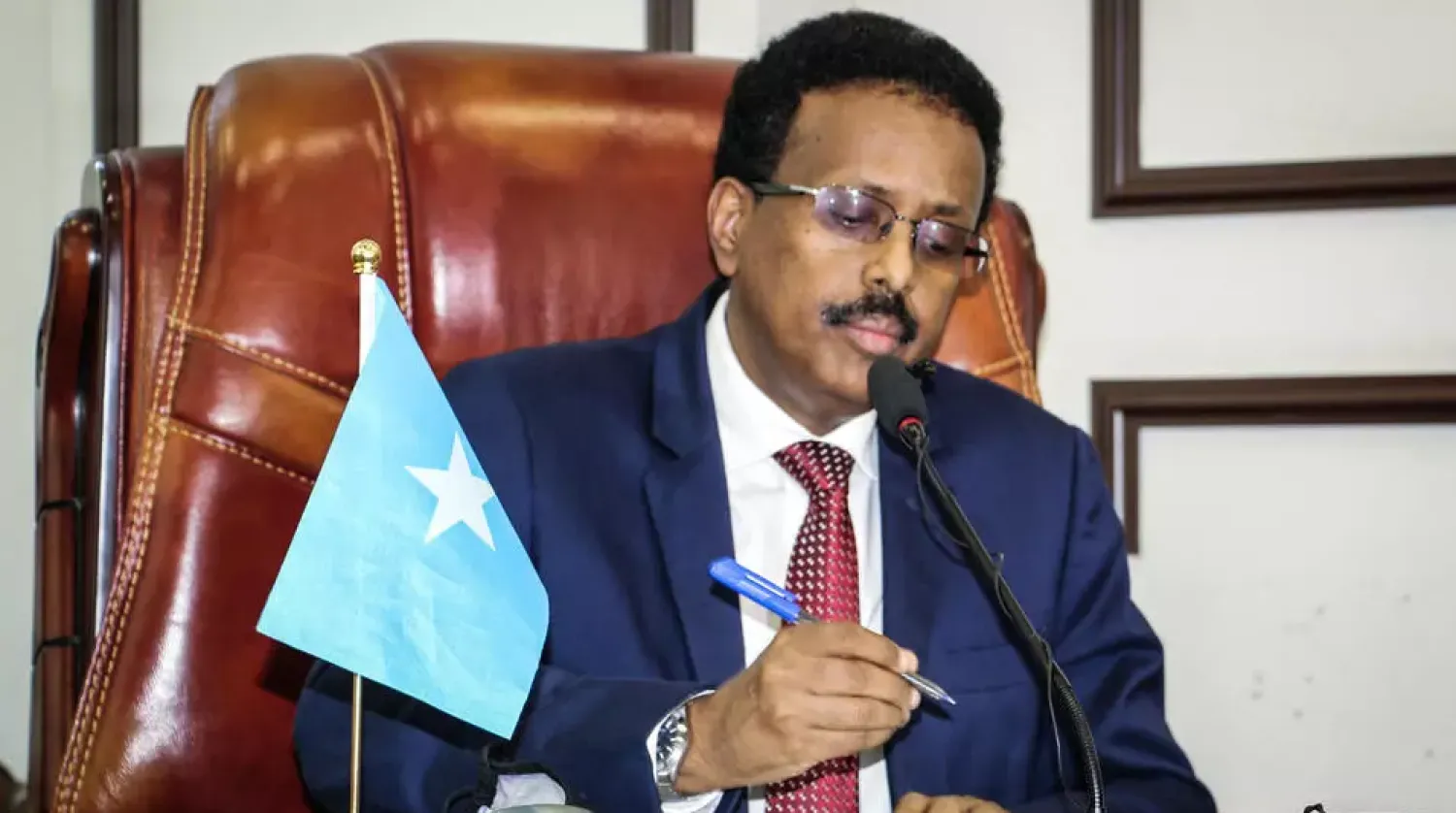
President Mohamed Abdullahi Mohamed  - AFP
President Mohamed Abdullahi Mohamed - AFP
TT

Somalia Govt Says to Hold Elections Within 60 Days

President Mohamed Abdullahi Mohamed  - AFP
President Mohamed Abdullahi Mohamed - AFP

Somalia's government announced on Thursday that delayed elections would be held within 60 days, following months of deadlock over the vote that erupted into violence in the troubled country.

President Mohamed Abdullahi Mohamed and state leaders had been unable to agree on the terms of a vote before his term lapsed in February, triggering an unprecedented constitutional crisis.

The political impasse exploded into violence in April when negotiations collapsed and the lower house of parliament extended the president's mandate by two years, sparking gun battles on the streets of Mogadishu.

Under pressure the president, better known as Farmajo, reversed the mandate extension and ordered his prime minister to reconvene with the leaders of Somalia's five states to chart a fresh roadmap toward elections.

"About the schedule of elections, the national consultative forum agreed that elections will be held within 60 days," said deputy information minister Abdirahman Yusuf at the conclusion of five days of negotiations in the capital.

The exact dates for parliamentary and presidential elections would be determined by the electoral board, he added.

"It is a historic day," said Prime Minister Mohamed Hussein Roble, whose office will take charge of overseeing the electoral process.

"After days of discussions involving respect, patience and compromise, we have succeeded in reaching consensus over the disputed issues of the elections."

Somalia's elections follow a complex indirect model whereby special delegates chosen by the country's myriad clan elders pick lawmakers, who in turn choose the president.

The United Nations has described a one-person, one-vote election as essential for Somalia's democratization after decades of chaos and instability.

But the milestone has eluded the fragile country for half a century, hobbled by political infighting, logistical problems and a violent armed insurgency by the Al-Shabaab militant group.

Farmajo and the states agreed in September on a path to elections, again abandoning universial franchise for the indirect model, but increasing the number of delegates to make the process more inclusive.

But distrust over key appointments to crucial election committees, fears of rigging, and concerns about securing the vote itself, scuttled the plan.

Months of UN-backed negotiations failed to get the timetable back on track, with the crisis culminating in parliament approving the mandate extensions despite opposition from the Senate and the states.

The crisis stoked fears of outright civil war as soldiers deserted their posts in the countryside to fight for their political allegiances in the capital.

At least three people died in the clashes, with government losing control of key parts of Mogadishu as roads were sandbagged and fighters with machine guns watched key junctions.

The fighting drove tens of thousands of people from their homes, as Somalia's international partners called for a ceasefire and urged the warring sides to again come to the table.

Opposition forces withdrew in early May after Roble assured the political opposition that their concerns would be heard.

The US, one of Somalia's key foreign backers, had threatened sanctions if the Horn of Africa nation did not hold elections soon.

Somalia has not had an effective central government since the collapse of Siad Barre's military regime in 1991, which led to decades of civil war and lawlessness fuelled by clan conflicts.

The country also still battles the Al-Qaeda-linked Al-Shabaab group which controlled the capital until 2011 when it was pushed out by African Union troops.



Russia Evacuates 198 Workers from Iran Nuclear Plant Amid Airstrike

Rosatom State Atomic Energy Corporation Director General Alexey Likhachev arrives to attend the talks between Russian President Vladimir Putin and Armenian Prime Minister Nikol Pashinyan at the Kremlin in Moscow, Russia, 01 April 2026. (EPA/Pavel Bednyakov/AP Pool)
TT

Russia Evacuates 198 Workers from Iran Nuclear Plant Amid Airstrike

Rosatom State Atomic Energy Corporation Director General Alexey Likhachev arrives to attend the talks between Russian President Vladimir Putin and Armenian Prime Minister Nikol Pashinyan at the Kremlin in Moscow, Russia, 01 April 2026. (EPA/Pavel Bednyakov/AP Pool)

Russia started a planned evacuation of 198 workers from Iran's Bushehr atomic plant shortly after a US-Israeli projectile hit near the facility, Russian state media said on Saturday.

This was a third evacuation from the facility in southern Iran on the Gulf coast, which was built with Moscow's help, with about 100 Russian staff remaining there by now.

The area around Bushehr has been struck four times during this war. The latest attack on Saturday saw one person -- a guard at the facility -- killed, but did not damage the plant itself, according to Iranian state media.

"As planned, we began the main phase of the evacuation today," Russia's nuclear agency Rosatom head Alexey Likhachev was quoted as saying by Russia's TASS news agency.

"About 20 minutes after that ill-fated strike, buses set off from Bushehr station towards the Iranian-Armenian border (with) 198 people, to be precise -- this is the largest evacuation," he added.

Likhachev also said that Russia informed the US and Israel about the evacuation.

"The likelihood of a risk of damage or a potential nuclear incident is, unfortunately, only increasing, as has been confirmed by this morning's events," the Rosatom CEO said.

The agency plans to keep only a skeleton staff at Bushehr amid the threat of further strikes.

The Russian foreign ministry slammed the "evil" US-Israeli attack and urged a cessation of hostilities on Iranian nuclear facilities immediately.


Erdogan Says Middle East War Has Caused ‘Geostrategic Impasse’

This handout photograph taken and released by the Turkish presidential press service on April 4, 2026, shows Türkiye's President Recep Tayyip Erdogan (R) welcoming and shaking hands Ukraine's President Volodymyr Zelensky (L) upon arrival for a bilateral meeting on security at Dolmabahce Presidential Office, in Istanbul. (Turkish Presidential Press Service / AFP)
TT

Erdogan Says Middle East War Has Caused ‘Geostrategic Impasse’

This handout photograph taken and released by the Turkish presidential press service on April 4, 2026, shows Türkiye's President Recep Tayyip Erdogan (R) welcoming and shaking hands Ukraine's President Volodymyr Zelensky (L) upon arrival for a bilateral meeting on security at Dolmabahce Presidential Office, in Istanbul. (Turkish Presidential Press Service / AFP)

Türkiye's President Recep Tayyip Erdogan said the war in the Middle East had led to a "geostrategic impasse", during a telephone conversation with NATO chief Mark Rutte, his office said Saturday.

"President Erdogan said the process started by the intervention against Iran had led to a geostrategic impasse and that the international community had to redouble its efforts to bring an end to this war," said the statement.

Türkiye has attempted to mediate an end to the hostilities, notably through negotiations conducted with Pakistan and Egypt.

Erdogan said his country was also continuing efforts "to reach a peaceful outcome" to the conflict between Russia and Ukraine.

Ukrainian President Volodymyr Zelensky arrived in Istanbul Saturday for talks with Erdogan.

A senior Ukrainian official told AFP that the talks would not only be about drone interceptors but also about security cooperation in general.

The Turkish presidency said on X that the talks would focus "efforts towards a ceasefire and a lasting solution."


Several Injured in Israel by Iran Missile Fire

A picture shows the damage at a factory that got hit by a missile in Petah Tikva, east of Tel Aviv, on April 3, 2026. (AFP)
TT

Several Injured in Israel by Iran Missile Fire

A picture shows the damage at a factory that got hit by a missile in Petah Tikva, east of Tel Aviv, on April 3, 2026. (AFP)

Israeli emergency services said its crew treated five people who were injured Saturday in Tel Aviv and surrounding areas after Iran fired several rounds of missiles toward Israel.

Since midnight, seven waves of Iranian missiles have been launched towards Israel, according to the Israeli military.

Israel's Magen David Adom emergency services said a 45-year-old man was treated for minor injuries from glass shrapnel in the central city of Bnei Brak and taken to hospital.

As the day progressed, rescue teams said they had treated three additional casualties -- two men in their 20s hit by glass fragments and one injured by blast.

A 52-year-old man "lightly injured by the blast wave" was also transferred to a hospital in Ramat Gan, in central Israel, the emergency service said.

In a residential neighborhood of Ramat Gan, AFP images showed the top floor of a house completely blown out, exposing its gutted interior, with a crushed bookcase and an exercise bike amid the debris.

Numerous impact marks were visible on the walls.

Nearby, another home was largely destroyed, stripped of its outer walls, according to AFP photographs.

"All this is from shrapnel," Joy Frankel, a social worker told AFP near one of the impacted sites.

According to several local media outlets, including The Times of Israel, a cluster munition missile fired from Iran on Saturday morning landed near the Kirya military base in Tel Aviv, not far from the defense ministry.

The military said its air defenses were working to down missiles fired from Iran, each a time it announced incoming projectiles.

Since February 28, the United States and Israel have conducted joint strikes against Iran, prompting the Tehran to retaliate with daily missile barrages targeting Israel and several neighboring countries across the region.