

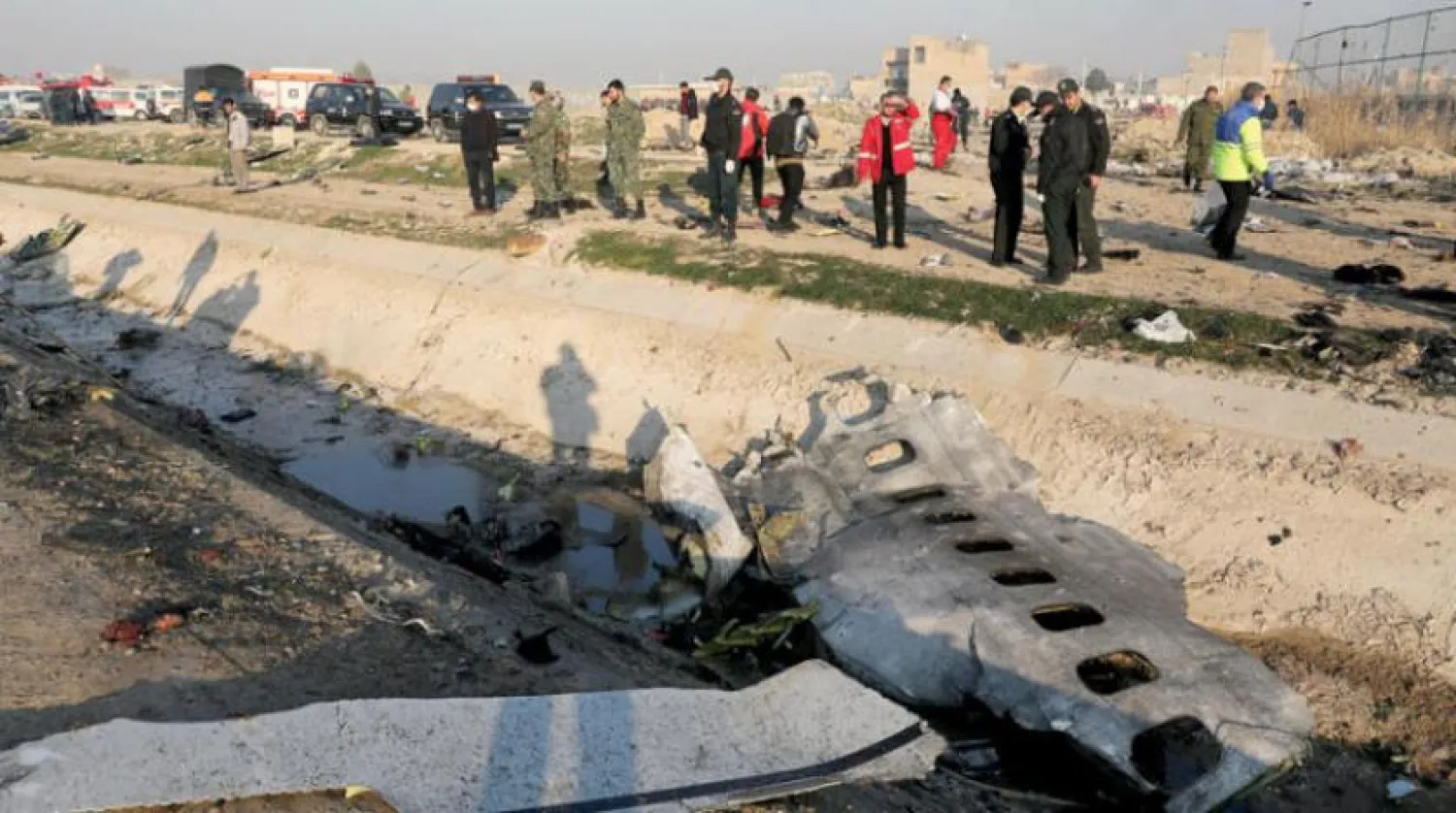

HRW: Ukraine Airline Victims’ Families Harassed, Abused

The debris of the Ukrainian plane that was shot down by Iran southwest of Tehran (AP)
TT

HRW: Ukraine Airline Victims’ Families Harassed, Abused

The debris of the Ukrainian plane that was shot down by Iran southwest of Tehran (AP)

The Human Rights Watch (HRW) reported that Iranian authorities have engaged in a campaign of harassment and abuse against families of people killed in the Iranian Revolutionary Guard’s (IRGC) downing of Ukraine International Airlines Flight 752 in January 2020.

The authorities indicted 10 people for their role in the incident but have not provided any public information about their identities, ranks, or the charges against them.

Governments participating in the Flight 752 investigation should support family members of victims in pursuing a path for justice and accountability, said HRW.

The organization interviewed 31 family members of victims and people with direct knowledge from October 2020 to January 2021. They said that Iran’s security agencies had arbitrarily detained, summoned, abusively interrogated, tortured, and otherwise mistreated victims’ family members.

The agencies also failed to return victims’ possessions to their relatives and interfered with burial and memorial gatherings in an apparent attempt to curtail efforts for accountability.

HRW deputy Middle East director Michael Page said that IRGC killed 176 people without a shred of accountability, and now Iran’s brutal security agencies are abusing victims’ family members to squash any hope for justice.

“Rather than attempting to regain people’s trust through a transparent investigation and redress for the families, the authorities are again silencing accountability efforts.”

On January 8, 2020, the Ukrainian plane was downed close to Tehran’s Imam Khomeini international airport. After several initial denials, the Armed Forces Central Command admitted on January 11 that IRGC had “mistakenly” shot down the passenger jet, killing all 176 passengers and crew on board.

Iranian authorities said that “human error” by a missile operator led to launching two surface-to-air missiles at the plane. But they did not disclose critical evidence supporting the claim and have not provided any details of their judicial investigation.

The cabinet announced that it had allocated $150,000 to compensate the family of each passenger.

On March 17, Iran’s Aircraft Accident Investigation Board published its final report on the incident in which it said, based on information provided by the military, that Iranian missiles were launched at the plane due to a 105-degree miscalibration of the launcher’s radar.

The report did not clarify inconsistencies in the Iranian government’s findings raised by various independent observers, including the UN special rapporteur on extrajudicial executions in a detailed letter to the Iranian government in December.

The foreign affairs and transport ministers of Canada, the intended destination of most of the passengers, indicated that the report makes no attempt to answer critical questions about what truly happened. “It appears incomplete and has no hard facts or evidence.”

On May 20, a Canadian court ruled in a civil lawsuit that “on the balance of probabilities, the missile attacks on Flight 752 were intentional and directly caused the deaths of all on board.”

After Iranian authorities admitted they shot down the plane, protests broke out in several Iranian cities, and security forces responded with rubber bullets, pepper spray, and tear gas.

Over the past year, courts have sentenced at least 20 people in connection with their participation in protests. At least three more participants are currently on trial.

At least 16 people said that security agencies threatened them not to participate in interviews with foreign media or had followed or summoned their relatives or friends who attended memorials and filmed those attending these events.

In some cases, security forces interrogated or detained family members for several hours, and in at least one case, the authorities tortured a person in custody.

In another case, plainclothes officers asked to meet a family member who had spoken against authorities’ conduct at a public place and threatened that person with prosecution.

Several of those interviewed said that the authorities returned important documents from the victims, but did not return any valuables, such as jewelry and electronic devices.

Videos and photos published two days after the crash show bulldozers demolishing the site before authorities had accepted responsibility for downing the plane, raising concerns that they failed to secure evidence that was then destroyed or left unusable for investigations or legal proceedings.



UN: At Least 15 Children Killed in Sudan Drone Strike

The war in Sudan, ongoing since mid-April 2023, has caused extensive destruction across the country (AFP)
TT

UN: At Least 15 Children Killed in Sudan Drone Strike

The war in Sudan, ongoing since mid-April 2023, has caused extensive destruction across the country (AFP)

A drone strike on a displacement camp in Sudan killed at least 15 children earlier this week, the United Nations reported late on Wednesday.

"On Monday 16 February, at least 15 children were reportedly killed and 10 wounded after a drone strike on a displacement camp in Al Sunut, West Kordofan," the UN children's agency said in a statement.

Across the Kordofan region, currently the Sudan war's fiercest battlefield, "we are seeing the same disturbing patterns from Darfur -- children killed, injured, displaced and cut off from the services they need to survive," UNICEF's Executive Director Catherine Russell said.


MSF Will Keep Operating in Gaza 'as Long as We Can'

(FILES) A Palestinian man walks on his crutches to the Doctors Without Borders or Medecins Sans Frontieres (MSF) clinic, in the al-Rimal neighborhood of Gaza City on new year's Eve, December 31, 2025. (Photo by Omar AL-QATTAA / AFP)
TT

MSF Will Keep Operating in Gaza 'as Long as We Can'

(FILES) A Palestinian man walks on his crutches to the Doctors Without Borders or Medecins Sans Frontieres (MSF) clinic, in the al-Rimal neighborhood of Gaza City on new year's Eve, December 31, 2025. (Photo by Omar AL-QATTAA / AFP)

The head of Doctors Without Borders in the Palestinian territories told AFP the charity would continue working in Gaza for as long as possible, following an Israeli decision to end its activities there.

In early February, Israel announced it was terminating all the activities in Gaza by the medical charity, known by its French acronym MSF, after it failed to provide a list of its Palestinian staff.

MSF has slammed the move, which takes effect on March 1, as a "pretext" to obstruct aid.

"For the time being, we are still working in Gaza, and we plan to keep running our operations as long as we can," Filipe Ribeiro told AFP in Amman, but said operations were already facing challenges.

"Since the beginning of January, we are not anymore in the capacity to get international staff inside Gaza. The Israeli authorities actually denied any entry to Gaza, but also to the West Bank," he said.

Ribeiro added that MSF's ability to bring medical supplies into Gaza had also been impacted.

"They're not allowed for now, but we have some stocks in our pharmacies that will allow us to keep running operations for the time being," he said.

"We do have teams in Gaza that are still working, both national and international, and we have stocks."

In December, Israel announced it would prevent 37 aid organizations, including MSF, from working in Gaza from March 1 for failing to submit detailed information about their Palestinian employees, drawing widespread condemnation from NGOs and the United Nations.

It had alleged that two MSF employees had links with Palestinian militant groups Hamas and Islamic Jihad, which the medical charity has repeatedly and vehemently denied.

MSF says it did not provide the names of its Palestinian staff because Israeli authorities offered no assurances regarding their safety.

Ribeiro warned of the massive impact the termination of MSF's operations would have for healthcare in war-shattered Gaza.

"MSF is one of the biggest actors when it comes to the health provision in Gaza and the West Bank, and if we are obliged to leave, then we will create a huge void in Gaza," he said.

The charity says it currently provides at least 20 percent of hospital beds in the territory and operates around 20 health centers.

In 2025 alone, it carried out more than 800,000 medical consultations, treated more than 100,000 trauma cases and assisted more than 10,000 infant deliveries.


Egyptian-Turkish Military Talks Focus on Strengthening Partnership

The Commander of the Egyptian Air Force during his meeting with the Turkish Air Force chief in Cairo on Wednesday (Egyptian military spokesperson)
TT

Egyptian-Turkish Military Talks Focus on Strengthening Partnership

The Commander of the Egyptian Air Force during his meeting with the Turkish Air Force chief in Cairo on Wednesday (Egyptian military spokesperson)

Senior Egyptian and Turkish air force commanders met in Cairo on Wednesday for talks focused on strengthening military partnership and expanding bilateral cooperation, in the latest sign of warming defense ties between the two countries.

The meeting brought together the Commander of the Egyptian Air Force, Lt. Gen. Amr Saqr, and his Turkish counterpart, Gen. Ziya Cemal Kadioglu, to review a range of issues of mutual interest amid growing cooperation between the two air forces.

Egypt’s military spokesperson said the talks reflect the Armed Forces’ commitment to deepening military collaboration with friendly and partner nations.

Earlier this month, Egypt and Türkiye signed a military cooperation agreement during talks in Cairo between Egyptian President Abdel Fattah el-Sisi and his Turkish counterpart, President Recep Tayyip Erdogan.

Sisi highlighted similar viewpoints on regional and international issues, while Erdogan noted that enhanced cooperation and forthcoming joint steps would help support regional peace.

Cairo and Ankara also signed an agreement last August on the joint production of vertical take-off and landing (VTOL) drones. Production of unmanned ground vehicles has also begun under a partnership between the Turkish firm HAVELSAN and Egypt’s Kader Factory.

During the talks, Saqr underscored the importance of coordinating efforts to advance shared interests and expressed hope for closer ties that would benefit both air forces.

Kadioglu, for his part, stressed the depth of bilateral partnership and the strong foundations of cooperation between the two countries’ air forces.

According to the military spokesperson, Kadioglu also toured several Egyptian Air Force units to review the latest training and armament systems introduced in recent years.

Military cooperation between Egypt and Türkiye has gained momentum since 2023, following the restoration of full diplomatic relations and reciprocal presidential visits that reflected positively on the defense sector.

In September last year, the joint naval exercise “Sea of Friendship 2025” was held in Turkish territorial waters, aimed at enhancing joint capabilities and exchanging expertise against a range of threats.