

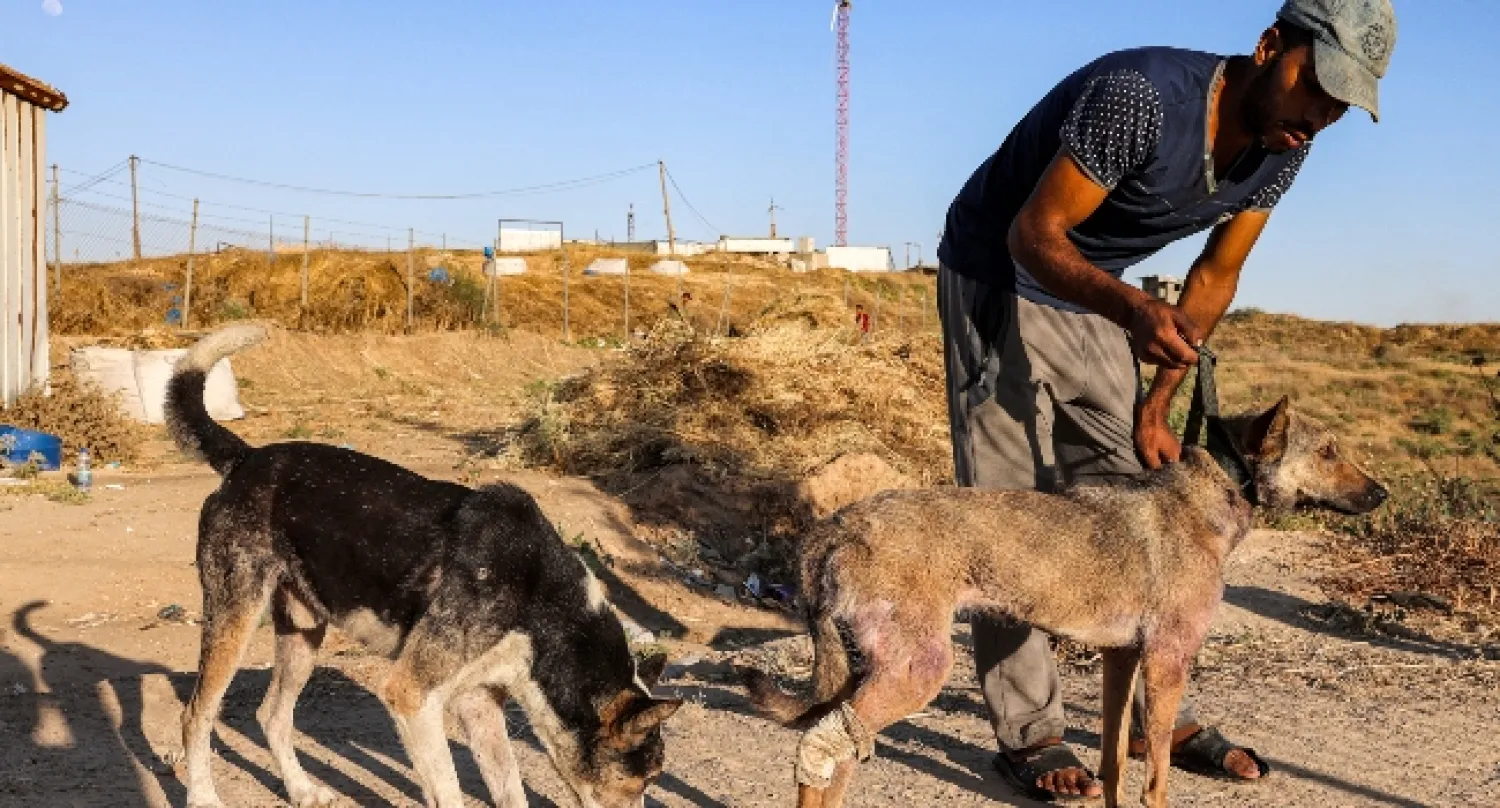

In Gaza, Traumatized Palestinians Tend to Shell-Shocked Pets

A worker tends to a dog at the Sulala dog shelter in Gaza City which has received several wounded animals after the 11-day conflict between Israel and the Islamist Hamas controlling the Palestinian enclave - AFP
TT

In Gaza, Traumatized Palestinians Tend to Shell-Shocked Pets

A worker tends to a dog at the Sulala dog shelter in Gaza City which has received several wounded animals after the 11-day conflict between Israel and the Islamist Hamas controlling the Palestinian enclave - AFP

A smashed goldfish bowl, panicked birds in a cage, scores of animals needing treatment. The loss or injury of treasured pets has added to the grief and trauma of Gaza residents after last month's deadly conflict.

Neriman, a nine-year-old Palestinian girl, clutched a glass jar holding her goldfish Hoor, delighted it had survived after her other one, Hooriya, died in an Israeli air strike in Gaza City.

In the latest war, Israeli strikes on Gaza killed 254 Palestinians, including 66 children, as well as some fighters, authorities there say.

Fire by Palestinian militants claimed 12 lives in Israel, including one child, a teenager and an Israeli soldier.

Pets also suffered, as well as the children who owned them, according to AFP.

"I was so sad that Hooriya died and I cried when I buried her in the field," said Neriman, of her first fish, whose name meant "Mermaid" in Arabic.

"But I was so happy that Hoor had survived," she added of her second fish.

At an animal clinic in Gaza City, Amani Abu Shaaban held a fluffy cat to her chest as they waited to see a vet.

"My cat has been very scared since the war. She refuses to eat, and her hair is falling out," she said.

"Even the sound of a mobile phone ringing freaks her out."

Nearby, vet Mutasem Qaddoura examined two cats, one after the other.

One needed an operation for a broken leg, the other was dehydrated and malnourished.

Dozens of pets owners have flocked to his clinic since Gaza's May 21 ceasefire though supplies to treat them are scarce.

"The state of veterinary medicine is disastrous in Gaza," Qaddoura said.

"We use X-ray machines intended for humans and platinum screws meant to fix children's bones to treat the animals."

- Pets left behind -

Neriman and her family had been forced to flee their home on May 13, after an Israeli officer warned neighbors of an imminent strike on a nearby bank.

In the panic she left behind her fish, as well as two parakeets, Alloosh and Malloosh, given to her by her father for her sixth birthday.

But soon after, she started worrying.

"I just had to go home with my father to get them," she said.

When they returned, she found a special outfit she had laid out on her bed for the Eid holidays covered in rubble, the bed collapsed and the windows blown in.

"I heard Alloosh and Malloosh chirping under the rubble, and I found the fish bowl broken," she said.

Hooriya had died, but they saved Hoor, a scene shown in a video which has since gone viral on social media.

- Desperate dogs -

South of Gaza city, 30-year-old Adel al-Wadia said he had tried to feed some of the dogs at the coastal strip's main dog shelter during the bombing.

"They were howling with fear and hunger and it made me sad, so I risked trying to get as close as possible to give them food," he said.

The shelter's founder, Saeed el-Aer, said he returned after the ceasefire to find many of his canine wards scared and famished.

Dozens had panicked and escaped during the 11-day war, and several were wounded, he said.

"At least three dogs need an operation, including one who needs a paw amputated," he said.

Other animals were even less lucky.

Aer pointed to an area beyond the shelter's fence.

"Over there, we buried the donkey and the horse after we found they had died from shrapnel wounds," he said.



Belgium’s Francis Halzen Wins Nobel Prize in Physics

Eva Olsson, Ellen Moons, and Mark Pearce sit in front of a screen displaying Francis Halzen as the recipient of the 2026 Nobel Prize in Physics during a press conference at the Royal Swedish Academy of Sciences in Stockholm, Sweden, on October 6, 2026. (Photo by Christine OLSSON / TT NEWS AGENCY / AFP)
TT

Belgium’s Francis Halzen Wins Nobel Prize in Physics

Eva Olsson, Ellen Moons, and Mark Pearce sit in front of a screen displaying Francis Halzen as the recipient of the 2026 Nobel Prize in Physics during a press conference at the Royal Swedish Academy of Sciences in Stockholm, Sweden, on October 6, 2026. (Photo by Christine OLSSON / TT NEWS AGENCY / AFP)

Belgian Francis Halzen won the Nobel Prize in physics on Tuesday for his contributions to the IceCube Neutrino Observatory and his discovery of high-energy neutrinos of astrophysical origin.

The Royal Swedish Academy of Sciences announced the award in Stockholm.

The prize money this year is 12 million Swedish kronor (about $1.2 million), whether for an individual, a small group of laureates or an organization.

Last year, three scientists won the Nobel Prize in physics for research on the strange behavior of subatomic particles called quantum tunneling that enabled the ultra-sensitive

measurements achieved by MRI machines and laid the groundwork for better cellphones and faster computers.

The announcements of this year's prizes began Monday with the Nobel Prize in medicine being awarded to three scientists whose work led to a tool that uses light to help unravel how the brain works.

This week's awards continue Wednesday with the chemistry prize and literature on Thursday. After Friday’s peace prize is awarded, the Nobel Memorial Prize in Economic Sciences will be announced on Monday.

The prize money this year is 12 million Swedish kronor (about $1.2 million), whether for an individual, a small group of laureates or an organization.


Indonesia Says Will Halt Forest Destruction for Rice Paddies

A man attempts to extinguish flames with a bucket amid thick smoke and fires burning through peatland in Palangkaraya, Central Kalimantan, on October 3, 2026. (Photo by REINA / AFP)
TT

Indonesia Says Will Halt Forest Destruction for Rice Paddies

A man attempts to extinguish flames with a bucket amid thick smoke and fires burning through peatland in Palangkaraya, Central Kalimantan, on October 3, 2026. (Photo by REINA / AFP)

Indonesia said on Tuesday it will halt a project to raze several million hectares of forest to clear land for rice production, saying it had reached self-sufficiency levels of the staple grain.

The government launched a program in 2024 to stop relying on rice imports within five years by clearing three million hectares of land for paddies.

Indonesia is one of the world's most forested countries, and as such a major absorber of planet-warming carbon emissions from mankind's burning of fossil fuel.

It aims to become a net carbon sink by 2030, with forests and other land use absorbing more carbon than they emit.

However, observers have said continuing forest destruction for agriculture and logging, as well as rampant wildfires, could put Indonesia's plans at risk.

President Prabowo Subianto hailed an "important victory" this year after data showed countrywide rice demand had been met with domestic production in one of the world's top consumers of the commodity.

Climate envoy Hashim Djojohadikusumo said on Tuesday the government's strategic reserve rice stock had reached about 5.3 million tonnes.

"The government sees no further need for expanding rice cultivation areas in the so-called forest areas," said Hashim, who is Prabowo's brother.

He added that the government will focus instead on "intensification measures" using superior seeds, for example, to increase rice yields.

It was not known how much forest had already been replaced by rice paddies before the project was halted.

According to the National Food Agency, a government body that seeks to advance food security, Indonesia produced 34.71 million tons of rice in 2025 -- exceeding annual demand of 31.19 million tons.

Haze from wildfires consuming forests and peatlands in Indonesia has blanketed neighboring Malaysia and Singapore for weeks.

Hot, dry conditions associated with the El Nino weather phenomenon have fueled the fires, which are also linked to land clearing.

The Mighty Earth advocacy group welcomed Hashim's announcement, AFP reported.

"This decision renews Indonesia's leadership in showing how to expand agriculture while protecting nature," the NGO's founder, Glenn Hurowitz, said in a statement.

"This decision creates an opportunity for large-scale investments in achieving President Prabowo's goal of restoring 12 million hectares of forest, peat, and other ecosystems," he added.


Vietnam Busts Cat-stealing Ring that Took 2,700 Pets for Food

Stray cats. AFP
Stray cats. AFP
TT

Vietnam Busts Cat-stealing Ring that Took 2,700 Pets for Food

Stray cats. AFP
Stray cats. AFP

Vietnamese police have arrested 12 men accused of stealing nearly 2,700 cats during night raids into residential neighborhoods, taking the pets to be slaughtered for food, police and state media said on Monday.

Fur removal machines, cat traps and measuring scales were among items confiscated during investigations into the alleged cat-stealing ring in Ho Chi Minh City.

Consumption of dogs and cats is legal in Vietnam, where many restaurants openly advertise the meat, but vendors are required to obtain certificates showing the origin of the animals.

Media reports have said that stolen cats can be sold at restaurants for at least 70,000 dong ($2.70) per kilogram.

The 12 men were arrested on allegations of property theft and admitted "to stealing and trafficking approximately 2,700 cats of various types", police said in a statement.

Criminal proceedings began on Sunday, but it was not clear when the men were detained.

The suspects pounced between 11:00 pm and 04:00 am, roaming residential areas on motorbikes in small groups to steal local cats, state media said.

The network was first discovered in July, with police seizing 50 live cats alongside 55 cat traps, two scales and two fur removal machines.

Each team was estimated to have stolen between four and 10 cats per night.

Police in Ho Chi Minh City arrested 18 people earlier this year accused of being part of two separate cat-stealing rings.