White House Says Biden, Erdogan to Have Expansive Discussion on Bilateral Ties

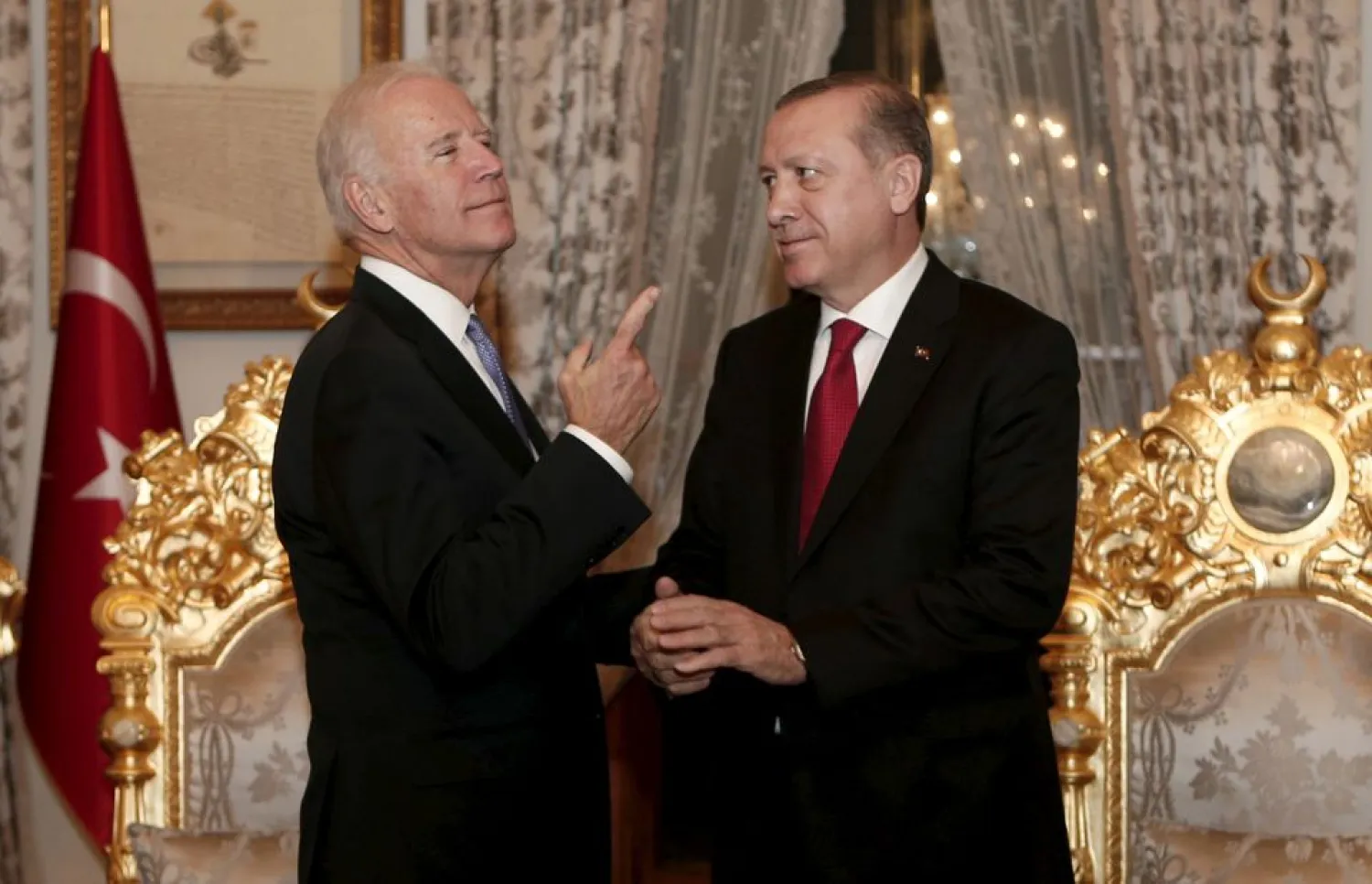
Turkish President Tayyip Erdogan (R) and then-US Vice President Joe Biden chat after their meeting in Istanbul, Turkey January 23, 2016. REUTERS/Sedat Suna/Pool/File Photo
TT

White House Says Biden, Erdogan to Have Expansive Discussion on Bilateral Ties

Turkish President Tayyip Erdogan (R) and then-US Vice President Joe Biden chat after their meeting in Istanbul, Turkey January 23, 2016. REUTERS/Sedat Suna/Pool/File Photo

US President Joe Biden and Turkish President Tayyip Erdogan will meet to discuss Syria, Afghanistan and other regional issues next week and will also look at the "significant differences" between Washington and Ankara, the US national security advisor said on Monday.

Speaking at a White House briefing, Jake Sullivan said the eastern Mediterranean, Syria, Iran, as well as the role that Turkey will play in Afghanistan as the United States withdraws from the country will be part of the "expansive agenda".

In addition, the meeting, planned to take place on June 14 on the sidelines of the NATO summit in Brussels, will also review their ties and look for ways on how the United States and Turkey deal with some of their "significant differences on values and human rights and other issues", Sullivan said.

"President Biden knows Erdogan very well, the two men have spent a good amount of time together and they're both, I think, looking forward to the opportunity, to really have a business like opportunity to review the full breadth of the relationship," Sullivan said.

Ankara and Washington have been struggling to repair ties, strained in recent years over several issues, including Turkey's purchase of Russian defense systems which resulted in US sanctions, policy differences in Syria, as well as Washington's alarm over Ankara's human rights track record.

The two NATO allies also have differing views in Nagorno-Karabakh conflict as well as Ankara's oil and gas ambitions in the eastern Mediterranean while Turkey's potential role in Afghanistan in the aftermath of planned US pullout could serve as an area of cooperation.


Italy, Germany and France Offer Help with Hormuz Only after Ceasefire

Britain, France, Germany, Italy, Japan and the Netherlands say they are ready "to contribute to appropriate efforts to ensure safe passage through the Strait of Hormuz" post-ceasefire. Giuseppe CACACE / AFP/File
TT

Italy, Germany and France Offer Help with Hormuz Only after Ceasefire

Britain, France, Germany, Italy, Japan and the Netherlands say they are ready "to contribute to appropriate efforts to ensure safe passage through the Strait of Hormuz" post-ceasefire. Giuseppe CACACE / AFP/File

Six major international powers said Thursday they were ready "to contribute to" ensuring safe passage through the Strait of Hormuz, though three stressed that any initiative would take place post-ceasefire.

Britain, France, Germany, Italy, Japan and the Netherlands said Thursday they were ready "to contribute to appropriate efforts to ensure safe passage through the Strait of Hormuz".

The grouping said they "welcome the commitment of nations who are engaging in preparatory planning", as they condemned "in the strongest terms recent attacks by Iran on unarmed commercial vessels in the Gulf".

But Italy, Germany and France made clear later Thursday that they were not talking about any immediate military help, but rather a potential multilateral initiative after a ceasefire.

The declaration came as an effective Iranian blockade of the strait has paralyzed commercial shipping through the crucial maritime chokepoint, which in peacetime sees a fifth of global crude oil and liquefied natural gas pass through it.

The war, which erupted on February 28 when the United States and Israel began bombing Iran, has led Tehran to retaliate with strikes across the Gulf region.

Twenty-three commercial vessels, including 10 tankers, have reported incidents or having been attacked.

The situation has left around 20,000 seafarers stranded on approximately 3,200 vessels west of the strait, according to the International Maritime Organization.

"We express our deep concern about the escalating conflict," the allies' joint statement said.

"We call on Iran to cease immediately its threats, laying of mines, drone and missile attacks and other attempts to block the Strait to commercial shipping," it added.

"Freedom of navigation is a fundamental principle of international law, including under the United Nations Convention on the Law of the Sea.

"The effects of Iran's actions will be felt by people in all parts of the world, especially the most vulnerable."

- Not a 'war mission' -

US President Donald Trump has urged other world powers, and NATO, to help reopen the Hormuz Strait to commercial shipping.

But they have rebuffed his call in the short term while insisting they were open to discussions and planning.

Italy's Defense Minister Guido Crosetto said the statement by the six countries should not be seen as a "war mission".

"No entry into Hormuz without a truce and a comprehensive multilateral initiative", for which "it is right and appropriate for the United Nations to provide the legal framework", he said in a statement.

And in Berlin, Defense Minister Boris Pistorius said that any German military involvement "would depend on the situation after a ceasefire... and whether we could participate within the framework of an international mandate".

Military involvement would also require approval by the German parliament, he added.

French President Emmanuel Macron told reporters his country planned to sound out permanent members of the UN Security Council on the possibility of establishing a UN framework for future plans -- once the ongoing exchange of fire had ended -- to secure navigation in the Strait of Hormuz.

"We have initiated an exploratory process, and we will see in the coming days whether it stands a chance of succeeding," he said in Brussels following a European summit that took place on Thursday.

A UK defense official told reporters at a briefing Wednesday that "the level of threat is such that I don't see many nations being willing to put warships into the middle of that threat right now".

The defense official noted London has sent a "small number" of additional military "planners" to US Central Command to "help with the planning and option development for... whatever comes next in the Strait of Hormuz might look like".


Iran's Supreme Leader Says Enemies' 'Security Must be Taken Away'

19 March 2026, Iran, Tehran: An Iranian flag bearing the picture of 
Supreme Leader Mojtaba Khamenei, is waved in Tehran. Photo: Saeid Zareian/dpa
19 March 2026, Iran, Tehran: An Iranian flag bearing the picture of Supreme Leader Mojtaba Khamenei, is waved in Tehran. Photo: Saeid Zareian/dpa
TT

Iran's Supreme Leader Says Enemies' 'Security Must be Taken Away'

19 March 2026, Iran, Tehran: An Iranian flag bearing the picture of 
Supreme Leader Mojtaba Khamenei, is waved in Tehran. Photo: Saeid Zareian/dpa
19 March 2026, Iran, Tehran: An Iranian flag bearing the picture of Supreme Leader Mojtaba Khamenei, is waved in Tehran. Photo: Saeid Zareian/dpa

Iran’s new Supreme Leader Mojtaba Khamenei called Friday for the enemies of his nations to have their “security” taken away, in his latest message to the public.

Khamenei made the remarks in a statement issued on his behalf and sent to President Masoud Pezeshkian, after Israel killed Intelligence Minister Esmail Khatib.

Khamenei hasn’t been seen since he was named as supreme leader, succeeding his father, the 86-year-old Supreme Leader Ali Khamenei, who was killed in an Israeli airstrike on the first day of the war on Feb. 28.

American and Israeli officials have suggested that Mojtaba Khamenei was hurt in the war.


Iran Revolutionary Guards Say US-Israel Strikes Killed Spokesman

Motorists drive along a street in Tehran on March 14, 2026. (Photo by ATTA KENARE / AFP)
TT

Iran Revolutionary Guards Say US-Israel Strikes Killed Spokesman

Motorists drive along a street in Tehran on March 14, 2026. (Photo by ATTA KENARE / AFP)

Iran's Revolutionary Guards said on Friday that US-Israeli strikes had killed their spokesman Ali Mohammad Naini.

Naini "was martyred in the criminal cowardly terrorist attack by the American-Zionist side at dawn,” the Guards said in a statement on their Sepah News website.

A short time earlier, the spokesman insisted that Tehran was still building missiles, seeking to counter a claim by Israeli Prime Minister Benjamin Netanyahu that it no longer could.

Naini also said the Iran war would go on.

“These people expect the war to continue until the enemy is completely exhausted,” the general said of the Iranian public. “This war must end when the shadow of war is lifted from the country."