


Scientists Discover ‘Life Elixir’ for Food Crops in Warming Time

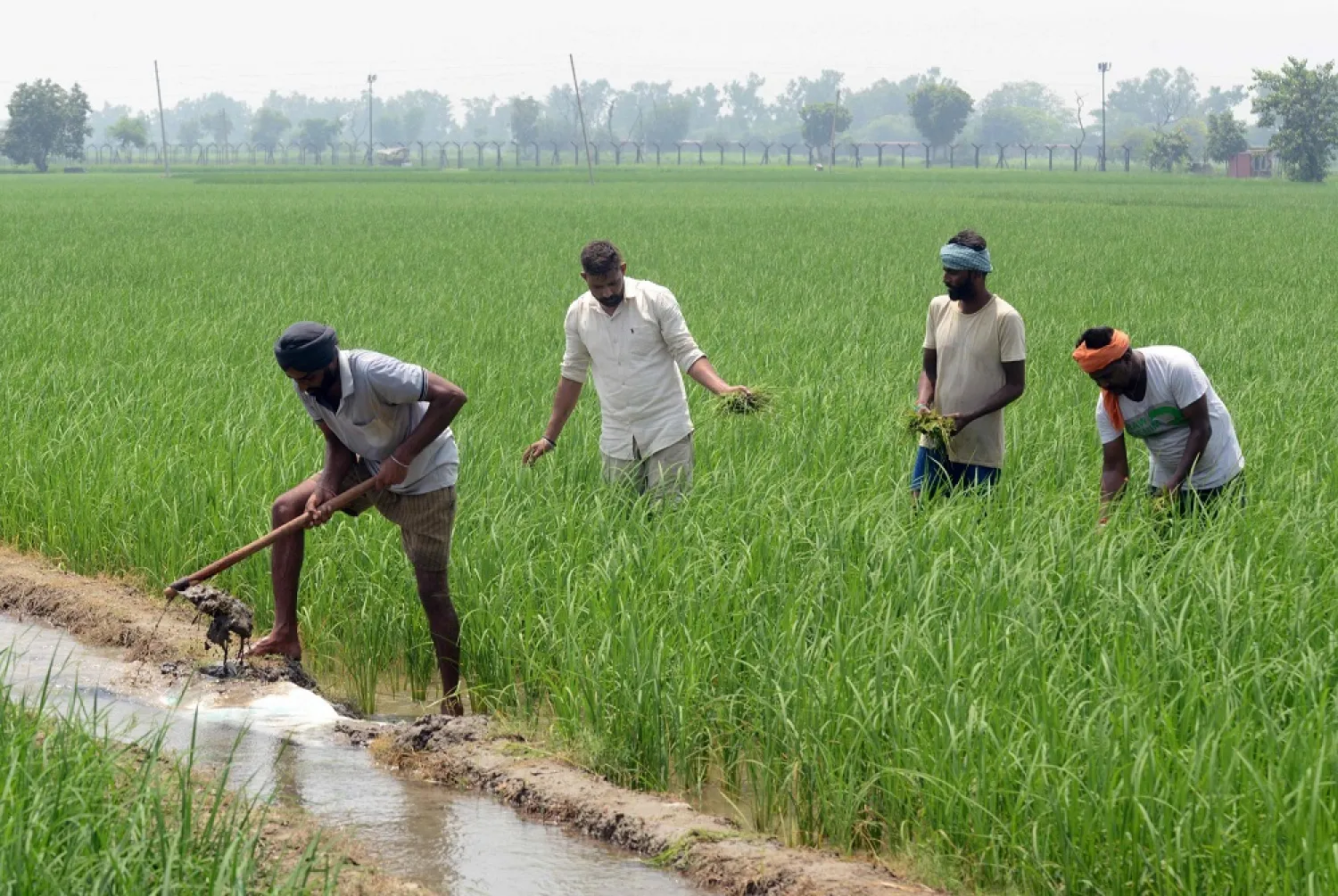
Indian farmers work in a rice field near the border fence with Pakistan outside Amritsar. (AFP file photo)
TT

Scientists Discover ‘Life Elixir’ for Food Crops in Warming Time

Indian farmers work in a rice field near the border fence with Pakistan outside Amritsar. (AFP file photo)

University of California scientists have discovered genetic data that will help food crops like tomatoes and rice survive longer, more intense periods of drought on our warming planet.

Over the course of the last decade, the research team sought to create a molecular atlas of crop roots, where plants first detect the effects of drought and other environmental threats. In so doing, they uncovered genes that scientists can use to protect the plants from these stresses.

Their work, published on May 18 in the journal Cell, achieved a high degree of understanding of the root functions because it combined genetic data from different cells of tomato roots grown both indoors and outside.

“Frequently, researchers do lab and greenhouse experiments, but farmers grow things in the field, and this data looks at field samples too. The data yielded information about genes that tell the plant to make three key things,” said Neelima Sinha, a UC Davis professor of plant biology and the paper’s co-author in a report posted on the university’s website.

The study pointed out to xylem, which are hollow, pipe-like vessels that transport water and nutrients from the roots all the way up to the shoots. Without transport in xylem, the plant cannot create its own food via photosynthesis.

“Xylem are very important to shore up plants against drought as well as salt and other stresses,” said lead study author Siobhan Brady, a professor of plant biology at UC Davis.

In turn, without plant mineral transport in xylem, humans and other animals would have fewer vitamins and nutrients essential for our survival. In addition to some typical players needed to form the xylem, new and surprising genes were found.

The second key set of genes is those that direct an outer layer of the root to produce lignin and suberin. Suberin is the key substance in cork and it surrounds plant cells in a thick layer, holding in water during drought.

Crops like tomatoes and rice have suberin in the roots. Apple fruits have suberin surrounding their outer cells. Anywhere it occurs, it prevents the plant from losing water. Lignin also waterproofs cells and provides mechanical support.

“Suberin and lignin are natural forms of drought protection, and now that the genes that encode for them in this very specific layer of cells have been identified, these compounds can be enhanced. I’m excited we’ve learned so much about the genes regulating this moisture barrier layer. It is so important for being able to improve drought tolerance for crops,” said study co-author Julia Bailey-Serres.

Genes that encode for a plant’s root meristem also turned out to be remarkably similar between tomato, rice, and Arabidopsis, a weed-like model plant. The meristem is the growing tip of each root, and it’s the source of all the cells that make up the root.

“It’s the region that’s going to make the rest of the root, and serves as its stem cell niche. It dictates the properties of the roots themselves, such as how big they get. Having knowledge of it can help us develop better root systems,” said Bailey-Serres.

Brady explained that when farmers are interested in a particular crop, they select plants that have features they can see, such as bigger, more attractive fruits. Much more difficult is for breeders to select plants with properties below ground they can’t see.

“The ‘hidden half’ of a plant, below ground, is critical for breeders to consider if they want to grow a plant successfully. Being able to modify the meristem of a plant’s roots will help us engineer crops with more desirable properties,” Brady said.

Though this study analyzed only three plants, the team believes the findings can be applied more broadly.

“Tomato and rice are separated by more than 125 million years of evolution, yet we still see similarities between the genes that control key characteristics. It’s likely these similarities hold true for other crops too,” said Bailey-Serres.



Trump Urges 2028 Astronaut Moon Landing in Sweeping Space Policy Order

FILE PHOTO: US President Donald Trump poses on the red carpet for the 2025 Kennedy Center Honors at the John F. Kennedy Center for the Performing Arts in Washington, D.C., US, December 7, 2025. REUTERS/Jeenah Moon/File Photo
TT

Trump Urges 2028 Astronaut Moon Landing in Sweeping Space Policy Order

FILE PHOTO: US President Donald Trump poses on the red carpet for the 2025 Kennedy Center Honors at the John F. Kennedy Center for the Performing Arts in Washington, D.C., US, December 7, 2025. REUTERS/Jeenah Moon/File Photo

President Donald Trump enshrined the US goal to put humans back on the moon by 2028 and defend space from weapon threats in a sweeping executive order issued on Thursday, the first major space policy move of his administration's second term.

The order, issued hours after billionaire private astronaut and former SpaceX customer Jared Isaacman was sworn in as NASA's 15th administrator, also reorganized national space policy coordination under Trump's chief science adviser, Michael Kratsios, Reuters reported.

Titled "ENSURING AMERICAN SPACE SUPERIORITY," the order calls on the Pentagon and US intelligence agencies to create a space security strategy, urges efficiency among private contractors and seeks demonstrations of missile-defense technologies under Trump's Golden Dome program.

It appeared to ‌cancel the White ‌House's top space policy-coordinating body, the National Space Council, a ‌panel ⁠of cabinet members that ‌the president revived during his first term and has considered axing this year.

But an adminitration official said it would not be cancelled and suggested it would live on under the White House's Office of Technology Policy with a different structure in which the president, rather than the vice president, would be chairman.

The goal to land humans on the moon by the end of Trump's second term in 2028 bears resemblance to the president's 2019 directive in his first term to make a lunar return by 2024, putting the ⁠moon at the center of US space exploration policy with a timeline many in the industry regarded as unrealistic. Development and testing ‌delays with NASA’s Space Launch System and SpaceX’s Starship gradually pushed ‍that landing target date back.

NASA's goal had been ‍2028 under former president Barack Obama.

A 2028 astronaut moon landing would be ‍the first of many planned under NASA's Artemis effort to build a long-term presence on the lunar surface. The US is in competition with China, which is targeting 2030 for its first crewed moon landing. The order on Thursday called for "establishment of initial elements of a permanent lunar outpost by 2030," reinforcing NASA's existing goal to develop long-term bases with nuclear power sources.

At the start of his second term, Trump had repeatedly talked about sending missions to Mars as Elon Musk, a major donor ⁠who has made sending humans to the Red Planet a priority for his company SpaceX, served a stint as a close adviser and powerful government efficiency czar. But lawmakers in Congress this year have slowly put the moon back in focus, pressuring then-NASA nominee Isaacman to stick with the agency's moon program on which billions of dollars have been spent.

The White House, in a government efficiency push led by Musk, slashed NASA's workforce by 20% and has sought to cut the agency's 2026 budget by roughly 25% from its usual $25 billion, imperiling dozens of space-science programs that scientists and some officials regard as priorities.

Isaacman, who plans to give his first agency-wide address to NASA employees on Friday, has said he believes the space agency should try to target both the moon and Mars simultaneously while prioritizing a lunar return in ‌order to beat China.

The 2028 moon-landing target depends heavily on the development progress of SpaceX's giant Starship lander, which has been criticized by NASA's former acting administrator for moving too slowly.


Rare Diamond Changes Lives of Two Indian Friends

Satish Khatik and Sajid Mohammed found a 15.34-carat gem-quality diamond in Panna (Amit Rathaur)
TT

Rare Diamond Changes Lives of Two Indian Friends

Satish Khatik and Sajid Mohammed found a 15.34-carat gem-quality diamond in Panna (Amit Rathaur)

On a recent winter morning in Panna, a diamond mining region in central India, two childhood friends made a discovery that they think could change their lives forever.

Satish Khatik and Sajid Mohammed stumbled upon a large, glistening rock on a plot of land they had leased just weeks earlier, according to BBC India.

When they took the stone to the city's official diamond evaluator, they learnt they had found a 15.34-carat gem-quality diamond - one of the finest varieties of natural diamonds that exist.

“The estimated market price of the stone is around five to six million rupees [$55,000 - $66,000] and it will be auctioned soon,” Anupam Singh, the diamond evaluator, told BBC Hindi.

The government holds quarterly auctions, drawing buyers from across India and abroad to bid for the diamonds.

“Estimated prices depend on the dollar rate and benchmarks set by the Rapaport report,” Singh said. Rapaport is widely regarded as a leading authority on independent diamond and jewelry market analysis.

Khatik and Mohammed say they are over the moon. “We can now get our sisters married,” they said.

Khatik, 24, who runs a meat shop and Mohammed, 23 who sells fruits, come from poor backgrounds and are the youngest sons in their families.

For generations, their families have been trying their luck at finding diamonds, which is a common quest among the district's residents.

Panna, which is in Madhya Pradesh state, is among India's least developed districts - its residents face poverty, water scarcity and unemployment.

While most mines are run by the federal government, state authorities lease small plots to locals each year at nominal rates. With few job opportunities in the city, residents hope for a prized find to improve their fortunes - but most come up empty-handed.

Mohammed said his father and grandfather had dug through these plots for decades but discovered nothing more that “dust and slivers of quartz.”

His father Nafees said that the “gods have finally rewarded their hard work and patience.”

They leased a plot in search of diamonds partly out of desperation, as their meagre incomes could not keep pace with rising household costs - let alone pay for a wedding, Mohammed told the BBC.


SpaceX Loses Contact with Starlink Satellite after Mishap

FILE PHOTO: SpaceX logo and Elon Musk silhouette are seen in this illustration taken, December 19, 2022. REUTERS/Dado Ruvic/Illustration/File Photo
TT

SpaceX Loses Contact with Starlink Satellite after Mishap

FILE PHOTO: SpaceX logo and Elon Musk silhouette are seen in this illustration taken, December 19, 2022. REUTERS/Dado Ruvic/Illustration/File Photo

SpaceX's Starlink said one of its satellites experienced an anomaly in space on Wednesday that created a "small number" of debris and cut off communications with the spacecraft at 418 km (259.73 miles) in altitude, a rare kinetic accident in orbit for the satellite internet giant.

"The satellite is largely intact, tumbling, and will reenter the Earth's atmosphere and fully demise within weeks," Starlink said in a post on X.

The company said it was working with the US Space Force and NASA to monitor the debris pieces, the number of which SpaceX did not say.

Space Force's space-tracking unit did not immediately return a Reuters request for comment on the number of trackable debris, which could pose risks for other active satellites in orbit.

With the Starlink satellite still somewhat intact, the event seemed smaller in scale than other orbital mishaps such as the breakup of an Intelsat satellite that created more than 700 pieces, or the breakup of a Chinese rocket body last year.