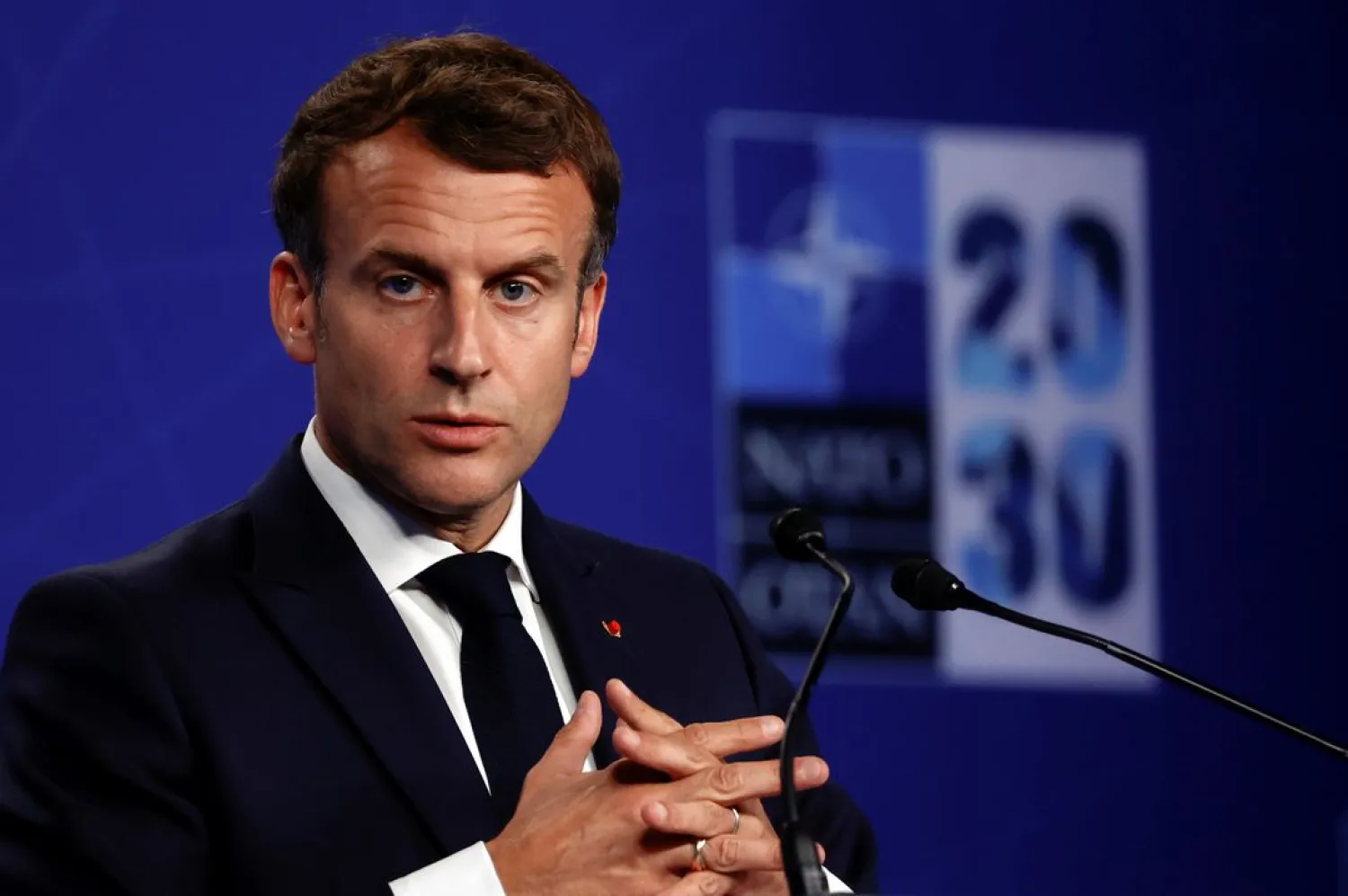
France's Macron Calls for European Tech Company Push by 2030

France's President Emmanuel Macron holds a news conference during the NATO summit in Brussels, Belgium June 14, 2021. (Reuters)
TT

France's Macron Calls for European Tech Company Push by 2030

France's President Emmanuel Macron holds a news conference during the NATO summit in Brussels, Belgium June 14, 2021. (Reuters)

French President Emmanuel Macron on Tuesday outlined an ambitious push for Europe to create 10 technology giants worth 100 billion euros ($121.26 billion) each in valuation by 2030, in a bid to rival US companies that dominate the sector.

The goals are part of a Europe-wide initiative France is trying to lead to improve funding for start-ups, especially in their later stages of growth, to propel them into a bigger league where they can attract more investors and top staff.

Macron has pushed to make France into a "start-up nation" since coming to power in 2017, rendering the country more attractive to foreign investors through labor reforms for example.

French efforts to create "unicorns", or companies worth at least $1 billion, are still overshadowed by US equivalents, however. Macron said last year he expected France to have 25 "unicorns" by 2025.

The latest plan to help European start-ups includes ramping up funding schemes, through EU-wide finances and by encouraging more venture capital funds to invest, according to a manifesto signed by some 200 businesses, which includes start-up association and other companies.

They also recommended modernizing regulations in Europe as well as creating competitive stock option schemes as part of initiatives to scale up European technology firms.


Google Unveils AI Tool Probing Mysteries of Human Genome

A Google logo is seen at a company research facility in Mountain View, California, US, May 13, 2025. (Reuters)
TT

Google Unveils AI Tool Probing Mysteries of Human Genome

A Google logo is seen at a company research facility in Mountain View, California, US, May 13, 2025. (Reuters)

Google unveiled an artificial intelligence tool Wednesday that its scientists said would help unravel the mysteries of the human genome -- and could one day lead to new treatments for diseases.

The deep learning model AlphaGenome was hailed by outside researchers as a "breakthrough" that would let scientists study and even simulate the roots of difficult-to-treat genetic diseases.

While the first complete map of the human genome in 2003 "gave us the book of life, reading it remained a challenge", Pushmeet Kohli, vice president of research at Google DeepMind, told journalists.

"We have the text," he said, which is a sequence of three billion nucleotide pairs represented by the letters A, T, C and G that make up DNA.

However, "understanding the grammar of this genome -- what is encoded in our DNA and how it governs life -- is the next critical frontier for research," said Kohli, co-author of a new study in the journal Nature.

Only around two percent of our DNA contains instructions for making proteins, which are the molecules that build and run the body.

The other 98 percent was long dismissed as "junk DNA" as scientists struggled to understand what it was for.

However, this "non-coding DNA" is now believed to act like a conductor, directing how genetic information works in each of our cells.

These sequences also contain many variants that have been associated with diseases. It is these sequences that AlphaGenome is aiming to understand.

- A million letters -

The project is just one part of Google's AI-powered scientific work, which also includes AlphaFold, the winner of 2024's chemistry Nobel.

AlphaGenome's model was trained on data from public projects that measured non-coding DNA across hundreds of different cell and tissue types in humans and mice.

The tool is able to analyze long DNA sequences then predict how each nucleotide pair will influence different biological processes within the cell.

This includes whether genes start and stop and how much RNA -- molecules which transmit genetic instructions inside cells -- is produced.

Other models already exist that have a similar aim. However, they have to compromise, either by analyzing far shorter DNA sequences or decreasing how detailed their predictions are, known as resolution.

DeepMind scientist and lead study author Ziga Avsec said that long sequences -- up to a million DNA letters long -- were "required to understand the full regulatory environment of a single gene".

And the high resolution of the model allows scientists to study the impact of genetic variants by comparing the differences between mutated and non-mutated sequences.

"AlphaGenome can accelerate our understanding of the genome by helping to map where the functional elements are and what their roles are on a molecular level," study co-author Natasha Latysheva said.

The model has already been tested by 3,000 scientists across 160 countries and is open for anyone to use for non-commercial reasons, Google said.

"We hope researchers will extend it with more data," Kohli added.

- 'Breakthrough' -

Ben Lehner, a researcher at Cambridge University who was not involved in developing AlphaGenome but did test it, said the model "does indeed perform very well".

"Identifying the precise differences in our genomes that make us more or less likely to develop thousands of diseases is a key step towards developing better therapeutics," he explained.

However, AlphaGenome "is far from perfect and there is still a lot of work to do", he added.

"AI models are only as good as the data used to train them" and the existing data is not very suitable, he said.

Robert Goldstone, head of genomics at the UK's Francis Crick Institute, cautioned that AlphaGenome was "not a magic bullet for all biological questions".

This was partly because "gene expression is influenced by complex environmental factors that the model cannot see", he said.

However, the tool still represented a "breakthrough" that would allow scientists to "study and simulate the genetic roots of complex disease", Goldstone added.


Hong Kong Scientists Launch AI Model to Better Predict Extreme Weather

A general view of Two International Finance Centre (IFC), HSBC headquarters and Bank of China in Hong Kong, China July 13, 2021. (Reuters)
TT

Hong Kong Scientists Launch AI Model to Better Predict Extreme Weather

A general view of Two International Finance Centre (IFC), HSBC headquarters and Bank of China in Hong Kong, China July 13, 2021. (Reuters)

A team of Hong Kong scientists has developed an artificial intelligence weather-forecasting system to predict thunderstorms and heavy downpours up to four hours ahead, ​compared with the range of 20 minutes to two hours now.

The system will help governments and emergency services respond more effectively to increasingly frequent extremes of weather linked to climate change, the team from Hong Kong University of Science and Technology said on Wednesday.

"We hope to use AI and satellite data to improve prediction of extreme weather ‌so we can ‌be better prepared," said Su ‌Hui, chair ⁠professor ​of ‌the university's civil and environmental engineering department, who led the project.

The system aimed to predict heavy rainfall, Su told a press conference to describe the work published in the Proceedings of the National Academy of Sciences in December.

Its model applies generative AI techniques, injecting noise into training data so that the ⁠system learns to reverse the process in the effort to produce more ‌precise forecasts.

Developed in collaboration with China’s ‍weather authorities, it refreshes forecasts ‍every 15 minutes and has boosted accuracy by more ‍than 15%, the team said.

Such work is crucial because the number of typhoons and episodes of wet weather Hong Kong and much of southern China faced in 2025 far exceeded the seasonal ​norm, scientists said.

The city issued its highest rainstorm warning five times last year and the second ⁠highest 16 times, setting new records, its observatory said.

Both China's Meteorological Administration and Hong Kong's Observatory are working to incorporate the model into forecasts.

The team's new AI framework, called the Deep Diffusion Model based on Satellite Data (DDMS), was trained using infrared brightness temperature data collected between 2018 and 2021 by China’s Fengyun-4 satellite.

Satellites can detect cloud formation earlier than other forecasting systems such as radar, Su added.

The data was combined with meteorological expertise to capture the evolution of convective cloud ‌systems and later validated with spring and summer samples from 2022 and 2023.


Will the EU Ban Social Media for Children in 2026?

The Instagram logo displayed on a mobile phone alongside a laptop keyboard in Liverpool, Britain, 23 January 2026. (EPA)
TT

Will the EU Ban Social Media for Children in 2026?

The Instagram logo displayed on a mobile phone alongside a laptop keyboard in Liverpool, Britain, 23 January 2026. (EPA)

As France moves one step closer to banning social media for children, the European Union is seriously considering whether it's time for the bloc to follow suit.

Pressure has been rising since Australia's social media ban for under-16s entered into force, and Brussels is keeping a close eye on how successful it proves, with the ban already facing legal challenges.

France had been spearheading a months-long push for similar EU action alongside member states including Denmark, Greece and Spain -- before deciding to strike out on its own. Its lower house of parliament this week passed a bill that would ban social media use by under-15s, which still needs Senate approval to become law.

At EU level, tough rules already regulate the digital space, with multiple probes ongoing into the impact on children of platforms including Instagram and TikTok.

European Commission chief Ursula von der Leyen has advocated going further with a minimum age limit, but first wants to hear from experts on what approach the 27-nation bloc should take.

- 'All doors open' -

Promised by the end of 2025, a consultative panel on social media use promised by von der Leyen is now expected to be set up "early" this year.

Its objective? To advise the president on what the EU's next steps should be to further protect children online, commission spokesman Thomas Regnier said.

"We're leaving all doors open. We will get feedback, and then we will take potential future decisions in this regard," Regnier said on Tuesday.

The European Parliament has already called for a social media ban on under-16s -- with Malaysia, Norway and New Zealand also planning similar restrictions.

France isn't alone in opting not to wait for EU-level action.

Denmark last year said it would ban access to social media for minors under 15.

Both countries are among five EU states currently testing an age-verification app they hope will prevent children accessing harmful content online.

Commission spokesman Regnier said that tool, which is to be rolled out by the end of the year, would be a way for Brussels to enforce compliance with whatever rules are adopted at national level, in France or elsewhere.

- EU vows to 'close cases' -

While the EU has yet to ban children from social media, its content law known as the Digital Services Act (DSA) gives regulators the power to force companies to modify their platforms to better protect minors online.

For example, the DSA bans targeted advertising to children.

The EU can "use the DSA to impact the way that children interact with social media", Paul Oliver Richter, affiliate fellow at the Bruegel think tank said.

In February and May 2024 respectively, the EU launched probes into TikTok, and Meta's Facebook and Instagram, over fears the platforms may not be doing enough to address negative impacts on young people.

In both investigations, the EU expressed fears over the so-called "rabbit hole" effect -- which occurs when users are fed related content based on an algorithm, in some cases leading to more extreme content.

Nearly two years on, the EU has yet to wrap up the probes, although one official says regulators hope to deliver preliminary findings in the first half of the year.

EU spokesman Regnier has insisted "work is heavily ongoing".

Without referring to any specific probes, he said that "for certain investigations, we need more time", but added: "We will close these cases."