


Israelis Taste the Future with Lab-Grown Chicken 'Food Revolution'

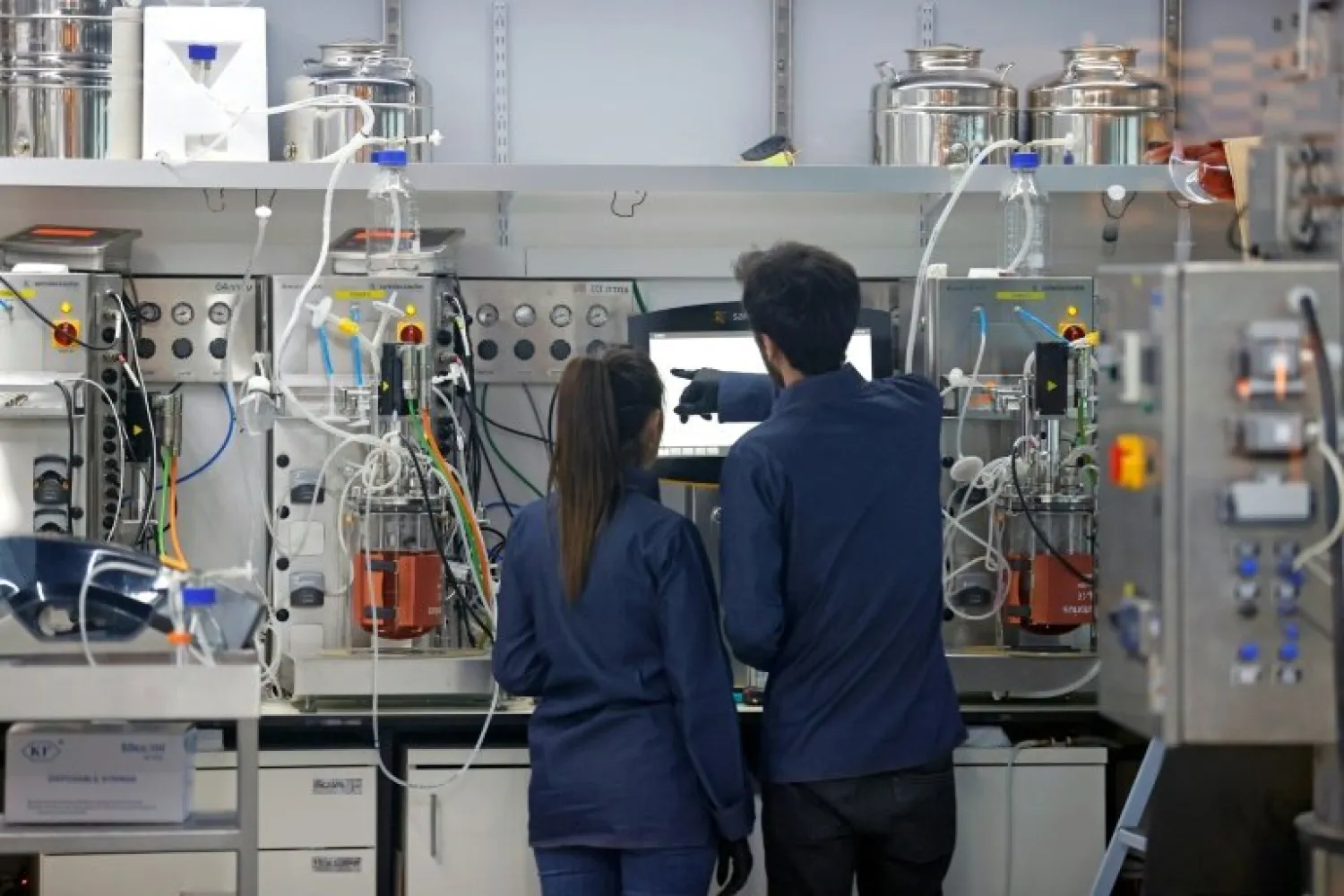
Technicians produce 'cultured chicken' meat at the food-tech startup SuperMeat - AFP
TT

Israelis Taste the Future with Lab-Grown Chicken 'Food Revolution'

Technicians produce 'cultured chicken' meat at the food-tech startup SuperMeat - AFP

It looks like chicken and tastes like chicken, but diners in Israel are tucking into laboratory-grown "meat" that scientists claim is an environmentally friendly way to feed the world's growing population.

In a small restaurant in a nondescript building in a science park in the central Israeli town of Ness Ziona, diners munched burgers and minced meat rice rolls made with "cultured chicken" -- meat grown in the adjacent SuperMeat production site, AFP reported.

"It was delicious, the flavor was great," said Gilly Kanfi, a self-described "meat eater" from Tel Aviv, who had signed up for the meal months in advance.

"If I didn't know, I would have thought it was a regular chicken burger."

The Chicken, as the eatery is called, is a testing ground of sorts for SuperMeat, hosting periodical test meals to generate customer feedback while waiting for regulatory approval.

The restaurant's dark and elegant interior is framed by large windows looking onto a bright-lit laboratory, where technicians monitor large stainless-steel fermentation vats.

"This is the first time in the world people can actually have a taste of a cultivated meat product, while observing the production and the manufacturing process in front of their eyes," said Ido Savir, SuperMeat's chief executive.

Here, at least, the laboratory has made redundant the age-old question of whether the chicken or the egg came first.

The process involves cultivating cells taken from a fertilized chicken egg.

Cell cultures are fed a plant-based liquid including proteins, fats, sugars, minerals and vitamins.

With all the feed going directly into production, it grows rapidly, with the mass doubling within a matter of hours, the company says.

Savir, a vegan with a background in computer science, sees himself as being at the "forefront of a food revolution" trying to help supply food while limiting the impact on the planet.

Developers said they are working to provide more ethical and sustainable ways to create cruelty- and slaughter-free meat, with the product grown without using genetic engineering or antibiotics.

The company is currently able to produce "hundreds of kilograms" each week, Savir said.

But he hopes to earn regulatory approval from the US Food and Drug Administration, and would then increase production to a "commercial" scale.

"This way we'll be able to reduce the amount of land, water use and so many other resources, and keep the product very healthy and clean," he said, noting the high prevalence of diseases among chickens produced in factory-style production.

Global meat production is projected to rise 15 percent by 2027, according to the UN Food and Agriculture Organization.

SuperMeat is not the first to develop the technology. In December, a Singapore restaurant made history when it became the first to sell lab-grown chicken meat.

The Israeli firm has developed a versatile product, blending muscle, fat and connective tissue cells to create different cuts -- even including pet food.

Zhuzha, a white bull terrier attending the meal along with its owner, enthusiastically devoured the SuperMeat dog food it was handed.

"Pets love our meat as well," Savir said with a smile.

The human diners said the product was as good as the real thing.

"It really surprised me," said Lisa Silver, a regular meat-eater. "If I can get that in a restaurant, I will go vegan, totally. It's a game-changer."

For her sister Annabelle, it was the first time in years she had eaten meat.

"One of the reasons that I became vegetarian originally was because it's not ethical, it's not sustainable," she said.

"To get meat minus the cruelty is just amazing, it's perfect, I could eat this every single day."

But the question whether the product should be considered meat is one faced not only by vegetarians -- but also Jewish rabbinic authorities.

Producing meat in a cruelty-free way that does not harm the environment is a positive development that will "save the world problems", said Rabbi Eliezer Simcha Weisz, a member of Israel's Chief Rabbinate Council.

While rabbis would have to learn the novel process and supervise it, Weisz said he expected the product would eventually receive a kosher designation.

Tal Gilboa, a prominent veganism activist who served as an adviser to former prime minister Benjamin Netanyahu, said Israel was leading the way on cultured meat technology.

Gilboa would like the world to turn to a plant-based diet, and sees cultivated meats as a pragmatic way for people to take the first steps to vegetarianism.

"The world population is increasing at a break-neck speed," she said, adding that the only way to keep up will be "through technology".

Savir believes the technology could change humanity for the better.

"Like we saw with the revolution of the smart phone, once this is available, we'll start producing so much meat," he said.

"It would increase food security for nations around the world, a very sustainable, animal-friendly and efficient process."



Surprise Shark Caught on Camera for 1st Time in Antarctica’s Near-freezing Deep

In this image made from video and released by the University of Western Australia, a sleeper shark swims into the spotlight of a video camera in Antarctica in January 2025. (Minderoo-UWA Deep-Sea Research Centre, Inkfish, Kelpie Geoscience via AP)
TT

Surprise Shark Caught on Camera for 1st Time in Antarctica’s Near-freezing Deep

In this image made from video and released by the University of Western Australia, a sleeper shark swims into the spotlight of a video camera in Antarctica in January 2025. (Minderoo-UWA Deep-Sea Research Centre, Inkfish, Kelpie Geoscience via AP)

An ungainly barrel of a shark cruising languidly over a barren seabed far too deep for the sun’s rays to illuminate was an unexpected sight.

Many experts had thought sharks didn’t exist in the frigid waters of Antarctica before this sleeper shark lumbered warily and briefly into the spotlight of a video camera, researcher Alan Jamieson said this week. The shark, filmed in January 2025, was a substantial specimen with an estimated length of between 3 and 4 meters (10 and 13 feet).

“We went down there not expecting to see sharks because there’s a general rule of thumb that you don’t get sharks in Antarctica,” Jamieson said.

“And it’s not even a little one either. It’s a hunk of a shark. These things are tanks,” he added.

The camera operated by the Minderoo-UWA Deep-Sea Research Centre, which investigates life in the deepest parts of the world’s oceans, was positioned off the South Shetland Islands near the Antarctic Peninsula. That is well inside the boundaries of the Antarctic Ocean, also known as the Southern Ocean, which is defined as below the 60-degree south latitude line.

The center on Wednesday gave The Associated Press permission to publish the images.
The shark was 490 meters (1,608 feet) deep where the water temperature was a near-freezing 1.27 degrees Celsius (34.29 degrees Fahrenheit).

A skate appears in frame motionless on the seabed and seemingly unperturbed by the passing shark. The skate, a shark relative that looks like a stingray, was no surprise since scientists already knew their range extended that far south.

Jamieson, who is the founding director of the University of Western Australia-based research center, said he could find no record of another shark found in the Antarctic Ocean.

Peter Kyne, a Charles Darwin University conservation biologist independent of the research center, agreed that a shark had never before been recorded so far south.

Climate change and warming oceans could potentially be driving sharks to the Southern Hemisphere’s colder waters, but there was limited data on range changes near Antarctica because of the region’s remoteness, Kyne said.

The slow-moving sleeper sharks could have long been in Antarctica without anyone noticing, he said.

“This is great. The shark was in the right place, the camera was in the right place and they got this great footage,” Kyne said. “It’s quite significant.”

The sleeper shark population in the Antarctic Ocean was likely sparse and difficult for humans to detect, Jamieson said.

The photographed shark was maintaining a depth of around 500 meters (1,640 feet) along a seabed that sloped into much deeper water. The shark maintained that depth because that was the warmest layer of several water layers stacked upon each other to the surface, Jamieson said.

The Antarctic Ocean is heavily layered, or stratified, to a depth of around 1,000 meters (3,280 feet) because of conflicting properties including colder, denser water from below not readily mixing with fresh water running off melting ice from above.

Jamieson expects other Antarctic sharks live at the same depth, feeding on the carcasses of whales, giant squids and other marine creatures that die and sink to the bottom.

There are few research cameras positioned at that specific depth in Antarctic waters.

Those that are can only operate during the Southern Hemisphere summer months, from December through February.

“The other 75% of the year, no one’s looking at all. And so this is why, I think, we occasionally come across these surprises,” Jamieson said.


17th Century Wreck Reappears from Stockholm Deep

The remains of a 17th century shipwreck is pictured after resurfacing in Stockholm, Sweden, on February 17, 2026. (Photo by Jonathan NACKSTRAND / AFP)
TT

17th Century Wreck Reappears from Stockholm Deep

The remains of a 17th century shipwreck is pictured after resurfacing in Stockholm, Sweden, on February 17, 2026. (Photo by Jonathan NACKSTRAND / AFP)

A 17th century Swedish Navy shipwreck buried underwater in central Stockholm for 400 years has suddenly become visible due to unusually low Baltic Sea levels.

The wooden planks of the ship's well-preserved hull have since early February been peeking out above the surface of the water off the island of Kastellholmen, providing a clear picture of its skeleton.

"We have a shipwreck here, which was sunk on purpose by the Swedish Navy," Jim Hansson, a marine archeologist at Stockholm's Vrak - Museum of Wrecks, told AFP.

Hansson said experts believe that after serving in the navy, the ship was sunk around 1640 to use as a foundation for a new bridge to the island of Kastellholmen.

Archeologists have yet to identify the exact ship, as it is one of five similar wrecks lined up in the same area to form the bridge, all dating from the late 16th and early 17th centuries.

"This is a solution, instead of using new wood you can use the hull itself, which is oak" to build the bridge, Hansson said.

"We don't have shipworm here in the Baltic that eats the wood, so it lasts, as you see, for 400 years," he said, standing in front of the wreck.

Parts of the ship had already broken the surface in 2013, but never before has it been as visible as it is now, as the waters of the Baltic Sea reach their lowest level in about 100 years, according to the archaeologist.

"There has been a really long period of high pressure here around our area in the Nordics. So the water from the Baltic has been pushed out to the North Sea and the Atlantic," Hansson explained.

A research program dubbed "the Lost Navy" is underway to identify and precisely date the large number of Swedish naval shipwrecks lying on the bottom of the Baltic.


China Has Slashed Air Pollution, but the ‘War’ Isn’t Over 

This picture taken on February 11, 2026 shows pedestrians walking along an overpass as traffic snarls in Beijing. (AFP)
TT

China Has Slashed Air Pollution, but the ‘War’ Isn’t Over 

This picture taken on February 11, 2026 shows pedestrians walking along an overpass as traffic snarls in Beijing. (AFP)

Fifteen years ago, Beijing's Liangma riverbanks would have been smog-choked and deserted in winter, but these days they are dotted with families and exercising pensioners most mornings.

The turnaround is the result of a years-long campaign that threw China's state power behind policies like moving factories and electrifying vehicles, to improve some of the world's worst air quality.

Pollution levels in many Chinese cities still top the World Health Organization's (WHO) limits, but they have fallen dramatically since the "airpocalypse" days of the past.

"It used to be really bad," said Zhao, 83, soaking up the sun by the river with friends.

"Back then when there was smog, I wouldn't come out," she told AFP, declining to give her full name.

These days though, the air is "very fresh".

Since 2013, levels of PM2.5 -- small particulate that can enter the lungs and bloodstream -- have fallen 69.8 percent, Beijing municipality said in January.

Particulate pollution fell 41 percent nationwide in the decade from 2014, and average life expectancy has increased 1.8 years, according to the University of Chicago's Air Quality Life Index (AQLI).

China's rapid development and heavy coal use saw air quality decline dramatically by the 2000s, especially when cold winter weather trapped pollutants close to the ground.

There were early attempts to tackle the issue, including installing desulphurization technology at coal power plants, while factory shutdowns and traffic control improved the air quality for events like the 2008 Olympics.

But the impact was short-lived, and the problem worsened.

- Action plan -

Public awareness grew, heightened by factors like the US embassy in Beijing making monitoring data public.

By 2013, several international schools had installed giant inflatable domes around sport facilities to protect students.

That year, multiple episodes of prolonged haze shrouded Chinese cities, with one in October bringing northeastern Harbin to a standstill for days as PM2.5 levels hit 40 times the WHO's then-recommended standard.

The phrase "I'm holding your hand, but I can't see your face" took off online.

Later that year, an eight-year-old became the country's youngest lung cancer patient, with doctors directly blaming pollution.

As concerns mounted, China's ruling Communist Party released a ten-point action plan, declaring "a war against pollution".

It led to expanded monitoring, improved factory technology and the closure or relocation of coal plants and mines.

In big cities, vehicles were restricted and the groundwork was laid for widespread electrification.

For the first time, "quantitative air quality improvement goals for key regions within a clear time limit" were set, a 2016 study noted.

These targets were "the most important measure", said Bluetech Clean Air Alliance director Tonny Xie, whose non-profit worked with the government on the plan.

"At that time, there were a lot of debates about whether we can achieve it, because (they were) very ambitious," he told AFP.

The policy targeted several key regions, where PM2.5 levels fell rapidly between 2013 and 2017, and the approach was expanded nationwide afterwards.

"Everybody, I think, would agree that this is a miracle that was achieved in China," Xie said.

China's success is "entirely" responsible for a decline in global pollution since 2014, AQLI said last summer.

- 'Low-hanging fruits' gone -

Still, in much of China the air remains dangerous to breathe by WHO standards.

This winter, Chinese cities, including financial hub Shanghai, were regularly among the world's twenty most polluted on monitoring site IQAir.

Linda Li, a running coach who has lived in both Beijing and Shanghai, said air quality has improved, but she still loses up to seven running days to pollution in a good month.

A top environment official last year said China aimed to "basically eliminate severe air pollution by 2025", but the government did not respond when AFP asked if that goal had been met.

Official 2025 data found nationwide average PM2.5 concentrations decreased 4.4 percent on-year.

Eighty-eight percent of days featured "good" air quality.

However, China's current definition of "good" is PM2.5 levels of under 35 micrograms per cubic meter, significantly higher than the WHO's recommended five micrograms.

China wants to tighten the standard to 25 by 2035.

The last five years have also seen pollution reduction slow.

The "low-hanging fruits" are gone, said Chengcheng Qiu from the Center for Research on Energy and Clean Air (CREA).

Qiu's research suggests pollution is shifting west as heavy industry relocates to regions like Xinjiang, and that some cities in China have seen double-digit percentage increases in PM2.5 in the last five years.

"They can't just stop all industrial production. They need to find cleaner ways to produce the output," Qiu said.

There is hope for that, given China's status as a renewable energy powerhouse, with coal generation falling in 2025.

"Cleaner air ultimately rests on one clear direction," said Qiu.

"Move beyond fossil fuels and let clean energy power the next stage of development."