


Why Do Houthi Insurgents Insist on War?

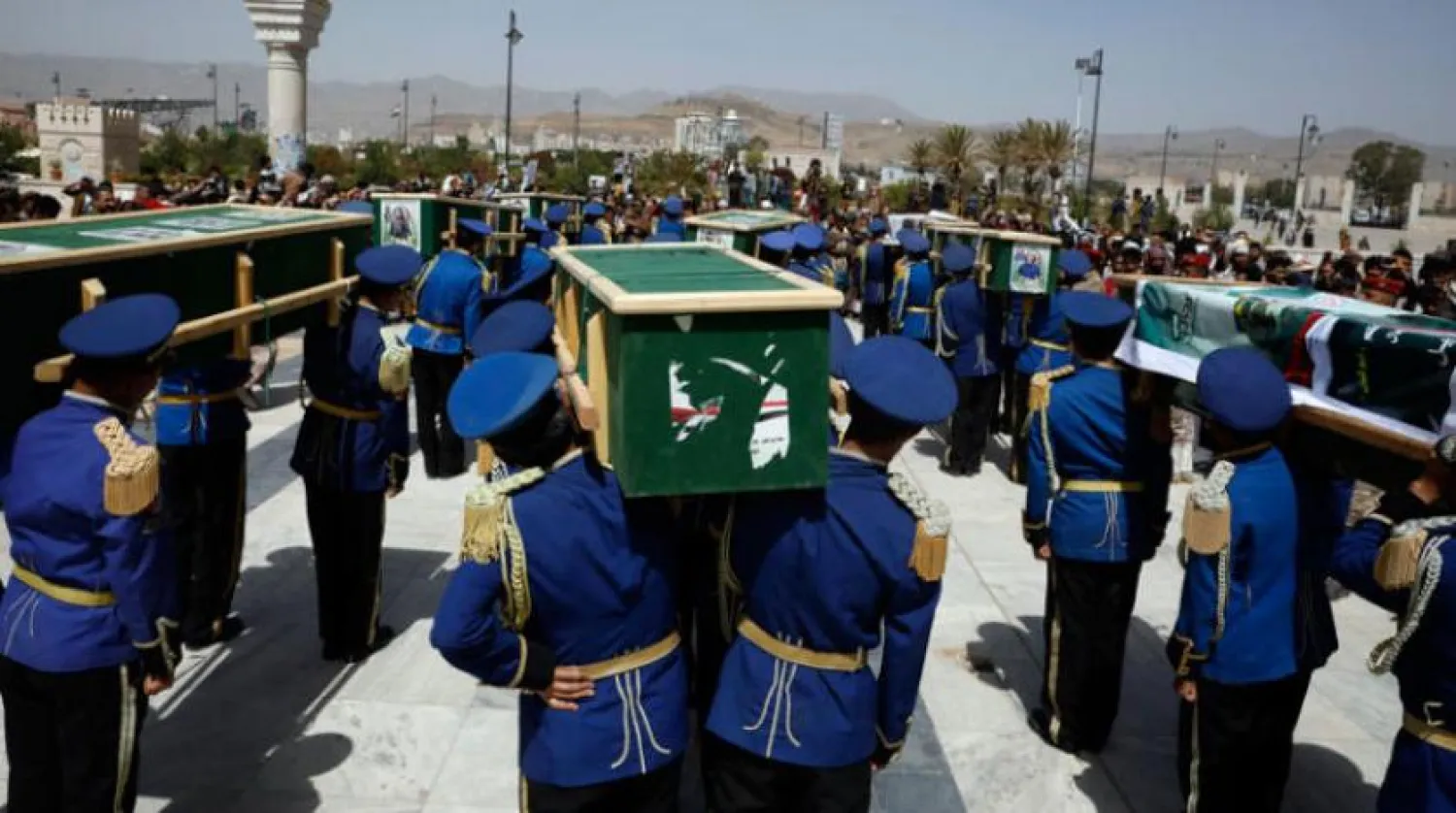
A funeral service for Houthi combatants in Sanaa (EPA)
TT

Why Do Houthi Insurgents Insist on War?

A funeral service for Houthi combatants in Sanaa (EPA)

So far, Iran-backed Houthi militias in Yemen continue to refuse to engage with any UN and international community proposals for achieving a ceasefire and bring about peace to Yemen.

For many Yemenis, Houthis evading peace efforts can be traced back to a mix of the very nature of the militia, its violence-oriented ideology, and the goal of advancing Iran’s expansionist ambitions in the region.

For the regime in Tehran, dominating the south of the Arabian Peninsula would give it a serious grip on one of the key routes for international trade.

Houthis rejecting peace efforts mounted by both the UN Special Envoy for Yemen Martin Griffiths and US Special Envoy Tim Lenderking over the last few weeks begs a fundamental question: “What leverages do Yemenis and the official state have against this group?”

The Iran-backed insurgency has constantly dodged conciliatory efforts and exploited the protracted conflict to achieve political and military gains. They do so by secretly piggybacking their personal goals on humanitarian relief agendas.

Each day, the challenge of forcing compliance from the group and moving it away from Iran’s expansionist program becomes tougher—especially that the militias are working nonstop towards the “Houthification” (Houthi sectarian indoctrination) of local communities.

“Houthis have no regard to politics, nationalism or authority in Yemen,” warns Yemeni academic and political researcher Fares al-Beil.

“They simply refuse peace efforts because peace would spell their end,” he told Asharq Al-Awsat, adding that militias thrive only during wars.

“War constitutes life for militias, while peace ends their raison d’être.”

According to Beil, Houthi militias were created to add fuel to the fires of battle in Yemen, and this has nothing to do with love for their country.

“There is no connection between their Yemeni identity and their Iranian undertaking,” explained the researcher, adding that Houthis exclusively serve their mission without holding “any respect or value for their future.”

Iran’s ultimate plan for Houthis is that they remain a proxy for spreading destruction in the region.

For Beil, It’s wishful thinking to believe that Iran, after Houthis succeeded in turning parts of Yemen into military bastions that answer directly to the Iranian Revolutionary Guard, would accept giving up its influence in exchange for peace.

“It is not reasonable for Iran to give up all of that and go with Houthis partnering in an authority or government and giving up their weapons, projects, and ambitions,” said Beil.

Iran believes that it has accomplished a lot with the militia, so it is a far shot that it would abandon all this and hand the militias over to a Yemeni national project and a state of peace and concession.



Italy Arrests 7 Accused of Raising Millions for Hamas

Palestinian Hamas members secure the area as Egyptian workers accompanied by members of the International Committee of the Red Cross (ICRC) search for the remains of the last Israeli hostage in the Zeitoun neighborhood of Gaza City on December 8, 2025. (Photo by Omar AL-QATTAA / AFP)
TT

Italy Arrests 7 Accused of Raising Millions for Hamas

Palestinian Hamas members secure the area as Egyptian workers accompanied by members of the International Committee of the Red Cross (ICRC) search for the remains of the last Israeli hostage in the Zeitoun neighborhood of Gaza City on December 8, 2025. (Photo by Omar AL-QATTAA / AFP)

Italian police said Saturday that they have arrested seven people suspected of raising millions of euros for Palestinian group Hamas.

Police also issued international arrests for two others outside the country, said AFP.

Three associations, officially supporting Palestinian civilians but allegedly serving as a front for funding Hamas, are implicated in the investigation, said a police statement.

The nine individuals are accused of having financed approximately seven million euros ($8 million) to "associations based in Gaza, the Palestinian territories, or Israel, owned, controlled, or linked to Hamas."

While the official objective of the three associations was to collect donations "for humanitarian purposes for the Palestinian people," more than 71 percent was earmarked for the direct financing of Hamas" or entities affiliated with the movement, according to police.

Some of the money went to "family members implicated in terrorist attacks," the statement said.

Among those arrested was Mohammad Hannoun, president of the Palestinian Association in Italy, according to media reports.

Interior Minister Matteo Piantedosi posted on X that the operation "lifted the veil on behavior and activities which, pretending to be initiatives in favor of the Palestinian population, concealed support for and participation in terrorist organizations."


Türkiye Holds Military Funeral for Libyan Officers Killed in Plane Crash

The Libyan national flag flies at half-mast in Tripoli on December 24, 2025, after the head of Libya's armed forces and his four aides died in a plane crash in Türkiye. (AFP)
TT

Türkiye Holds Military Funeral for Libyan Officers Killed in Plane Crash

The Libyan national flag flies at half-mast in Tripoli on December 24, 2025, after the head of Libya's armed forces and his four aides died in a plane crash in Türkiye. (AFP)

Türkiye held a military funeral ceremony Saturday morning for five Libyan officers, including western Libya’s military chief, who died in a plane crash earlier this week.

The private jet with Gen. Muhammad Ali Ahmad al-Haddad, four other military officers and three crew members crashed on Tuesday after taking off from Ankara, Türkiye’s capital, killing everyone on board. Libyan officials said the cause of the crash was a technical malfunction on the plane.

Al-Hadad was the top military commander in western Libya and played a crucial role in the ongoing, UN-brokered efforts to unify Libya’s military.

The high-level Libyan delegation was on its way back to Tripoli, Libya’s capital, after holding defense talks in Ankara aimed at boosting military cooperation between the two countries.

Saturday's ceremony was held at 8:00 a.m. local time at the Murted Airfield base, near Ankara, and attended by the Turkish military chief and the defense minister. The five caskets, each wrapped in a Libyan national flag, were then loaded onto a plane to be returned to their home country.

Türkiye’s military chief, Selcuk Bayraktaroglu, was also on the plane headed to Libya, state-run news agency TRT reported.

The bodies recovered from the crash site were kept at the Ankara Forensic Medicine Institute for identification. Justice Minister Yilmaz Tunc told reporters their DNA was compared to family members who joined a 22-person delegation that arrived from Libya after the crash.

Tunc also said Germany was asked to help examine the jet's black boxes as an impartial third party.


Syrian Foreign Ministry: Talks with SDF Have Not Yielded Tangible Results

SDF fighters are seen at a military parade in Qamishli. (Reuters file)
TT

Syrian Foreign Ministry: Talks with SDF Have Not Yielded Tangible Results

SDF fighters are seen at a military parade in Qamishli. (Reuters file)

A source from the Syrian Foreign Ministry said on Friday that the talks with the Kurdish Syrian Democratic Forces (SDF) over their integration into state institutions “have not yielded tangible results.”

Discussions about merging the northeastern institutions into the state remain “hypothetical statements without execution,” it told Syria’s state news agency SANA.

Repeated assertions over Syria’s unity are being contradicted by the reality on the ground in the northeast, where the Kurds hold sway and where administrative, security and military institutions continue to be run separately from the state, it added.

The situation “consolidates the division” instead of addressing it, it warned.

It noted that despite the SDF’s continued highlighting of its dialogue with the Syrian state, these discussions have not led to tangible results.

It seems that the SDF is using this approach to absorb the political pressure on it, said the source. The truth is that there is little actual will to move from discussion to application of the March 10 agreement.

This raises doubts over the SDF’s commitment to the deal, it stressed.

Talk about rapprochement between the state and SDF remains meaningless if the agreement is not implemented on the ground within a specific timeframe, the source remarked.

Furthermore, the continued deployment of armed formations on the ground that are not affiliated with the Syrian army are evidence that progress is not being made.

The persistence of the situation undermines Syria’s sovereignty and hampers efforts to restore stability, it warned.