

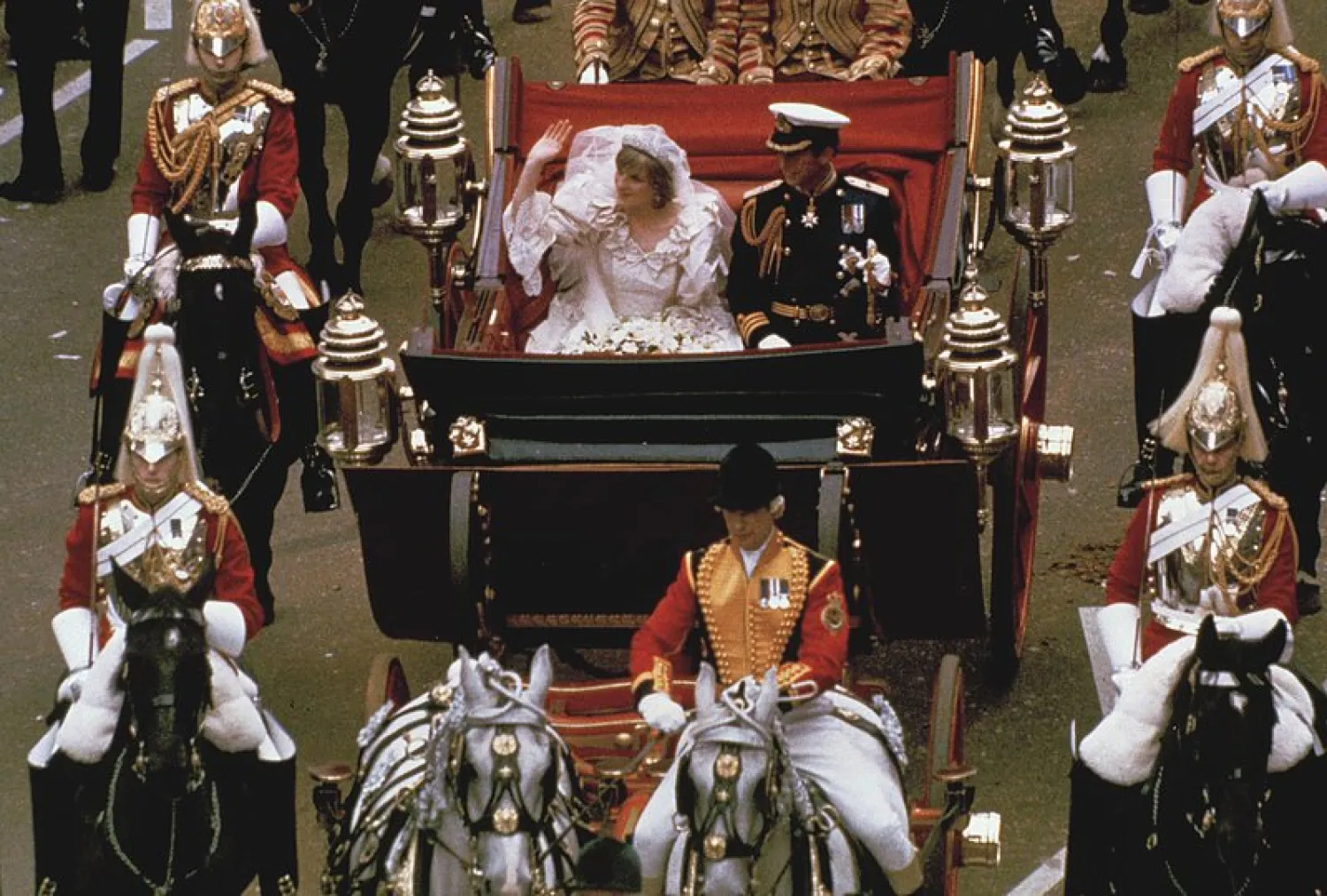

Charles and Diana's 'Wedding of The Century'

FILE - This is a July 29, 1981 file photo of the carriage carrying the Prince and Princess of Wales on its way from St. Paul's Cathedral to Buckingham Palace after the royal wedding in London. (AP Photo/File)
TT

Charles and Diana's 'Wedding of The Century'

FILE - This is a July 29, 1981 file photo of the carriage carrying the Prince and Princess of Wales on its way from St. Paul's Cathedral to Buckingham Palace after the royal wedding in London. (AP Photo/File)

Their fairy-tale marriage 40 years ago this month was dubbed the "wedding of the century".

But for Prince Charles and Lady Diana Spencer it would all end in tears, recriminations and tragedy, with the after-effects still being felt by the British royals today.

Presidents and prime ministers as well as the crowned heads of Europe and beyond streamed into St Paul's Cathedral in London on July 29, 1981 for the ceremony, which was watched on television by 750 million people around the world.

Here is an account of the wedding based on AFP reporting of the time.

- Love and fanfare -
The marriage of Charles, a bachelor of 32, and his 20-year-old blushing bride was a heady mix of "love and protocol", wrote AFP special correspondent Michel Leclercq on the day.

The famous kiss from the balcony of Buckingham Palace which was splashed on front pages around the world the next day took place against a backdrop of British fanfare, with horse-drawn carriages and trumpets.

People around the globe watched from their armchairs as Lady Diana stepped out of the glass carriage which had brought her to St Paul's Cathedral.

As she arrived on the arm of her father Earl Spencer, the woman who was about to become the Princess of Wales revealed the day's best-kept secret: her spectacular wedding gown.

- The dress -
She climbed the steps of St Paul's in her ivory taffeta dress, a 7.5-metre (22-foot) train cascading behind her, and a diamond tiara on her head.

"When she appeared wearing ivory, hidden under a multitude of pleats, frills, mother of pearl sequins and crinoline, a formidable roar rose from the crowd," AFP wrote.

Trailed by her bridesmaids, she walked slowly down the aisle past the 2,500 handpicked guests to the sound of trumpets to join Prince Charles, who wore a Royal Navy commander's full dress uniform.

- Nerves -
As the world looked on, the royal couple were clearly feeling the pressure.

Under the dome of St Paul's and in thunderous silence, the future king's voice trembled as he murmured "I will".

The bride also stumbled while reading the marriage vows, despite smiles of encouragement from Charles.

"As she repeated the ritual wording Lady Diana betrayed nervousness and inverted the prince's names," AFP wrote.

Diana also timidly said, "I will". It had been agreed in advance that she would not vow to obey her husband, in a break with tradition that in those days still raised some eyebrows.

Prince Charles then laid the gold ring on her left hand and at 12:20 pm precisely, AFP wrote: "Prince Charles and Lady Diana Spencer are married."

New Zealand soprano Kiri Te Kanawa then sang Handel's "Let the Bright Seraphim" as part of a concert that was beamed to the crowd outside.

- Tears -
Britain's Queen Mother, 81 at the time, wiped away a tear, while Charles' mother Queen Elizabeth II, dressed in a turquoise dress and matching hat, had "moist eyes" on several occasions throughout the service, AFP wrote.

With Britain doing what its media commented it does best -- putting on a state occasion -- it was very much a British affair.

"The British press did not devote a line to the make-up of Princess Grace of Monaco, the suit of French President Francois Mitterrand or the pale pink suit worn by Nancy Reagan (the US First Lady)," AFP wrote.

- 'Furtive kiss' -
Britain had a national holiday and around 600,000 people gathered in the streets, some having camped out all night, waving Union Jack flags as they witnessed the two newly-weds crossing London on the three-kilometer (two-mile) route from the church in their open-topped state carriage.

The assembled crowds then cheered the famous kiss on the balcony of Buckingham Palace.

The "furtive kiss" symbolized "a marriage where the spontaneity of love managed to win over tradition", AFP wrote, somewhat wishfully, as things would turn out.

- Britain parties -
Britain danced to the tune of the wedding which was accompanied by the biggest security operation since World War II, with the British mainland still in the grip of an Irish Republican Army (IRA) bombing campaign.

Hair salons were advertising the "Diana cut" and admirers bought commemorative mugs and plates bearing a photograph of the royal couple along with other royal gadgets.

After the major fanfare, the couple attended a more intimate reception at the Palace where Diana was photographed kissing her youngest bridesmaid, a five-year-old, before departing on honeymoon on the royal yacht Britannia to cruise the Mediterranean.

- Fairy tale turns sour -
In his sermon, the Archbishop of Canterbury Robert Runcie called the wedding a "fairy tale".

But it lasted less than five years during which an "heir and spare", princes William and Harry, were born.

After that, the marriage gradually turned acrimonious, with stories of infidelity, embarrassing leaked telephone conversations and Diana's bulimia and suicide attempts.

The royal couple separated in 1992 followed by their divorce in 1996.

Diana's death in 1997 in a car crash in Paris caused deep distress and rocked the monarchy.

The queen, whose distance and reserve marked her out from her subjects, was accused of heartlessness.

In a civil ceremony on April 9, 2005, Charles married his new wife, Camilla Parker Bowles, who had emerged as the real love of his life and to whom he reportedly gave a bracelet engraved with the initials of their nicknames for each other -- Fred and Gladys -- the night before his wedding to Diana.

While Diana would have become queen upon Charles' accession to the throne, Camilla will merely be queen consort.



Perry Bamonte, Keyboardist and Guitarist for The Cure, Dies at 65

Perry Bamonte of The Cure performs at North Island Credit Union Amphitheater on May 20, 2023 in Chula Vista, California. (Getty Images/AFP)
TT

Perry Bamonte, Keyboardist and Guitarist for The Cure, Dies at 65

Perry Bamonte of The Cure performs at North Island Credit Union Amphitheater on May 20, 2023 in Chula Vista, California. (Getty Images/AFP)

Perry Bamonte, keyboardist and guitarist in The Cure, has died at 65, the English indie rock band confirmed through their official website on Friday.

In a statement, the band wrote that Bamonte died "after a short illness at home" on Christmas Day.

"It is with enormous sadness that ‌we confirm ‌the death of our ‌great ⁠friend and ‌bandmate Perry Bamonte who passed away after a short illness at home over Christmas," the statement said, adding he was a "vital part of The Cure story."

The statement said Bamonte was ⁠a full-time member of The Cure since 1990, ‌playing guitar, six-string bass, ‍and keyboards, and ‍performed in more than 400 shows.

Bamonte, ‍born in London, England, in 1960, joined the band's road crew in 1984, working alongside his younger brother Daryl, who worked as tour manager for The Cure.

Bamonte first worked as ⁠an assistant to co-founder and lead vocalist, Robert Smith, before becoming a full member after keyboardist Roger O'Donnell left the band in 1990.

Bamonte's first album with The Cure was "Wish" in 1992. He continued to work with them on the next three albums.

He also had various acting ‌roles in movies: "Judge Dredd,About Time" and "The Crow."


First Bond Game in a Decade Hit by Two-month Delay

'007 First Light' depicts a younger Bond earning his license to kill. Ina FASSBENDER / AFP
TT

First Bond Game in a Decade Hit by Two-month Delay

'007 First Light' depicts a younger Bond earning his license to kill. Ina FASSBENDER / AFP

A Danish video game studio said it was delaying the release of the first James Bond video game in over a decade by two months to "refine the experience".

Fans will now have to wait until May 27 to play "007 First Light" featuring Ian Fleming's world-famous spy, after IO Interactive said on Tuesday it was postponing the launch to add some final touches.

"007 First Light is our most ambitious project to date, and the team has been fully focused on delivering an unforgettable James Bond experience," the Danish studio wrote on X.

Describing the game as "fully playable", IO Interactive said the two additional months would allow their team "to further polish and refine the experience", giving players "the strongest possible version at launch".

The game, which depicts a younger Bond earning his license to kill, is set to feature "globe-trotting, spycraft, gadgets, car chases, and more", IO Interactive added.

It has been more than a decade since a video game inspired by Bond was released. The initial release date was scheduled for March 27.


Movie Review: An Electric Timothee Chalamet Is the Consummate Striver in Propulsive ‘Marty Supreme’

 Timothee Chalamet attends the premiere of "Marty Supreme" at Regal Times Square on Tuesday, Dec. 16, 2025, in New York. (AP)
Timothee Chalamet attends the premiere of "Marty Supreme" at Regal Times Square on Tuesday, Dec. 16, 2025, in New York. (AP)
TT

Movie Review: An Electric Timothee Chalamet Is the Consummate Striver in Propulsive ‘Marty Supreme’

 Timothee Chalamet attends the premiere of "Marty Supreme" at Regal Times Square on Tuesday, Dec. 16, 2025, in New York. (AP)
Timothee Chalamet attends the premiere of "Marty Supreme" at Regal Times Square on Tuesday, Dec. 16, 2025, in New York. (AP)

“Everybody wants to rule the world,” goes the Tears for Fears song we hear at a key point in “Marty Supreme,” Josh Safdie’s nerve-busting adrenaline jolt of a movie starring a never-better Timothee Chalamet.

But here’s the thing: everybody may want to rule the world, but not everybody truly believes they CAN. This, one could argue, is what separates the true strivers from the rest of us.

And Marty — played by Chalamet in a delicious synergy of actor, role and whatever fairy dust makes a performance feel both preordained and magically fresh — is a striver. With every fiber of his restless, wiry body. They should add him to the dictionary definition.

Needless to say, Marty is a New Yorker.

Also needless to say, Chalamet is a New Yorker.

And so is Safdie, a writer-director Chalamet has called “the street poet of New York.” So, where else could this story be set?

It’s 1952, on Manhattan’s Lower East Side. Marty Mauser is a salesman in his uncle’s shoe store, escaping to the storeroom for a hot tryst with his (married) girlfriend. This witty opening sequence won’t be the only thing recalling “Uncut Gems,” co-directed by Safdie with his brother Benny before the two split for solo projects. That film, which feels much like the precursor to “Marty Supreme,” began as a trip through the shiny innards of a rare opal, only to wind up inside Adam Sandler’s colon, mid-colonoscopy.

Sandler’s Howard Ratner was a New York striver, too, but sadder, and more troubled. Marty is young, determined, brash — with an eye always to the future. He’s a great salesman: “I could sell shoes to an amputee,” he boasts, crassly. But what he’s plotting to unveil to the world has nothing to do with shoes. It’s about table tennis.

How likely is it that this Jewish kid from the Lower East Side can become the very face of a sport in America, soon to be “staring at you from the cover of a Wheaties box?”

To Marty, perfectly likely. Still, he knows nobody in the US cares about table tennis. He’s so determined to prove everyone wrong, starting at the British Open in London, that when there’s a snag obtaining cash for his trip, he brandishes a gun at a colleague to get it.

Shaking off that sorta-armed robbery thing, Marty arrives in London, where he fast-talks his way into a suite at the Ritz. Here, he spies fellow guest Kay Stone (Gwyneth Paltrow, in a wise, stylish return to the screen), a former movie star married to an insufferable tycoon (“Shark Tank” personality Kevin O’Leary, one of many nonactors here.)

Kay’s skeptical, but Marty finds a way to woo her. Really, all he has to say is: “Come watch me.” Once she sees him play, she’s sneaking into his room in a lace corselet.

This would be a good time to stop and consider Chalamet’s subtly transformed appearance. He is stick-thin — duh, he never stops moving. His mustache is skimpy. His skin is acne-scarred — just enough to erase any movie-star sheen. Most strikingly, his eyes, behind the round spectacles, are beady — and smaller. Definitely not those movie-star eyes.

But then, nearly all the faces in “Marty Supreme” are extraordinary. In a movie with more than 100 characters, we have known actors (Fran Drescher, Abel Ferrara); nonacting personalities (O’Leary, and an excellent Tyler Okonma (Tyler, The Creator) as Marty’s friend Wally); and exciting newcomers like Odessa A’Zion as Marty’s feisty girlfriend Rachel.

There are also a slew of nonactors in small parts, plus cameos from the likes of David Mamet and even high wire artist Philippe Petit. The dizzying array makes one curious how it all came together — is casting director Jennifer Venditti taking interns? Production notes tell us that for one hustling scene at a bowling alley, young men were recruited from a sports trading-card convention.

Elsewhere on the creative team, composer Daniel Lopatin succeeds in channeling both Marty’s beating heart and the ricochet of pingpong balls in his propulsive score. The script by Safdie and cowriter Ronald Bronstein, loosely based on real-life table tennis hustler Marty Reisman, beats with its own, never-stopping pulse. The same breakneck aesthetic applies to camera work by Darius Khondji.

Back now to London, where Marty makes the finals against Japanese player Koto Endo (Koto Kawaguchi, like his character a deaf table tennis champion). “I’ll be dropping a third atom bomb on them,” he brags — not his only questionable World War II quip. But Endo, with his unorthodox paddle and grip, prevails.

After a stint as a side act with the Harlem Globetrotters, including pingpong games with a seal — you’ll have to take our word for this, folks, we’re running low on space — Marty returns home, determined to make the imminent world championships in Tokyo.

But he's in trouble — remember he took cash at gunpoint? Worse, he has no money.

So Marty’s on the run. And he’ll do anything, however messy or dangerous, to get to Japan. Even if he has to totally debase himself (mark our words), or endanger friends — or abandon loyal and brave Rachel.

Is there something else for Marty, besides his obsessive goal? If so, he doesn’t know it yet. But the lyrics of another song used in the film are instructive here: “Everybody’s got to learn sometime.”

So can a single-minded striver ultimately learn something new about his own life?

We'll have to see. As Marty might say: “Come watch me.”