


Tunisia President Sacks Defense Minister amid Political Turmoil

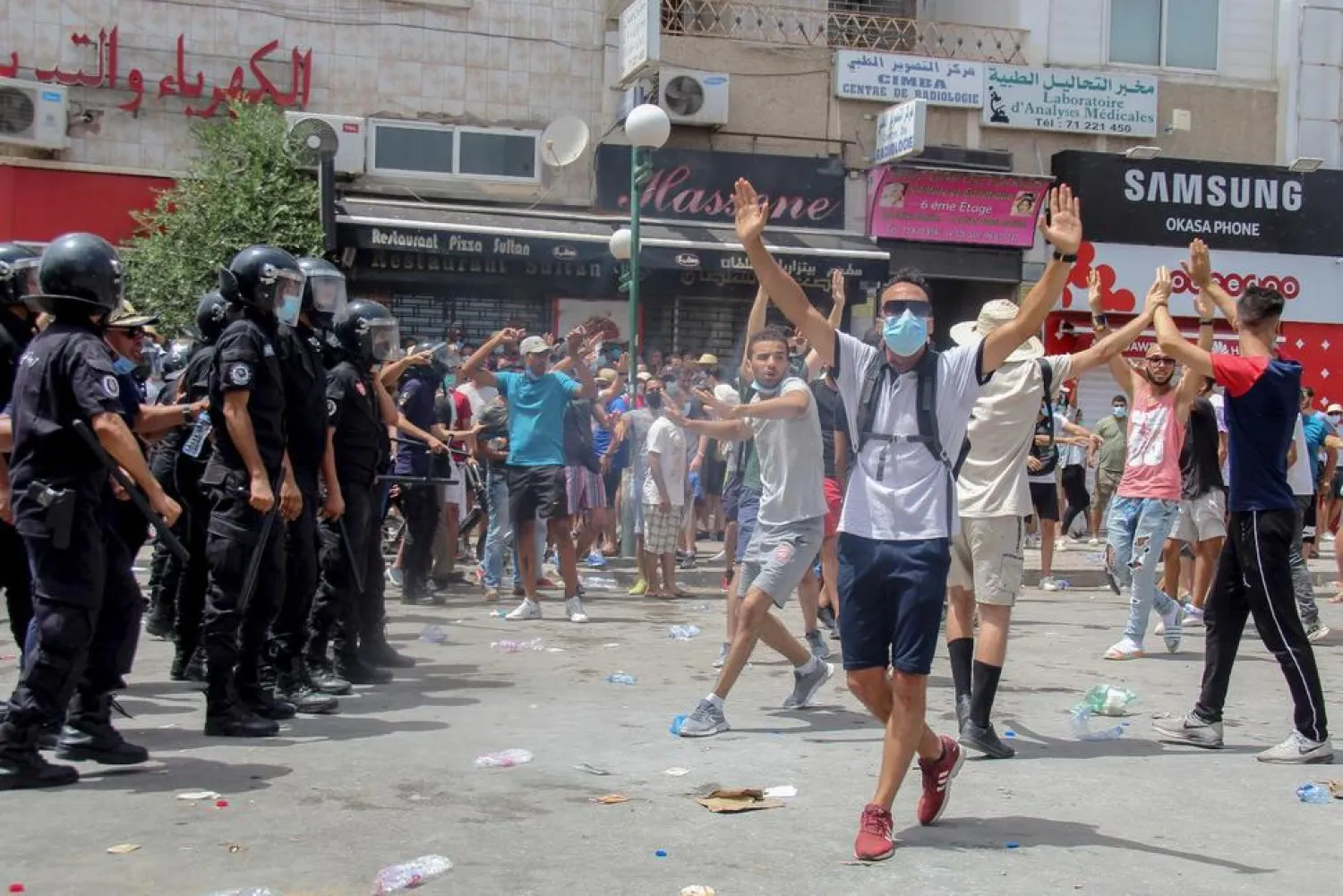
Protesters face Tunisian police officers during a demonstration in Tunis, Tunisia, Sunday, July 25, 2021. (AP)
TT

Tunisia President Sacks Defense Minister amid Political Turmoil

Protesters face Tunisian police officers during a demonstration in Tunis, Tunisia, Sunday, July 25, 2021. (AP)

Tunisian President Kais Saied sacked the defense minister Monday, a day after ousting the prime minister and suspending parliament, plunging the young democracy into constitutional crisis in the midst of a pandemic.

Street clashes erupted Monday outside the army-barricaded parliament, after Saied dismissed Prime Minister Hichem Mechichi and ordered parliament closed for 30 days, a move the biggest political party Ennahdha decried as a “coup”.

Saied declared on Sunday that he had “taken the necessary decisions to save Tunisia, the state and the Tunisian people,” following street protests in multiple cities against the government’s handling of the Covid pandemic.

The president, who under the constitution controls the armed forces, warned his opponents against taking up arms, threatening that if anyone “fires a single bullet, our forces will respond with a rain of bullets”.

On Monday afternoon, a statement from the presidency announced the dismissals of Defense Minister Ibrahim Bartaji and acting justice minister Hasna Ben Slimane, who is also the government spokeswoman.

‘Very dangerous’
Soldiers from early Monday blockaded the assembly in Tunis while Saied backers hurled stones, bottles and insults at supporters of the Islamist-inspired Ennahdha, whose leader, parliament Speaker Rached Ghannouchi, was barred entry to the complex.

Troops also surrounded the office of Mechichi, who was yet to officially react to the events rocking the North African country.

Later in the afternoon, the protests died down.

Saied’s dramatic move -- a decade on from Tunisia’s 2011 revolution -- comes even though the constitution enshrines a parliamentary democracy.

It “is a coup d’etat against the revolution and against the constitution,” said Ennahdha, the lead party in Tunisia’s fractious ruling coalition charged, warning its members “will defend the revolution”.

The crisis follows months of deadlock between the president, the premier and Ennahdha chief Ghannouchi, which has crippled the Covid response as deaths have surged to one of the world’s highest per capita rates.

Tunisia has recently been overwhelmed by Covid-19 cases which have raised the death toll to more than 18,000 in a nation of 12 million.

Police also shuttered the local bureau of Qatari-based Al Jazeera television, the network’s Tunis director Lotfi Hajji said, warning that “what is happening is very dangerous, it is proof that freedom of the press is threatened”.

‘Imminent danger’
The powerful Tunisian General Labor Union (UGTT) which played a key role in the 2011 uprising, said the president acted “in accordance” with the constitution to “prevent imminent danger and to restore the normal functioning” of the state.

Saied’s power-grab sparked jubilant rallies late Sunday by thousands of his supporters who flooded the streets of Tunis, waving the national flag and sounding their car horns as fireworks lit up the sky.

But the shock move was criticized abroad.

The United States is concerned about developments in Tunisia and urged calm in the country, White House spokeswoman Jen Psaki said on Monday, adding the United States is in touch at a senior level with Tunisian leaders to learn more.

Psaki said the White House has not made a determination on whether it was a coup.

Germany urged a rapid “return to constitutional order” while the foreign ministry in Turkey, where the government supports Ennahdha, called for “democratic legitimacy” to be restored.

France called for respect of the rule of law in Tunisia as quickly as possible and called on all political parties to refrain from violence.

Since Saied was elected in 2019, he has been locked in a showdown with Mechichi and Ghannouchi.

The rivalry has blocked ministerial appointments and diverted resources from tackling Tunisia’s many economic and social problems.

In the chaotic scenes outside parliament Monday, Ghannouchi admonished an army officer who was blocking access and who had declared the troops were “the protectors of the nation”.

Ghannouchi retorted that “the Tunisian people will never accept an authoritarian government, whatever your efforts”.

Saied said he would assume executive power “with the help” of a government whose new chief he would appoint himself.

The president also lifted parliamentary immunity for lawmakers.

Skepticism
In the 10 years since Tunisia’s popular revolution toppled long-time leader Zine El Abidine Ben Ali, Tunisia has had nine governments.

Some of them have lasted only a few months, hindering the reforms needed to revamp the country’s struggling economy and poor public services.

Sunday’s political drama began with mass protests against the government for its failures in tackling the pandemic.

“The people want the dissolution of parliament,” the crowd chanted outside parliament in Tunis. Protests were also reported in several other cities.

A senior Ennahdha official, speaking to AFP on condition of anonymity, alleged that the protests and subsequent celebrations, had all been choreographed by the president.

After Saied’s announcement, one jubilant supporter, Nahla, brandished a Tunisian flag and hailed the president’s “courageous decisions”.

“This is the president we love!” she said.

But one man, aged in his forties, watched on without enthusiasm and said: “These fools are celebrating the birth of a new dictator.”



Israel Military Says Soldier Killed in Gaza 

A drone view shows the destruction in a residential neighborhood, after the withdrawal of the Israeli forces from the area, amid a ceasefire between Israel and Hamas in Gaza, in Gaza City, October 21, 2025. (Reuters)
TT

Israel Military Says Soldier Killed in Gaza 

A drone view shows the destruction in a residential neighborhood, after the withdrawal of the Israeli forces from the area, amid a ceasefire between Israel and Hamas in Gaza, in Gaza City, October 21, 2025. (Reuters)

The Israeli military announced that one of its soldiers had been killed in combat in southern Gaza on Wednesday, but a security source said the death appeared to have been caused by "friendly fire".

"Staff Sergeant Ofri Yafe, aged 21, from HaYogev, a soldier in the Paratroopers Reconnaissance Unit, fell during combat in the southern Gaza Strip," the military said in a statement.

A security source, however, told AFP that the soldier appeared to have been "killed by friendly fire", without providing further details.

"The incident is still under investigation," the source added.

The death brings to five the number of Israeli soldiers killed in Gaza since a ceasefire took effect on October 10.


Syria: SDF’s Mazloum Abdi Says Implementation of Integration Deal May Take Time

People sit outdoors surrounded by nature, with the Tigris river flowing in the background, following a long atmospheric depression, near the Syrian-Turkish border in Derik, Syria, February 16, 2026 REUTERS/Orhan Qereman
TT

Syria: SDF’s Mazloum Abdi Says Implementation of Integration Deal May Take Time

People sit outdoors surrounded by nature, with the Tigris river flowing in the background, following a long atmospheric depression, near the Syrian-Turkish border in Derik, Syria, February 16, 2026 REUTERS/Orhan Qereman

Mazloum Abdi, commander of the Syrian Democratic Forces, said the process of merging the SDF with Syrian government forces “may take some time,” despite expressing confidence in the eventual success of the agreement.

His remarks came after earlier comments in which he acknowledged differences with Damascus over the concept of “decentralization.”

Speaking at a tribal conference in the northeastern city of Hasakah on Tuesday, Abdi said the issue of integration would not be resolved quickly, but stressed that the agreement remains on track.

He said the deal reached last month stipulates that three Syrian army brigades will be created out of the SDF.

Abdi added that all SDF military units have withdrawn to their barracks in an effort to preserve stability and continue implementing the announced integration agreement with the Syrian state.

He also emphasized the need for armed forces to withdraw from the vicinity of the city of Ayn al-Arab (Kobani), to be replaced by security forces tasked with maintaining order.


Israeli Far-Right Minister to Push for ‘Migration’ of West Bank, Gaza Palestinians 

A Palestinian man checks leather belts as people prepare for Ramadan, in the old city of Hebron in the Israeli-occupied West Bank, February 17,2026. (Reuters)
TT

Israeli Far-Right Minister to Push for ‘Migration’ of West Bank, Gaza Palestinians 

A Palestinian man checks leather belts as people prepare for Ramadan, in the old city of Hebron in the Israeli-occupied West Bank, February 17,2026. (Reuters)

Israel's far-right Finance Minister Bezalel Smotrich said he would pursue a policy of "encouraging the migration" of Palestinians from the occupied West Bank and Gaza Strip, Israeli media reported Wednesday.

"We will eliminate the idea of an Arab terror state," said Smotrich, speaking at an event organized by his Religious Zionism Party late on Tuesday.

"We will finally, formally, and in practical terms nullify the cursed Oslo Accords and embark on a path toward sovereignty, while encouraging emigration from both Gaza and Judea and Samaria.

"There is no other long-term solution," added Smotrich, who himself lives in a settlement in the West Bank.

Since last week, Israel has approved a series of measures backed by far-right ministers to tighten control over the West Bank, including in areas administered by the Palestinian Authority under the Oslo Accords, in place since the 1990s.

The measures include a process to register land in the West Bank as "state property" and facilitate direct purchases of land by Jewish Israelis.

The measures have triggered widespread international outrage.

On Tuesday, the UN missions of 85 countries condemned the measures, which critics say amount to de facto annexation of the Palestinian territory.

"We strongly condemn unilateral Israeli decisions and measures aimed at expanding Israel's unlawful presence in the West Bank," they said in a statement.

"Such decisions are contrary to Israel's obligations under international law and must be immediately reversed.

"We underline in this regard our strong opposition to any form of annexation."

UN Secretary-General Antonio Guterres on Monday called on Israel to reverse its land registration policy, calling it "destabilizing" and "unlawful".

The West Bank would form the largest part of any future Palestinian state. Many on Israel's religious right view it as Israeli land.

Israeli NGOs have also raised the alarm over a settlement plan signed by the government which they say would mark the first expansion of Jerusalem's borders into the occupied West Bank since 1967.

The planned development, announced by Israel's Ministry of Construction and Housing, is formally a westward expansion of the Geva Binyamin, or Adam, settlement situated northeast of Jerusalem in the West Bank.

The current Israeli government has fast-tracked settlement expansion, approving a record 52 settlements in 2025.

Excluding Israeli-annexed east Jerusalem, more than 500,000 Israelis live in West Bank settlements and outposts, which are illegal under international law.