


Saudi Arabia Threatens 3-Year Travel Ban for Citizens who Visit ‘Red List’ States

A general view of Riyadh, Saudi Arabia. (SPA)
TT

Saudi Arabia Threatens 3-Year Travel Ban for Citizens who Visit ‘Red List’ States

A general view of Riyadh, Saudi Arabia. (SPA)

Saudi Arabia will impose a three-year travel ban on citizens travelling to countries on the Kingdom’s “red list” under efforts to curb the spread of coronavirus and its new variants, reported the Saudi Press Agency on Tuesday.

It cited an unnamed interior ministry official as saying some Saudi citizens, who in May were allowed to travel abroad without prior permission from authorities for the first time since March 2020, had violated travel regulations.

“Anyone who is proven to be involved will be subject to legal accountability and heavy penalties upon their return, and will be banned from travel for three years,” the official said.

Saudi Arabia has banned travel to or transit at a number of countries including Afghanistan, Argentina, Brazil, Egypt, Ethiopia, India, Indonesia, Lebanon, Pakistan, South Africa, Turkey, Vietnam and the United Arab Emirates.

“The Ministry of Interior stresses that citizens are still banned from travelling directly or via another country to these states or any other that has yet to control the pandemic or where the new strains have spread,” the official said.

The Kingdom on Tuesday recorded 1,379 new COVID-19 infections, bringing its total to 520,774 cases and 8,189 deaths.

It saw daily infections fall from a peak above 4,000 in June 2020 to below the 100 mark in early January.

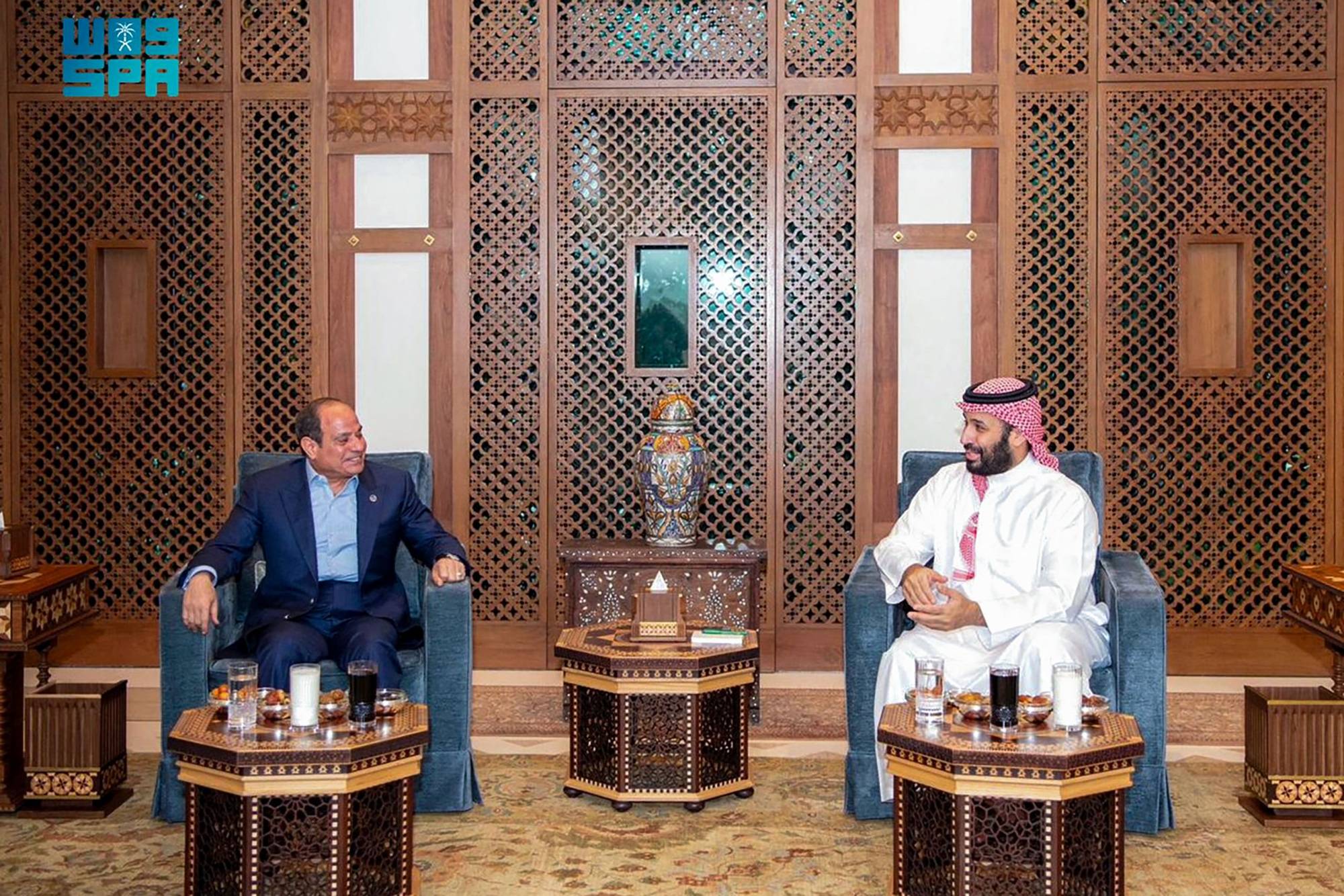

Mohammed bin Salman Welcomes Egypt’s Sisi in Jeddah

Prince Mohammed bin Salman, Crown Prince and Prime Minister, welcomes Egyptian President Abdel Fattah al-Sisi in Jeddah on Monday. (SPA)
TT

Mohammed bin Salman Welcomes Egypt’s Sisi in Jeddah

Prince Mohammed bin Salman, Crown Prince and Prime Minister, welcomes Egyptian President Abdel Fattah al-Sisi in Jeddah on Monday. (SPA)

Prince Mohammed bin Salman, Crown Prince and Prime Minister, welcomed Egyptian President Abdel Fattah al-Sisi in Jeddah on Monday.

Sisi kicked off a “fraternal” visit to Saudi Arabia as part of the two countries’ “keenness on bolstering the historic brotherly relations that bind them.”

Prince Mohammed bin Salman, Crown Prince and Prime Minister, and Egyptian President Abdel Fattah al-Sisi meet in Jeddah on Monday. (SPA)

The visit aims to continue consultations and coordination over various regional and international issues of interest, said the Egyptian presidency.

Crown Prince Mohammed also held an iftar banquet in Sisi’s honor.


GCC Secretary-General Meets Lebanese Ambassador to Saudi Arabia

Secretary General of the Gulf Cooperation Council Jasem Mohamed Albudaiwi. GCC
TT

GCC Secretary-General Meets Lebanese Ambassador to Saudi Arabia

Secretary General of the Gulf Cooperation Council Jasem Mohamed Albudaiwi. GCC

Gulf Cooperation Council (GCC) Secretary-General Jasem Albudaiwi met Lebanon's Ambassador to the Kingdom of Saudi Arabia Ali Karanouh in Riyadh on Monday.

The two sides discussed several topics, reviewing relations between the GCC and Lebanon and ways to develop them to achieve mutual interests, SPA reported.

They also addressed the latest regional and international developments and conditions.

Albudaiwi noted that the GCC has accepted an invitation to attend the International Conference in Support of the Lebanese Army and Security Forces, scheduled to take place next month in Paris, the capital of France.

He added that this participation reaffirms the GCC’s steadfast support for the brotherly Lebanese Republic and its commitment to Lebanon’s sovereignty, security, and stability.


Saudi Arabia Stresses importance of Iraq Respecting Kuwait’s Sovereignty, Territorial Integrity 

Saudi Arabia Stresses importance of Iraq Respecting Kuwait’s Sovereignty, Territorial Integrity 
TT

Saudi Arabia Stresses importance of Iraq Respecting Kuwait’s Sovereignty, Territorial Integrity 

Saudi Arabia Stresses importance of Iraq Respecting Kuwait’s Sovereignty, Territorial Integrity 

Saudi Arabia reiterated on Monday its “categorical rejections of any claims of rights by any other party in the divided submerged area within its designated boundaries with Kuwait.”

It underscored “the importance of Iraq respecting Kuwait’s sovereignty and territorial integrity and honoring bilateral and international agreements,” said a Saudi Foreign Ministry statement.

It added that Saudi Arabia was monitoring with “deep concern the coordinate lists and a map filed by Iraq with the United Nations.”

“The submissions include encroachments that extend to large parts of the divided submerged area adjacent to the Saudi-Kuwaiti divided zone.,” it noted.

“The Kingdom shares with Kuwait ownership of natural resources in that area under agreements concluded and in force between them. Those agreements are based on the provisions of the 1982 United Nations Convention on the Law of the Sea,” stressed the statement.

“The coordinates also violate the sovereignty of Kuwait over its maritime areas and its maritime elevations, including Fasht Al-Qaid and Fasht Al-Aij,” it remarked.

Kuwait’s foreign ministry said Iraq's claim infringes on Kuwait’s sovereignty by placing Kuwaiti areas, including the Fasht al-Qaid and Fasht al-Aij shoals, in Iraqi territory.

Saudi Arabia called on Iraq to comply with all relevant United Nations resolutions, especially United Nations Security Council Resolution 833. The resolution demarcated the land and maritime boundary between Kuwait and Iraq.

The ministry called for “reason, wisdom and dialogue to prevail in resolving differences,” urging “serious and responsible engagement in line with the rules and principles of international law and good neighborliness.”

Qatar, the United Emirates and Oman have issued statements in solidarity with Kuwait.
