


Probe into Beirut Blast Stalls Again, Leaving Families Fuming One Year on

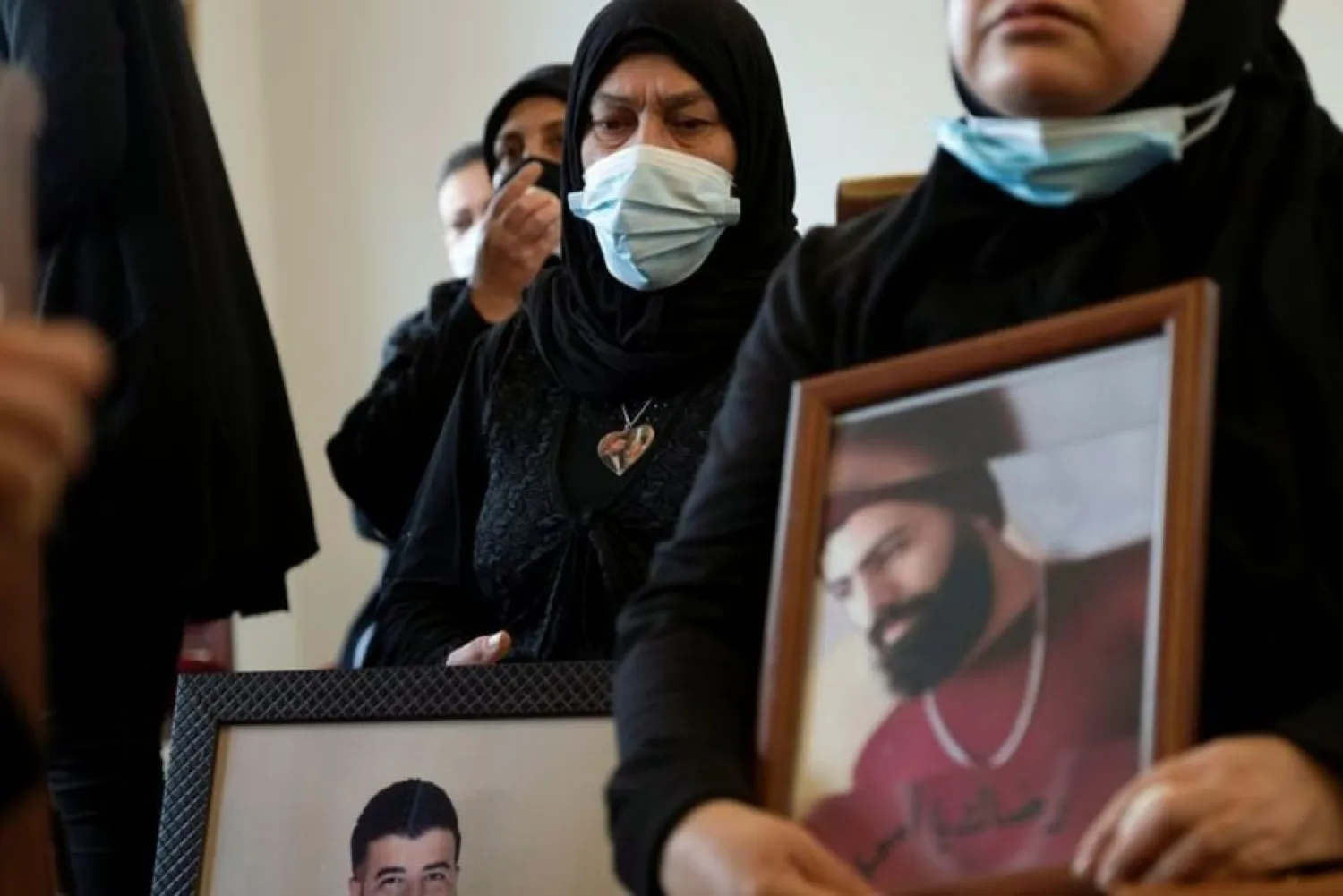
Relatives of victims of Beirut port explosion, hold their pictures during a ceremony in Beirut, Lebanon March 20, 2021. (Reuters)
TT

Probe into Beirut Blast Stalls Again, Leaving Families Fuming One Year on

Relatives of victims of Beirut port explosion, hold their pictures during a ceremony in Beirut, Lebanon March 20, 2021. (Reuters)

Ibrahim Hoteit lost his younger brother, Tharwat, in the huge explosion that ripped through the port of Beirut last August. He went around hospitals collecting body parts, starting with Tharwat’s scalp, and buried his remains in a small coffin.

Nearly a year later, Hoteit, a spokesperson for families of more than 200 people who died in the disaster, is still trying to call to account those he says are responsible for allowing the accident to happen.

Earlier this month, during a protest outside the caretaker interior minister’s house in the Lebanese capital, he said security forces used tear gas during scuffles with the crowd.

“We can’t be deprived of truth and justice in the face of a crime of such magnitude,” he told Reuters.

As Beirut prepares to mark the first anniversary of a blast that flattened large swathes of the city, politicians and senior security officials have yet to be questioned in a formal investigation.

In the latest twist, Tarek Bitar, the judge leading the probe, had a request to question Major General Abbas Ibrahim - head of the powerful General Security agency - turned down by caretaker interior minister Mohamed Fahmy.

Ibrahim said he was subject to the law like all Lebanese, but the investigation should take place “far away from narrow political considerations”.

Fahmy’s decision prompted some relatives of those killed to march near his house this month, carrying empty coffins covered in images of the victims. The demonstration turned violent.

A senior interior ministry source said measures the security forces took were necessary to protect the private home of the minister.

The relatives’ frustration reflects widespread anger among Lebanese about the investigation and, more broadly, over how the country is being run.

Lebanon’s debt has spiraled, inflation is high, more than half the population lives in poverty and rival political factions have repeatedly failed to form a government.

Setbacks
Much of the devastation from the blast is still visible. The port resembles a bomb site, and many buildings have been left in a state of collapse.

Major questions remain unanswered, including why such a large shipment of ammonium nitrate, a highly explosive chemical used in bombs and fertilizer, was left stored in the middle of a crowded city for years after being unloaded in 2013.

The immunity enjoyed by senior officials has raised suspicions among some families that there may never be accountability.

“How can you have justice if everyone from the smallest official to the biggest ... has immunity?” said Nizar Saghieh, head of the Legal Agenda, a research and advocacy organization.

Fahmy’s move to block the judge from questioning Ibrahim was based on the advice of a judicial committee at the interior ministry not to lift his immunity, according to a letter explaining the decision.

The challenges Bitar faces are not unique.

His predecessor, Fadi Sawwan, was removed from the probe in February after a court granted the request of two of the former ministers he charged with negligence for the disaster - Ali Hassan Khalil and Ghazi Zoaiter - to have him removed.

A copy of the decision seen by Reuters cited “legitimate suspicion” over Sawwan’s neutrality, partly because it alleged his house was damaged in the blast.

Khalil and Zoaiter, along with a third former minister and the outgoing prime minister Hassan Diab, declared their innocence when Sawwan charged them, refused to be questioned as suspects and accused Sawwan of overstepping his powers.

A document seen by Reuters that was sent just over two weeks before the blast showed the president and prime minister were warned about the security risk posed by the chemicals stored at the port and that they could destroy the capital.

Bitar wants the government and parliament to allow him to question several top officials, including all those charged by Sawwan, in addition to former Interior Minister Nouhad Mashnouk.

With his request to question Ibrahim denied, the immediate fate of Bitar’s investigation appears to rest on parliamentary immunity being lifted from Mashnouk, Khalil and Zoaiter, all of whom are MPs.

MPs met to discuss Bitar’s request earlier this month, saying they needed more information to before deciding.



Israel Military Says Soldier Killed in Gaza 

A drone view shows the destruction in a residential neighborhood, after the withdrawal of the Israeli forces from the area, amid a ceasefire between Israel and Hamas in Gaza, in Gaza City, October 21, 2025. (Reuters)
TT

Israel Military Says Soldier Killed in Gaza 

A drone view shows the destruction in a residential neighborhood, after the withdrawal of the Israeli forces from the area, amid a ceasefire between Israel and Hamas in Gaza, in Gaza City, October 21, 2025. (Reuters)

The Israeli military announced that one of its soldiers had been killed in combat in southern Gaza on Wednesday, but a security source said the death appeared to have been caused by "friendly fire".

"Staff Sergeant Ofri Yafe, aged 21, from HaYogev, a soldier in the Paratroopers Reconnaissance Unit, fell during combat in the southern Gaza Strip," the military said in a statement.

A security source, however, told AFP that the soldier appeared to have been "killed by friendly fire", without providing further details.

"The incident is still under investigation," the source added.

The death brings to five the number of Israeli soldiers killed in Gaza since a ceasefire took effect on October 10.


Syria: SDF’s Mazloum Abdi Says Implementation of Integration Deal May Take Time

People sit outdoors surrounded by nature, with the Tigris river flowing in the background, following a long atmospheric depression, near the Syrian-Turkish border in Derik, Syria, February 16, 2026 REUTERS/Orhan Qereman
TT

Syria: SDF’s Mazloum Abdi Says Implementation of Integration Deal May Take Time

People sit outdoors surrounded by nature, with the Tigris river flowing in the background, following a long atmospheric depression, near the Syrian-Turkish border in Derik, Syria, February 16, 2026 REUTERS/Orhan Qereman

Mazloum Abdi, commander of the Syrian Democratic Forces, said the process of merging the SDF with Syrian government forces “may take some time,” despite expressing confidence in the eventual success of the agreement.

His remarks came after earlier comments in which he acknowledged differences with Damascus over the concept of “decentralization.”

Speaking at a tribal conference in the northeastern city of Hasakah on Tuesday, Abdi said the issue of integration would not be resolved quickly, but stressed that the agreement remains on track.

He said the deal reached last month stipulates that three Syrian army brigades will be created out of the SDF.

Abdi added that all SDF military units have withdrawn to their barracks in an effort to preserve stability and continue implementing the announced integration agreement with the Syrian state.

He also emphasized the need for armed forces to withdraw from the vicinity of the city of Ayn al-Arab (Kobani), to be replaced by security forces tasked with maintaining order.


Israeli Far-Right Minister to Push for ‘Migration’ of West Bank, Gaza Palestinians 

A Palestinian man checks leather belts as people prepare for Ramadan, in the old city of Hebron in the Israeli-occupied West Bank, February 17,2026. (Reuters)
TT

Israeli Far-Right Minister to Push for ‘Migration’ of West Bank, Gaza Palestinians 

A Palestinian man checks leather belts as people prepare for Ramadan, in the old city of Hebron in the Israeli-occupied West Bank, February 17,2026. (Reuters)

Israel's far-right Finance Minister Bezalel Smotrich said he would pursue a policy of "encouraging the migration" of Palestinians from the occupied West Bank and Gaza Strip, Israeli media reported Wednesday.

"We will eliminate the idea of an Arab terror state," said Smotrich, speaking at an event organized by his Religious Zionism Party late on Tuesday.

"We will finally, formally, and in practical terms nullify the cursed Oslo Accords and embark on a path toward sovereignty, while encouraging emigration from both Gaza and Judea and Samaria.

"There is no other long-term solution," added Smotrich, who himself lives in a settlement in the West Bank.

Since last week, Israel has approved a series of measures backed by far-right ministers to tighten control over the West Bank, including in areas administered by the Palestinian Authority under the Oslo Accords, in place since the 1990s.

The measures include a process to register land in the West Bank as "state property" and facilitate direct purchases of land by Jewish Israelis.

The measures have triggered widespread international outrage.

On Tuesday, the UN missions of 85 countries condemned the measures, which critics say amount to de facto annexation of the Palestinian territory.

"We strongly condemn unilateral Israeli decisions and measures aimed at expanding Israel's unlawful presence in the West Bank," they said in a statement.

"Such decisions are contrary to Israel's obligations under international law and must be immediately reversed.

"We underline in this regard our strong opposition to any form of annexation."

UN Secretary-General Antonio Guterres on Monday called on Israel to reverse its land registration policy, calling it "destabilizing" and "unlawful".

The West Bank would form the largest part of any future Palestinian state. Many on Israel's religious right view it as Israeli land.

Israeli NGOs have also raised the alarm over a settlement plan signed by the government which they say would mark the first expansion of Jerusalem's borders into the occupied West Bank since 1967.

The planned development, announced by Israel's Ministry of Construction and Housing, is formally a westward expansion of the Geva Binyamin, or Adam, settlement situated northeast of Jerusalem in the West Bank.

The current Israeli government has fast-tracked settlement expansion, approving a record 52 settlements in 2025.

Excluding Israeli-annexed east Jerusalem, more than 500,000 Israelis live in West Bank settlements and outposts, which are illegal under international law.