Acceleration of Global Warming ‘Code Red’ for Humanity

The IPCC report approved by 195 nations shines a harsh spotlight on governments dithering in the face of mounting evidence that climate change is an existential crisis AMOS GUMULIRA AFP/File
TT

Acceleration of Global Warming ‘Code Red’ for Humanity

The IPCC report approved by 195 nations shines a harsh spotlight on governments dithering in the face of mounting evidence that climate change is an existential crisis AMOS GUMULIRA AFP/File

Global heating has arrived with a vengeance and will see Earth's average temperature reach 1.5 degrees Celsius above preindustrial levels around 2030, a decade earlier than projected only three years ago, according to a landmark UN assessment published on Monday.

The Intergovernmental Panel on Climate Change (IPCC) bombshell -- landing 90 days before a key climate summit desperate to keep 1.5C in play -- says the threshold will be breached around 2050, no matter how aggressively humanity draws down carbon pollution, AFP reported.

Years in the making, the sobering report approved by 195 nations shines a harsh spotlight on governments dithering in the face of mounting evidence that climate change is an existential threat.

Nature itself has underscored their negligence.

With only 1.1C of warming so far, an unbroken cascade of deadly, unprecedented weather disasters bulked up by climate change has swept the world this summer, from asphalt-melting heatwaves in Canada, to rainstorms turning China's city streets into rivers, to untameable wildfires sweeping Greece and California.

"This report is a reality check," said Valerie Masson-Delmotte, who co-led hundreds of scientists in reviewing a mountain of published climate science.

"It has been clear for decades that the Earth's climate is changing, and the role of human influence on the climate system is undisputed."

Indeed, all but a tiny fraction of warming so far is "unequivocally caused by human activities," the IPCC concluded for the first time in its three-decade history.

The world must brace itself for worse -- potentially much worse -- to come, the report made clear.

Even if the 1.5C target humanity is now poised to overshoot is miraculously achieved, it would still generate heatwaves, rainfall, drought and other extreme weather "unprecedented in the observational record", it concluded.

At slightly higher levels of global heating, what is today once-a-century coastal flooding will happen every year by 2100, fueled by storms gorged with extra moisture and rising seas.

"This report should send a shiver down the spine of everyone who reads it," said Dave Reay, director of the Edinburgh Climate Change Institute at the University of Edinburgh, who was not among the authors.

"In the unblinking delivery style of the IPCC, it sets out where we are now and where we are headed and climate change: in a hole, and still digging."

Another looming danger is "tipping points", invisible thresholds -- triggered by rising temperatures -- for irreversible changes in Earth's climate system.

Disintegrating ice sheets holding enough water to raise seas a dozen meters; the melting of permafrost laden with double the carbon in the atmosphere; the transition of the Amazon from tropical forest to savannah -- these potential catastrophes "cannot be ruled out," the report cautions.

Our natural allies in the fight against climate change, meanwhile, are suffering battle fatigue.

Since about 1960, forests, soil and oceans have steadily absorbed 56 percent of all the CO2 humanity has chucked into the atmosphere -- even as those emissions have increased by half.

- Sliver of hope -

But these carbon sinks are becoming saturated, according to the IPCC, and the percentage of human-induced carbon they soak up is likely to decline as the century unfolds.

The IPCC "report is a code red for humanity," UN Secretary-General Antonio Guterres said.

"The alarm bells are deafening, and the evidence is irrefutable: greenhouse gas emissions from fossil fuel burning and deforestation are choking our planet and putting billions of people at immediate risk."

The report does offer a sliver of hope for keeping the 1.5C goal alive.

The IPPC projected the increase in global surface temperature for five emissions scenarios -- ranging from wildly optimistic to outright reckless -- and identifies best estimates for 20-year periods with mid-points of 2030, 2050 and 2090.

By mid-century, the 1.5C threshold will be breached across the board -- by a 10th of a degree along the most ambitious pathway, and by nearly a full degree at the opposite extreme.

But under the most optimistic storyline, Earth's surface will have cooled a notch to 1.4C by century's end.

The other long-term trajectories, however, do not look promising.

Temperature increases by 2090 range from a hugely challenging 1.8C to a catastrophic 4.4C.

The report's authors were at pains to emphasize that the 1.5C goal is not all-or-nothing.

"It is important politically, but it is not a cliff edge where everything will suddenly become very catastrophic," said lead author Amanda Maycock, director of the Institute for Climate and Atmospheric Sciences at the University of Leeds.

Ed Hawkins, a professor of climate science at the University of Reading and a lead author, said that "every bit of warming matters."

"The consequences get worse and worse as we get warmer and warmer. Every tonne of CO2 matters."

Part 2 of the IPCC assessment -- on impacts -- shows how climate change will fundamentally reshape life on Earth in the coming decades, according to a draft seen by AFP. It is slated for publication in February. Part 3, to be released in March, focuses on ways to reduce carbon in the atmosphere.

The focus now will shift to the political arena, where a non-stop series of ministerial and summit meetings, including a critical G20 in October, will lead up to the COP26 UN climate conference in Glasgow, hosted by Britain.

Countries do not see eye-to-eye on many basic issues, beginning with the 1.5C goal.

China, India, Brazil, South Africa and Russia are lukewarm on it, US special presidential envoy for climate John Kerry told the New Yorker last week. Rich countries, meanwhile, have badly missed a deadline to provide funding for developing nations to green their economies and adapt to climate change already in the pipeline.

"The new IPCC report is not a drill but the final warning that the bubble of empty promises is about to burst," said Saleemul Huq, director of the International Center for Climate Change and Development in Dhaka.

"It's suicidal, and economically irrational to keep procrastinating."


Poland Bars Chinese-Made Cars from Military Sites Over Data Security Fears 

A soldier from the 18th Mechanized Division stands guard on a Light Strike Vehicle "Zmija" during a media tour organized by the country's military to demonstrate the security measures on the Polish Belarusian border, near Bialowieza, Poland, January 10, 2025. (Reuters)
TT

Poland Bars Chinese-Made Cars from Military Sites Over Data Security Fears 

A soldier from the 18th Mechanized Division stands guard on a Light Strike Vehicle "Zmija" during a media tour organized by the country's military to demonstrate the security measures on the Polish Belarusian border, near Bialowieza, Poland, January 10, 2025. (Reuters)

Poland has barred Chinese-made vehicles from entering military facilities due to concerns their onboard sensors could be used to collect sensitive data, the Polish Army said on Tuesday evening.

The army said in ‌a statement ‌that such vehicles ‌may ⁠still be allowed onto ⁠secured sites if specified functions are disabled and other safeguards required under each facility's security rules are in place.

To ⁠limit the risk ‌of ‌exposing confidential information, the military has ‌also banned connecting company ‌phones to infotainment systems in vehicles manufactured in China.

The restrictions do not apply ‌to publicly accessible military locations such as hospitals, ⁠clinics, ⁠libraries, prosecutors' offices or garrison clubs, the army said.

It added that the measures are precautionary and align with practices used by NATO members and other allies to ensure high standards of protection for defense infrastructure.


Starmer, Trump discussed Russia-Ukraine, Iran after Geneva Talks, Downing Street Says 

US President Donald Trump and British Prime Minister Keir Starmer announce an agreement between the two countries as they hold a press conference at Chequers at the conclusion of a state visit on September 18, 2025 in Aylesbury, Britain. (Reuters)
TT

Starmer, Trump discussed Russia-Ukraine, Iran after Geneva Talks, Downing Street Says 

US President Donald Trump and British Prime Minister Keir Starmer announce an agreement between the two countries as they hold a press conference at Chequers at the conclusion of a state visit on September 18, 2025 in Aylesbury, Britain. (Reuters)

British ‌Prime Minister Keir Starmer spoke to US President Donald Trump on Tuesday night about US-mediated Russia-Ukraine peace talks in Geneva, as well as talks between the US and Iran on ‌their nuclear ‌dispute, a Downing Street ‌spokesperson ⁠said.

Starmer also discussed ⁠Gaza with Trump and stressed on the importance of securing further access for humanitarian aid, the spokesperson said.

Negotiators ⁠from Ukraine and ‌Russia ‌concluded the first of two days ‌of the US-mediated ‌peace talks in Geneva on Tuesday, with Trump pressing Kyiv to act fast ‌to reach a deal.

Separately, Iranian Foreign Minister ⁠Abbas ⁠Araqchi said Tehran and Washington reached an understanding on Tuesday on "guiding principles" aimed at resolving their longstanding nuclear dispute, but that did not mean a deal is imminent.


Japan PM Takaichi Reappointed Following Election

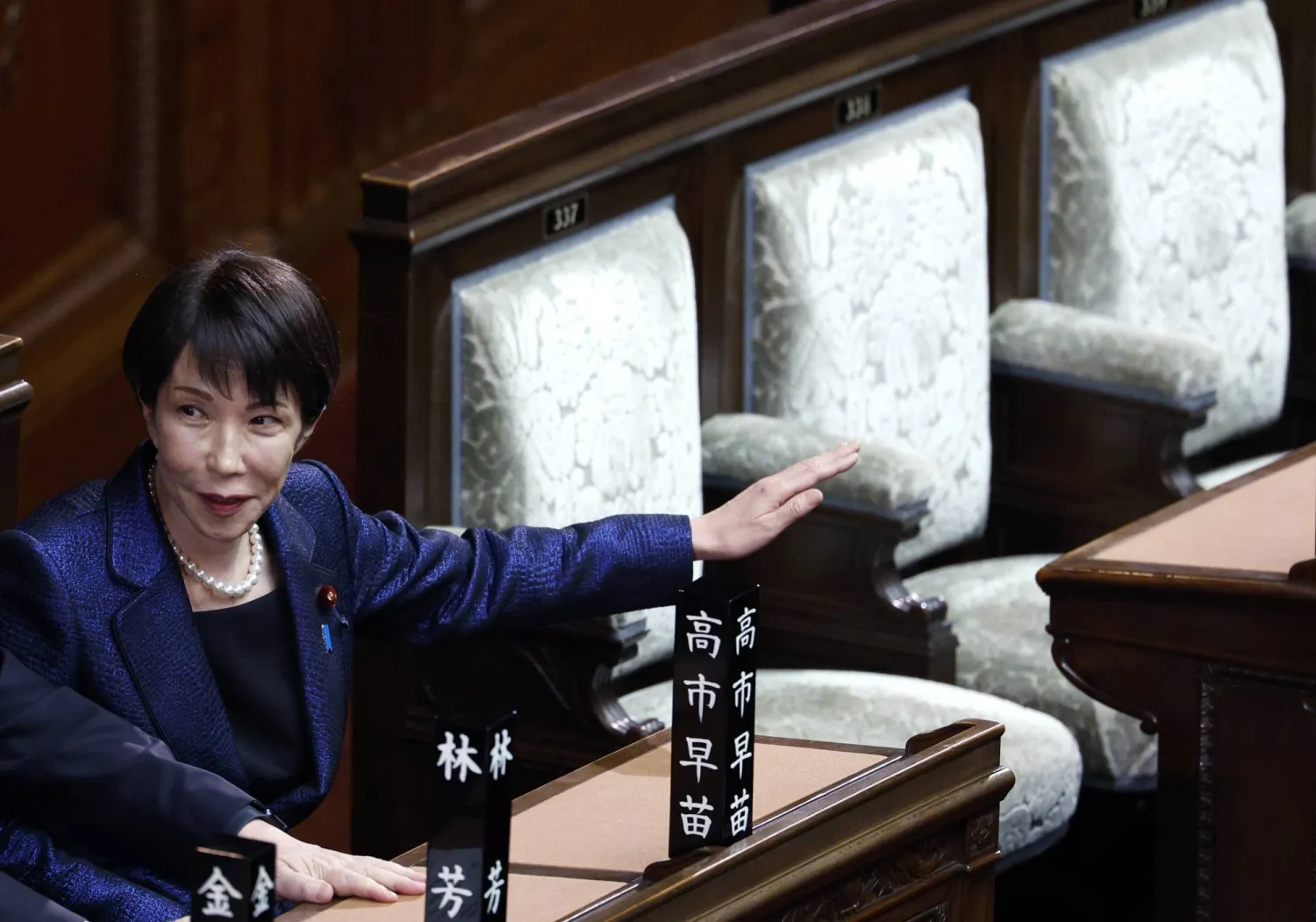
Sanae Takaichi gestures at the Lower House of the Parliament in Tokyo, Japan, 18 February 2026. EPA/FRANCK ROBICHON
TT

Japan PM Takaichi Reappointed Following Election

Sanae Takaichi gestures at the Lower House of the Parliament in Tokyo, Japan, 18 February 2026. EPA/FRANCK ROBICHON

Japan's lower house formally reappointed Sanae Takaichi as prime minister on Wednesday, 10 days after her historic landslide election victory.

Takaichi, 64, became Japan's first woman premier in October and won a two-thirds majority for her party in the snap lower house elections on February 8.

She has pledged to bolster Japan's defenses to protect its territory and waters, likely further straining relations with Beijing, and to boost the flagging economy.

Takaichi suggested in November that Japan could intervene militarily if Beijing sought to take Taiwan by force.

China, which regards the democratic island as part of its territory and has not ruled out force to annex it, was furious.

Beijing's top diplomat Wang Yi told the Munich Security Conference on Saturday that forces in Japan were seeking to "revive militarism".

In a policy speech expected for Friday, Takaichi will pledge to update Japan's "Free and Open Indo-Pacific" strategic framework, local media reported.

"Compared with when FOIP was first proposed, the international situation and security environment surrounding Japan have become significantly more severe," chief government spokesman Minoru Kihara said Monday.

In practice this will likely mean strengthening supply chains and promoting free trade through the Trans-Pacific Partnership (CPTPP) that Britain joined in 2024.

Takaichi's government also plans to pass legislation to establish a National Intelligence Agency and to begin concrete discussions towards an anti-espionage law, the reports said.

Takaichi has promised too to tighten rules surrounding immigration, even though Asia's number two economy is struggling with labor shortages and a falling population.

On Friday Takaichi will repeat her campaign pledge to suspend consumption tax on food for two years in order to ease inflationary pressures on households, local media said, according to AFP.

This promise has exacerbated market worries about Japan's colossal debt, with yields on long-dated government bonds hitting record highs last month.

Rahul Anand, the International Monetary Fund chief of mission in Japan, said Wednesday that debt interest payments would double between 2025 and 2031.

"Removing the consumption tax (on food) would weaken the tax revenue base, since the consumption tax is an important way to raise revenues without creating distortions in the economy," Anand said.

To ease such concerns, Takaichi will on Friday repeat her mantra of having a "responsible, proactive" fiscal policy and set a target on reducing government debt, the reports said.

She will also announce the creation of a cross-party "national council" to discuss taxation and how to fund ageing Japan's ballooning social security bill.

But Takaichi's first order of business will be obtaining approval for Japan's budget for the fiscal year beginning on April 1 after the process was delayed by the election.

The ruling coalition also wants to pass legislation that will outlaw destroying the Japanese flag, according to the media reports.

It wants too to accelerate debate on changing the constitution and on revising the imperial family's rules to ease a looming succession crisis.

Takaichi and many within her Liberal Democratic Party (LDP) oppose making it possible for a woman to become emperor, but rules could be changed to "adopt" new male members.