Yemen's Hadi Rejects Copying Iran Experience, Urges Advancing Implementation of Riyadh Agreement

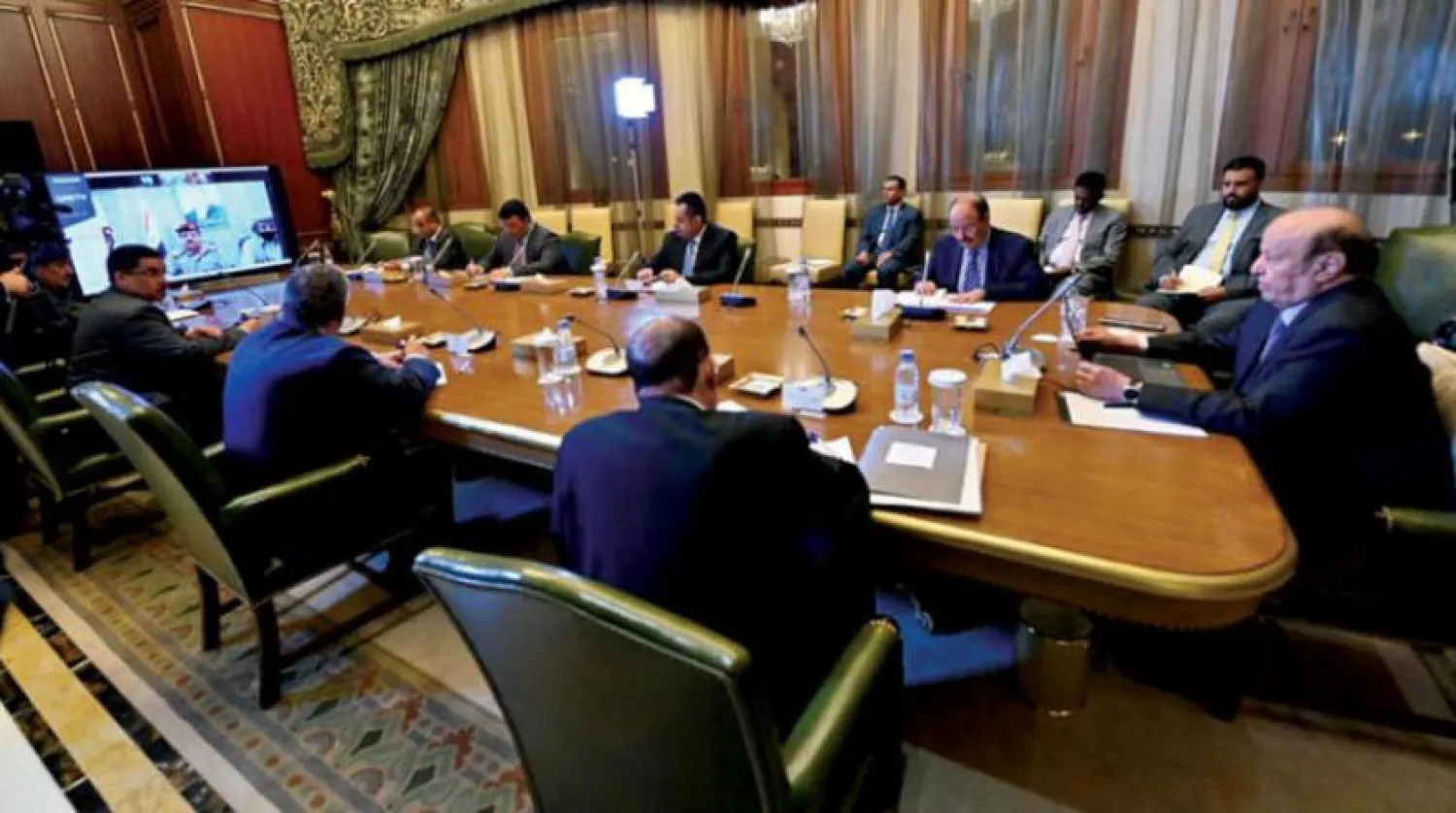
Yemeni President Abdrabbuh Mansour Hadi during his meeting with members of the National Defense Council. (Saba)
TT

Yemen's Hadi Rejects Copying Iran Experience, Urges Advancing Implementation of Riyadh Agreement

Yemeni President Abdrabbuh Mansour Hadi during his meeting with members of the National Defense Council. (Saba)

President Abdrabbuh Mansour Hadi reiterated the total rejection of Tehran-backed Houthi militias importing the Iranian experience into Yemen, stressing instead the need to strengthen national unity and move forward with implementing the Riyadh Agreement.

Hadi also called on authorities to take necessary measures to save the war-torn country’s deteriorating economy.

The president made his statements at a national defense meeting he chaired in Riyadh, Saudi Arabia.

Vice President Ali Mohsen al-Ahmar, parliament Speaker Sultan al-Burkani, Prime Minister Maeen Abdulmalik and Shura Council Speaker Ahmed Obaid bin Daghr attended the meeting.

Hadi reviewed various issues that included field, political and economic developments.

He talked about regional and international peace efforts and renewed the official state’s desire to find a permanent and sustainable solution to the crisis.

The meeting was held a time when the Houthis are waging an intense military offensive against the northeastern governorate of Marib, where over a million internally displaced refugees have sought asylum from war.

More so, the internationally recognized Yemeni government continues to suffer from unresolved disputes with the Southern Transitional Council (STC), a matter which has delayed its return to the interim capital, Aden.

Government officials fear for their safety back in Aden, given that some security and military stipulations of the Riyadh Agreement have not been implemented yet.

The Riyadh Agreement was signed between the internationally-recognized Yemeni government and the STC in the Saudi capital in December 2019 and called for the formation of a new government, disarmament of militia groups, the demilitarization of Aden, and improving the economy.

While the international community hopes that newly appointed UN Special Envoy for Yemen Hans Grundberg will achieve a breakthrough in finding a settlement for the embattled country, Houthi leaders have announced their conditions for a truce remain unchanged and called for more recruitment of militants.

Against all international hopes of a solution for the crisis, Houthis leaders have expressed determination to “purge” state institutions in Houthi-run territory from any opposition to the Iran-backed insurgency’s rule.


Netanyahu Doubts Lebanese Government’s Ability to Disarm Hezbollah

Smoke rises in al-Mansouri following Israeli explosions reported by Lebanon’s state news agency NNA as seen from Hinniyeh, southern Lebanon, September 28, 2026. (Reuters) 
TT

Netanyahu Doubts Lebanese Government’s Ability to Disarm Hezbollah

Smoke rises in al-Mansouri following Israeli explosions reported by Lebanon’s state news agency NNA as seen from Hinniyeh, southern Lebanon, September 28, 2026. (Reuters) 

Israeli Prime Minister Benjamin Netanyahu said on Sunday he does not trust the Lebanese government to disarm Hezbollah, affirming that his forces will remain in the security zone in southern Lebanon.

The PM’s comments came as the Israeli army raised its alert level over the weekend amid concerns of a possible escalation on multiple fronts.

In the south of Lebanon, Israeli forces continue to attack villages, while assessments in Tel Aviv warn that Hezbollah is regrouping, studying Israeli activity, and preparing to mount a significant attack dependent on developments with Iran.

Israel Will Remain in Security Zone

In an interview with Radio North on Sunday, Netanyahu underlined that Israel intends to remain in its security zone in southern Lebanon until Hezbollah is disarmed.

“No, I don't trust them to disarm Hezbollah,” Netanyahu told host Gadi Ness when asked if he believes the Lebanese government will disarm the party. “That's why we said that as long as it is not disarmed, we will remain in this zone that changed the situation in the north.”

He explained that Israel’s military presence is aimed at preventing Hezbollah from rebuilding its military capabilities and threatening northern Israeli communities.

Netanyahu also said Israel created a security zone free of all terrorist systems, affirming that “a large part of the villages were simply terrorist strongholds and they are no longer there.”

The Israeli PM said Israel would continue its military operations against Hezbollah “as much as necessary” and vowed to ultimately eliminate the group.

“We will eliminate Hezbollah, although it is weakened and a shadow of itself,” he said, adding that Israel also needed to address the threat posed by Hezbollah's drones.

Israel Raises State of Alert

Meanwhile, Maariv newspaper reported Saturday that the Israeli army had placed the 36th and 91st divisions on what it described as “an extremely high state of operational alert.”

The newspaper said the army deployed two divisions in the Golan Heights and southern Lebanon.

“Hezbollah was recruiting members and strengthening its defensive positions in the Bekaa Valley, along the coast and in Beirut’s southern suburb,” the report said.

It also cited Israeli assessments suggesting that the party might launch an attack targeting an Israeli military site or patrol, or even attempt to kidnap soldiers.

The newspaper then cited an Israeli military source as saying that Israel had raised its alert level to prepare for a prolonged period of heightened readiness, amid reports that Iran was seeking to create a regional crisis involving multiple fronts.

Ongoing Israeli Attacks

At the field level, Israeli forces continued their attacks on several areas in southern Lebanon. Artillery shelling targeted the town of Al-Mansouri and the outskirts of the town of Zibqin in the governorate of Tyre.

A massive explosion was heard in the town of Al-Qantara in the Marjayoun district, while Israeli forces carried out a violent demolition in the town of Al-Khiam at night, destroying Al-Mabarrat School building.


Arab League Reaffirms Support for Palestinian Territorial Integrity and Independence

Arab League Reaffirms Support for Palestinian Territorial Integrity and Independence
TT

Arab League Reaffirms Support for Palestinian Territorial Integrity and Independence

Arab League Reaffirms Support for Palestinian Territorial Integrity and Independence

Secretary-General of the Arab League Nabil Fahmy affirmed that the Arab League, in cooperation with its member states and partners, will continue working to end the suffering of the Palestinian people, the Saudi Press Agency reported on Sunday.

He stressed the Arab League's commitment to mobilizing humanitarian, political, and legal support, implementing international legitimacy resolutions, and ensuring that the Gaza Strip remains an integral part of an independent Palestinian state.

Fahmy’s remarks were delivered on his behalf by Ambassador Dr. Faed Mustafa, Assistant Secretary-General and Head of the Palestine and Occupied Arab Territories Sector, during an event held Sunday at the Arab League’s General Secretariat in Cairo to commemorate the victims of what the statement described as Israel’s genocide against the Palestinian people in the Gaza Strip.

Fahmy said the October 17 commemoration renews the commitment to defending human dignity, upholding the rights of the Palestinian people, and working to end the tragedy endured by residents of the Gaza Strip.

Citing Palestinian medical statistics, he said the death toll in Gaza had exceeded 74,000, including more than 21,000 children, while over 35,000 women had been killed or injured since October 2023. He warned that continued restrictions on water, food, medicine, humanitarian aid, and reconstruction materials, coupled with the shrinking of safe zones, were further exacerbating the humanitarian crisis.

Fahmy called for the unimpeded delivery of humanitarian aid and the provision of essential supplies, including medicine, food, and fuel. He also urged the restoration of water and sanitation networks and essential services, stressing that recovery and reconstruction required ensuring the foundations for a dignified life for Gaza’s population.

He said Israel’s continued military presence and expanding control over parts of the Gaza Strip were further limiting the areas accessible to civilians and raising concerns over compliance with the ceasefire terms. He stressed the need to consolidate the ceasefire, ensure Israel’s withdrawal in line with agreed commitments, and enable the Palestinian Authority to resume its role in Gaza.

Fahmy underscored that achieving a just peace requires a clear political path that ends the occupation, preserves the unity of Palestinian territory, and guarantees the Palestinian people's right to self-determination. He stressed that this path must lead to the establishment of an independent, sovereign Palestinian state based on the June 4, 1967, borders, with East Jerusalem as its capital, in accordance with international legitimacy resolutions and the Arab Peace Initiative.


US Officials Visit Palestinian Village After Settler Attacks on Diplomats

 US Assistant Secretary of State for Democracy, Human Rights and Labor Riley Barnes visits the Christian Palestinian village of Taybeh near Ramallah, a day after Israeli militant settlers attacked a French mayor and European diplomats during olive harvest, in the Israeli-occupied West Bank, October 18, 2026. (Reuters)
US Assistant Secretary of State for Democracy, Human Rights and Labor Riley Barnes visits the Christian Palestinian village of Taybeh near Ramallah, a day after Israeli militant settlers attacked a French mayor and European diplomats during olive harvest, in the Israeli-occupied West Bank, October 18, 2026. (Reuters)
TT

US Officials Visit Palestinian Village After Settler Attacks on Diplomats

 US Assistant Secretary of State for Democracy, Human Rights and Labor Riley Barnes visits the Christian Palestinian village of Taybeh near Ramallah, a day after Israeli militant settlers attacked a French mayor and European diplomats during olive harvest, in the Israeli-occupied West Bank, October 18, 2026. (Reuters)
US Assistant Secretary of State for Democracy, Human Rights and Labor Riley Barnes visits the Christian Palestinian village of Taybeh near Ramallah, a day after Israeli militant settlers attacked a French mayor and European diplomats during olive harvest, in the Israeli-occupied West Bank, October 18, 2026. (Reuters)

US diplomats visited a Christian Palestinian town in the Israeli-occupied West Bank on Sunday following attacks by militant Israeli settlers on European diplomats and an American photojournalist in the previous two days.

Riley Barnes, assistant secretary of state for democracy, human rights and labor, Brian Burch, US ambassador to the Holy See, and a number of other diplomats visited the Latin Convent church and were expected to meet with members of the Christian community in Taybeh.

Belgian, French and Polish diplomats, along with a French mayor and Palestinian civilians, had been attacked near Taybeh on Saturday by masked Israeli settlers.

The previous day, ‌Washington Post photojournalist ‌Heidi Levine was taken to hospital after being assaulted ‌while covering ⁠a Palestinian olive ⁠harvest near another West Bank village.

The diplomats' visit coincided with US President Donald Trump endorsing his ally, Prime Minister Benjamin Netanyahu, for Israel's parliamentary election on October 27.

NETANYAHU CIRCUMSPECT ON SETTLER VIOLENCE

Trump has this year expressed his opposition to settlement expansion, but his administration has put little pressure on Netanyahu's right-wing, pro-settler government to change its policy.

UN bodies and most countries deem the settlements ⁠illegal under international law, but Israel rejects this, viewing ‌the territory as disputed rather than occupied.

While ‌Foreign Minister Gideon Saar and the Israeli military both blamed "Israeli rioters" for the ‌attack on the diplomats, Netanyahu, whose coalition is projected to lose ‌its governing majority, has been more circumspect.

He has said the diplomats entered a "sensitive area with a history of confrontations without prior coordination with the Israeli army", and that the facts of the attack on Levine are "unclear".

France urged Israeli authorities to arrest Saturday's attackers ‌and to end criminal violence in the West Bank, but by Sunday there was no announcement from Israeli ⁠authorities of ⁠any arrests in either of the two latest incidents.

The West Bank is home to some 500,000 settlers and at least 3 million Palestinians.

Settler attacks on the Palestinians are surging, with at least 170 since September 27, according to Yesh Din, an Israeli human rights group. Journalists, activists and foreign observers have also been targeted.

Yet prosecutions of Israeli settlers are rare.

On Sunday, Reuters saw a group of at least 10 settlers, masked and dressed in black, hurling rocks at Palestinians and activists harvesting olives near the Palestinian West Bank town of Salfit, prompting the farmers to flee.

Israeli border police were in the area and shot tear gas towards the hills.