

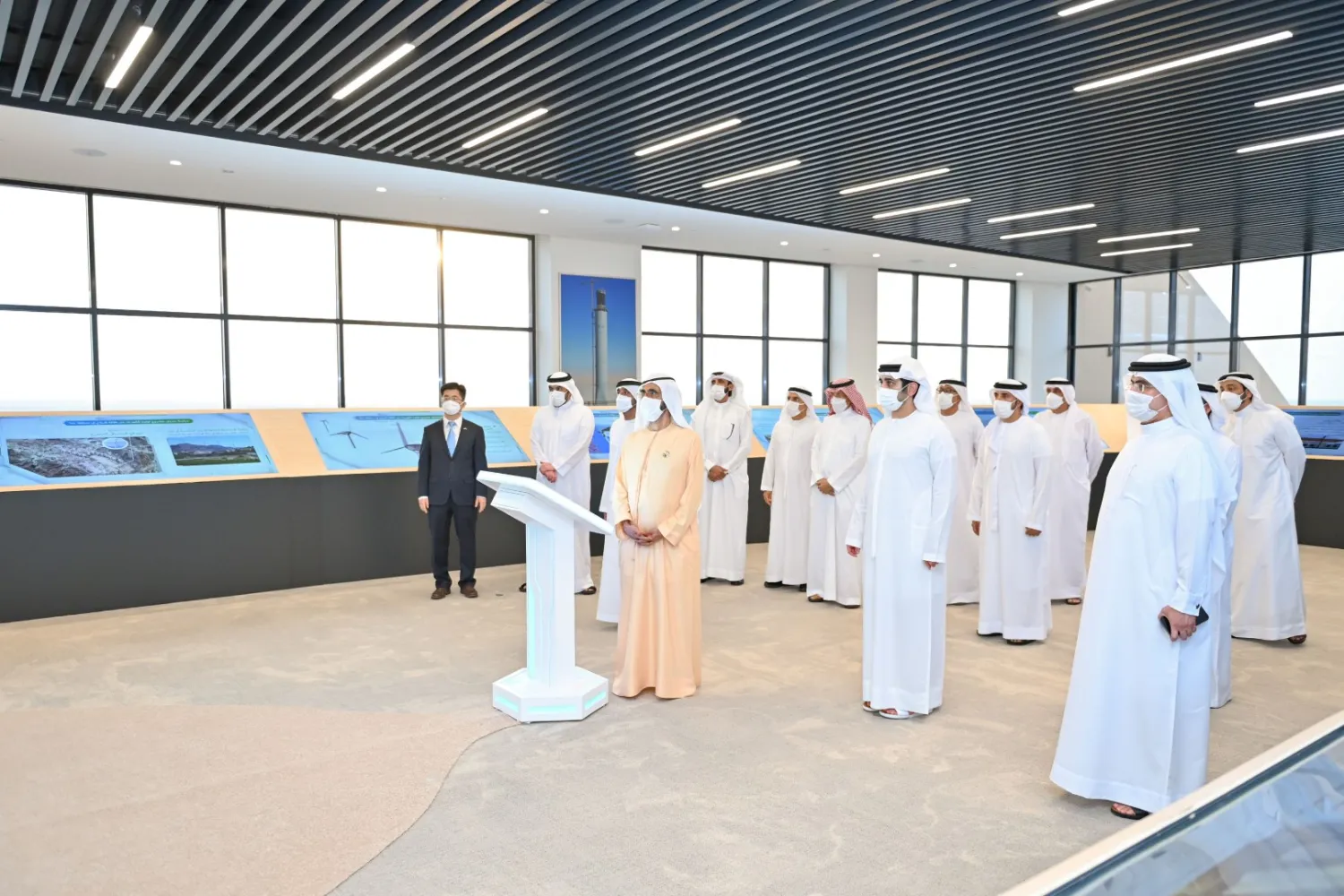

Dubai Inaugurates 300MW 1st Stage of 5th phase of Mohammed bin Rashid Solar Park

Mohammed bin Rashid inaugurates 300MW first stage of fifth phase of Mohammed bin Rashid Al Maktoum Solar Park - WAM
TT

Dubai Inaugurates 300MW 1st Stage of 5th phase of Mohammed bin Rashid Solar Park

Mohammed bin Rashid inaugurates 300MW first stage of fifth phase of Mohammed bin Rashid Al Maktoum Solar Park - WAM

Sheikh Mohammed bin Rashid Al Maktoum, Vice President, Prime Minister and Ruler of Dubai, has inaugurated the 300 megawatt (MW) first stage of the 900MW fifth phase of the Mohammed bin Rashid Al Maktoum Solar Park, state news agency WAM reported.

Implemented by Dubai Electricity and Water Authority (DEWA) using the Independent Power Producer (IPP) model, the solar park is the largest single-site solar park in the world with a planned total capacity of 5,000MW by 2030.

The Solar Park’s projects constitute one of the key pillars of the Dubai Clean Energy Strategy 2050, which aims to provide 75 percent of Dubai’s total power capacity from clean energy sources by 2050. The fifth phase investments amount to AED2.058 billion, according to DEWA.

In November 2019, DEWA announced the consortium led by ACWA Power and Gulf Investment Corporation as the Preferred Bidder to build and operate the fifth phase of the Mohammed bin Rashid Al Maktoum Solar Park using photovoltaic (PV) solar panels based on the IPP model. DEWA achieved a world record by receiving the lowest bid of $1.6953 cents per kilowatt hour (Levelised Cost of Energy) for this phase. A total of 60 Requests for Qualifications (RFQ) were received from international developers.

To implement the project, DEWA established Shuaa Energy 3 in partnership with the consortium led by ACWA Power and Gulf Investment Corporation.

DEWA owns 60 percent of the company, and the consortium owns the remaining 40 percent. The project uses the latest Solar photovoltaic bifacial technologies, which allows solar radiation to reach the front and back of the panels, with single-axis tracking to increase generation.

The fifth phase will provide clean energy to over 270,000 residences in Dubai, including 90,000 residences by the commissioned first stage, and will reduce 1.18 million tonnes of carbon emissions annually. To be commissioned in stages until 2023, the fifth phase uses the latest solar photovoltaic bifacial technologies with Single Axis Tracking to increase energy production.

Mohammad Abunayyan, Chairman of ACWA Power, said: "ACWA Power, a renowned Saudi company, is at the forefront of global efforts in progressing the energy transformation. Stemming from this notion, and based on our long-term strategic partnership with DEWA, the launch of the first stage of the fifth phase of the Mohammed bin Rashid Al Maktoum Solar Park has been completed in record time of less than twelve months. The milestone reached today stands testament to our commitment to fulfil our mission despite the challenges imposed by the pandemic, and reinforces our support of DEWA’s ambitious vision of strengthening the green ecosystem in Dubai and adopting innovative sustainable solutions. These solutions have already been demonstrated through our portfolio of projects that span 13 countries in three continents. We mark this occasion with great pride and would like to reiterate our commitment in supporting the development of pioneering sustainable development plans in Dubai."

Ibrahim Al Qadhi, CEO of Gulf Investment Corporation (GIC), said: "GIC is pleased to participate in the development of the Mohammed bin Rashid Al Maktoum Solar Park (Phase V) together with the Dubai Electricity and Water Authority and ACWA Power, and to achieve the commissioning of the first phase of this landmark project ahead of the target date despite the challenges caused by the COVID-19 outbreak."

"GIC is a leading investor in energy projects with over $11billion in investments in the sector and intends to continue to play a major role in utilities projects in the Arabian Gulf region," Al Qadhi added.



Saudi Cabinet Approves Cancellation of Expat Levy on Foreign Workers in Licensed Industrial Establishments

Prince Mohammed bin Salman bin Abdulaziz Al Saud, Crown Prince and Prime Minister, chairs a cabinet meeting. (SPA)
TT

Saudi Cabinet Approves Cancellation of Expat Levy on Foreign Workers in Licensed Industrial Establishments

Prince Mohammed bin Salman bin Abdulaziz Al Saud, Crown Prince and Prime Minister, chairs a cabinet meeting. (SPA)

The Saudi Cabinet, chaired by Prince Mohammed bin Salman bin Abdulaziz Al Saud, Crown Prince and Prime Minister, approved on Wednesday the cancellation of the expat levy on foreign workers in licensed industrial establishments.

The decision is based on the recommendation of the Council of Economic and Development Affairs.

It reflects the continued support and empowerment the industrial sector receives from the Kingdom’s leadership.

It also underscores the Crown Prince’s commitment to enabling national factories, strengthening their sustainability, and enhancing their global competitiveness.

The step aligns with the Kingdom’s ambitious vision to build a competitive and resilient industrial economy, recognizing industry as a cornerstone of national economic diversification under Saudi Vision 2030.

Minister of Industry and Mineral Resources Bandar Alkhorayef expressed his sincere gratitude and appreciation to Custodian of the Two Holy Mosques King Salman bin Abdulaziz Al Saud and to Crown Prince Mohammed on the Cabinet’s decisions.

The move reflects the continued support and empowerment the industrial sector receives from the Crown Prince, he added.

He noted that the move will boost the global competitiveness of the Saudi industry and further increase the reach and presence of non-oil exports in international markets.

Alkhorayef stressed that the exemption of the expat levy over the past six years - through the first and second exemption periods from October 1, 2019, to December 31, 2025 - played a critical role in driving qualitative growth in the industrial sector and expanding the Kingdom’s industrial base.

Between 2019 and the end of 2024, the sector achieved significant milestones: the number of industrial facilities increased from 8,822 factories to more than 12,000; total industrial investments rose by 35%, from SAR908 billion to SAR1.22 trillion; non-oil exports grew by 16%, rising from SAR187 billion to SAR217 billion; employment grew by 74%, from 488,000 workers to 847,000; localization increased from 29% to 31%; and industrial GDP rose by 56%, from SAR322 billion to more than SAR501 billion.

Alkhorayef said that these achievements would not have been possible without the unwavering support provided to the industry and mineral resources ecosystem by the Kingdom’s leadership.

The minister added that the Cabinet’s decision to cancel the expat levy for the licensed industrial establishments will further strengthen sustainable industrial development in the Kingdom, bolster national industrial capabilities, and attract more high-quality investments, especially given the incentives and enablers offered by the industrial ecosystem.

The decision will also reduce operational costs for factories, helping them expand, grow, and increase their output, and accelerate the adoption of modern operating models such as automation, artificial intelligence, and advanced manufacturing technologies. This, he said, will boost the sector’s efficiency and enhance its ability to compete globally.

Alkhorayef reaffirmed the ministry’s commitment to supporting the continued growth of the industrial sector in the coming period through close cooperation with all relevant entities, empowering the private sector, and providing an investment-friendly industrial environment that fosters innovation and technology.

These efforts reflect the Kingdom’s commitment to its vision of becoming a global industrial powerhouse by enabling advanced industries, attracting international investment, offering 800 industrial investment opportunities worth SAR1 trillion, and tripling industrial GDP to SAR895 billion by 2035 and reinforcing industry as a central pillar of national economic diversification, he said.


UK Exempts Egypt's Zohr Gas Field from Russia Sanctions

Rosneft and Lukoil, Russia's top oil producers, were sanctioned by Britain and the United States in October over their role in financing Moscow's invasion of Ukraine (File Photo via AFP)
TT

UK Exempts Egypt's Zohr Gas Field from Russia Sanctions

Rosneft and Lukoil, Russia's top oil producers, were sanctioned by Britain and the United States in October over their role in financing Moscow's invasion of Ukraine (File Photo via AFP)

Britain on Wednesday added Egypt's Zohr gas field, in which Russian oil major Rosneft holds a 30% stake and London-based BP has a 10% holding, to a list of projects exempt from its Russia sanctions.

Rosneft and Lukoil, Russia's top oil producers, were sanctioned by Britain and the United States in October over their role in financing Moscow's invasion of Ukraine.

The general licence, amended on Wednesday, now also allows payments and business operations linked to Zohr until October 2027, Reuters reported.
BP holds its stake in Zohr alongside majority stakeholder Eni, Rosneft and other partners.

The licence gave no reason for the exemption. The British government did not immediately respond to a request for comment.

Other projects exempted by the licence include other large oil and gas ventures in Russia, Kazakhstan and the Caspian region.

Zohr is operated by Italy's Eni and with an estimated 30 trillion cubic feet (Tfc) of gas is the Mediterranean's biggest field, though production has fallen well below its peak in 2019.

Eni has pledged about $8 billion of investment in Egypt and recently launched a Mediterranean drilling campaign to boost output.


Italy, France Say it's 'Premature' to Sign EU-Mercosur Trade Deal

Italy's Prime Minister Giorgia Meloni speaks at the the lower house of Parliament, ahead of a European Union leaders' summit, in Rome, Italy, December 17, 2025. REUTERS/Remo Casilli
TT

Italy, France Say it's 'Premature' to Sign EU-Mercosur Trade Deal

Italy's Prime Minister Giorgia Meloni speaks at the the lower house of Parliament, ahead of a European Union leaders' summit, in Rome, Italy, December 17, 2025. REUTERS/Remo Casilli

Italy and France on Wednesday said they were not ready to back a trade agreement between the European Union and the South American trade bloc Mercosur, dealing a blow to hopes of finalizing the deal in the coming days.

European Commission President Ursula von der Leyen had been expected to fly to Brazil at the end of this week to sign the accord, reached a year ago after a quarter-century of talks with the bloc of Argentina, Bolivia, Brazil, Paraguay and Uruguay.

Germany, Spain and Nordic countries say the agreement will help exports hit by US tariffs and reduce dependence on China by providing access to minerals. Confirming an earlier Reuters report, Italian Prime Minister Giorgia Meloni sided with French President Emmanuel Macron in calling for a delay in approving the deal, which Poland and Hungary also oppose. "The Italian government has always been clear in saying that the agreement must be beneficial for all sectors and that it is therefore necessary to address, in particular, the concerns of our farmers," Meloni told the lower house of Italy's parliament. She told lawmakers it would be "premature" to sign the deal before further measures to protect farmers were finalised, adding the deal needed adequate reciprocity guarantees for the agricultural sector, Reuters reported.

PARIS, ROME DEMAND TOUGHER SAFEGUARDS

France too wants tougher safeguards, including "mirror clauses" requiring Mercosur products to comply with EU rules on the use of pesticide and chlorine and tighter food safety inspections.

"No-one would understand if vegetables, beef and chicken that are chemically treated with products banned in France were to arrive on our soil," French government spokesperson Maud Bregeon told a news briefing. Supporters of the deal say it would not override existing EU regulations on food standards. The European Parliament, Commission and the Council, the grouping of EU governments, are set to negotiate an agreement on Mercosur safeguards later on Wednesday after EU lawmakers backed tightening some controls on imports of some farm products. Meloni's Brothers of Italy party said those controls were still not sufficient to ensure farmers could compete on even terms.

"This does not mean that Italy intends to block or oppose the agreement as a whole ... I am very confident that, come the start of next year, all these conditions can be met," Meloni said.

Latin American officials have grown impatient, with one Brazilian official warning it was "now or never". The Mercosur bloc is pursuing deals with other nations such as Japan, India and Canada.