


Jimmy Carter, Trounced in 1980, Gets Fresh Look from History

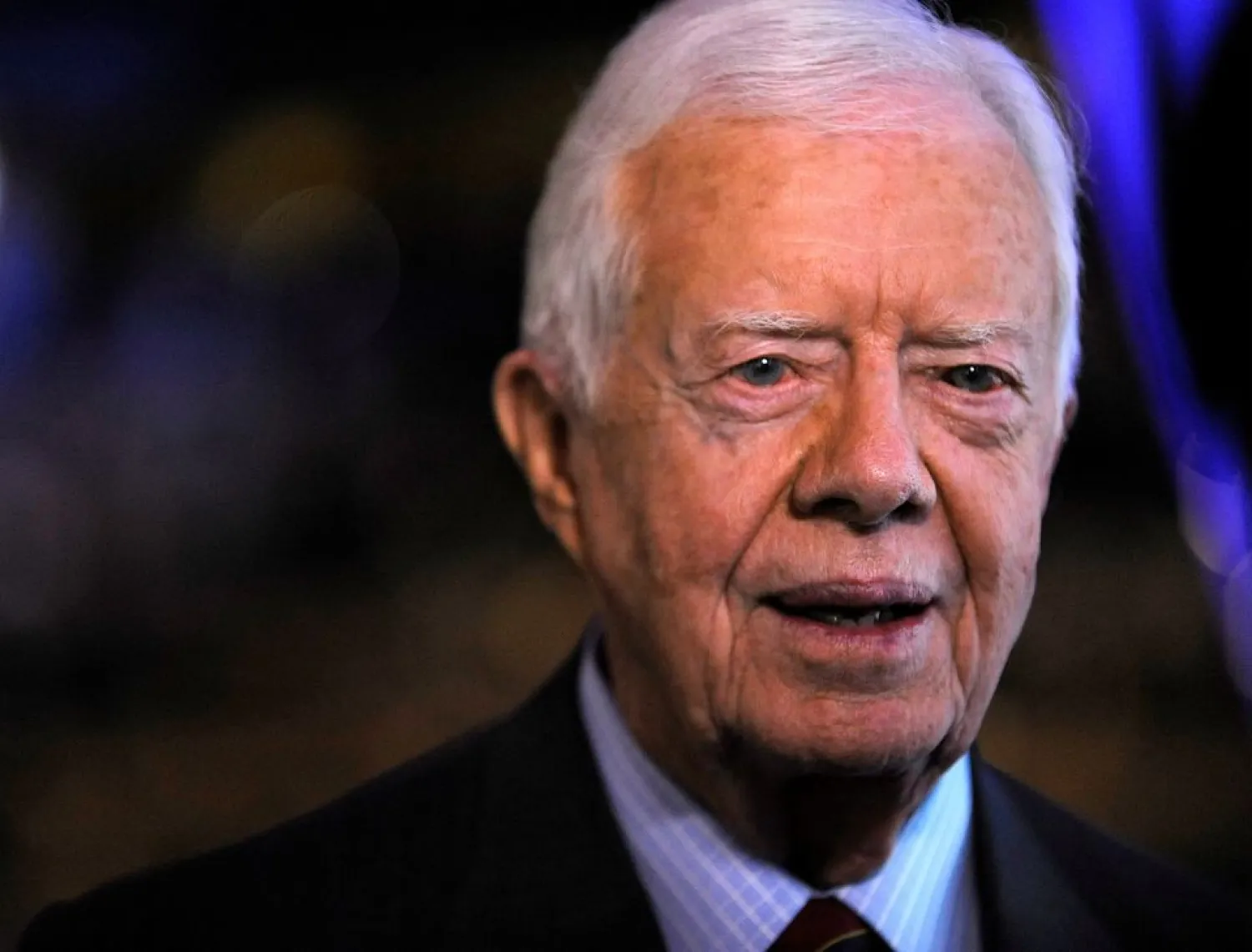
FILE PHOTO - Former US President Jimmy Carter attends the 2008 Democratic National Convention in Denver, Colorado, US August 25, 2008. REUTERS/Eric Thayer/File Photo
TT

Jimmy Carter, Trounced in 1980, Gets Fresh Look from History

FILE PHOTO - Former US President Jimmy Carter attends the 2008 Democratic National Convention in Denver, Colorado, US August 25, 2008. REUTERS/Eric Thayer/File Photo

Jimmy Carter is sometimes called a better former president than he was president.

Nodding to Carter's decades of work as a globe-trotting humanitarian but with a glaring reminder of his landslide defeat in 1980, the backhanded compliment rankles Carter allies and, they say, the former president himself.

Yet now, 40 years removed from the White House, the most famous resident of Plains, Georgia, is riding a new wave of attention as biographers, filmmakers, climate activists and Carter’s fellow Democrats push to recast his presidential legacy, even as Republicans sometimes try to remind voters of the volatile economy and international affairs that doomed Carter to one term.

The renewed spotlight is especially significant for the broad swath of Americans too young to remember a presidency that spanned from 1977 to 1981. Sandwiched between the Watergate era of Richard Nixon and two terms of Ronald Reagan, Carter's tenure came before Millennials or Generation Z voters were born and earlier than most of Generation X reached political awareness.

“People have always come up to tell me how much, my grandfather and my grandmother meant to them,” Jason Carter, 46, said in an interview. “They used to be my parents’ age or older. Now they’re younger than I am, sometimes much younger. It’s a remarkable thing.”

Many of those fans have known Carter, now 96 and largely confined to his home, only as the aging humanitarian occasionally in the news for building Habitat for Humanity houses, a critique of a successor or his latest health challenge.

In the past year, however, CNN released a documentary titled: “Jimmy Carter: Rock & Roll President” and independent documentarists Jim Pattiz and Will Pattiz debuted “Carterland” at the Atlanta Film Festival. Two new books hit shelves in the same span: one a comprehensive biography, the other a narrower look at Carter’s time in Washington. In the preceding two years, new books included an explanation of how Carter’s 1976 victory rewrote the rules of modern presidential campaigns and an in-depth analysis of Carter’s White House years by his then-domestic policy adviser.

Altogether, the new works depict not a failed president but an ambitious, far-reaching one who is getting a more nuanced assessment from history than he got from his contemporaries.

The Pattiz brothers, documentary filmmakers born a decade after Carter left the White House, emerged from producing “Carterland” to see the 39th president as a visionary on environmental issues, especially.

“Carter had these very farsighted views of how he wanted to solve the energy crisis, and it involved conservation, but also involved turning away from fossil fuels and turning toward renewable energy, things like solar power and other renewables,” said Jim Pattiz, 29.

Carter put solar panels on the White House, and he called for “shared sacrifice” to confront energy shortages. But he couldn’t overcome voters’ frustrations with fuel prices and availability. The solar panels were removed during Reagan’s presidency. But Will Pattiz, 30, said time vindicated Carter. If “President Carter had gotten an extra term in office,” he said, “we likely wouldn’t be having a climate crisis right now.”

Carter likely wouldn't go that far. In 2019, the former president used his last annual presentation at The Carter Center in Atlanta to blame himself for his post-presidential center being “basically mute on the subject of global warming.”

In his new book, “The Outlier,” historian Kai Bird writes that Carter’s “domestic and foreign policy ledgers are lengthy and fulsome.” Carter’s brokerage of the Camp David Accords between Israel and Egypt remain his most undisputed success. But Bird also highlights Carter policies sometimes associated more with others. Carter negotiated SALT II nuclear arms treaty with the Soviet Union, leaving Reagan a firm foundation for his dealings with the Kremlin.

The Iran hostage crises cemented Carter's defeat. But Bird and Stuart Eizenstat, Carter's domestic policy adviser, detail in their books how Carter and his administration won the hostages' release, even if Tehran held them until Reagan's inauguration.

On the domestic front, it was Carter, not Reagan, who started the widespread deregulation of industries including airlines, natural gas, railroads and trucking. Carter came as close to a major health care overhaul as any president did until President Barack Obama's 2010 Affordable Care Act. And for all the political damage Carter suffered for inflation it was Carter’s appointee as Federal Reserve chairman, Paul Volcker, whose monetary policies curbed the spikes of the late 1970s and early 1980s.

Jason Carter said the new wave of analyses look beyond “the political failure of not getting reelected as the defining factor” of Carter's presidency.

Beyond policy details, Amber Roessner, a 41-year-old University of Tennessee professor who wrote “Jimmy Carter and the Birth of the Marathon Media Campaign,” said Carter's broader political identity from the 1970s has “regained some saliency.”

Carter, she said, ran and governed with a “message of moral reform,” emphasizing competence and moderation. He espoused his born-again Christianity and called in his nomination acceptance for “love to be aggressively translated into simple justice.”

In 1976, that was the antidote to the Watergate scandal, Nixon's resignation and the dynamics that lingered from Vietnam and the civil rights era. Now, it translates to the 21st century's hyperpartisan politics, the nation's latest reckoning with racism and former President Donald Trump's turbulent tenure and serial mistruths.

“There are so many parallels,” Roessner said.

It was enough to draw multiple Democratic presidential candidates to Plains during the 2020 presidential campaign, something that hadn't happened in the previous four decades.

“There was so much distrust in government (and) he had a message of truth and honesty,” Minnesota Sen. Amy Klobuchar told The Associated Press, explaining after one of her visits why she sometimes invoked Carter as she campaigned.

Biden, who as a young Delaware politician became the first US senator to endorse Carter's 1976 bid, capped the pilgrimage parade in April, as he and first lady Jill Biden visited privately with Jimmy and Rosalynn Carter at their home.

“We talked about old times,” Biden told reporters afterward.

If anything, two presidents huddling in small-town south Georgia carried a weightier message: Old is new again.



Coffee Regions Hit by Extra Days of Extreme Heat, Say Scientists 

17 April 2012, North Rhine-Westphalia, Vluyn: A general view of Arabica Coffee beans. (dpa)
TT

Coffee Regions Hit by Extra Days of Extreme Heat, Say Scientists 

17 April 2012, North Rhine-Westphalia, Vluyn: A general view of Arabica Coffee beans. (dpa)

The world's main coffee-growing regions are roasting under additional days of climate change-driven heat every year, threatening harvests and contributing to higher prices, researchers said Wednesday.

An analysis found that there were 47 extra days of harmful heat per year on average in 25 countries representing nearly all global coffee production between 2021 and 2025, according to independent research group Climate Central.

Brazil, Vietnam, Colombia, Ethiopia and Indonesia -- which supply 75 percent of the world's coffee -- experienced on average 57 additional days of temperatures exceeding the threshold of 30C.

"Climate change is coming for our coffee. Nearly every major coffee-producing country is now experiencing more days of extreme heat that can harm coffee plants, reduce yields, and affect quality," said Kristina Dahl, Climate Central's vice president for science.

"In time, these impacts may ripple outward from farms to consumers, right into the quality and cost of your daily brew," Dahl said in a statement.

US tariffs on imports from Brazil, which supplies a third of coffee consumed in the United States, contributed to higher prices this past year, Climate Central said.

But extreme weather in the world's coffee-growing regions is "at least partly to blame" for the recent surge in prices, it added.

Coffee cultivation needs optimal temperatures and rainfall to thrive.

Temperatures above 30C are "extremely harmful" to arabica coffee plants and "suboptimal" for the robusta variety, Climate Central said. Those two plant species produce the majority of the global coffee supply.

For its analysis, Climate Central estimated how many days each year would have stayed below 30C in a world without carbon pollution but instead exceeded that level in reality -- revealing the number of hot days added by climate change.

The last three years have been the hottest on record, according to climate monitors.


Dog Gives Olympics Organizers Paws for Thought

A dog wanders on the ski trail during the women's team cross country free sprint qualification event of the Milano Cortina 2026 Winter Olympic Games at Tesero Cross-Country Skiing Stadium in Lago di Tesero (Val di Fiemme), on February 18, 2026. (Photo by Anne-Christine POUJOULAT / AFP)
TT

Dog Gives Olympics Organizers Paws for Thought

A dog wanders on the ski trail during the women's team cross country free sprint qualification event of the Milano Cortina 2026 Winter Olympic Games at Tesero Cross-Country Skiing Stadium in Lago di Tesero (Val di Fiemme), on February 18, 2026. (Photo by Anne-Christine POUJOULAT / AFP)

A dog decided he would bid for an unlikely Olympic medal on Wednesday as he joined the women's cross country team free sprint in the Milan-Cortina Games.

The dog ran onto the piste in Tesero in northern Italy and gamely, even without skis, ran behind two of the competitors, Greece's Konstantina Charalampidou and Tena Hadzic of Croatia.

He crossed the finishing line, his moment of glory curtailed as he was collared by the organizers and led away -- his owner no doubt will have a bone to pick with him when they are reunited.


Olives, Opera and a Climate-Neutral Goal: How a Mural in Greece Won ‘Best in the World’ 

A building with the mural entitled “Kalamata” depicting opera legend Maria Callas by artist Kleomenis Kostopoulos is seen in Kalamata town, about 240 kilometers (150 miles) southwest of Athens, Monday, Feb. 9, 2026. (AP) 
TT

Olives, Opera and a Climate-Neutral Goal: How a Mural in Greece Won ‘Best in the World’ 

A building with the mural entitled “Kalamata” depicting opera legend Maria Callas by artist Kleomenis Kostopoulos is seen in Kalamata town, about 240 kilometers (150 miles) southwest of Athens, Monday, Feb. 9, 2026. (AP) 

Long known for its olives and seaside charm, the southern Greek city of Kalamata has found itself in the spotlight thanks to a towering mural that reimagines legendary soprano Maria Callas as an allegory for the city itself.

The massive artwork on the side of a prominent building in the city center has been named 2025’s “Best Mural of the World” by Street Art Cities, a global platform celebrating street art.

Residents of Kalamata, approximately 240 kilometers (150 miles) southwest of Athens, cultivate the world-renowned olives, figs and grapes that feature prominently on the mural.

That was precisely the point.

Vassilis Papaefstathiou, deputy mayor of strategic planning and climate neutrality, explained Kalamata is one of the few Greek cities with the ambitious goal of becoming climate-neutral by 2030. He and other city leaders wanted a way to make abstract concepts, including sustainable development, agri-food initiatives, and local economic growth, more tangible for the city’s nearly 73,000 residents.

That’s how the idea of a massive mural in a public space was born.

“We wanted it to reflect a very clear and distinct message of what sustainable development means for a regional city such as Kalamata,” Papaefstathiou said. “We wanted to create an image that combines the humble products of the land, such as olives and olive oil — which, let’s be honest, are famous all over the world and have put Kalamata on the map — with the high-level art.”

“By bringing together what is very elevated with ... the humbleness of the land, our aim was to empower the people and, in doing so, strengthen their identity. We want them to be proud to be Kalamatians.”

Southern Greece has faced heatwaves, droughts and wildfires in recent years, all of which affect the olive groves on which the region’s economy is hugely dependent.

The image chosen to represent the city was Maria Callas, widely hailed as one of the greatest opera singers of the 20th century and revered in Greece as a national cultural symbol. She may have been born in New York to Greek immigrant parents, but her father came from a village south of Kalamata. For locals, she is one of their own.

This connection is also reflected in practice: the alumni association at Kalamata’s music school is named for Callas, and the cultural center houses an exhibition dedicated to her, which includes letters from her personal archive.

Artist Kleomenis Kostopoulos, 52, said the mural “is not actually called ‘Maria Callas,’ but ‘Kalamata’ and my attempt was to paint Kalamata (the city) allegorically.”

Rather than portraying a stylized image of the diva, Kostopoulos said he aimed for a more grounded and human depiction. He incorporated elements that connect the people to their land: tree branches — which he considers the above-ground extension of roots — birds native to the area, and the well-known agricultural products.

“The dress I create on Maria Callas in ‘Kalamata’ is essentially all of this, all of this bloom, all of this fruition,” he said. “The blessed land that Kalamata itself has ... is where all of these elements of nature come from.”

Creating the mural was no small feat. Kostopoulos said it took around two weeks of actual work spread over a month due to bad weather. He primarily used brushes but also incorporated spray paint and a cherry-picker to reach all edges of the massive wall.

Papaefstathiou, the deputy mayor, said the mural has become a focal point.

“We believe this mural has helped us significantly in many ways, including in strengthening the city’s promotion as a tourist destination,” he said.

Beyond tourism, the mural has sparked conversations about art in public spaces. More building owners in Kalamata have already expressed interest in hosting murals.

“All of us — residents, and I personally — feel immense pride,” said tourism educator Dimitra Kourmouli.

Kostopoulos said he hopes the award will have a wider impact on the art community and make public art more visible in Greece.

“We see that such modern interventions in public space bring tremendous cultural, social, educational and economic benefits to a place,” he said. “These are good springboards to start nice conversations that I hope someday will happen in our country, as well.”