


Leaked Footage Shows Grim Conditions in Iran's Evin Prison

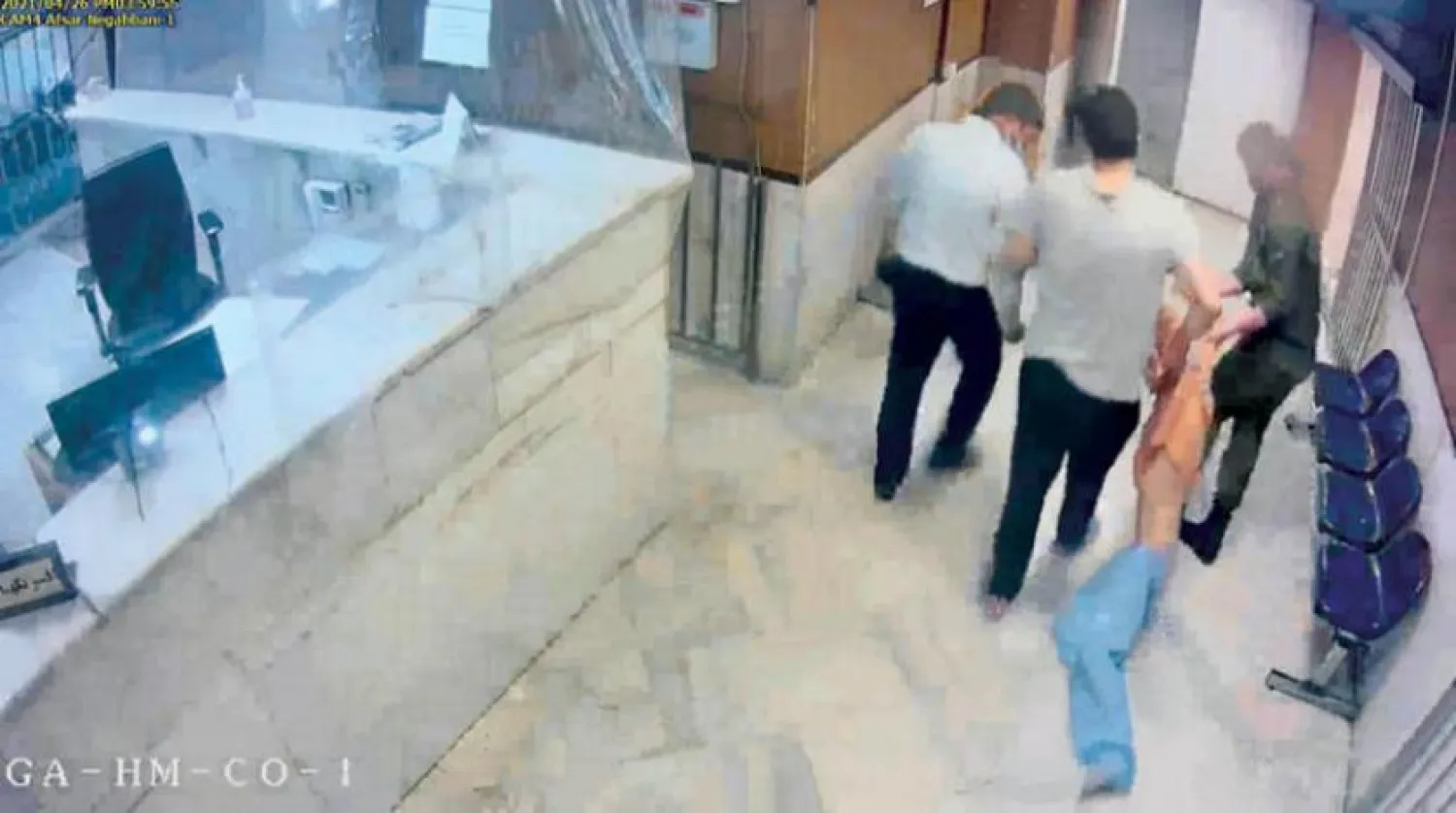
In this undated frame grab taken from video shared with The Associated Press, guards drag an emaciated prisoner, at Evin prison in Tehran, Iran. AP
TT

Leaked Footage Shows Grim Conditions in Iran's Evin Prison

In this undated frame grab taken from video shared with The Associated Press, guards drag an emaciated prisoner, at Evin prison in Tehran, Iran. AP

The guard in a control room at Iran's notorious Evin prison springs to attention as one by one, monitors in front of him suddenly blink off and display something very different from the surveillance footage he had been watching.

“Cyberattack,” the monitors flash. Other guards gather around, holding up their mobile phones and filming, or making urgent calls. "General protest until the freedom of political prisoners" reads another line on the screens.

An online account, purportedly by an entity describing itself as a group of hackers, shared footage of the incident, as well as parts of other surveillance video it seized, with The Associated Press. The alleged hackers said the release of the footage was an effort to show the grim conditions at the prison, known for holding political prisoners and those with ties abroad who are often used as bargaining chips in negotiations with the West.

In one part of the footage, a man smashes a bathroom mirror to try to cut open his arm. Prisoners — and even guards — beat each other in scenes captured by surveillance cameras. Inmates sleeping in single rooms with bunk beds stacked three high against the walls, wrapping themselves in blankets to stay warm.

“We want the world to hear our voice for freedom of all political prisoners,” read a message from the online account to the AP.

Iran, which has faced criticism from the United Nations special rapporteur over its prison conditions, did not immediately respond to a request for comment sent to its UN mission in New York. Iranian state media in the country have not acknowledged the incident at Evin.

However, several embarrassing hacking incidents have struck Iran amid ongoing tensions over its accelerated nuclear program and as talks with the West over reviving the atomic accord between Tehran and world powers remain on hold.

Four former prisoners at Evin, as well as an Iranian human rights activist abroad, have told the AP that the videos resemble areas from the facility in northern Tehran. Some of the scenes also matched photographs of the facility previously taken by journalists, as well as images of the prison as seen in satellite photos accessed by the AP.

The footage also shows rows of sewing machines that prisoners use, a solitary confinement cell with a squat toilet and exterior areas of the prison. There are images of the prison's open-air exercise yard, prisoners' bathrooms and offices within the facility.

Much of the footage bears timestamps from 2020 and this year. Several videos without the stamp show guards wearing facemasks, signaling they came amid the coronavirus pandemic.

Though there is no sound in the videos, they speak to the grim world faced by prisoners at the facility. One sequence shows what appears to be an emaciated man dumped from a car in the parking lot, then dragged through the prison. Another shows a cleric walking down the stairs and passing by the man, without stopping.

Guards in another video are seen beating a man in a prisoner's uniform. One guard sucker-punches a prisoner in a holding cell. Guards also fight among themselves, as do the prisoners. Many are crammed into single-room cells. No one wears a facemask.

The account that shared the videos with the AP calls itself “The Justice of Ali.”

It claimed to have “hundreds” of gigabytes of data from what it described as a hack conducted several months ago. It did not answer questions about who was involved in the leak.

The account linked the timing of its leak to the recent election of Iranian President Ebrahim Raisi, a hard-line acolyte of Supreme leader Ali Khamenei involved in the execution of thousands in 1988 at the end of the Iran-Iraq War.

“The Evin prison is a stain on Raisi’s black turban and white beard,” the message on the screens in the prison control room also read.

Iran, long sanctioned by the West, faces difficulties in getting up-to-date hardware and software, often relying on Chinese-manufactured electronics or older systems. The control room system seen in the video, for instance, appeared to be running Windows 7, for which Microsoft no longer provides patches. That would make it easier for a potential hacker to target. Pirated versions of Windows and other software are common across Iran.

In recent months, Iran's railroad system was targeted by an apparent cyberattack.

Evin prison was built in 1971 under Iran's Shah Mohammad Reza Pahlavi. It housed political prisoners then and later, after the 1979 revolution swept the shah from power.

While in theory under the control of Iran's prison system, Evin also has specialized units for political prisoners and those with Western ties, run by the paramilitary Revolutionary Guard, which answers only to Khamenei. The facility is the target of both US and European Union sanctions.

After Iran cracked down on protesters following the disputed 2009 re-election of hard-line President Mahmoud Ahmadinejad, many of the arrested protesters ended up in Evin. Lawmakers later pushed for reforms at Evin, following reports of abuses at the prison — which led to the installation of the closed-circuit cameras.

Problems continued, however. Reports by UN Special Rapporteur Javaid Rehman repeatedly named Evin prison as a site of abuses of prisoners. Rehman warned in January that Iran's entire prison system faced “long-standing overcrowding and hygiene deficiencies" and “insurmountable obstacles for responding to COVID-19.”

“Prisoners of conscience and political prisoners have contracted COVID-19 or experienced symptoms, with many denied testing or treatment or suffering unnecessary delays in receiving test results and treatment,” he wrote.



Poland Bars Chinese-Made Cars from Military Sites Over Data Security Fears 

A soldier from the 18th Mechanized Division stands guard on a Light Strike Vehicle "Zmija" during a media tour organized by the country's military to demonstrate the security measures on the Polish Belarusian border, near Bialowieza, Poland, January 10, 2025. (Reuters)
TT

Poland Bars Chinese-Made Cars from Military Sites Over Data Security Fears 

A soldier from the 18th Mechanized Division stands guard on a Light Strike Vehicle "Zmija" during a media tour organized by the country's military to demonstrate the security measures on the Polish Belarusian border, near Bialowieza, Poland, January 10, 2025. (Reuters)

Poland has barred Chinese-made vehicles from entering military facilities due to concerns their onboard sensors could be used to collect sensitive data, the Polish Army said on Tuesday evening.

The army said in ‌a statement ‌that such vehicles ‌may ⁠still be allowed onto ⁠secured sites if specified functions are disabled and other safeguards required under each facility's security rules are in place.

To ⁠limit the risk ‌of ‌exposing confidential information, the military has ‌also banned connecting company ‌phones to infotainment systems in vehicles manufactured in China.

The restrictions do not apply ‌to publicly accessible military locations such as hospitals, ⁠clinics, ⁠libraries, prosecutors' offices or garrison clubs, the army said.

It added that the measures are precautionary and align with practices used by NATO members and other allies to ensure high standards of protection for defense infrastructure.


Starmer, Trump discussed Russia-Ukraine, Iran after Geneva Talks, Downing Street Says 

US President Donald Trump and British Prime Minister Keir Starmer announce an agreement between the two countries as they hold a press conference at Chequers at the conclusion of a state visit on September 18, 2025 in Aylesbury, Britain. (Reuters)
TT

Starmer, Trump discussed Russia-Ukraine, Iran after Geneva Talks, Downing Street Says 

US President Donald Trump and British Prime Minister Keir Starmer announce an agreement between the two countries as they hold a press conference at Chequers at the conclusion of a state visit on September 18, 2025 in Aylesbury, Britain. (Reuters)

British ‌Prime Minister Keir Starmer spoke to US President Donald Trump on Tuesday night about US-mediated Russia-Ukraine peace talks in Geneva, as well as talks between the US and Iran on ‌their nuclear ‌dispute, a Downing Street ‌spokesperson ⁠said.

Starmer also discussed ⁠Gaza with Trump and stressed on the importance of securing further access for humanitarian aid, the spokesperson said.

Negotiators ⁠from Ukraine and ‌Russia ‌concluded the first of two days ‌of the US-mediated ‌peace talks in Geneva on Tuesday, with Trump pressing Kyiv to act fast ‌to reach a deal.

Separately, Iranian Foreign Minister ⁠Abbas ⁠Araqchi said Tehran and Washington reached an understanding on Tuesday on "guiding principles" aimed at resolving their longstanding nuclear dispute, but that did not mean a deal is imminent.


Japan PM Takaichi Reappointed Following Election

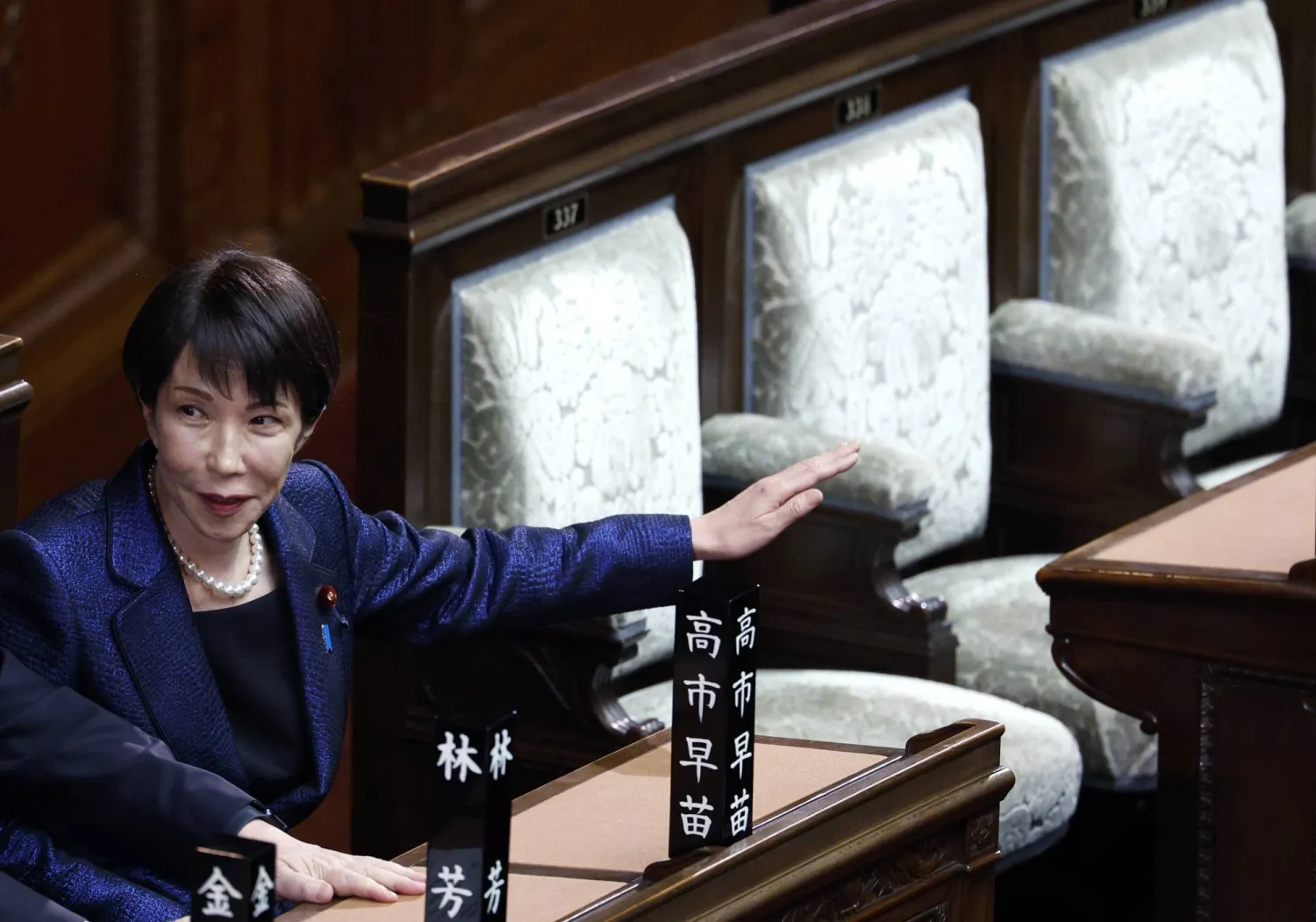
Sanae Takaichi gestures at the Lower House of the Parliament in Tokyo, Japan, 18 February 2026. EPA/FRANCK ROBICHON
TT

Japan PM Takaichi Reappointed Following Election

Sanae Takaichi gestures at the Lower House of the Parliament in Tokyo, Japan, 18 February 2026. EPA/FRANCK ROBICHON

Japan's lower house formally reappointed Sanae Takaichi as prime minister on Wednesday, 10 days after her historic landslide election victory.

Takaichi, 64, became Japan's first woman premier in October and won a two-thirds majority for her party in the snap lower house elections on February 8.

She has pledged to bolster Japan's defenses to protect its territory and waters, likely further straining relations with Beijing, and to boost the flagging economy.

Takaichi suggested in November that Japan could intervene militarily if Beijing sought to take Taiwan by force.

China, which regards the democratic island as part of its territory and has not ruled out force to annex it, was furious.

Beijing's top diplomat Wang Yi told the Munich Security Conference on Saturday that forces in Japan were seeking to "revive militarism".

In a policy speech expected for Friday, Takaichi will pledge to update Japan's "Free and Open Indo-Pacific" strategic framework, local media reported.

"Compared with when FOIP was first proposed, the international situation and security environment surrounding Japan have become significantly more severe," chief government spokesman Minoru Kihara said Monday.

In practice this will likely mean strengthening supply chains and promoting free trade through the Trans-Pacific Partnership (CPTPP) that Britain joined in 2024.

Takaichi's government also plans to pass legislation to establish a National Intelligence Agency and to begin concrete discussions towards an anti-espionage law, the reports said.

Takaichi has promised too to tighten rules surrounding immigration, even though Asia's number two economy is struggling with labor shortages and a falling population.

On Friday Takaichi will repeat her campaign pledge to suspend consumption tax on food for two years in order to ease inflationary pressures on households, local media said, according to AFP.

This promise has exacerbated market worries about Japan's colossal debt, with yields on long-dated government bonds hitting record highs last month.

Rahul Anand, the International Monetary Fund chief of mission in Japan, said Wednesday that debt interest payments would double between 2025 and 2031.

"Removing the consumption tax (on food) would weaken the tax revenue base, since the consumption tax is an important way to raise revenues without creating distortions in the economy," Anand said.

To ease such concerns, Takaichi will on Friday repeat her mantra of having a "responsible, proactive" fiscal policy and set a target on reducing government debt, the reports said.

She will also announce the creation of a cross-party "national council" to discuss taxation and how to fund ageing Japan's ballooning social security bill.

But Takaichi's first order of business will be obtaining approval for Japan's budget for the fiscal year beginning on April 1 after the process was delayed by the election.

The ruling coalition also wants to pass legislation that will outlaw destroying the Japanese flag, according to the media reports.

It wants too to accelerate debate on changing the constitution and on revising the imperial family's rules to ease a looming succession crisis.

Takaichi and many within her Liberal Democratic Party (LDP) oppose making it possible for a woman to become emperor, but rules could be changed to "adopt" new male members.