

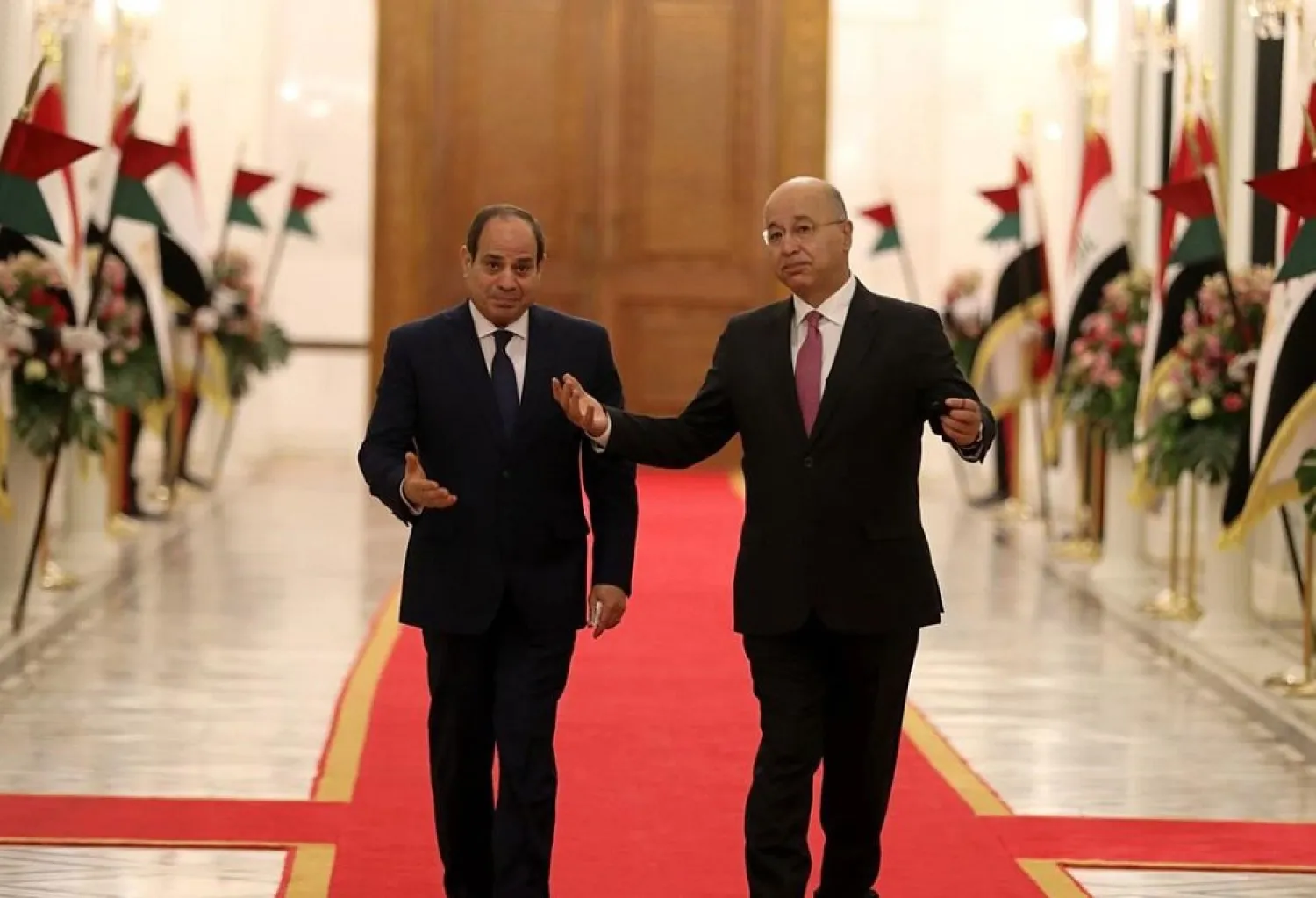

Iraq Brings Together Middle East Leaders in Bid to Restore Arab Role

Iraqi President Barham Salih, right, welcomes Egyptian President Abdel Fattah al-Sisi as he arrives at the Baghdad’s Presidential Palace, Saturday, Aug. 28, 2021. (AP)
TT

Iraq Brings Together Middle East Leaders in Bid to Restore Arab Role

Iraqi President Barham Salih, right, welcomes Egyptian President Abdel Fattah al-Sisi as he arrives at the Baghdad’s Presidential Palace, Saturday, Aug. 28, 2021. (AP)

Arab heads of state and senior officials from the region held a rare meeting Saturday at a conference hosted by Iraq. The meeting is aimed at easing Middle East tensions and underscored the Arab country’s new role as mediator.

French President Emmanuel Macron also attended the Baghdad meeting, hailing it as a major boost for Iraq and its leadership. The country had been largely shunned for the past few decades because of security concerns amid back-to-back wars and internal unrest, its airport frequently attacked with rockets by insurgents.

On Saturday, Iraqi leaders were on hand at Baghdad International Airport to receive the red carpet arrivals. They included Egyptian President Abdel Fattah al-Sisi, Jordan’s King Abdullah and Qatar’s Emir Sheikh Tamim bin Hamad Al Thani. It was the first official visit to Iraq by the Qatari emir. Among the participants were also Saudi Foreign Minister Prince Faisal bin Farhan.

Iran’s new foreign minister, Hossein Amir-Abdollahian, was also present.

The high-level meeting in Baghdad sent a message of Arab solidarity with Iraq, which has increasingly been pulled into Iran’s orbit in recent years.

“This summit marks the return of Iraq as a pivotal player in the region,” said political analyst Ihsan al-Shammari, who heads the Iraqi Political Thinking Center in Baghdad. “Having rival parties be seated at the same table is a significant step in that direction.”

Iraqi special forces deployed in Baghdad, particularly around the Green Zone, seat of the Iraqi government, where the meeting was held. Participants were expected to discuss a regional water crisis, the war in Yemen and a severe economic and political crisis in Lebanon that has brought the country to the point of collapse.

Lebanon, which has been without a functional government for the past year, and Syria, which has been suspended from the Arab League since 2011, were not represented at the meeting.

Macron, whose country is co-organizing the meeting, described Saturday’s meeting as “historic,” showcasing Iraq’s return to stability following the ruinous war against the ISIS group, which was defeated in 2017.

Sunday’s meeting was a chance for Iraqi leaders to underscore their recent efforts to portray Iraq as a neutral mediator in the region’s crises and re-engage with the world after decades of conflict.

“Iraq, which for years has been a headline for war and conflicts, is hosting leaders and representatives of the region today to affirm their support for Iraqi sovereignty and prosperity,” said President Barham Salih.

Iraq’s message at the summit is that it stands at the same distance from all sides, an Iraqi government official told The Associated Press. He spoke on condition of anonymity because he was not authorized to give official statements.

After decades of conflict, Iraq is seeking to reclaim a leadership role and status in the Arab world with a centrist policy and a determination among the country’s top leaders to maintain good relations with both Iran and the United States and its regional allies.



UN Says It Risks Halting Somalia Aid Due to Funding Cuts 

A Somali trader marks watermelons for sale at an open-air grocery market as Muslims start the fasting month of Ramadan, the holiest month in the Islamic calendar, within Bakara market in Mogadishu, Somalia, February 18, 2026. (Reuters)
TT

UN Says It Risks Halting Somalia Aid Due to Funding Cuts 

A Somali trader marks watermelons for sale at an open-air grocery market as Muslims start the fasting month of Ramadan, the holiest month in the Islamic calendar, within Bakara market in Mogadishu, Somalia, February 18, 2026. (Reuters)

The UN's World Food Program (WFP) warned Friday it would have to stop humanitarian assistance in Somalia by April if it did not receive new funding.

The Rome-based agency said it had already been forced to reduce the number of people receiving emergency food assistance from 2.2 million in early 2025 to just over 600,000 today.

"Without immediate funding, WFP will be forced to halt humanitarian assistance by April," it said in a statement.

In early January, the United States suspended aid to Somalia over reports of theft and government interference, following the destruction of a US-funded WFP warehouse in the capital Mogadishu's port.

The US announced a resumption of WFP food distribution on January 29.

However, all UN agencies have warned of serious funding shortfalls since Washington began slashing aid across the world following President Donald Trump's return to the White House last year.

"The situation is deteriorating at an alarming rate," said Ross Smith, WFP Director of Emergency Preparedness and Response, in Friday's statement.

"Families have lost everything, and many are already being pushed to the brink. Without immediate emergency food support, conditions will worsen quickly.

"We are at the cusp of a decisive moment; without urgent action, we may be unable to reach the most vulnerable in time, most of them women and children."

Some 4.4 million people in Somalia are facing crisis-levels of food insecurity, according to the WFP, the largest humanitarian agency in the country.

The Horn of Africa country has been plagued by conflict and also suffered two consecutive failed rainy seasons.


Hamas Says Path for Gaza Must Begin with End to ‘Aggression’ 

Makeshift tents of displaced Palestinian families among the ruins of their homes at sunset during the holy month of Ramadan in Jabaliya northern Gaza Strip on, 19 February 2026. (EPA)
TT

Hamas Says Path for Gaza Must Begin with End to ‘Aggression’ 

Makeshift tents of displaced Palestinian families among the ruins of their homes at sunset during the holy month of Ramadan in Jabaliya northern Gaza Strip on, 19 February 2026. (EPA)

Discussions on Gaza's future must begin with a total halt to Israeli "aggression", the Palestinian movement Hamas said after US President Donald Trump's Board of Peace met for the first time.

"Any political process or any arrangement under discussion concerning the Gaza Strip and the future of our Palestinian people must start with the total halt of aggression, the lifting of the blockade, and the guarantee of our people's legitimate national rights, first and foremost their right to freedom and self-determination," Hamas said in a statement Thursday.

Trump's board met for its inaugural session in Washington on Thursday, with a number of countries pledging money and personnel to rebuild the Palestinian territory, more than four months into a fragile ceasefire between Israel and Hamas.

Israeli Prime Minister Benjamin Netanyahu has insisted however that Hamas must disarm before any reconstruction begins.

"We agreed with our ally the US that there will be no reconstruction of Gaza before the demilitarization of Gaza," Netanyahu said.

The Israeli leader did not attend the Washington meeting but was represented by his foreign minister Gideon Saar.

Trump said several countries had pledged more than seven billion dollars to rebuild the territory.

Muslim-majority Indonesia will take a deputy commander role in a nascent International Stabilization Force, the unit's American chief Major General Jasper Jeffers said.

Trump, whose plan for Gaza was endorsed by the UN Security Council in November, also said five countries had committed to providing troops, including Morocco, Kazakhstan, Kosovo and Albania.


Official Contacts Aim to Keep Lebanon out of War on Iran as Israel Raises Readiness on Northern Front 

This photograph shows a memorial for slain Lebanese Hezbollah longtime leader Hassan Nasrallah at the entrance of the southern village of Qannarit on February 16, 2026. (AFP)
TT

Official Contacts Aim to Keep Lebanon out of War on Iran as Israel Raises Readiness on Northern Front 

This photograph shows a memorial for slain Lebanese Hezbollah longtime leader Hassan Nasrallah at the entrance of the southern village of Qannarit on February 16, 2026. (AFP)

Israel has raised the alert level of its military along the border with Lebanon, raising questions that Lebanon’s south may again be involved in a regional confrontation should the US attack Iran.

Given the heightened tensions between the US and Iran, questions have been asked over whether Hezbollah will become involved in a new war. Its Secretary-General Sheikh Naim Qassem had recently announced that the party will not remain on the side if Iran is attacked.

On the ground, Israel blew up houses in southern Lebanon border towns and carried out air strikes in the south. Israeli military spokesman Avichay Adraee said the raids targeted “Hezbollah infrastructure,” including arms caches and rocket launchers.

Their presence in the south is a violation of current agreements, he added.

Amid the high regional tensions, Israel’s Maariv quoted a military source as saying that the army has come up with plans, including a preemptive strike against Hezbollah, which would drag the south and the whole of Lebanon into a new war.

Ministerial sources told Asharq Al-Awsat that the presidency has been carrying out internal and foreign contacts since Thursday morning to keep Lebanon out of any escalation.

Hezbollah had launched a “support front” war against Israel a day after Hamas’ October 7, 2023 attack. In 2024, the war spiraled into an all-out conflict, with Israel decimating the Hezbollah leadership and severely weakening the party.

Israel believes that Hezbollah has been rebuilding its capabilities since the ceasefire that was struck in November 2024.

Kassim Kassir, a political analyst who is close to Hezbollah, told Asharq Al-Awsat: “No one knows what Hezbollah will do because the situation is tied the extent of the attack, should it happen.”

He noted that Qassem was ambiguous when he said the party will decide what to do when the time is right, but at any rate, he stressed that the party will not remain on the sidelines or abandon Iran.

“No one knows what Hezbollah’s abilities are, so everything is possible,” Kassir said.

Riad Kahwaji, a security and defense affairs expert, said he does not rule out the possibility that Hezbollah would join the war should the US attack Iran.

Speaking to Asharq Al-Awsat, he stressed that Iran is now the United States’ main target, when previously it used to confront its proxies.

It has now taken the fight directly to the heart of the problem, which is the Iranian regime, he remarked.

The extent of the military mobilization in the region and the frequent American statements about regime change all indicate that a major military operation may be imminent, he added.

Israel’s military also favors preemptive operations, so it is watching Hezbollah, which remains Iran’s most powerful regional proxy despite the blows it received in 2024 war, Kahwaji said.

Hezbollah still possesses a rocket arsenal that can threaten Israel, he remarked.

Israel’s high level of alert on the border with Lebanon could be in readiness for any development. Should Tel Aviv receive word from Washington that it intends to attack Iran, then it could launch operations against Hezbollah as part of preemptive strikes aimed at preventing the party from launching attacks against it, Kahwaji said.

“As long as Hezbollah possesses heavy weapons, such as rockets, and drones, that it has not handed over to the army, then Lebanon will continue to be vulnerable to attacks in the next confrontation. It will be exposed to Israeli strikes as long as this issue remains unresolved,” he added.