

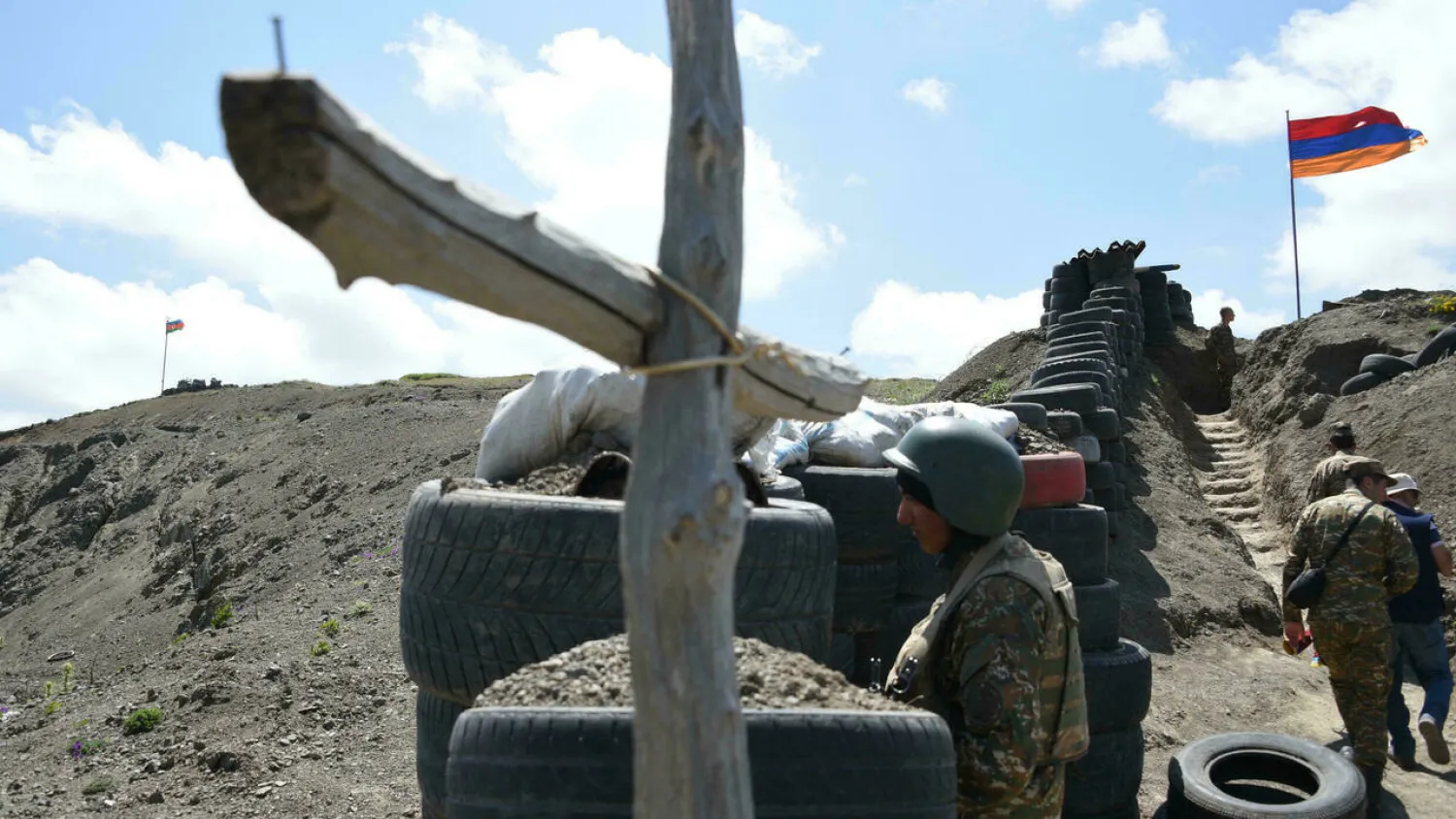

Armenia Takes Rival Azerbaijan to Top UN court

At Armenia's border with Azerbaijan. Decades of tensions over Azerbaijan's breakaway region of Nagorno-Karabakh erupted into a six-week war in 2020 that claimed more than 6,500 lives Karen MINASYAN AFP
TT

Armenia Takes Rival Azerbaijan to Top UN court

At Armenia's border with Azerbaijan. Decades of tensions over Azerbaijan's breakaway region of Nagorno-Karabakh erupted into a six-week war in 2020 that claimed more than 6,500 lives Karen MINASYAN AFP

Armenia dragged rival Azerbaijan to the UN's top court on Thursday, accusing it of decades of rights abuses including last year's war over a disputed region.

Yerevan is calling on the International Court of Justice (ICJ) to take emergency measures to "protect and preserve Armenia’s rights", the Hague-based tribunal said in a statement.

Azerbaijan said it would "hold Armenia to account" for what it said were rights abuses against its own people, reported Agence France-Presse.

Armenia's case is based on an allegation that Azerbaijan has breached a UN treaty, the International Convention on the Elimination of All Forms of Racial Discrimination (ICERD).

"For decades, Azerbaijan has subjected Armenians to racial discrimination," the filing says, "with Azerbaijan’s President Ilham Aliyev himself leading the way".

"As a result of this state-sponsored policy of Armenian hatred, Armenians have been subjected to systemic discrimination, mass killings, torture and other abuse."

Armenia also says that the alleged violations "once again came to the fore in September 2020, after Azerbaijan’s aggression".

The ICJ was set up after World War II to rule on disputes between United Nations member states. Cases usually take years to reach a conclusion.

Decades of tensions over Azerbaijan's breakaway region of Nagorno-Karabakh erupted into a six-week war last autumn that claimed more than 6,500 lives.

It ended in November with a Russian-brokered ceasefire under which Armenia ceded territories it had controlled for decades.

Nagorno-Karabakh is an ethnic Armenian region of Azerbaijan that broke away from Baku's control in the early 1990s after the collapse of the Soviet Union. Around 30,000 people have died during the conflict.

- 'Grave breaches' -
Azerbaijan said it would launch its own legal proceedings in response to the Armenian move.

"In the coming days, we will hold Armenia to account for breaches" of the discrimination convention, Azerbaijan’s deputy foreign minister Elnur Mammadov said in an English-language tweet.

"Thirty years of human rights abuses against Azerbaijanis during occupation will not be tolerated."

The Azerbaijan foreign ministry said it had been "carefully documenting and compiling evidence of gross human rights abuses" by Armenia for its own legal action.

"This includes Armenia’s targeting of Azerbaijanis for expulsion, torture, murder and serious mistreatment,"

"We will not tolerate these grave breaches of ICERD by Armenia, and will be seeking justice under international law as soon as possible."

Both sides have long traded accusations of rights abuses, including in last year's war.

In February, the foreign ministers of Armenia and Azerbaijan both addressed the United Nations Human Rights Council over their claims that the other side violated international law.

Armenia accused Azerbaijani forces of targeting civilian infrastructure and destroying Armenian cultural and religious heritage.

Azerbaijan, which was backed by Turkey during the conflict, for its part accused Armenian forces of war crimes.

In December, Amnesty International urged Baku and Yerevan to urgently probe "war crimes" committed by both sides during the fighting.

While Armenia has not opened an investigation into its army for war crimes, Azerbaijan has charged two of its soldiers for mutilating bodies of Armenian soldiers.

In the 1990s, Armenian-backed separatists in Nagorno-Karabakh declared independence from Azerbaijan in a war over the mountainous province that left some 10,000 dead.

Armenia's ally Russia refused to intervene militarily in the latest conflict last year, but deployed several thousand peacekeepers to Nagorno-Karabakh after brokering the peace accord in November.



US Judge Blocks Deportation of Columbia University Palestinian Activist

Mohsen Mahdawi at a press conference in Vermont last year - Photo by Alex Driehaus/AP
TT

US Judge Blocks Deportation of Columbia University Palestinian Activist

Mohsen Mahdawi at a press conference in Vermont last year - Photo by Alex Driehaus/AP

A US immigration judge has blocked the deportation of a Palestinian graduate student who helped organize protests at Columbia University against Israel's war in Gaza, according to US media reports.

Mohsen Mahdawi was arrested by immigration agents last year as he was attending an interview to become a US citizen.

Mahdawi had been involved in a wave of demonstrations that gripped several major US university campuses since Israel began a massive military campaign in the Gaza Strip.

A Palestinian born in the occupied West Bank, Mahdawi has been a legal US permanent resident since 2015 and graduated from the prestigious New York university in May. He has been free from federal custody since April.

In an order made public on Tuesday, Judge Nina Froes said that President Donald Trump's administration did not provide sufficient evidence that Mahdawi could be legally removed from the United States, multiple media outlets reported.

Froes reportedly questioned the authenticity of a copy of a document purportedly signed by Secretary of State Marco Rubio that said Mahdawi's activism "could undermine the Middle East peace process by reinforcing antisemitic sentiment," according to the New York Times.

Rubio has argued that federal law grants him the authority to summarily revoke visas and deport migrants who pose threats to US foreign policy.

The Trump administration can still appeal the decision, which marked a setback in the Republican president's efforts to crack down on pro-Palestinian campus activists.

The administration has also attempted to deport Mahmoud Khalil, another student activist who co-founded a Palestinian student group at Columbia, alongside Mahdawi.

"I am grateful to the court for honoring the rule of law and holding the line against the government's attempts to trample on due process," Mahdawi said in a statement released by his attorneys and published Tuesday by several media outlets.

"This decision is an important step towards upholding what fear tried to destroy: the right to speak for peace and justice."


Fire Breaks out Near Iran's Capital Tehran, State Media Says

Smoke rises from a fire caused by an explosion in Tehran (File photo - Reuters)
TT

Fire Breaks out Near Iran's Capital Tehran, State Media Says

Smoke rises from a fire caused by an explosion in Tehran (File photo - Reuters)

A fire broke out in Iran's Parand near the capital city Tehran, state media reported on Wednesday, publishing videos of smoke rising over the area which is close to several military and strategic sites in the country's Tehran province, Reuters reported.

"The black smoke seen near the city of Parand is the result of a fire in the reeds around the Parand river bank... fire fighters are on site and the fire extinguishing operation is underway", state media cited the Parand fire department as saying.


Pakistan PM Sharif to Seek Clarity on Troops for Gaza in US Visit

US President Donald Trump looks at Pakistan's Prime Minister Shehbaz Sharif speaking following the official signing of the first phase of the Gaza ceasefire agreement between Israel and Hamas, during a world leaders' summit on ending the Gaza war, in Sharm El-Sheikh, Egypt, October 13, 2025. REUTERS/Evelyn Hockstein/File Photo
TT

Pakistan PM Sharif to Seek Clarity on Troops for Gaza in US Visit

US President Donald Trump looks at Pakistan's Prime Minister Shehbaz Sharif speaking following the official signing of the first phase of the Gaza ceasefire agreement between Israel and Hamas, during a world leaders' summit on ending the Gaza war, in Sharm El-Sheikh, Egypt, October 13, 2025. REUTERS/Evelyn Hockstein/File Photo

Before Pakistan commits to sending troops to Gaza as part of the International Stabilization Force it wants assurances from the United States that it will be a peacekeeping mission rather than tasked with disarming Hamas, three sources told Reuters.

Pakistan's Prime Minister Shehbaz Sharif is set to attend the first formal meeting of President Donald Trump's Board of Peace in Washington on Thursday, alongside delegations from at least 20 countries.

Trump, who will chair the meeting, is expected to announce a multi-billion dollar reconstruction plan for Gaza and detail plans for a UN-authorized stabilization force for the Palestinian enclave.

Three government sources said during the Washington visit Sharif wanted to better understand the goal of the ISF, what authority they were operating under and what the chain of command was before making a decision on deploying troops.

"We are ready to send troops. Let me make it clear that our troops could only be part of a peace mission in Gaza," said one of the sources, a close aide of Sharif.

"We will not be part of any other role, such as disarming Hamas. It is out of the question," he said.

Analysts say Pakistan would be an asset to the multinational force, with its experienced military that has gone to war with arch-rival India and tackled insurgencies.

"We can send initially a couple of thousand troops anytime, but we need to know what role they are going to play," the source added.

Two of the sources said it was likely Sharif, who has met Trump earlier this year in Davos and late last year at the White House, would either have an audience with him on the sidelines of the meeting or the following day at the White House.

Initially designed to cement Gaza's ceasefire, Trump sees the Board of Peace, launched in late January, taking a wider role in resolving global conflicts. Some countries have reacted cautiously, fearing it could become a rival to the United Nations.

While Pakistan has supported the establishment of the board, it has voiced concerns against the mission to demilitarize Gaza's militant group Hamas.