

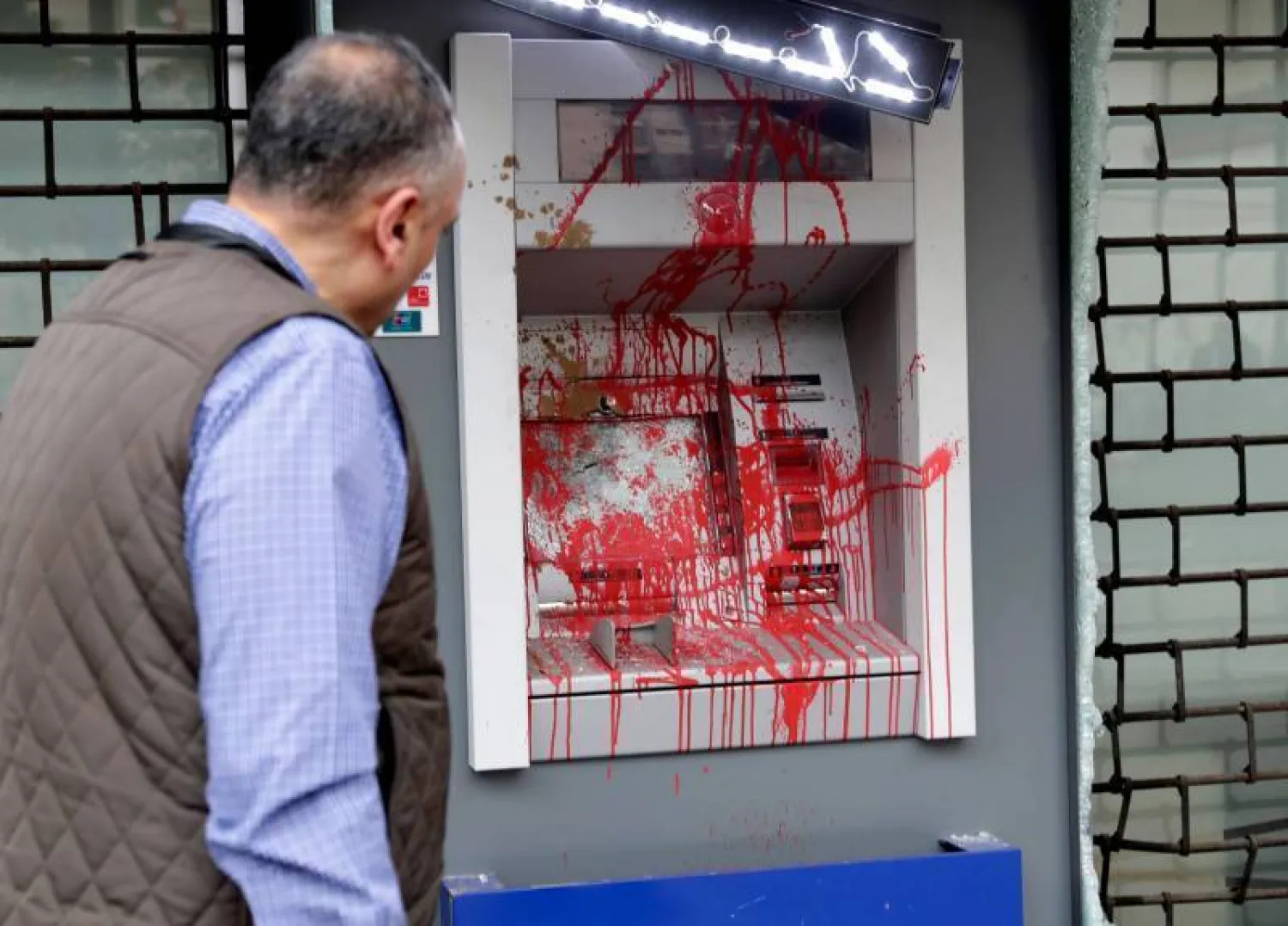

Young Lebanese Driving Crypto ‘Revolution’ after Banks Go Bust

Lebanon’s tech-savvy youth are increasingly turning to cryptocurrency to shield themselves from currency depreciation. (AFP)
TT

Young Lebanese Driving Crypto ‘Revolution’ after Banks Go Bust

Lebanon’s tech-savvy youth are increasingly turning to cryptocurrency to shield themselves from currency depreciation. (AFP)

On a recent afternoon, Lebanese cryptocurrency trader Mario Awad was sorting out the details of a $2 million deal with a high-profile customer - complete with a hotel stay and the promise of a lively night out.

“I have (security) officers, politicians, media personalities, everyone is buying crypto,” he told the Thomson Reuters Foundation between non-stop phone calls at his plush two-storey flat in the coastal town of Jbeil, north of Beirut.

“Increasingly, it’s also your average person who is trying to get out of the collapsed banks and cut their losses,” he said.

Awad sits at the top of a booming cryptocurrency market fueled by the collapse of Lebanon’s financial system in 2019.

The Lebanese pound, which has been pegged to the US dollar for more than two decades, slid from 1,500 to the dollar to roughly 15,000 on the parallel market by September this year.

Lebanese are forced to withdraw money in pounds at a massive loss or take out US dollar-denominated cheques which are then sold for a fraction of their price - currently about 20%.

A recovery plan proposed by the government to the International Monetary Fund in 2020 estimated the losses in Lebanon’s financial system at about $83 billion.

The bankrupt country’s tech-savvy youth are increasingly turning to cryptocurrency to shield themselves from currency depreciation, get money in and out of the country, and try to make up the losses they have suffered.

“It’s funny when people say crypto isn’t real because what we found out in Lebanon is that this digital currency is 100 times more real than the lollars we have in the bank,” said crypto enthusiast Ahmad, using a slang term for US dollars stuck in Lebanon’s financial system.

P2P market
Ahmad - who works in oil and gas in the Arab Gulf and asked to use only his first name - said he had tens of thousands of dollars in savings in the bank when the crisis hit.

The 31-year-old removed the lion’s share in June 2020, losing about 60% of his savings in the process.

Through a friend, he joined one of the dozens of cryptocurrency trading groups on apps like WhatsApp and Telegram where members exchange decentralized digital currencies in person-to-person trades, known as “P2P”.

After getting his money out of the bank in cash, Ahmad handed wads of it over to a crypto trader who sent the corresponding amount of cryptocurrency to Ahmad’s digital wallet, taking a commission somewhere between 1% and 3%.

The majority of transactions taking place in Lebanon’s crypto chatrooms range between a few hundred and a few thousand dollars’ worth of so-called stablecoins - such as tether, also called USDT - whose values always hover around $1 per unit.

Effectively digital dollars, these can then be traded for other, more speculative, cryptocurrencies such as bitcoin, the first and most famous cryptocurrency, which was conceived in the wake of the 2008 global financial crisis as an alternative to central-bank issued currencies.

A spokesperson for Lebanon’s central bank did not respond to repeated requests for comment on the size of Lebanon’s cryptocurrency market or the legality of cryptocurrency trading in the country.

Six cryptocurrency traders who spoke to the Thomson Reuters Foundation said millions of dollars’ worth of cryptocurrency was changing hands in Lebanon each day.

Many Lebanese crypto users are sympathetic to the anti-establishment roots of digital currencies: in the same period that the Lebanese pound has been in freefall, cryptocurrencies have rallied to all-time highs.

The country’s economic crisis, likely among the world’s worst since the 1850s, according to a June World Bank report, is widely blamed on systemic corruption and decades of mismanagement by a closely-knit ruling elite.

“The developers of bitcoin were definitely thinking about the exact things that happened here ... about corrupt institutions with bad monetary and fiscal policies leading to the debasement of currencies,” said cryptocurrency user Jad.

The 34-year-old music producer based in Beirut noted he bought cryptocurrency with most of his savings.

“Personally, I’m in it for the revolution... I can be the custodian of my money and have it in my pocket on my phone,” he added.

Ali Noureddine, a Lebanese economist at independent news platform Megaphone, said many entering the cryptocurrency trade in Lebanon were driven by an ideological opposition to “a banking system that no-one trusts to store their money in.”

But he said cryptocurrency had not yet shown itself to be a long-term alternative to state-backed money in Lebanon because most businesses do not accept it and its volatility does not yet make it a reliable store of value - one of the main functions of a currency.

“It’s still largely a commodity to speculate on for those with a bit of an adventurous streak who think they can make a profit in six months or so,” he said.

‘Regulatory desert’
And while cryptocurrency is growing increasingly popular among Lebanese, it inhabits a legal grey area.

“It’s a regulatory desert,” said a Lebanese executive at a leading global cryptocurrency exchange who goes by the name CryptoLira on Twitter but asked to remain anonymous.

“For many, that’s seen as good because we’re not living in a country where regulations and politicians give us hope - quite the opposite. But it does harm widespread adoption (of cryptocurrency),” he said.

As well as trading cryptocurrencies, many Lebanese are now “mining” them.

The energy-intensive process involves creating cryptocurrency by solving complex sums used to record and verify blocks of digital currency transactions.

In a country beset by rolling power cuts, crypto miners can operate thanks to a heavy fuel subsidy that makes Lebanon’s electricity some of the cheapest in the world and, until recently, kept it affordable to run private diesel generators whenever the power went off.

“There are people who bought enough diesel to sustain them for months at very low, subsidized rates,” a local cryptocurrency miner said, speaking on condition of anonymity.

As they watch the country’s unemployment rate soar, Lebanese miners say it’s worth going to any lengths to obtain cryptocurrency because it provides an easy and consistent source of income.

“Even if you’re making $10 a day with a normal computer, that’s now several times the minimum wage,” the miner said.

And those at the forefront of Lebanon’s crypto boom say none of that money will ever see the inside of a Lebanese bank.

“After what we’ve been through, I’m never putting one cent back in a Lebanese bank,” Jad said.

“You need an alternative - and opening a crypto account is easy-peasy.”


Microsoft to Invest $10 bn for Japan AI Data Centers

Microsoft's Vice Chair and President Brad Smith (4th L) and (L-R) Sakura Internet Inc President and CEO Kunihiro Tanaka, SoftBank Corp. President and CEO Junichi Miyakawa, Microsoft Japan President Miki Tsusaka, hold a meeitng with Japan's Prime Minister Sanae Takaichi (2nd R) and Vice Minister of Economy, Trade and Industry Toshiro Ino (R) at the Prime Minister's Office in Tokyo on April 3, 2026. Kazuhiro NOGI / POOL/AFP
TT

Microsoft to Invest $10 bn for Japan AI Data Centers

Microsoft's Vice Chair and President Brad Smith (4th L) and (L-R) Sakura Internet Inc President and CEO Kunihiro Tanaka, SoftBank Corp. President and CEO Junichi Miyakawa, Microsoft Japan President Miki Tsusaka, hold a meeitng with Japan's Prime Minister Sanae Takaichi (2nd R) and Vice Minister of Economy, Trade and Industry Toshiro Ino (R) at the Prime Minister's Office in Tokyo on April 3, 2026. Kazuhiro NOGI / POOL/AFP

Microsoft said Friday it will invest $10 billion in Japan over the next four years to build artificial intelligence data centers and related infrastructure.

Power-hungry data centers -- warehouse-like facilities that power AI tools from chatbots to image generators -- are springing up worldwide, and the sector is growing particularly fast in Asia.

Microsoft President Brad Smith met Japanese Prime Minister Sanae Takaichi at her office on Friday to announce the investment, said AFP.

Smith said in a statement that it was a "response to Japan's growing need for cloud and AI services".

Businesses in Japan, the world's fourth-largest economy, are keen to get ahead in the fast-moving AI field.

But data centers expansion there is constrained by limited space and relatively expensive electricity.

The US tech giant will collaborate with Japan's SoftBank Group and Sakura Internet to expand domestic tech infrastructure, it said in a press release.

It follows a $2.9 billion two-year investment Microsoft announced in 2024 to bolster the country's push into AI and strengthen its cyber defenses.

The investment unveiled Friday also includes funds to enhance cybersecurity partnerships with Japanese government agencies, and to train one million engineers in cooperation with telecom and tech giants NTT and NEC.

A rush to build data centers in the Asia-Pacific region, especially in India and Southeast Asia, has sparked concerns over the facilities' environmental impact.

That includes increased demand on electricity grids that are often reliant on fossil fuels, and on local water supplies used to cool the hot servers inside.

Microsoft says it has pledged to become carbon negative, zero-waste and "water positive" by 2030.

On Tuesday, the company announced plans to invest more than $1 billion in cloud and AI data center infrastructure and operations in Thailand over the next two years.


Kia to Sell Lower-priced Electric Vehicle in US

A KIA logo on an electric vehicle is seen on display at the Canadian International AutoShow in Toronto, Ontario, Canada, February 13, 2025. REUTERS/Carlos Osorio
TT

Kia to Sell Lower-priced Electric Vehicle in US

A KIA logo on an electric vehicle is seen on display at the Canadian International AutoShow in Toronto, Ontario, Canada, February 13, 2025. REUTERS/Carlos Osorio

Kia said Wednesday it will begin selling a lower-priced electric vehicle in the United States later this year as automakers work to recharge EV sales.

The Korean automaker said at the New York Auto Show it will offer the EV3 in the US market starting later this year, Reuters reported.

Automakers are facing a tougher EV market in the United States after Congress repealed the $7,500 EV tax credit last year but higher gasoline prices in recent weeks has prompted new interest in the EVs.


Passengers Stranded in Moving Traffic after Robotaxi Outage in China

This file photo taken on August 1, 2024 shows a general view of a driverless robotaxi autonomous vehicle developed as part of tech giant Baidu's Apollo Go self-driving project, in Wuhan, in central China's Hubei province. (Photo by PEDRO PARDO / AFP)
TT

Passengers Stranded in Moving Traffic after Robotaxi Outage in China

This file photo taken on August 1, 2024 shows a general view of a driverless robotaxi autonomous vehicle developed as part of tech giant Baidu's Apollo Go self-driving project, in Wuhan, in central China's Hubei province. (Photo by PEDRO PARDO / AFP)

Some robotaxi passengers were left stranded in the middle of fast-moving traffic in a major Chinese city after their driverless vehicles stopped running, according to police and media reports on Wednesday.

A preliminary investigation indicates more than 100 robotaxis came to a halt because of a “system malfunction,” police in the city of Wuhan said in a statement, without elaborating. No injuries were reported.

One passenger told Chinese media that their robotaxi stopped after turning a corner. An instruction on a screen read: “Driving system malfunction. Staff are expected to arrive in 5 minutes.” After no one showed up, the passenger pushed an SOS button and was told that staff were on their way. The car door could be opened, so the passenger got out on their own.

It is the first time a mass shutdown of robotaxis has been reported in China, The Associated Press said. In December, many of Waymo’s self-driving cars came to a stop in San Francisco because of a power outage.

The taxis in Wuhan are operated by Baidu, a major Chinese internet and AI company that is expanding its Apollo Go robotaxi business to overseas locations in Europe and the Mideast.

Baidu did not have any immediate comment.

Police said reports that taxis were coming to a halt started coming in around 9 p.m., while media reports said multiple people were rescued.

While some passengers were able to exit their taxis on their own, others were afraid to get out because their vehicle had stopped in the middle lane of a ring road with other vehicles passing on both sides, the reports said. Ring roads are elevated roads without traffic lights designed to move traffic quickly in urban areas.

Baidu operates hundreds of robotaxis in Wuhan, which hosted an early pilot project for the company.
