


Egyptian President Warns of Grave Threat to Regional Security, Stability

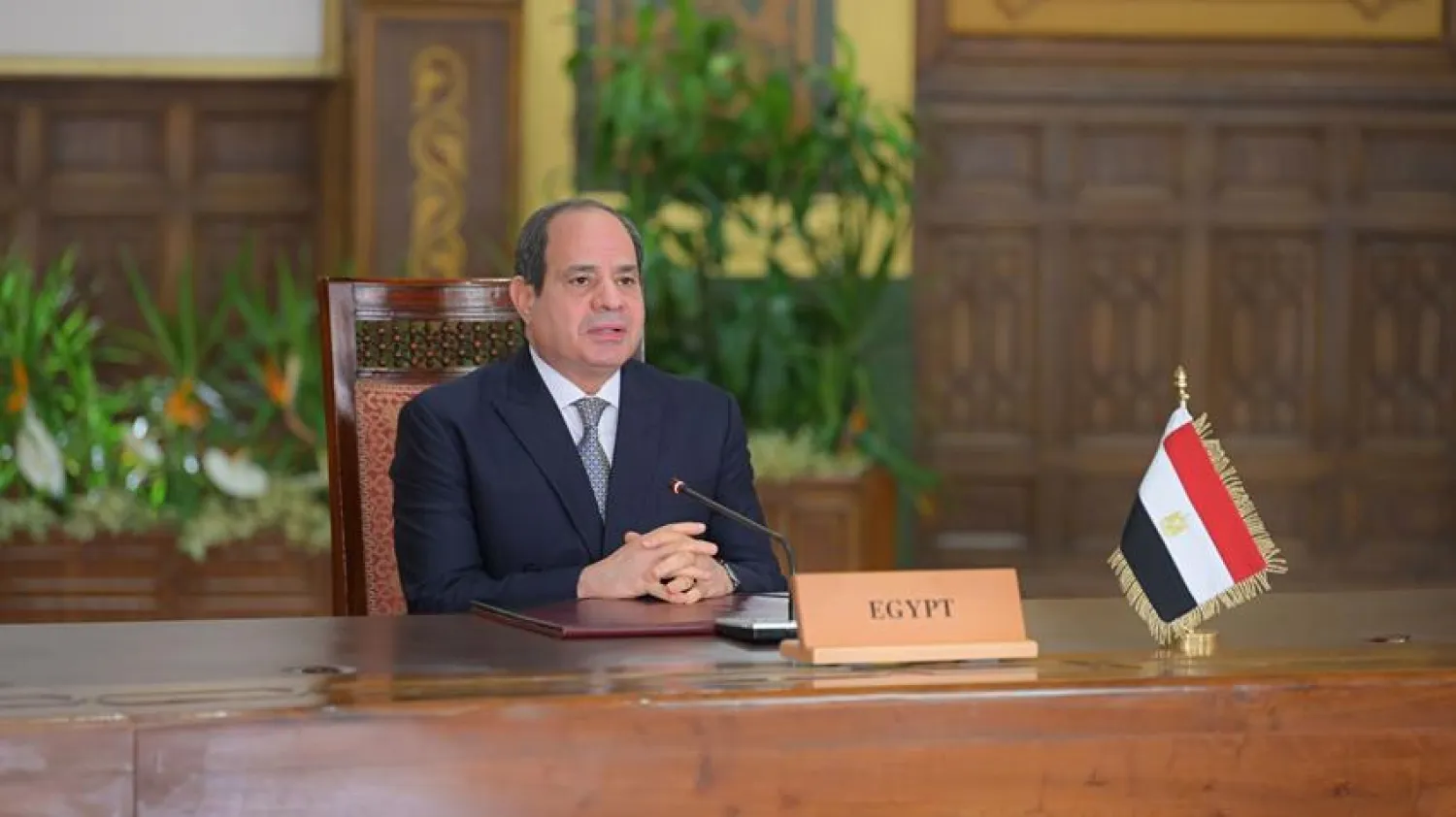
Egyptian President Abdel Fattah El-Sisi (Egyptian Presidency)
TT

Egyptian President Warns of Grave Threat to Regional Security, Stability

Egyptian President Abdel Fattah El-Sisi (Egyptian Presidency)

Egyptian President Abdel Fattah El-Sisi warned of a grave threat to regional security and stability amid the faltering negotiations between Egypt, Sudan, and Ethiopia over the Grand Ethiopian Renaissance Dam (GERD) on the Nile River.

Egypt and Sudan have been negotiating with Ethiopia for ten years to reach an agreement on filling and operating the dam, but the talks have not yielded any results.

Last week, the UN Security Council called on the three countries to resume negotiations under the auspices of the African Union (AU), stressing in a presidential statement the need to reach an agreement acceptable and binding to all.

Speaking at the UN General Assembly, Sisi said: “You might all be aware of the outcome of a decade-long cycle of negotiations among Egypt, Sudan, and Ethiopia as a result of clear intransigence and unjustified rejection to engage positively with the negotiations process in its successive stages, and instead choosing a unilateral approach and imposing facts on the ground.”

The Nile River has always been the principal artery of life in Egypt, which explains the overwhelming concern by the Egyptian citizen regarding the GERD, said the president.

“Egypt, which acknowledges the rights of its brothers for development,” suffers from drought “and its people remain below the level of water poverty.”

However, Egypt is still committed to reaching a legally binding, balanced, and comprehensive agreement on the filling and operation of the dam to protect the existence of 150 million Egyptians and Sudanese, said Sisi.

Cooperation among African countries “will not be attained when one side determines the requirements of the other. This process should be reciprocal.”

Sisi underscored the need for all countries to respect their commitments under international law and the relevant UN Security Council resolutions.

To prevent the situation from escalating into a threat to international peace and stability, Egypt resorted to the General Assembly to support African mediation efforts through an effective role by observers from the UN and friendly countries, asserted the president.

Ethiopia says the dam, which it has been building since 2011 on the main tributary of the Nile, is essential to the development of its economy and energy.

However, Egypt considers it a serious threat to its water share.

The Egyptian Minister of Irrigation, Mohamed Abdel-Aty, asserted that Cairo extends its hand to development, cooperation, and coordination for the common interest, in a way that does not harm any party.

He said before the plenary session on cooperation in transboundary river basins on the second day of the 5th Arab Water Forum on Wednesday in Dubai that Egypt has the right for its people or any African people to life and development.

The minister stressed the importance of water security as one of the tools to achieve the UN goals for sustainable development by working on the optimal use of every drop of water, especially in light of the many challenges facing the sector.

Egypt aims to continue regional cooperation to confront climate change and manage international river basins according to international laws and norms.


Palestinian President’s Advisor: Board of Peace, Related Entities Are a ‘Temporary Arrangement’

Palestinian President Mahmoud Abbas’ advisor Dr. Mahmoud Al-Habbash. WAFA
TT

Palestinian President’s Advisor: Board of Peace, Related Entities Are a ‘Temporary Arrangement’

Palestinian President Mahmoud Abbas’ advisor Dr. Mahmoud Al-Habbash. WAFA

Palestinian President Mahmoud Abbas’ advisor Dr. Mahmoud Al-Habbash said that the situation in the Gaza Strip, along with the formation of the Board of Peace and its related entities is not a Palestinian choice.

This is “a temporary arrangement (mandated by the UN Security Council) that the Palestinian leadership rejects under any circumstances... but it is the lesser of two evils,” Al-Habbash told Asharq Al-Awsat.

Speaking from Ramallah, Al-Habbash said that the Palestinian leadership “chose this arrangement to stop the massacre and open a potential window ... leading to a Palestinian state.”

US President Donald Trump announced last week the formation of the Board of Peace, a new body of world leaders meant to oversee next steps in Gaza.

The White House said there would be a main board, chaired by Trump himself, a Palestinian committee of technocrats meant to govern the war-wracked territory, and a second "executive board" that appears designed to have a more advisory role.

“Our clear and firm position is that we did not create this reality,” said Al-Habbash. “Rather, it is a reality imposed on us for two reasons: First, Israel’s aggression ... and second, the reckless adventure carried out by Hamas movement, which whetted Israel’s appetite to liquidate the Palestinian cause.”

According to Al-Habbash, “this transitional arrangement is the least harmful to the Palestinian cause,” because it ensures that Palestinians remain in the Gaza Strip and prevents displacement.


UN Human Rights Commissioner Calls for Accountability for Atrocity Crimes in Sudan

UN Human Rights commissioner Volker Turk 
TT

UN Human Rights Commissioner Calls for Accountability for Atrocity Crimes in Sudan

UN Human Rights commissioner Volker Turk 

UN Human Rights commissioner Volker Turk said on Sunday he is alarmed by the increasing militarization of society by all parties to the conflict in Sudan, also expressing his worries that the atrocity crimes committed during and after the takeover of El Fasher would be repeated in the Kordofan region.

Speaking at a press conference in Port Sudan, where the government had been operating as a temporary capital since the conflict began, the UN envoy said the proliferation of advanced military equipment, in particular drones, across Sudan has enhanced the military capabilities of both the Sudanese army (SAF) and the Rapid Support Forces (RSF), prolonging hostilities and deepening the crisis for civilians.

“I am deeply alarmed by the increasing militarization of society by all parties to the conflict, including through the arming of civilians and recruitment and use of children,” Turk noted.

The envoy said that during his visit to refugee camps in north Sudan, he heard accounts of widespread summary executions by RSF during the offensive on El Fasher, the capital of North Darfur region – for revenge, for suspected affiliation with the Sudanese Army or its allied Joint Forces.

He added, “I am very worried that the atrocity crimes committed during and after the takeover of El Fasher are at grave risk of repeating themselves in the Kordofan region, where the conflict has been rapidly escalating since late October.”

Horror and Hell

Turk also said the Sudanese population had endured “horror and hell,” especially with the expansion of the fighting in Kordofan.

“The Kordofan states are extremely volatile, with relentless military engagements, heavy shelling, drone bombardments and airstrikes causing widespread destruction and collapse of essential services,” he warned.

Since the end of October, and after taking control of El Fasher in Darfur, the RSF attacks have expanded into the neighboring Kordofan region, resulting in a continued displacement of civilians from the besieged city – all in the context of extreme food insecurity, with famine conditions confirmed in Kadugli, and risk of famine in other areas including Dilling, according to Turk.

The latest UN figures show that more than 65,000 people have been displaced since October.

At his press conference at Port Sudan airport, the envoy said that during his four-day visit to Port Sudan, Dongola, Ad Dabba and Merowe, he has met with those who have been hardest hit by brutal violence and injustice in this war.

“The terrifying experiences of these survivors must provoke action to end this conflict, and to make sure they can access what they need: medical care, psychosocial care, justice and support to pursue education and a livelihood”.

End This Madness

Turk and his UN team had visited the Al Afad site for internally displaced people (IDPs) in Ad Dabba, where they met with a large number of displaced people from the regions of Darfur and Kordofan.

“In my meetings with more than 50 local and international organizations in Dongola and Port Sudan, I heard appeals directed to those waging this war and the international community to end this madness,” he said.

“And to allow NGOs, journalists, lawyers and humanitarian actors to do their essential work without undue restrictions and reprisals,” Turk added.

He said the RSF and the Sudanese army must cease intolerable attacks against civilian objects that are indispensable to the civilian population, including markets, health facilities, schools and shelters.

“Attacks on critical civilian infrastructure are serious violations that can amount to war crimes,” Turk affirmed.

The UN envoy said the international community must ensure that the perpetrators of the horrific violations in Sudan face justice, regardless of their affiliation.

My Office, he said, is working to document and report on these violations and abuses to pave the way for accountability.

Turk described as “despicable” the fact that large sums of money are being spent on procuring increasingly advanced weaponry – funds he said that should be used to alleviate the suffering of the population.

Protection of Civilians

The envoy then called on all parties to the conflict to ensure the protection of civilians and civilian infrastructure, to guarantee safe passage for civilians to leave areas of active conflict – including Kadugli and Dilling – and for humanitarian aid to enter where it is needed.

He also repeated his call from three years ago, when he last visited Sudan, urging all those involved to set aside entrenched positions, power games, and personal interests, and to focus on the common interests of the Sudanese people.

The envoy then left Sudan with a plea that human rights be central to building confidence and bringing this war to an end, to resuming the difficult task of building a sustainable peace.

“It is difficult, but certainly not impossible, with the resilience and power of the Sudanese people,” he affirmed.


Syrian Government Announces Ceasefire with Kurdish-led SDF

Syrian President Ahmed al-Sharaa after signing an agreement at the presidential palace in Damascus on January 18, 2026. (EPA)
TT

Syrian Government Announces Ceasefire with Kurdish-led SDF

Syrian President Ahmed al-Sharaa after signing an agreement at the presidential palace in Damascus on January 18, 2026. (EPA)

The Syrian government Sunday announced a ceasefire with the Syrian Democratic Forces, taking almost full control of the country and dismantling the Kurdish-led forces that controlled the northeast for over a decade.

The announcement comes as tensions between government forces and the SDF boiled over earlier this month, eventually resulting in a major push by government forces toward the east. The SDF appeared to have largely retreated after initial clashes on a tense front line area in eastern Aleppo province.

Hours after the government announced the deal, SDF leader Mazloum Abdi confirmed it in a video statement, saying the group had accepted the agreement, which stipulates their withdrawal from Raqqa and Deir Ezzor provinces “to stop the bloodshed.”

“We will explain the terms of the agreement to our people in the coming days,” he said.

Syria’s Defense Ministry said it ordered the fighting to halt on the front lines after the agreement was announced.

Syria’s new leaders, since toppling Bashar al-Assad in December 2024, have struggled to assert their full authority over the war-torn country. An agreement was reached in March that would merge the SDF with Damascus, but it didn't gain traction as both sides accused each other of violating the deal.

Since the push, the government has largely asserted control of the Deir Ezzor and Raqqa provinces, critical areas under the SDF that include oil and gas fields, river dams along the Euphrates, and border crossings.

Syria’s state-run news agency SANA showed President Ahmed al-Sharaa signing and holding the agreement. Abdi, who was scheduled to meet with the president in Damascus was not seen, though his signature appeared on the document.

Sharaa told journalists that Abdi could not travel due to bad weather and will visit Damascus on Monday.

“It’s a victory for all Syrians of all backgrounds,” Sharaa told journalists in Damascus after signing the agreement. “Hopefully Syria will end its state of division and move to a state of unity and progress.”

US Envoy Tom Barrack met with Sharaa earlier Sunday as government forces were sweeping into the city of Raqqa and across Deir Ezzor. Abdi reportedly joined the meeting over the phone.

Barrack praised the agreement, saying it will lead to “renewed dialogue and cooperation toward a unified Syria,” ahead of working on the details of implementing the integration.

“This agreement and ceasefire represent a pivotal inflection point, where former adversaries embrace partnership over division,” said Barrack in a post on X.

The agreement includes dismantling the SDF and having its forces join Syria’s military and security forces, while senior military and civilian officials would be given high-ranking positions in state institutions.

The SDF would have to give up the Raqqa and Deir Ezzor provinces — both Arab-majority areas — to the Syrian military and government, as well as its border crossings and oil and gas fields.

Hassakah province, the heartland of the Kurdish population, is only expected to give its civilian administration back to Damascus, while the Kurdish-led agencies that handled prisons and sprawling camps with thousands of detained ISIS group fighters and families would be handed over to Damascus.

Agreement will be implemented gradually

There was no clear timeline on when and how the different elements of the agreement will take effect. Sharaa told journalists that it will be gradually implemented, beginning with the cessation of hostilities.

It appeared that tensions following clashes in Aleppo earlier this month had calmed after Abdi announced that his troops will withdraw east of the Euphrates River, and Sharaa issued a presidential decree that would strengthen Kurdish rights in the country.

Initially the withdrawal appeared to be going as planned, but then new clashes broke out and the Syrian military seized Tabqa, continuing into Raqqa province.

A senior Syrian government official who spoke on condition of anonymity because he was not authorized to speak publicly said government forces pushed eastward because the SDF despite saying they will withdraw east of the Euphrates by 7 a.m. did not do so.

Armed Arab clans in Raqqa and Deir Ezzor that largely do not support the SDF backed Damascus. By Sunday evening, the SDF lost control of large swaths of its territory and infrastructure, including dams and oil and gas fields.

The SDF took Raqqa from the ISIS group in 2017 as part of its military campaign to take down the group’s so-called "caliphate", which at its peak stretched across large parts of Syria and Iraq.

An Associated Press reporter in the area said that large military convoys swept into Raqqa city Sunday evening and were greeted by residents. It appeared that the SDF had withdrawn.

Raqqa celebrates

Crowds in Raqqa celebrated in the streets late into the evening, waving Syrian flags and setting off fireworks, while some fired into the air.

“Today, everyone is born anew,” said Yahya Al Ahmad, who was among the revelers.

A couple of thousand Kurdish families who lived in the areas captured by government forces fled to the SDF-controlled city of Qamishli amid the offensive. Many of them had previously been displaced from other areas multiple times during Syria’s 14-year civil war and were living in tents camps. A cultural center in the city was turned into a temporary shelter for them.

Residents of Qamishli expressed both hope and skepticism about the deal.

“The Kurds have become victims of international agreements and international deception,” said Goran Ibrahim, a doctor. But he said, “With regards to this agreement, the positive part is the end of the fighting in the region.”

Syria's ambassador to the UN, Ibrahim Olabi, told the AP, “Really this is now a moment to show that Syrians are able to put differences aside and move ahead...It’s a victory for Syria.”
