


Amid Outcry, Iran Confirms Recent Prison Deaths

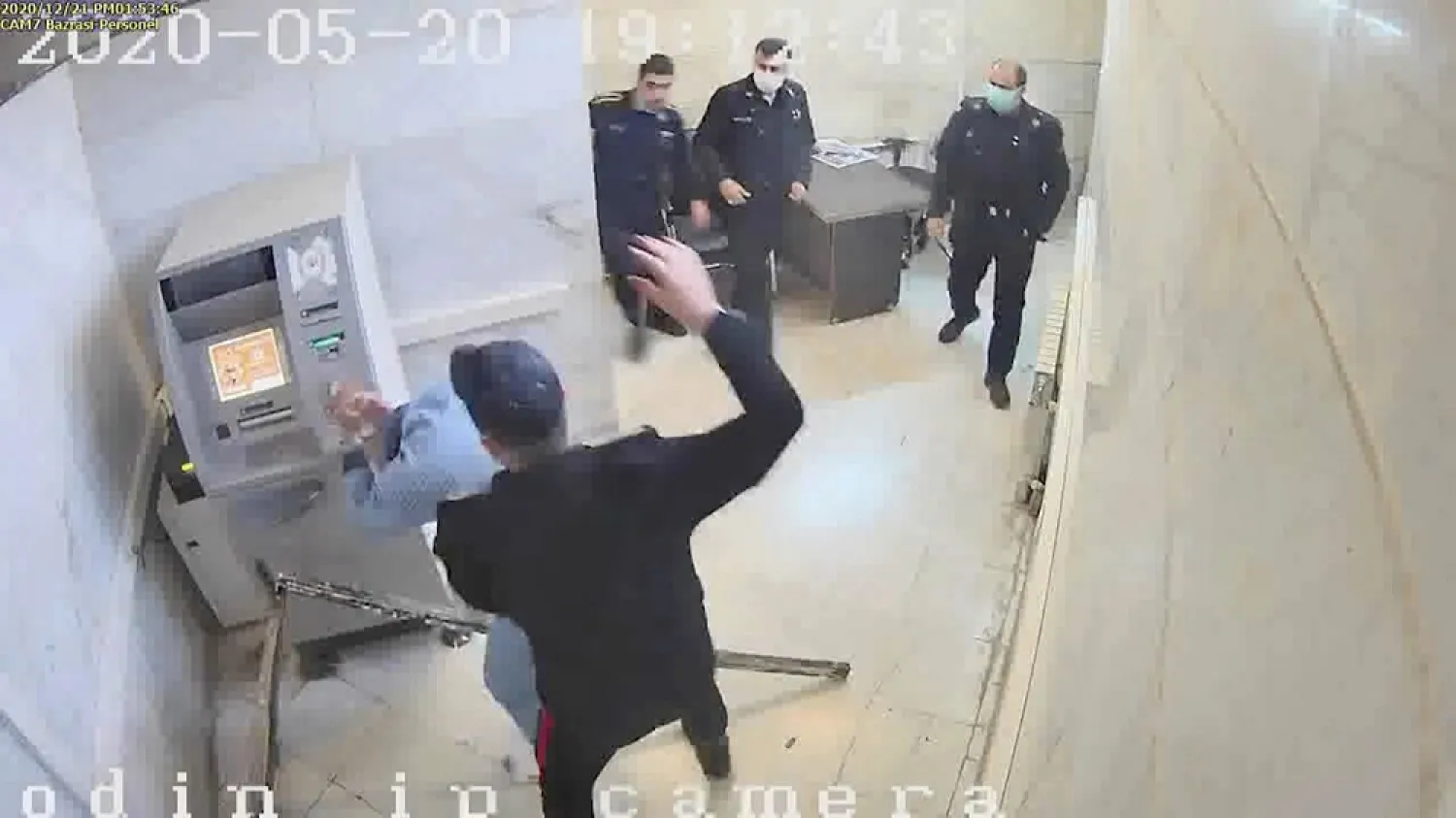
Image from release footage of accessed surveillance cameras at Tehran's Evin prison showing mistreatment of inmates. (AP)
TT

Amid Outcry, Iran Confirms Recent Prison Deaths

Image from release footage of accessed surveillance cameras at Tehran's Evin prison showing mistreatment of inmates. (AP)

Iran's Prison Organization confirmed the death of two detainees in jail south of Tehran and opened an investigation into the circumstances.

The Prison Organization formed a committee to investigate the death of Amir Hossein Hatami, 22, in Greater Tehran Prison, announced the authorities in a brief statement, AFP reported.

The Kurdistan Human Rights website, which monitors violations against Kurds in Iran, reported that the detainee made a phone call before his death and pleaded for help from his father.

On Sunday, Iran's Ghanoun newspaper reported that Hatami was arrested after getting into a fight without providing additional details.

Hatami's father said that his son was "beaten by prison officers," and his family learned in the call that he was waiting to be taken to the hospital, according to people close to the victim.

They indicated that he had difficulty speaking before his family received a call from the prison the following day, informing them of his death.

Videos circulated on social media of a protest in front of the Great Tehran Penitentiary, also known as Fashafouyeh prison.

Previously, head of the Prison Organization, Mohammad-Mehdi Hadj-Mohammadi had announced the death of Shahin Naseri in custody, asserting that a committee would investigate the incident.

Naseri testified in the 2020 murder trial of wrestler Navid Afkari, who was executed last year.

The two incidents sparked outcry on social media, prompting authorities to issue a statement.

Hadj-Mohammadi said in a statement published by the judicial authority's website, Mizan Online, that he is waiting for the final report of the investigation.

Last August, Hadj-Mohammadi blamed prison officials for "unacceptable behavior" after foreign media outlets published footage from the notorious Evin Prison, north of the capital, showing detainees being beaten and mistreated.

Amnesty International leaked surveillance footage from Evin, showed "appalling abuse of prisoners," which is evidence of the torture and other cruel, inhumane and degrading treatment prisoners receive.

Iran criticizes reports issued periodically by the United Nations and human rights organizations accusing Tehran of mismanaging prisons and mistreating detainees.

Amnesty denounced the impunity granted to prison officials in Iran. At least 70 deaths in custody in ten years have been confirmed, with information indicating that many of these deaths are linked to torture.

On September 8, Yaser Mangouri, 31, was reported dead in Urmieh, in the West Azerbaijan province, by the Ministry of Intelligence.

Amnesty investigated the cases of 72 men and women who were recorded as having died in custody since January 2010 in Iran. The deaths occurred at 42 prisons and detention centers in 16 provinces across the country.

In 46 cases, informed sources, including the deceased's relatives and/or fellow inmates, reported that the death resulted from physical torture or other ill-treatment at the hands of intelligence and security agents or prison officials.

In July, Amnesty International and other NGOs urged the United Nations Human Rights Council members to establish an investigative mechanism to collect and analyze evidence of the most serious crimes committed in Iran.




Trump Says Iran Has '22 Percent' of Missiles Left

US President Donald Trump (AFP)
TT

Trump Says Iran Has '22 Percent' of Missiles Left

US President Donald Trump (AFP)

Iran still has "21, 22 percent" of its missiles left, US President Donald Trump said on Friday, after Tehran fired dozens across the region during a week marked by repeated violations of a fragile ceasefire.

"They still have capacity. They have some missiles, they have some drones. I would say, percentage wise, maybe 21, 22 percent of their missiles," Trump told NBC News in an interview.

That estimate for Iran's remaining missile stockpile is higher than the 18 percent Trump gave in May. He has often claimed to have completely destroyed Iran's war-fighting capacity.

Iran's military said Friday it had fired "warning missiles" at two US destroyers in the Gulf of Oman -- a claim promptly denied by the US military.

Two days earlier, Kuwait said it had intercepted 30 ballistic missiles fired as part of "heinous Iranian aggression."

Weeks of complex talks marked by threats and flare-ups of violence have failed to secure a deal to end the war.

But Trump said Iran has "got no choice" except to reach an agreement.

"They're strong, they're proud, there are things they never thought they'd be doing that they're going to have to do," he told NBC.


Iran: IAEA is Politicizing Oversight of Tehran's Nuclear Program

International Atomic Energy Agency (IAEA) Director General Rafael Grossi speaks to the media on the sidelines of a meeting of the IAEA Board of Governors in Vienna, Austria, June 5, 2026. REUTERS/Elisabeth Mandl
TT

Iran: IAEA is Politicizing Oversight of Tehran's Nuclear Program

International Atomic Energy Agency (IAEA) Director General Rafael Grossi speaks to the media on the sidelines of a meeting of the IAEA Board of Governors in Vienna, Austria, June 5, 2026. REUTERS/Elisabeth Mandl

Iran's Deputy Foreign Minister Kazem Gharibabadi said that the UN nuclear watchdog should avoid turning technical reports into "tools of political pressure" if it wanted ⁠to contribute to ⁠a diplomatic solution.

He said that the loss of the agency's ⁠oversight at some facilities resulted from the attacks rather than a lack of cooperation by Iran, adding that the International Atomic Energy Agency was using ⁠the ⁠consequences of US and Israeli strikes on Iranian nuclear sites to create "ambiguity" about Tehran's nuclear program.

The agency reaffirmed in a confidential report on Thursday that a lack of access to verify nuclear material in Iran posed a "proliferation concern,” calling on the country to "engage the agency constructively.”

The IAEA has not had access to some key nuclear facilities in Iran since Israel and the United States launched a 12-day conflict in June 2025 that saw strikes on nuclear sites.

Nuclear sites have also been struck in the war that erupted on February 28. The IAEA has repeatedly urged access.

"While the agency acknowledged that the military attacks on Iran's nuclear facilities and sites have created an unprecedented situation, it is critical for the agency to conduct verification activities in Iran without delay," the IAEA said in the report.

Prior to US strikes in June 2025, the IAEA calculated that Iran possessed approximately 440 kilograms of uranium enriched to 60 percent, which is close to the 90 percent needed to make a bomb and well above the 3.67-percent limit set by a 2015 now-defunct agreement with Iran.

Since June 2025, the fate of this stockpile has remained uncertain, with Tehran refusing access to IAEA inspectors at sites ravaged by US and Israeli strikes.

"The agency's lack of access to verify the previously declared highly enriched uranium and low enriched uranium for nearly a year -- which is long overdue according to standard safeguard practices -- is a matter of proliferation concern," it added.


Australia Prosecutes Woman Accused of Enslaving Yazidi Teen in Syria

Syrian government security forces in front of the al-Hol camp in Hasakeh province in January 2026 (EPA)
TT

Australia Prosecutes Woman Accused of Enslaving Yazidi Teen in Syria

Syrian government security forces in front of the al-Hol camp in Hasakeh province in January 2026 (EPA)

A woman accused of enslaving a Yazidi teenager in Syria would agree to wear an electronic monitoring ankle bracelet and undergo religious counseling if she were freed on bail, her lawyer told a court Friday.

Zeinab Ahmad, 31, continued an application for bail in the Melbourne Magistrates’ Court on two slavery charges. Her application was heard on Thursday and Friday.

It will continue on June 15 when her lawyer Grace Morgan has called a police witness to testify, according to The Associated Press.

The mother of three would live with her daughter in the Melbourne home of her uncle Abraham Abbas. The mechanic told the court he hated ISIS.

A Yazidi woman has alleged she was enslaved in the Ahmad family home in 2017 and 2018 in the then-ISIS stronghold of Raqqa, Syria.

She also alleged she was raped and beaten by the defendants’ husband and father Mohammed Ahmad, who in currently held in an Iraqi prison.

This came while a district court in The Hague on Friday convicted a 49-year-old Dutch woman of war crimes and sentenced her to seven years in prison for allowing her then 14-year-old son to become a fighter for ISIS, according to Reuters.

The woman, identified only as Ayada K, was convicted of the ⁠war crime of aiding and abetting the recruitment of a child soldier by allowing a minor to take up arms for ISIS, the court said in a press release.

She was also convicted of aiding and abetting a terrorist organization and endangering her minor children.

The woman took her teenage son and daughter from the ⁠Netherlands to live in ISIS-held territory in Syria in 2014. Judges say she then let her son join ISIS military police at 14.

He ⁠died two years later while serving in an ISIS military unit, according to the verdict.

During the trial K invoked ⁠her right to remain silent. After the fall of ISIS in 2019 she remained in ⁠Syria until she was repatriated in 2024 with her remaining children and arrested on arrival.