


Officials: US has Reached Out to China About Cutting Oil Imports from Iran

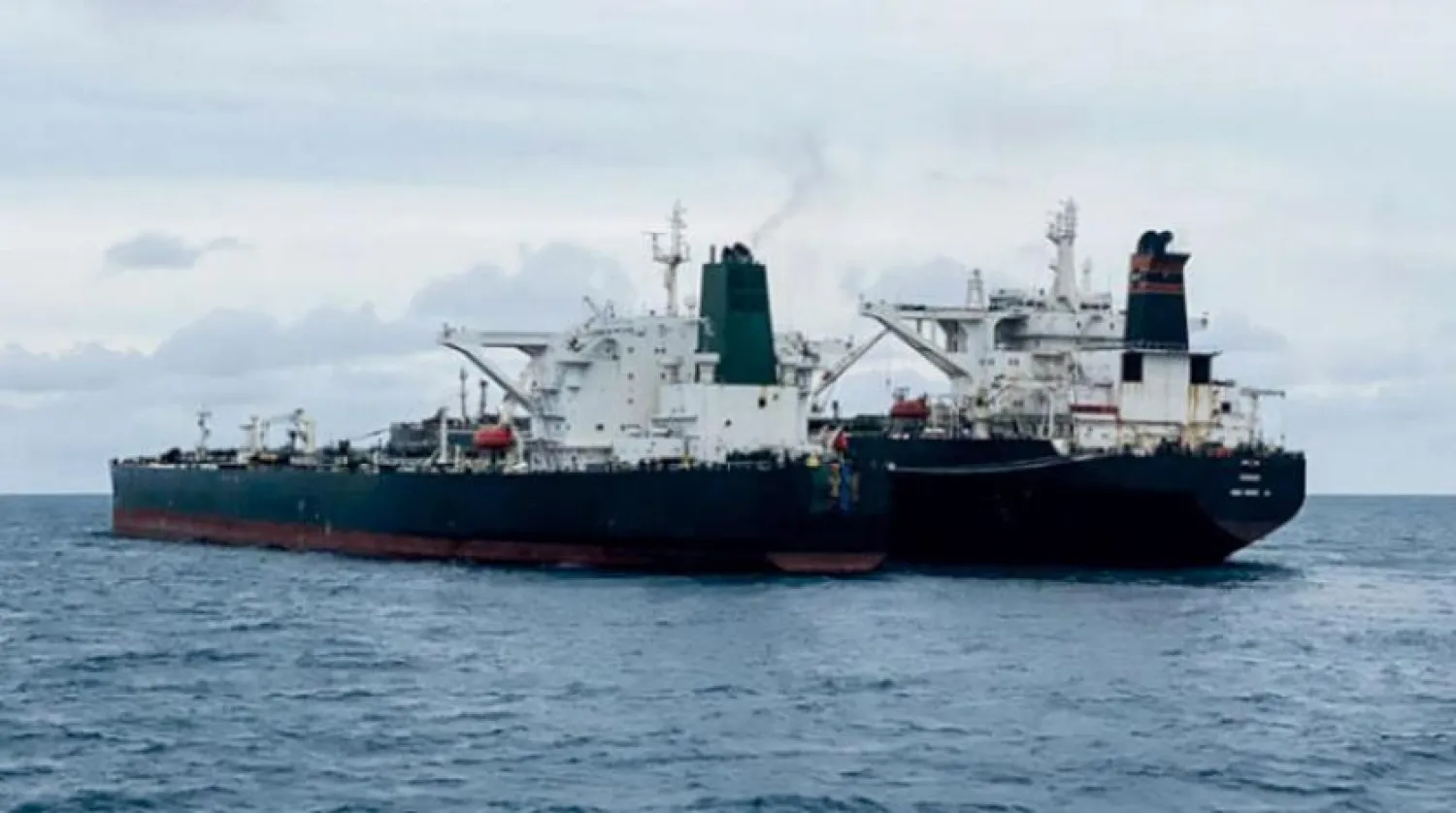
Panamanian-flagged MT Freya and the Iranian-flagged MT Horse vessels are seen anchored in the waters off Pontianak, West Kalimantan province, Indonesia, January 24, 2021 in this photo taken by Antara Foto. Antara Foto/via REUTERS
TT

Officials: US has Reached Out to China About Cutting Oil Imports from Iran

Panamanian-flagged MT Freya and the Iranian-flagged MT Horse vessels are seen anchored in the waters off Pontianak, West Kalimantan province, Indonesia, January 24, 2021 in this photo taken by Antara Foto. Antara Foto/via REUTERS

The United States has reached out to China diplomatically about reducing its purchases of Iranian crude oil, US and European officials said on Tuesday, as Washington seeks to persuade Tehran to resume talks about reviving the 2015 nuclear deal.

Purchases of Iranian oil by Chinese companies are believed to have helped keep Iran's economy afloat despite US sanctions that are designed to choke off such sales to put pressure on Iran to curb its nuclear program.

"We are aware of the purchases that Chinese companies are making of Iranian oil," said a senior US official who spoke on condition of anonymity because of the sensitivity of the matter.

"We have used our sanctions authorities to respond to Iranian sanctions evasion, including those doing business with China, and will continue to do so if necessary," he added.

"However, we have been approaching this diplomatically with the Chinese as part of our dialogue on Iran policy and think that, in general, this is a more effective path forward to address our concerns," Reuters quoted the official as saying.

Separately, a European official said this was one of the issues raised by US Deputy Secretary of State Wendy Sherman when she visited China in late July.

The European official, who also spoke on condition of anonymity because of the sensitivity of the nuclear diplomacy, said China has been protecting Iran and suggested one of the main issues for the West is how much oil China is buying from Iran.

The US State Department did not immediately respond to a request for comment on the statements by the US and European officials.

Commodity analytics firm Kpler estimates that year-to-date Chinese oil imports from Iran have averaged 553,000 barrels per day through August.

Indirect US-Iranian talks about reviving the 2015 deal that began in April adjourned in June two days after hardliner Ebrahim Raisi was elected president of Iran, replacing Hassan Rouhani whose administration had negotiated the agreement.

Under the deal, Iran agreed to place limits on its uranium enrichment program, which is one possible pathway to develop the fissile material for a nuclear weapon, in exchange for the easing of US, UN and European Union economic sanctions. Iran has denied seeking a nuclear bomb.

In 2018, then-US President Donald Trump abandoned the agreement and reimposed harsh economic sanctions that have crippled Iran's economy, though Tehran has continued to make illicit oil sales to customers, including Chinese companies.

After waiting for about a year, Iran responded to Trump's abrogation of the deal by starting to carry out some of the nuclear activities that it had agreed to curb under the pact, formally called the Joint Comprehensive Plan of Action (JCPOA).

Trump's successor President Joe Biden has said he was putting "diplomacy first" with Iran but if negotiations fail he would be prepared to turn to other unspecified options.

A French presidency official told reporters on Tuesday that Iran must return to the Vienna talks on the United States and Iran resuming compliance with the deal in order to avoid a diplomatic escalation that could jeopardize the negotiations.

"We need, in this phase, to stay in close contact and closely united with all of the members of the JCPOA, including the Russians and the Chinese," the French official said.

"In particular, we expect the Chinese to express themselves and act in a more determined way. We need to exert pressure, which is indispensable, on Iran," the French official added.

Iran's foreign minister said as recently as Friday that it will return to talks on resuming compliance with the nuclear deal "very soon," but he gave no specific date.

It is unclear how receptive China may be to any US diplomatic overture on Iran.


UK's Starmer Renews Vow to Fight any Leadership Challenge

Britain's Prime Minister Keir Starmer speaks to the members of the media on the sidelines of the G7 summit, in Thonon-les-Bains, France, Wednesday, June 17, 2026. (Isabel Infantes/Pool Photo via AP)
TT

UK's Starmer Renews Vow to Fight any Leadership Challenge

Britain's Prime Minister Keir Starmer speaks to the members of the media on the sidelines of the G7 summit, in Thonon-les-Bains, France, Wednesday, June 17, 2026. (Isabel Infantes/Pool Photo via AP)

UK Prime Minister Keir Starmer renewed his vow Friday to fight any challenge to his Labor party leadership, after his rival carved a path to Downing Street by winning a key by-election, AFP reported.

"If there is a contest then yes I will run, I will stand. I've said repeatedly, I'm not going to walk away from that," he told reporters in London after Andy Burnham was elected an MP in a northwest English constituency.


Iran's Chief Negotiator Says US Talks Bound by Tehran's 'Red Lines'

FILED - 12 October 2024, Lebanon, Beirut: Iranian Parliament speaker Mohammad Bagher Ghalibaf speaks during a press conference in Beirut. Photo: Hassan Ibrahim/Lebanese Parliament/dpa
TT

Iran's Chief Negotiator Says US Talks Bound by Tehran's 'Red Lines'

FILED - 12 October 2024, Lebanon, Beirut: Iranian Parliament speaker Mohammad Bagher Ghalibaf speaks during a press conference in Beirut. Photo: Hassan Ibrahim/Lebanese Parliament/dpa

Iran's chief negotiator Mohammad Bagher Ghalibaf said on Friday that talks with the United States would remain bound by Tehran's "red lines".

"As we have shown in the past path of negotiations, we are steadfast in fulfilling the conditions and red lines set, and in achieving the interests of the Iranian nation," Ghalibaf said in remarks published by the official IRNA news agency.

"If the enemy seeks to be excessive, we have proven that our fingers are on the trigger and we have no hesitation in giving a crushing response to the enemy."

Tehran and Washington signed a memorandum of understanding this week ending a regional war that erupted on February 28 with US-Israeli strikes on Iran.

Ghalibaf's remarks came after Iran's supreme leader Mojtaba Khamenei said he had approved the US-Iran deal despite having a "different view" on the matter, without elaborating.

In a message read out on state television, Khamenei said that direct talks with the United States "will not mean accepting the enemy's point of view".

In response to Khamenei's message, Foreign Minister Abbas Araghchi said the country's foreign policy apparatus "will be used to secure the sublime interests of Iran" and "protect the rights of the noble Iranian nation".

President Masoud Pezeshkian, who signed the deal on behalf of his country, issued a similar statement promising to adhere to Iran's red lines and defend its "dignity, honor and authority".

The US-Iran deal, which US President Donald Trump also signed, lays the groundwork for detailed 60-day negotiations on Iran's nuclear program and sanctions relief.

It remains unclear when talks for a final settlement would start after a first meeting in Switzerland slated for Friday was postponed.

The agreement provides for an end to the Middle East war on all fronts, including Lebanon, the lifting of the two-month US naval blockade on Iranian ports, and Tehran's reopening of the Strait of Hormuz "with no charge for 60 days only".

It also includes an Iranian commitment not to procure or develop nuclear weapons -- an ambition Tehran has consistently denied pursuing.

Conservatives in Iran appeared deeply skeptical of the deal and US intentions, with some expressing concern that Tehran could be giving up key sources of leverage before securing compensation and sanctions relief.

"The Americans do not honor to any commitments, they have not been loyal to any agreements, and they will not be," said Hossein Shariatmadari, editor-in-chief of the ultraconservative Kayhan newspaper, in an interview with state television on Thursday.

He added: "The Strait of Hormuz is the way to get compensation."

Ebrahim Rezaei, spokesman for parliament's national security commission, took issue with reports of possible inspections of Iranian nuclear facilities by a UN watchdog.

"I hope the government denies this, but if this claim is true... the parliament will stand up to lawlessness and disobedience," he said in a post on X.


Cuba Adopts Historic Package of Free-market Reforms

A vintage car passes by images of late Cuban President Fidel Castro, Cuba's former President Raul Castro and Cuba's President Miguel Diaz-Canel displayed on a billboard in Havana, Cuba, May 15, 2026. REUTERS/Norlys Perez
TT

Cuba Adopts Historic Package of Free-market Reforms

A vintage car passes by images of late Cuban President Fidel Castro, Cuba's former President Raul Castro and Cuba's President Miguel Diaz-Canel displayed on a billboard in Havana, Cuba, May 15, 2026. REUTERS/Norlys Perez

Cuban lawmakers Thursday adopted nearly 200 historic free-market reforms aimed at rescuing the communist island from a severe crisis aggravated by a US oil blockade.

In a landmark speech to the National Assembly, Prime Minister Manuel Marrero unveiled 176 measures aimed at rolling back the state's role in the economy and attracting investment in everything from banking to tourism and agriculture.

Under the reforms, foreign investors are no longer required to form joint ventures with the state, large private enterprises will be authorized and both Cuban and foreign investors will be allowed to acquire stakes in state companies.

These and other huge changes come as the United States exerts relentless pressure on the island, with President Donald Trump musing openly about taking over the Caribbean nation just 90 miles (145 km) from Florida.

Daniel Torralbas, a London-based Cuban economist, described the reforms as "the most profound" since the 1959 revolution led by Fidel Castro.

- 'Socialism or death!' -

They were adopted in a unanimous show of hands by lawmakers at a session which ended with President Miguel Diaz-Canel intoning Castro's famous revolutionary slogan: "Socialism or death!"

Marrero did not give a time-frame for implementing the reforms but Diaz-Canel had on Wednesday argued the need for "urgent changes" to stave off economic collapse.

The oil blockade imposed by Trump in January after his ouster of Cuba ally Nicolas Maduro in Venezuela has brought the island's economy to the brink of collapse, forcing the Communist Party into concessions it previously considered heretical.

While Havana's custom has always been to blame its woes on a more-than-six-decade US trade embargo and more recently the oil blockade, Diaz-Canel admitted to the existence of "obstacles that don't come from outside, nor the blockade."

In usually frank language, he called out "slowness, bureaucracy and norms that impede those who want to produce" as well as "decisions that we have put off."

"Their backs are up against the wall as never before," Michael Bustamante, Cuban studies chair at the University of Miami, told AFP.

"They're in the uncomfortable position of making changes to their economic model, seemingly because of the pressure that's being exerted on them by the United States."

A defiant Diaz-Canel insisted that the government was "not doing this because of pressure from the Yankees," but to "preserve" socialism.

- Collapsing revolution -

Just a single oil tanker -- from Russia -- has docked in Cuba since the beginning of the year.

Power cuts sometimes lasting over 30 hours have become the norm, and food, fuel, drinking water and medicine are in short supply.

The United Nations High Commissioner for Human Rights, Volker Turk, has warned that "children are dying" in Cuba because of a shortage of medical supplies and medication.

Victor Hierrezuelo, a 63-year-old bank worker, told AFP on Thursday that, absent reforms, "the revolution will collapse!"

It is unclear, however, whether the changes will satisfy Trump, who is pushing for a change in Cuba's leaders as well as its economic model.

Asked Thursday if Cuba was now in Trump's sights after he signed a deal to end the Iran war, Vice President JD Vance said Washington wanted Cubans to be "happy and successful."

"We're actually talking to the Cuban government right now about how they could change their ways to change that," he added.

Many disillusioned locals, weary after weeks of power cuts, which causes food to rot in 40C heat, shrugged off the reforms as too little, too late.

But the country's burgeoning small business sector welcomed the changes.

They "offer hope," said Mario Gonzales, the 32-year-old manager of a restaurant in Havana's historic old town, who is hoping for a tourism revival.
