World Bank Head Sees Situation in Sudan Improving

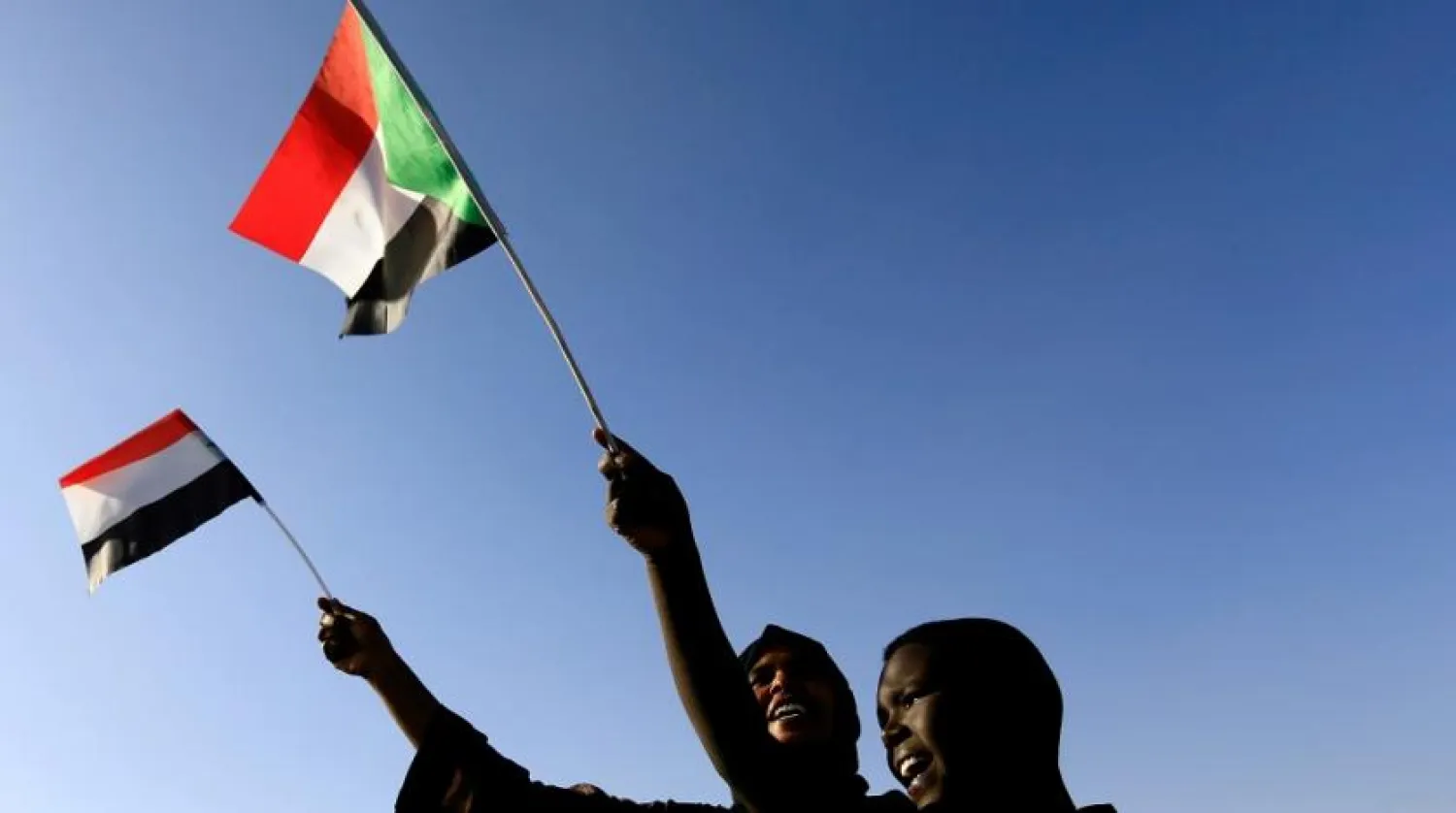
Sudanese civilians wave their national flag as they gather at the freedom square during the first anniversary of the start of the uprising that toppled Omar al-Bashir, in Khartoum, Sudan, Dec. 19, 2019. (Reuters)
TT

World Bank Head Sees Situation in Sudan Improving

Sudanese civilians wave their national flag as they gather at the freedom square during the first anniversary of the start of the uprising that toppled Omar al-Bashir, in Khartoum, Sudan, Dec. 19, 2019. (Reuters)

Sudan is making progress as it reconnects with the global economy but patience is needed as the country seeks to tackle shortages and attract investment, the head of the World Bank said on Thursday during a visit to Khartoum.

Sudan's economy has been mired in a crisis that led to the overthrow of former leader Omar al-Bashir in 2019 and has continued since.

Inflation slowed slightly last month to 388% and a sharply devalued currency has shown signs of stabilizing. The trade deficit declined 43% year-on-year to $1.2 billion in the first half of 2021 while remittances rose to $717 million from $136 million over the same period, Prime Minister Abdalla Hamdok said on Thursday.

However, many Sudanese are struggling with poverty, shortages of medicines, and power cuts.

Last week authorities said they had thwarted an attempted coup, and on Thursday thousands staged pro-democracy protests in Khartoum and other cities.

"Sudan is making a transition from a violent situation, from a situation of shortages to the situation that is gradually improving," World Bank President David Malpass said after meeting Hamdok.

"It takes time to go through this process and it will be important for people to approach it with patience and with tolerance for each other knowing that the whole that Sudan's building -- a nation -- is going to be stronger than the individual parts," Reuters quoted him as saying.

Earlier this year Sudan paved the way for extensive relief on more than $50 billion in foreign debt by enacting rapid economic reforms, unlocking access to international financing.

Over the next year the World Bank says it will commit about $2 billion in grants to help tackle poverty and inequality, and boost growth.

Hamdok said Sudan hoped to reach the point where reforms are felt on the ground "very soon".

"The Sudanese people have borne a very high cost of the reforms and we cannot take their patience for granted," he said.


Bitcoin Dips Below $90,000 as AI Worries Dent Risk Appetite

FILE PHOTO: Representations of cryptocurrency bitcoin are seen in this illustration taken November 25, 2024. REUTERS/Dado Ruvic/Illustration/File Photo/File Photo
TT

Bitcoin Dips Below $90,000 as AI Worries Dent Risk Appetite

FILE PHOTO: Representations of cryptocurrency bitcoin are seen in this illustration taken November 25, 2024. REUTERS/Dado Ruvic/Illustration/File Photo/File Photo

Cryptocurrencies tumbled on Thursday and bitcoin fell back below the $90,000 threshold in a renewed signal of market jitters as fresh concerns about artificial intelligence profits weighed on technology stocks.

Risk sentiment turned sour after US cloud firm Oracle's profit and revenue outlook missed forecasts and executives flagged higher spending - a sign AI infrastructure outlays are not turning profits as quickly as investors had hoped.

Bitcoin was last down 2.5% at $90,056.24, while ether tumbled 4.3% to $3,196.62, erasing the past two days of gains, extending weakness that began in the US trading session on Wednesday after the Federal Reserve cut interest rates, Reuters reported.

Stocks in Asia fell and futures pointed to lower openings in Europe and the United States.

"What we saw last night was even though risk assets were doing well, crypto didn't really want to know about it," said Tony Sycamore, market analyst at IG in Sydney.

"The crypto space really needs to see more convincing evidence that the washout we saw from that October 10 selloff is complete, and at this point in time it just doesn't look like it's there."

Standard Chartered on Tuesday slashed its expectations that bitcoin would hit $200,000 by the end of 2025, lowering its forecast to $100,000.

"We think buying by Bitcoin digital asset treasury companies is likely over," said Geoff Kendrick, global head of digital assets research at Standard Chartered. "As a result, we now think future Bitcoin price increases will effectively be driven by one leg only – ETF buying."


Fed Signals Pause on Rate Cuts as Investors Navigate Data Darkness and Leadership Change

FILE PHOTO: US Federal Reserve Chair Jerome Powell holds a press conference in Washington, D.C., US, October 29, 2025. REUTERS/Kevin Lamarque/File Photo
TT

Fed Signals Pause on Rate Cuts as Investors Navigate Data Darkness and Leadership Change

FILE PHOTO: US Federal Reserve Chair Jerome Powell holds a press conference in Washington, D.C., US, October 29, 2025. REUTERS/Kevin Lamarque/File Photo

After three consecutive interest rate cuts, investors now confront an uncertain US monetary policy outlook for the year ahead, clouded by persistent inflation, data gaps, and an impending leadership change at the Federal Reserve.

The US Federal Reserve cut interest rates by a quarter-percentage point on Wednesday in an uncommonly divided vote, but signaled it would likely pause further reductions in borrowing costs as officials look for clearer signals about the direction of the job market and inflation that "remains somewhat elevated."

The Fed's projection for a slower easing path contrasts with market expectations for two 0.25% cuts in 2026, which would bring the fed funds rate to about 3.0%. Policymakers see only one cut next year and one in 2027. Wednesday's cut brought the policy rate to a range of 3.50%-3.75%.

The central bank's updated projections showed six policymakers preferring no rate cut this year, and seven anticipating no further cuts in 2026.

How monetary policy evolves from here will hinge on economic data that is still lagging from the impact of the 43-day federal government shutdown in October and November. This comes as the US heads into a midterm-election year likely to focus on economic performance, with President Donald Trump urging sharper rate reductions.

"I think the guessing game of what the Fed does next is going to be getting a lot more difficult next year," said Art Hogan, chief market strategist at B Riley Wealth.

FED FACES A DELICATE BALANCING ACT

Investors face uncertainty over next year’s monetary policy as inflation trends and labor market strength remain unclear.

The Fed’s dual mandate—employment and price stability—is fueling internal debate at the Fed.

"To me, it just shows you the fine line the Fed is operating in, the fine line the economy is operating in, or I refer to it more as a delicate balance," said Brent Schutte, Chief Investment Officer at Northwestern Mutual Wealth Management Company.

"It's highly unknowable where we are headed in the next six to nine months, just given all the changes that are out there in this historically kind of odd period where you have tensions on both sides of their mandate."

The flow of economic data should gradually normalize after the recent government shutdown, but uncertainty remains.

"The Fed's guidance probably tells us less than usual about the interest rate outlook, for two big reasons," Bill Adams, chief economist for Comerica Bank, said in a note.

"First, they know less than usual about the current state of the economy because the shutdown delayed the release of economic statistics. Second, the Fed's guidance doesn't account for how its approach will change after Chair Powell's term ends in May," he said.

White House economic adviser Kevin Hassett, seen as the front-runner to be the next Fed chair, told the WSJ CEO Council on Tuesday there is "plenty of room" to cut interest rates further though a rise in inflation could change that view.

Trump said on Wednesday that the Federal Reserve's interest rate cut was small and that it could have been larger.

"This one just feels to me, at least looking forward into 2026, that there are still lots of unanswered questions that are out there that pertain to the direction of the economy and the direction of interest rates in the future," Schutte said.

IGNORE THE NOISE

For some investors, the wisest move is to stay the course and avoid knee-jerk reactions.

"You're about to get an awful lot of financial noise between now and the end of next year ..." said Alex Morris, chief investment officer at F/m Investments.

While investors may still have to grapple with the possibility of better-than-expected growth or higher inflation in the year ahead, those scenarios were seen as unlikely to trigger a tightening in monetary policy, he said.

"(It's) not so much that you need to be so worried that you should duck and cover," said Morris, who has been advocating for bond investors to extend duration.

Powell on Wednesday said the Fed's next move is unlikely to be a rate hike, given that is not the base case reflected in new projections from central bank policymakers.

Meanwhile, stock market investors don't appear too worried about the prospect of a pause in rate cuts. While lower rates have helped lift stocks to new highs, further easing, especially if driven by economic deterioration, may be unwelcome.

"I hope there aren’t rate cuts in ’26 because that will mean the economy is weakening. I’d rather have a solid economy and no more cuts," Chris Grisanti, chief market strategist, MAI Capital Management, said.


Four Saudi Companies Sign Agreements to Develop Syrian Oil and Gas Fields 

Saudi and Syrian officials are seen at Tuesday's signing ceremony. (SANA)
TT

Four Saudi Companies Sign Agreements to Develop Syrian Oil and Gas Fields 

Saudi and Syrian officials are seen at Tuesday's signing ceremony. (SANA)

Under the supervision and follow-up of the Saudi Ministry of Energy, four Saudi companies, TAQA, ADES Holding, Arabian Drilling, and the Arabian Geophysical and Surveying Company (ARGAS), signed on Tuesday agreements with the Syrian Petroleum Company covering services, technical support, and the development of oil and gas fields in Syria.

The agreements build on the ongoing cooperation between Saudi Arabia and Syria in the energy sector. They come within the framework of implementing the memoranda of understanding signed on August 28 and the subsequent technical workshops and field visits to gas fields and associated facilities, reported the Saudi Press Agency.

Tuesday’s deals include an agreement between ADES Holding and the Syrian Petroleum Company that sets out the basic principles for the development, operation, and production of gas fields. It defines the core terms that will form the basis of a final technical services contract to develop and operate gas fields and associated facilities within the designated contract area.

The agreement aims to increase production across five gas fields, Abu Rabah, Qamqam, North Al-Faydh, Al-Tiyas, and Zumlat al-Mahar, as well as any additional areas agreed upon at a later stage.

The second deal is a master service agreement between TAQA and the Syrian Petroleum Company to provide advanced, integrated solutions and services for the construction and maintenance of oil and gas fields and wells in Syria.

The agreement aims to boost operational efficiency and boost production using the latest technologies and state-of-the-art equipment.

Another master service agreement, between ARGAS and the Syrian Petroleum Company, will provide 2D and 3D seismic surveying and related technical services to support exploration and drilling activities.

It establishes a long-term cooperation framework designed to advance petroleum exploration and development in Syria’s energy sector, ensuring rapid response, operational flexibility, and the efficient initiation of technical projects.

The fourth agreement, between Arabian Drilling Company and the Syrian Petroleum Company, calls for the provision of drilling and workover services for oil and gas wells in Syria, including the leasing and operation of onshore drilling and workover rigs.

Arabian Drilling will supply the drilling and workover rigs, deliver workover operations and operational support, and provide workforce training and development.