


World Bank Head Sees Situation in Sudan Improving

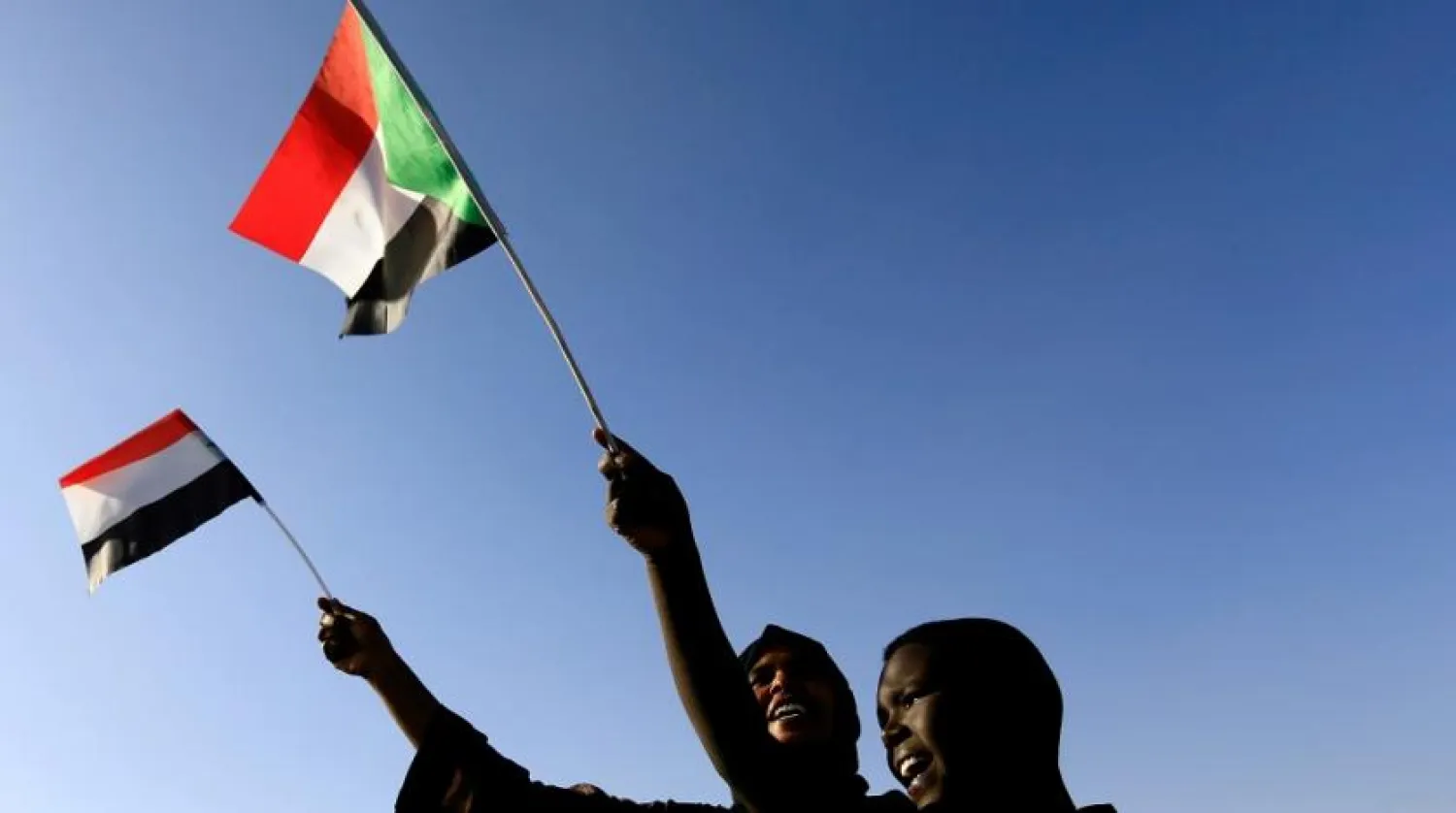
Sudanese civilians wave their national flag as they gather at the freedom square during the first anniversary of the start of the uprising that toppled Omar al-Bashir, in Khartoum, Sudan, Dec. 19, 2019. (Reuters)
TT

World Bank Head Sees Situation in Sudan Improving

Sudanese civilians wave their national flag as they gather at the freedom square during the first anniversary of the start of the uprising that toppled Omar al-Bashir, in Khartoum, Sudan, Dec. 19, 2019. (Reuters)

Sudan is making progress as it reconnects with the global economy but patience is needed as the country seeks to tackle shortages and attract investment, the head of the World Bank said on Thursday during a visit to Khartoum.

Sudan's economy has been mired in a crisis that led to the overthrow of former leader Omar al-Bashir in 2019 and has continued since.

Inflation slowed slightly last month to 388% and a sharply devalued currency has shown signs of stabilizing. The trade deficit declined 43% year-on-year to $1.2 billion in the first half of 2021 while remittances rose to $717 million from $136 million over the same period, Prime Minister Abdalla Hamdok said on Thursday.

However, many Sudanese are struggling with poverty, shortages of medicines, and power cuts.

Last week authorities said they had thwarted an attempted coup, and on Thursday thousands staged pro-democracy protests in Khartoum and other cities.

"Sudan is making a transition from a violent situation, from a situation of shortages to the situation that is gradually improving," World Bank President David Malpass said after meeting Hamdok.

"It takes time to go through this process and it will be important for people to approach it with patience and with tolerance for each other knowing that the whole that Sudan's building -- a nation -- is going to be stronger than the individual parts," Reuters quoted him as saying.

Earlier this year Sudan paved the way for extensive relief on more than $50 billion in foreign debt by enacting rapid economic reforms, unlocking access to international financing.

Over the next year the World Bank says it will commit about $2 billion in grants to help tackle poverty and inequality, and boost growth.

Hamdok said Sudan hoped to reach the point where reforms are felt on the ground "very soon".

"The Sudanese people have borne a very high cost of the reforms and we cannot take their patience for granted," he said.




Gold Prices Dip as Markets Brace for 'Hawkish' Fed Tone

UK gold bars and gold Sovereign coins are displayed at Baird & Co in Hatton Garden in London, Britain, October 8, 2025. REUTERS/Hiba Kola
TT

Gold Prices Dip as Markets Brace for 'Hawkish' Fed Tone

UK gold bars and gold Sovereign coins are displayed at Baird & Co in Hatton Garden in London, Britain, October 8, 2025. REUTERS/Hiba Kola

Gold edged down on Tuesday as investors, having mostly priced in a Federal Reserve rate cut, looked ahead for clues that the US central bank might opt for a gentler-than-expected easing cycle when its two-day policy meeting begins later in the day.

Spot gold was down 0.3% to $4,174.91 per ounce, as of 0609 GMT. US gold futures for December delivery slipped 0.4% to $4,202.70 per ounce.

Investors are largely repositioning ahead of the Federal Reserve's policy meeting, OANDA senior market analyst Kelvin Wong said.

"Earlier in the month, Jerome Powell signalled hawkish rate-cut guidance during his press conference. So investors in the US Treasury market are adjusting their positions."

The benchmark US 10-year Treasury yields held near a 2-1/2-month peak hit on Monday, Reuters reported.

Analysts widely expect a "hawkish cut" this week accompanied by guidance and forecasts that signal a high threshold for further easing into next year.

Last week, data showed the US Personal Consumption Expenditures (PCE) Price Index, the Fed's preferred inflation gauge, landed in line with expectations, while consumer sentiment improved in December.

Private payrolls for November recorded their sharpest drop in more than 2-1/2 years, but jobless claims fell to a three-year low for the week ended November 28.

Markets now assign an 89% probability of a quarter-point cut at the Fed's December 9–10 meeting, according to CME's FedWatch Tool.

Lower interest rates tend to favor non-yielding assets such as gold.

Meanwhile, silver fell 0.6% to $57.76 per ounce. The white metal hit a record high of $59.32 on Friday.

"Right now, silver is more of a higher-beta play among precious metals," Wong said, adding that low inventories, strong industrial demand, and expectations of Fed rate cuts are driving its momentum, pushing it into risk-on mode and outperforming gold.

Platinum lost 0.2% to $1,638.35, while palladium shed 0.4% to $1,459.78.


Türkiye Cenbank Net Reserves Rose $5.5 billion Last Week, Bankers Say

Türkiye's Central Bank headquarters is seen in Ankara, Türkiye in this January 24, 2014 file photo. REUTERS/Umit Bektas
TT

Türkiye Cenbank Net Reserves Rose $5.5 billion Last Week, Bankers Say

Türkiye's Central Bank headquarters is seen in Ankara, Türkiye in this January 24, 2014 file photo. REUTERS/Umit Bektas

The Turkish Central Bank's net reserves increased by around $5.5 billion last week, due to foreign currency buying and rising gold prices, according to bankers.

Calculations by four bankers showed that net reserves rose to almost $78 billion in the week ending December 5, with net reserves excluding swaps rising some $4.5 billion to $62.5 billion, Reuters reported.

The bankers said the central bank bought more than $3 billion last week, with more than $1 billion of the increase due to the gold price change.

The bank's total gross reserves increased by $3.3 billion to $186.5 billion last week, the bankers said.

Their calculations were based on the central bank's preliminary data, with official data to be released on Thursday.


Non-Oil Activities Account for Half of Saudi Economic Growth Momentum

Photo of the Saudi capital (SPA) 
TT

Non-Oil Activities Account for Half of Saudi Economic Growth Momentum

Photo of the Saudi capital (SPA) 

The Saudi economy posted real growth of 4.8% in the third quarter of 2025 compared with the same period of the previous year, reflecting the Kingdom’s sustained economic momentum. Non-oil activities were the primary engine of expansion, while seasonally adjusted real GDP rose 1.4% from the second quarter of 2025.

According to the final data released by the General Authority for Statistics (GASTAT), the annual growth figure came in slightly below the flash estimate published last October, which had projected a 5% increase. Even so, it remains the strongest quarterly performance recorded in 2025.

Non-oil activities delivered the largest contribution to overall annual growth, adding 2.4 percentage points, or 50% of the total 4.8% expansion. This outpaced the contribution from oil activities, which added 2.0 percentage points. The Authority revised its estimate for non-oil growth downward to 4.3% (from 4.5% in the flash estimate), while slightly raising its estimate for oil-sector growth to 8.3% (from 8.2%) for the previous quarter.

This improvement coincided with the gradual ramp-up in oil production following the expiration of voluntary cuts by the OPEC+ alliance at the end of August. Saudi Arabia increased its output by approximately 547,000 barrels per day starting in September, followed by an additional 137,000 barrels per day from November onward.

Both government activities and net taxes on products made modest positive contributions of 0.2 percentage points each.

On a quarterly, seasonally adjusted basis, oil and non-oil activities contributed 0.8 and 0.3 percentage points, respectively.

All economic sectors recorded positive annual growth. Oil refining emerged as the fastest-growing activity in the third quarter, rising 11.9% year-on-year and 3.9% quarter-on-quarter. It was followed by crude oil and natural gas activities, which grew 7.3% annually and 3.2% quarterly. Electricity, gas, and water services also posted gains of 6.4% year-on-year and 1.0% quarter-on-quarter.

From the expenditure perspective, performance varied between annual and quarterly comparisons. Final private consumption increased 2.6% year-on-year, but slipped 0.6% from the previous quarter. Conversely, final government consumption declined 3.1% annually, while increasing 1.4% quarter-on-quarter.

Gross fixed capital formation fell 0.7% year-on-year, but rebounded strongly on a quarterly basis with a 6.2% increase, indicating a pickup in investment spending during the third quarter.

Regarding foreign trade, the overall performance was buoyed by a significant surge in exports, which climbed 18.4% year-on-year and 7.5% quarter-on-quarter, reflecting strong external demand for Saudi products. Imports rose 4.3% annually, but edged down 1.2% on a quarterly basis.