


Russia, Iran Discuss Joint Strategic Cooperation

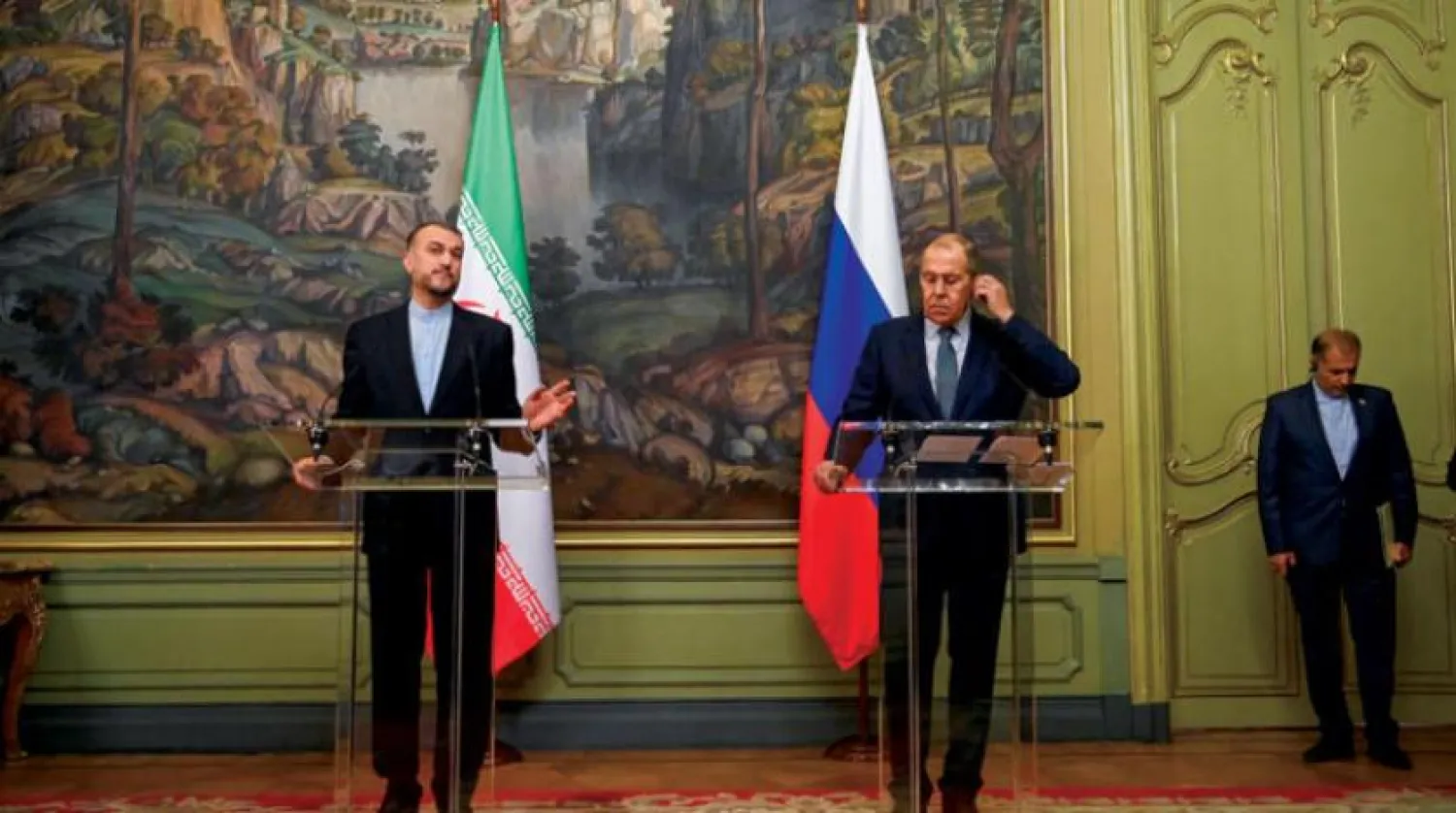
Russian Foreign Minister Sergei Lavrov with his Iranian counterpart, Hossein Amirabdollahian (AP)
TT

Russia, Iran Discuss Joint Strategic Cooperation

Russian Foreign Minister Sergei Lavrov with his Iranian counterpart, Hossein Amirabdollahian (AP)

Russian Foreign Minister Sergei Lavrov discussed with his Iranian counterpart, Hossein Amirabdollahian, in Moscow a wide range of bilateral and regional issues, namely bilateral cooperation and setting a road map ahead of concluding the strategic cooperation agreement.

The ministers addressed Iran's nuclear program and the developments in the South Caucasus, Syria, and Afghanistan, along with the security of the Gulf region.

Lavrov said that the talks focused on enhancing cooperation, noting that trade exchange between the two countries increased 42 percent during the past nine months despite the COVID-19 pandemic and Western sanctions.

He welcomed the launch of formal procedures on accepting Iran as a full member of the Shanghai Cooperation Organization (SCO), launched this year in Tajikistan.

"A new vector of our cooperation will have to do with Iran's joining the organization as a full member," said the minister.

He indicated that Iran asserted its commitment to implementing its obligations, and "we expect Washington, in turn, to abide by its commitments, under the agreement."

Lavrov strongly defended Iran's position regarding the stalled negotiations in Vienna, saying Russia's position was that the deal could be restored by implementing the original agreement signed in 2015.

"The international community is waiting for the US to return to the legal field of the deal and the cancellation of illegal restrictions both against Iran and its economic partners," he said.

Lavrov praised the level of Russian-Iranian cooperation and said that the two sides discussed the current developments and exchanged views on the steps to establish security and stability and revitalize the path of humanitarian aid.

The Russian minister touched on the situation in the Gulf region and discussed with his Iranian counterpart the necessity of strengthening the Arab-Iranian dialogue to resolve regional crises.

Lavrov indicated that Afghanistan suffered because of Washington's policies for more than two decades and has the full right to enjoy stability and security.

On the settlement in the Caucasian region, Lavrov said Moscow was discussing the so-called 3+3 format.

"We discussed an initiative to create the format 3+3: three Transcaucasian countries and three big neighbors - Russia, Iran, and Turkey. Iranian friends positively view this initiative, and we can see the same feeling in Azerbaijan and Turkey," Lavrov said.

The format will address the issues of security and unblocking economic and transport ties, Lavrov said.

"Iran, Russia, and Turkey, as the closest neighbors of these three republics, will also benefit from this," the minister said.

According to Lavrov, Iran already expressed its positive attitude to the initiative, the same reaction Russia met from Turkey and Azerbaijan.

For his part, Amirabdollahian announced that he discussed Syrian elections with Lavrov, stressing the importance of coordinating with Russia on the Syrian settlement.

The Iranian FM praised the bilateral relations with Russia and said that Tehran and Moscow share views on all discussed issues.

Addressing the situation in Afghanistan, Iran will hold a meeting at the level of foreign ministers and will invite Russia, he said.

"We will hold a meeting of Afghanistan's neighbor countries at the level of foreign ministers shortly, plus Russia. We want to hold it in Tehran. Russia also wants to hold a Moscow-format conference to assist in the settlement in Afghanistan. We view Iran's participation (in the conference of the Moscow format) positively," he said.

Amirabdollahian said Iran is concerned over the military drills held by Azerbaijan.

"As for the South Caucasus, we have concerns. [..] We will not tolerate geopolitical and map changes in the Caucasus. And we have serious concerns about the presence of terrorists and Zionists in this region."

He indicated that Tehran welcomes the representatives of the International Atomic Energy Agency (IAEA) as part of any "technical" visit that falls within the framework of their missions but rejects any visit with political agendas.

Iran could resume nuclear talks soon, Amirabdollahian pointed out, adding that during the UN General Assembly, US President Joe Biden has signaled a willingness to return to the deal. However, his Secretary of State Antony Blinken warned last week that time was running out, and the ball was in Iran's court.

He believed that the first step required Washington to show its seriousness by releasing Iran's $10 billion in US banks.

Asked about the results of the dialogues with Saudi Arabia, Amirabdollahian said his country presented its ideas and vision to normalize relations, asserting Iran's fully prepared to hold the talks, which will reduce foreign interferences and establish good neighborly relations.



Turkish FM to Attend Trump’s Board of Peace Meeting in Washington, Italy as ‘Observer’ 

28 November 2025, Berlin: Turkish Foreign Minister Hakan Fidan during a joint press conference with German Foreign Minister Wadephul. (dpa)
TT

Turkish FM to Attend Trump’s Board of Peace Meeting in Washington, Italy as ‘Observer’ 

28 November 2025, Berlin: Turkish Foreign Minister Hakan Fidan during a joint press conference with German Foreign Minister Wadephul. (dpa)

‌Turkish Foreign Minister Hakan Fidan will travel to Washington in lieu of President Recep Tayyip Erdogan for the inaugural meeting of US President Donald Trump's "Board of Peace" on Thursday, the foreign ministry said on Wednesday.

A Turkish diplomatic source told Reuters ‌that Fidan, during the ‌talks, would call ‌for ⁠determined steps to ⁠resolve the Palestinian issue and emphasize that Israel must end actions to hinder the flow of aid into Gaza and stop its ceasefire violations.

Fidan ⁠will also reiterate Türkiye's ‌readiness ‌to contribute to Gaza's reconstruction and its ‌desire to help protect Palestinians ‌and ensure their security, the source said.

He will also call for urgent action against Israel's "illegal ‌settlement activities and settler violence in the West Bank", ⁠the ⁠source added.

According to a readout from Erdogan's office, the president separately told reporters on Wednesday that he hoped the Board of Peace would help achieve "the lasting stability, ceasefire, and eventually peace that Gaza has longed for", and would focus on bringing about a two-state solution.

The board, of which Trump is the chairman, was initially designed to oversee the Gaza truce and the territory's reconstruction after the war between Hamas and Israel.

Meanwhile, Italy will be present at the meeting as an "observer", Italian Foreign Minister Antonio Tajani said Wednesday.

"I will go to Washington to represent Italy as an observer to this first meeting of the Board of Peace, to be present when talks occur and decisions are made for the reconstruction of Gaza and the future of Palestine," Tajani said according to ANSA news agency.

Italy cannot be present as anything more than an observer as the country's constitutional rules do not allow it to join an organization led by a single foreign leader.

But Tajani said it was key for Rome to be "at the forefront, listening to what is being done".

Since Trump launched the Board of Peace at the World Economic Forum in Davos in January, at least 19 countries have signed its founding charter.


Energy Secretary: US to Stop Iran's Nuclear Ambitions 'One Way or the Other'

US Secretary of Energy Chris Wright speaks during a press conference after a meeting with Venezuela's acting president Delcy Rodriguez at the Miraflores Presidential Palace in Caracas on February 11, 2026. (Photo by Juan BARRETO / AFP)
TT

Energy Secretary: US to Stop Iran's Nuclear Ambitions 'One Way or the Other'

US Secretary of Energy Chris Wright speaks during a press conference after a meeting with Venezuela's acting president Delcy Rodriguez at the Miraflores Presidential Palace in Caracas on February 11, 2026. (Photo by Juan BARRETO / AFP)

The United States will deter Iran from acquiring nuclear weapons "one way or the other", US Energy Secretary Chris Wright warned on Wednesday.

"They've been very clear about what they would do with nuclear weapons. It's entirely unacceptable," Wright told reporters in Paris on the sidelines of meetings of the International Energy Agency.

"So one way or the other, we are going to end, deter Iran's march towards a nuclear weapon," Wright said.

US and Iranian officials held talks in Geneva on Tuesday aimed at averting the possibility of US military intervention to curb Tehran's nuclear program.

Iran said following the talks that they had agreed on "guiding principles" for a deal to avoid conflict.

US Vice President JD Vance, however, said Tehran had not yet acknowledged all of Washington's red lines.


Iran, Russia to Conduct Joint Drills in the Sea of Oman 

This handout photo released by Iran's Revolutionary Guards Corps (IRGC)'s official website Sepanews on February 17, 2026, shows boats maneuvering around a tanker vessel during a military exercise by members of the IRGC and navy in the Strait of Hormuz. (Sepahnews / AFP)
TT

Iran, Russia to Conduct Joint Drills in the Sea of Oman 

This handout photo released by Iran's Revolutionary Guards Corps (IRGC)'s official website Sepanews on February 17, 2026, shows boats maneuvering around a tanker vessel during a military exercise by members of the IRGC and navy in the Strait of Hormuz. (Sepahnews / AFP)

Iran and Russia will conduct naval maneuvers in the Sea of Oman on Thursday, following the latest round of talks between Tehran and Washington in Geneva, Iranian media reported.

On Monday, the Revolutionary Guards, the ideological arm of Iran's military, also launched exercises in the strategic Strait of Hormuz, a challenge to US naval forces deployed in the region.

"The joint naval exercise of Iran and Russia will take place tomorrow (Thursday) in the Sea of Oman and in the northern Indian Ocean," the ISNA agency reported, citing drill spokesman, Rear Admiral Hassan Maghsoudloo.

"The aim is to strengthen maritime security and to deepen relations between the navies of the two countries," he said, without specifying the duration of the drill.

The war games come as Iran struck an upbeat tone following the second round of Oman-mediated negotiations in Geneva on Tuesday.

Previous talks between the two foes collapsed following the unprecedented Israeli strike on Iran in June 2025, which sparked a 12-day war that the United States briefly joined.

US President Donald Trump has deployed a significant naval force in the region, which he has described as an "armada."

Iranian officials have repeatedly threatened to block the Strait of Hormuz, particularly during periods of tension with the United States, but it has never been closed.

A key passageway for global shipments of oil and liquefied natural gas, the Strait of Hormuz has been the scene of several incidents in the past and has returned to the spotlight as pressure has ratcheted amid the US-Iran talks.

Iran announced on Tuesday that it would partially close it for a few hours for "security" reasons during its own drills in the strait.