

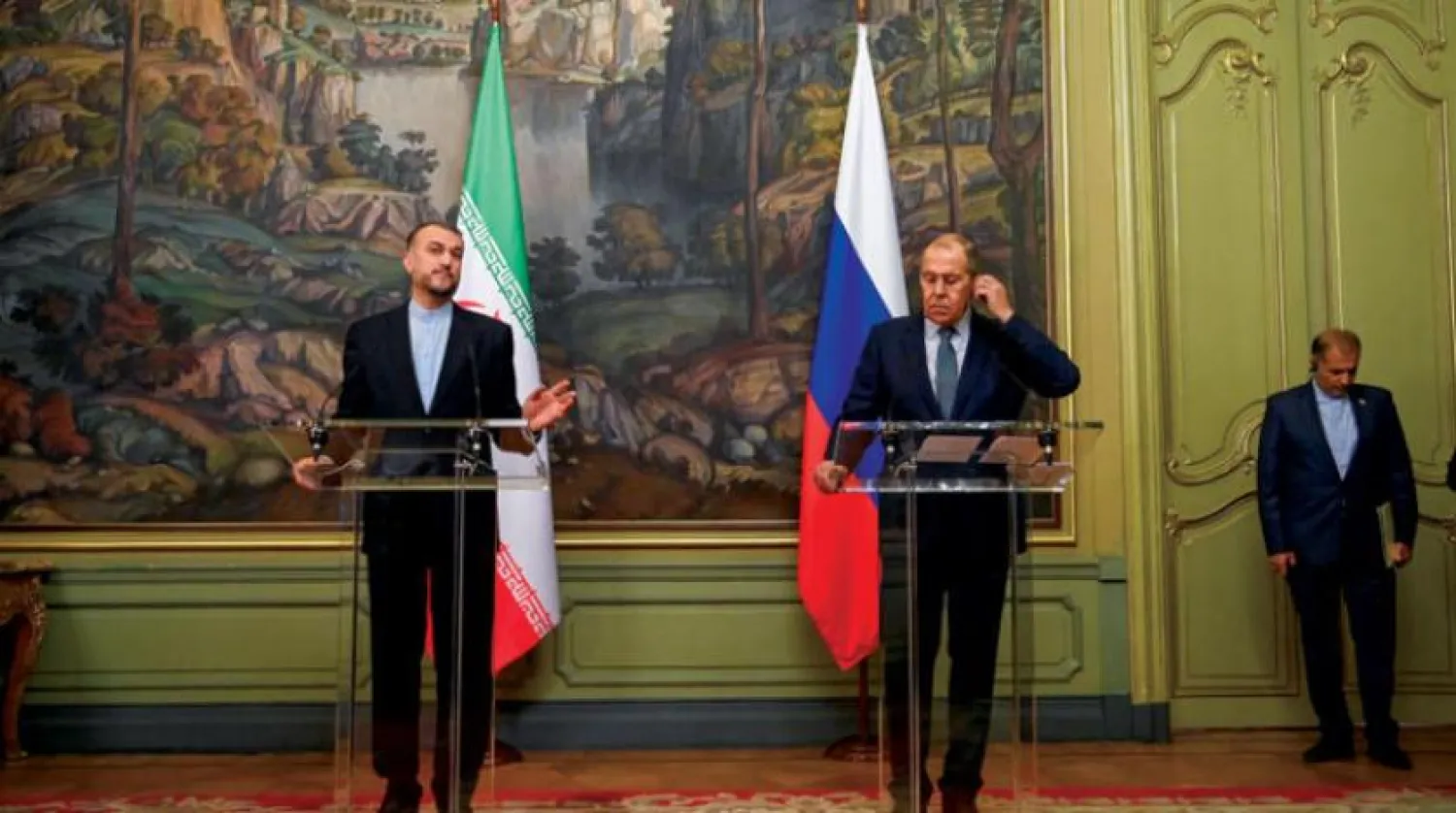

Russia, Iran Discuss Joint Strategic Cooperation

Russian Foreign Minister Sergei Lavrov with his Iranian counterpart, Hossein Amirabdollahian (AP)
TT

Russia, Iran Discuss Joint Strategic Cooperation

Russian Foreign Minister Sergei Lavrov with his Iranian counterpart, Hossein Amirabdollahian (AP)

Russian Foreign Minister Sergei Lavrov discussed with his Iranian counterpart, Hossein Amirabdollahian, in Moscow a wide range of bilateral and regional issues, namely bilateral cooperation and setting a road map ahead of concluding the strategic cooperation agreement.

The ministers addressed Iran's nuclear program and the developments in the South Caucasus, Syria, and Afghanistan, along with the security of the Gulf region.

Lavrov said that the talks focused on enhancing cooperation, noting that trade exchange between the two countries increased 42 percent during the past nine months despite the COVID-19 pandemic and Western sanctions.

He welcomed the launch of formal procedures on accepting Iran as a full member of the Shanghai Cooperation Organization (SCO), launched this year in Tajikistan.

"A new vector of our cooperation will have to do with Iran's joining the organization as a full member," said the minister.

He indicated that Iran asserted its commitment to implementing its obligations, and "we expect Washington, in turn, to abide by its commitments, under the agreement."

Lavrov strongly defended Iran's position regarding the stalled negotiations in Vienna, saying Russia's position was that the deal could be restored by implementing the original agreement signed in 2015.

"The international community is waiting for the US to return to the legal field of the deal and the cancellation of illegal restrictions both against Iran and its economic partners," he said.

Lavrov praised the level of Russian-Iranian cooperation and said that the two sides discussed the current developments and exchanged views on the steps to establish security and stability and revitalize the path of humanitarian aid.

The Russian minister touched on the situation in the Gulf region and discussed with his Iranian counterpart the necessity of strengthening the Arab-Iranian dialogue to resolve regional crises.

Lavrov indicated that Afghanistan suffered because of Washington's policies for more than two decades and has the full right to enjoy stability and security.

On the settlement in the Caucasian region, Lavrov said Moscow was discussing the so-called 3+3 format.

"We discussed an initiative to create the format 3+3: three Transcaucasian countries and three big neighbors - Russia, Iran, and Turkey. Iranian friends positively view this initiative, and we can see the same feeling in Azerbaijan and Turkey," Lavrov said.

The format will address the issues of security and unblocking economic and transport ties, Lavrov said.

"Iran, Russia, and Turkey, as the closest neighbors of these three republics, will also benefit from this," the minister said.

According to Lavrov, Iran already expressed its positive attitude to the initiative, the same reaction Russia met from Turkey and Azerbaijan.

For his part, Amirabdollahian announced that he discussed Syrian elections with Lavrov, stressing the importance of coordinating with Russia on the Syrian settlement.

The Iranian FM praised the bilateral relations with Russia and said that Tehran and Moscow share views on all discussed issues.

Addressing the situation in Afghanistan, Iran will hold a meeting at the level of foreign ministers and will invite Russia, he said.

"We will hold a meeting of Afghanistan's neighbor countries at the level of foreign ministers shortly, plus Russia. We want to hold it in Tehran. Russia also wants to hold a Moscow-format conference to assist in the settlement in Afghanistan. We view Iran's participation (in the conference of the Moscow format) positively," he said.

Amirabdollahian said Iran is concerned over the military drills held by Azerbaijan.

"As for the South Caucasus, we have concerns. [..] We will not tolerate geopolitical and map changes in the Caucasus. And we have serious concerns about the presence of terrorists and Zionists in this region."

He indicated that Tehran welcomes the representatives of the International Atomic Energy Agency (IAEA) as part of any "technical" visit that falls within the framework of their missions but rejects any visit with political agendas.

Iran could resume nuclear talks soon, Amirabdollahian pointed out, adding that during the UN General Assembly, US President Joe Biden has signaled a willingness to return to the deal. However, his Secretary of State Antony Blinken warned last week that time was running out, and the ball was in Iran's court.

He believed that the first step required Washington to show its seriousness by releasing Iran's $10 billion in US banks.

Asked about the results of the dialogues with Saudi Arabia, Amirabdollahian said his country presented its ideas and vision to normalize relations, asserting Iran's fully prepared to hold the talks, which will reduce foreign interferences and establish good neighborly relations.



Pakistan PM Sharif to Seek Clarity on Troops for Gaza in US Visit

US President Donald Trump looks at Pakistan's Prime Minister Shehbaz Sharif speaking following the official signing of the first phase of the Gaza ceasefire agreement between Israel and Hamas, during a world leaders' summit on ending the Gaza war, in Sharm El-Sheikh, Egypt, October 13, 2025. REUTERS/Evelyn Hockstein/File Photo
TT

Pakistan PM Sharif to Seek Clarity on Troops for Gaza in US Visit

US President Donald Trump looks at Pakistan's Prime Minister Shehbaz Sharif speaking following the official signing of the first phase of the Gaza ceasefire agreement between Israel and Hamas, during a world leaders' summit on ending the Gaza war, in Sharm El-Sheikh, Egypt, October 13, 2025. REUTERS/Evelyn Hockstein/File Photo

Before Pakistan commits to sending troops to Gaza as part of the International Stabilization Force it wants assurances from the United States that it will be a peacekeeping mission rather than tasked with disarming Hamas, three sources told Reuters.

Pakistan's Prime Minister Shehbaz Sharif is set to attend the first formal meeting of President Donald Trump's Board of Peace in Washington on Thursday, alongside delegations from at least 20 countries.

Trump, who will chair the meeting, is expected to announce a multi-billion dollar reconstruction plan for Gaza and detail plans for a UN-authorized stabilization force for the Palestinian enclave.

Three government sources said during the Washington visit Sharif wanted to better understand the goal of the ISF, what authority they were operating under and what the chain of command was before making a decision on deploying troops.

"We are ready to send troops. Let me make it clear that our troops could only be part of a peace mission in Gaza," said one of the sources, a close aide of Sharif.

"We will not be part of any other role, such as disarming Hamas. It is out of the question," he said.

Analysts say Pakistan would be an asset to the multinational force, with its experienced military that has gone to war with arch-rival India and tackled insurgencies.

"We can send initially a couple of thousand troops anytime, but we need to know what role they are going to play," the source added.

Two of the sources said it was likely Sharif, who has met Trump earlier this year in Davos and late last year at the White House, would either have an audience with him on the sidelines of the meeting or the following day at the White House.

Initially designed to cement Gaza's ceasefire, Trump sees the Board of Peace, launched in late January, taking a wider role in resolving global conflicts. Some countries have reacted cautiously, fearing it could become a rival to the United Nations.

While Pakistan has supported the establishment of the board, it has voiced concerns against the mission to demilitarize Gaza's militant group Hamas.


Türkiye Pleased with Alignment Steps by Syria, Kurdish Forces, Erdogan Says

Turkish President Tayyip Erdogan delivers a speech during the opening ceremony of male and female dormitories at Bogazici University, in Istanbul, Türkiye, February 13, 2026. REUTERS/Umit Bektas
TT

Türkiye Pleased with Alignment Steps by Syria, Kurdish Forces, Erdogan Says

Turkish President Tayyip Erdogan delivers a speech during the opening ceremony of male and female dormitories at Bogazici University, in Istanbul, Türkiye, February 13, 2026. REUTERS/Umit Bektas

Turkish President Tayyip Erdogan said he is pleased to see steps taken in neighbouring Syria to integrate the Kurdish-led Syrian Democratic Forces (SDF) into state structures, after a US-backed ceasefire deal late last month between the sides.

In a readout on Wednesday of his comments to reporters on a return flight from Ethiopia, Erdogan was cited as saying Ankara is closely monitoring the Syrian integration steps and providing guidance on implementing the agreement.

Meanwhile, a Turkish parliamentary commission voted overwhelmingly on Wednesday to approve a report envisaging legal reforms alongside the militant Kurdistan Workers Party's (PKK) disarmament, advancing a peace process meant to end decades of conflict.

The PKK - designated a terrorist organization by Türkiye, the United States and European Union - halted attacks last year and said it would disarm and disband, calling on Ankara to take steps to let its members participate in politics.

The roughly 60-page report proposes a roadmap for the parliament to enact laws, including a conditional legal framework that urges the judiciary to review legislation and comply with European Court of Human Rights and Constitutional Court rulings.

The pro-Kurdish DEM Party, which has been closely involved in the process and held several meetings with PKK leader Abdullah Ocalan in prison, objected to the report's presentation of the Kurdish issue as a terrorism problem but generally welcomed the report and called for rapid implementation.

“We believe legal regulations must be enacted quickly,” senior DEM lawmaker Gulistan Kilic Kocyigit told Reuters. Parts of the report offered “a very important roadmap for the advancement of this process," she said.

Erdogan signaled that the legislative process would begin straight away. “Now, discussions will begin in our parliament regarding the legal aspects of the process,” he said.


Turkish FM to Attend Trump’s Board of Peace Meeting in Washington, Italy as ‘Observer’ 

28 November 2025, Berlin: Turkish Foreign Minister Hakan Fidan during a joint press conference with German Foreign Minister Wadephul. (dpa)
TT

Turkish FM to Attend Trump’s Board of Peace Meeting in Washington, Italy as ‘Observer’ 

28 November 2025, Berlin: Turkish Foreign Minister Hakan Fidan during a joint press conference with German Foreign Minister Wadephul. (dpa)

‌Turkish Foreign Minister Hakan Fidan will travel to Washington in lieu of President Recep Tayyip Erdogan for the inaugural meeting of US President Donald Trump's "Board of Peace" on Thursday, the foreign ministry said on Wednesday.

A Turkish diplomatic source told Reuters ‌that Fidan, during the ‌talks, would call ‌for ⁠determined steps to ⁠resolve the Palestinian issue and emphasize that Israel must end actions to hinder the flow of aid into Gaza and stop its ceasefire violations.

Fidan ⁠will also reiterate Türkiye's ‌readiness ‌to contribute to Gaza's reconstruction and its ‌desire to help protect Palestinians ‌and ensure their security, the source said.

He will also call for urgent action against Israel's "illegal ‌settlement activities and settler violence in the West Bank", ⁠the ⁠source added.

According to a readout from Erdogan's office, the president separately told reporters on Wednesday that he hoped the Board of Peace would help achieve "the lasting stability, ceasefire, and eventually peace that Gaza has longed for", and would focus on bringing about a two-state solution.

The board, of which Trump is the chairman, was initially designed to oversee the Gaza truce and the territory's reconstruction after the war between Hamas and Israel.

Meanwhile, Italy will be present at the meeting as an "observer", Italian Foreign Minister Antonio Tajani said Wednesday.

"I will go to Washington to represent Italy as an observer to this first meeting of the Board of Peace, to be present when talks occur and decisions are made for the reconstruction of Gaza and the future of Palestine," Tajani said according to ANSA news agency.

Italy cannot be present as anything more than an observer as the country's constitutional rules do not allow it to join an organization led by a single foreign leader.

But Tajani said it was key for Rome to be "at the forefront, listening to what is being done".

Since Trump launched the Board of Peace at the World Economic Forum in Davos in January, at least 19 countries have signed its founding charter.