


Celebrities Join Prince William for Earthshot Prize Award

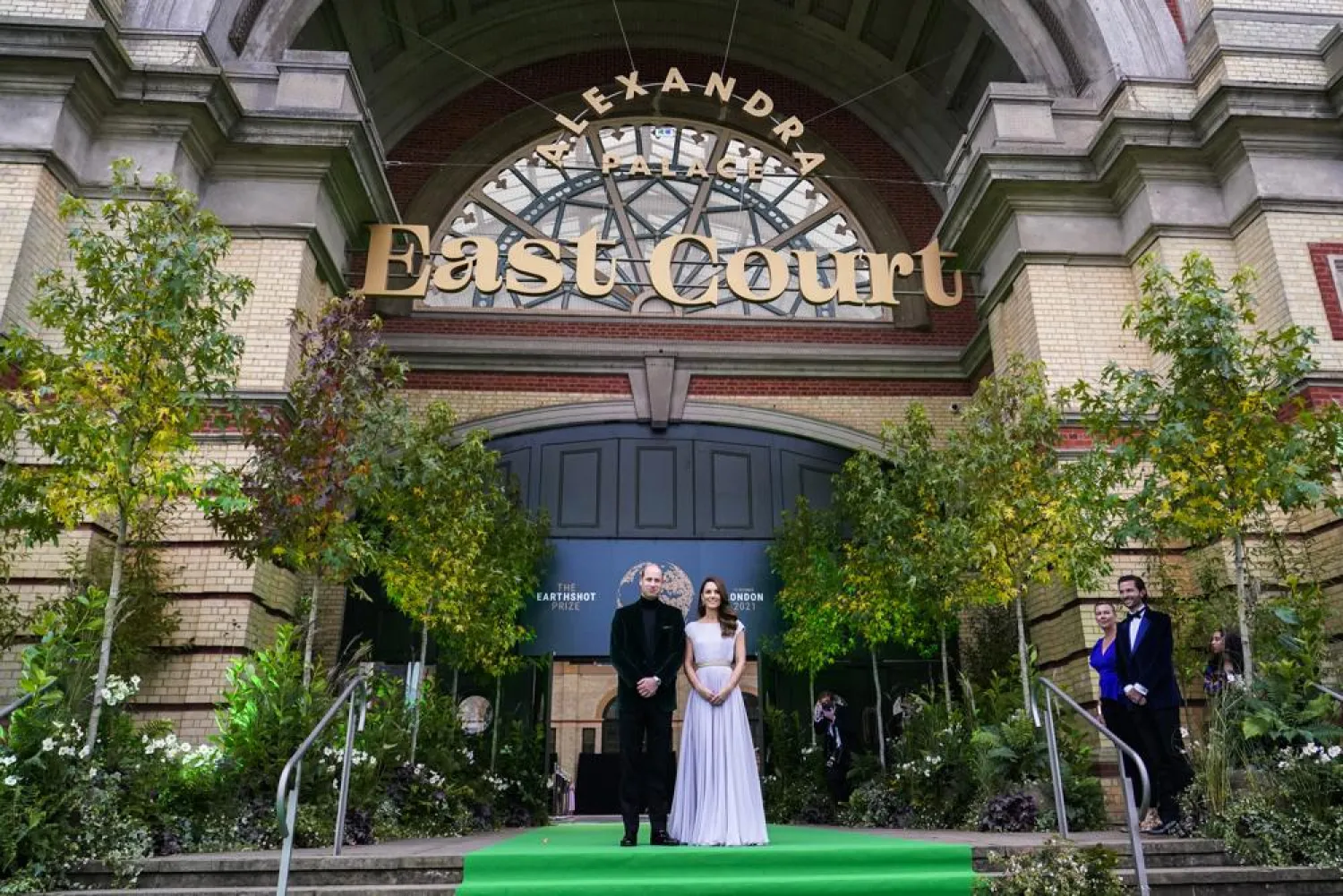
Britain's Prince William and Kate, Duchess of Cambridge attend the first ever Earthshot Prize Awards Ceremony at Alexandra Palace in London on Sunday Oct. 17, 2021.  (AP Photo/Alberto Pezzali, pool)
Britain's Prince William and Kate, Duchess of Cambridge attend the first ever Earthshot Prize Awards Ceremony at Alexandra Palace in London on Sunday Oct. 17, 2021. (AP Photo/Alberto Pezzali, pool)
TT

Celebrities Join Prince William for Earthshot Prize Award

Britain's Prince William and Kate, Duchess of Cambridge attend the first ever Earthshot Prize Awards Ceremony at Alexandra Palace in London on Sunday Oct. 17, 2021.  (AP Photo/Alberto Pezzali, pool)
Britain's Prince William and Kate, Duchess of Cambridge attend the first ever Earthshot Prize Awards Ceremony at Alexandra Palace in London on Sunday Oct. 17, 2021. (AP Photo/Alberto Pezzali, pool)

Celebrities joined Prince William in London on Sunday for the inaugural awards ceremony of his Earthshot Prize, an ambitious environmental program that aims to find new ideas and technologies around the world to tackle climate change and Earth’s most pressing challenges.

The winners announced Sunday included the government of Costa Rica, which was honored for a project that pays local citizens to restore natural ecosystems, and the city of Milan, which was handed a prize for its Food Waste Hubs program, which recovers food from supermarkets and restaurants and distributes it to those in need.

Actors Emma Thompson, Emma Watson and David Oyelowo joined William and Kate, the Duchess of Cambridge, in handing out the awards at Alexandra Palace in north London.

Guests were asked to “consider the environment when choosing their outfit,” and Watson arrived wearing a gown made from 10 wedding dresses from the charity Oxfam. Kate wore an Alexander McQueen dress made for her in 2011, while her husband wore a dark green velvet blazer and a polo neck.
William and his charity, The Royal Foundation, launched the Earthshot Prize last year, inspired by President John F. Kennedy’s 1962 “Moonshot” speech that challenged and inspired Americans to go to the moon.

The prize, to be awarded to five winners every year until 2030, is billed as the most prestigious of its kind. Each winner will receive a grant worth 1 million pounds ($1.4 million) to develop and scale up their ideas.

"There’s been lots of amazing ideas over the past decades but it’s the implementation that really counts, so that’s what this is all about. So it’s really a reason to be cheerful,” Thompson said.

The other winners were a land-based coral farm in the Bahamas to restore dying coral reefs; a green hydrogen technology developed to transform how homes and buildings are powered; and an India-based technology that creates fuel from agricultural waste in a bid to stop crop burning.

William has said he wanted the initiative to inject some optimism into the climate debate, and on Sunday he urged young people not to give up hope for the future.

“For too long, we haven’t done enough to protect the planet for your future. The Earthshot is for you,” he said. “In the next 10 years, we are going to act. We are going to find the solutions to repair our planet.”

The United States will host next year’s award ceremony, he added.

The ceremony came days ahead of the COP26 UN climate change summit in Glasgow, which begins Oct. 31. William, his father Prince Charles and Queen Elizabeth II are all expected to attend.

Earlier this week William criticized the space race and space tourism, saying in an interview that the world’s greatest minds should be focused on repairing Earth instead of “trying to find the next place to go and live.”



Lula, the President Without a Cellphone, Turns to Selfies to Woo Voters

Brazilian President Luiz Inacio Lula da Silva, the Workers' Party (PT) candidate for presidential re-election attends the closing ceremony of a joint meeting of the Workers' Party (PT) caucuses in Congress, ahead of the runoff election, in Brasilia, Brazil, October 7, 2026. (Reuters)
TT

Lula, the President Without a Cellphone, Turns to Selfies to Woo Voters

Brazilian President Luiz Inacio Lula da Silva, the Workers' Party (PT) candidate for presidential re-election attends the closing ceremony of a joint meeting of the Workers' Party (PT) caucuses in Congress, ahead of the runoff election, in Brasilia, Brazil, October 7, 2026. (Reuters)

Brazil's President Luiz Inacio Lula da Silva does not own a cellphone and has long mocked the "finger-tapping generation."

However, facing a fierce battle for re-election, the 80-year-old on Wednesday recorded and shared his first selfie video on social media as part of a shake-up of his campaign to win over voters.

Lula was caught off-guard by his second-place finish behind right-wing senator Flavio Bolsonaro on Sunday, putting him on the backfoot heading into the October 25 runoff election.

"People are always bugging me. Janja gets up every day saying, 'Come on, take a selfie.' I don't like it. But today, I decided to do it," he said, referring to his wife, during a meeting with young influencers.

Lula's campaign is focusing heavily on social media ahead of the runoff, a domain typically dominated by the right in Brazil.

"Come on, folks, let's hit the streets; let's talk to people," Lula said in the video posted on Instagram and TikTok.

His rival Flavio Bolsonaro has been doing spontaneous selfie videos directly addressing his followers for months on social media.

Lula on Wednesday convened leftist influencers who won legislative seats on Sunday to advise his campaign, such as Ana Elisa Santos Silva, who, at 21, was elected the country's youngest federal deputy.

"Today, our most important campaign leaflet is the mobile phone," the influencer told reporters.

She said she had worked late into the night with the president's communications team to bring him onto social media "in a way that makes him feel comfortable."

"The far right dominates the narrative on social media," said Ana Elisa, who has nearly three million followers.

It is a tricky challenge for Lula.

"I don't use a cellphone because I need my hands to do other things," Lula insisted on Wednesday. "And I like to say only what is essential."


Nobel Prize in Chemistry Awarded to Kagan, Soai for Untangling Mirror Images in Molecules

(Bottom L-R) Heiner Linke, Chair of the Nobel Committee for Chemistry; Ellen Moons, Secretary General of the Royal Swedish Academy of Sciences; and Peter Somfai, Member of the Nobel Committee for Vhemistry, react in front of a screen displaying this year's laureates Henri Kagan of France and Kenso Soai from Japan during the announcement of the winners of the 2026 Nobel Prize in Chemistry at the Royal Swedish Academy of Sciences in Stockholm, Sweden, on October 7, 2026.  (Photo by Jonathan Nackstrand / AFP)
(Bottom L-R) Heiner Linke, Chair of the Nobel Committee for Chemistry; Ellen Moons, Secretary General of the Royal Swedish Academy of Sciences; and Peter Somfai, Member of the Nobel Committee for Vhemistry, react in front of a screen displaying this year's laureates Henri Kagan of France and Kenso Soai from Japan during the announcement of the winners of the 2026 Nobel Prize in Chemistry at the Royal Swedish Academy of Sciences in Stockholm, Sweden, on October 7, 2026. (Photo by Jonathan Nackstrand / AFP)
TT

Nobel Prize in Chemistry Awarded to Kagan, Soai for Untangling Mirror Images in Molecules

(Bottom L-R) Heiner Linke, Chair of the Nobel Committee for Chemistry; Ellen Moons, Secretary General of the Royal Swedish Academy of Sciences; and Peter Somfai, Member of the Nobel Committee for Vhemistry, react in front of a screen displaying this year's laureates Henri Kagan of France and Kenso Soai from Japan during the announcement of the winners of the 2026 Nobel Prize in Chemistry at the Royal Swedish Academy of Sciences in Stockholm, Sweden, on October 7, 2026.  (Photo by Jonathan Nackstrand / AFP)
(Bottom L-R) Heiner Linke, Chair of the Nobel Committee for Chemistry; Ellen Moons, Secretary General of the Royal Swedish Academy of Sciences; and Peter Somfai, Member of the Nobel Committee for Vhemistry, react in front of a screen displaying this year's laureates Henri Kagan of France and Kenso Soai from Japan during the announcement of the winners of the 2026 Nobel Prize in Chemistry at the Royal Swedish Academy of Sciences in Stockholm, Sweden, on October 7, 2026. (Photo by Jonathan Nackstrand / AFP)

Scientists Henri B. Kagan and Kenso Soai won the Nobel Prize in chemistry Wednesday for untangling mysterious mirror images in molecules, a discovery that has been used to develop countless drugs and transformed modern medicine.

Many molecules come in versions that look alike but are not exactly identical, like right and left hands. One mirror image of the chemical carvone smells like mint, for example, while the other has a whiff of caraway, a spice often used in rye bread.

Even life itself prefers one mirror image over the other. DNA twists to the right, and the proteins in human bodies are made of mostly left-handed building blocks, The AP news reported.

Versions of the same molecule can behave differently when interacting with other chemicals. When designing drugs to treat diseases, scientists want to be choosy about which mirror image they get. They want the version of a molecule to treat a cold, not one that will make the sniffles worse.

Kagan, who is from France, and Soai, from Japan, found ways to make chemistry pick a side, designing and manipulating reactions to produce the desired mirror image.

“This is probably the coolest experiment in organic chemistry,” said Peter Somfai, a member of the Nobel Committee for Chemistry. “Taken together, the groundbreaking discoveries by Henri Kagan and Kenso Soai have reshaped our understanding of molecular chirality,” a term that comes from the Greek word for “hand.”

The discovery enabled most modern medicines Scientists paid tribute to Kagan and Soai's work, which the Nobel committee described as a feat never previously achieved by anyone “other than life itself.”

“It might be difficult to say that this drug, or that drug, was developed using this,” Somfai said. “I would say all of them, because we use this as a tool, we use this as an understanding, how to develop catalysts, how they function.”

In the 1980s, Kagan’s work showed there might be a way to design reactions to produce one form of a molecule over the other. Years later, Soai perfected the process. He created the first-ever chemical reaction to efficiently produce only one of a molecule’s mirror images, in what’s now known as the Soai reaction.

“The medicines we have today would not be possible without this chemistry,” said Rigoberto Hernandez, president of the American Chemical Society.

Kagan, 95, is affiliated with the Université Paris-Sud in Orsay, France. Soai, 76, is affiliated with the Tokyo University of Science.

The French Academy of Sciences, of which Kagan is a member, congratulated the two scientists and expressed its pride in the prize.

Neither the Université Paris-Sud nor the Tokyo University of Science immediately responded to requests for comment from The Associated Press.

“I’m very excited to receive the very nice news,” Soai told the committee and journalists by phone. “Of course this is one of the most exciting days in my life.”

He said he was shopping near his home when he was reached by the Nobel committee.

More Nobel prizes will be awarded over the next week The Royal Swedish Academy of Sciences announced the winner in Stockholm.

Last year, three scientists won the chemistry Nobel for their development of new molecular structures that can trap vast quantities of gas inside, laying the groundwork to potentially suck greenhouse gases out of the atmosphere or harvest moisture from desert environments.

This year's prizes began with the Nobel for medicine, awarded Monday to three scientists whose work led to a tool that uses light to help unravel how the brain works. The physics award Tuesday recognized a scientist's efforts to demystify a rare group of neutrinos.

The literature prize is set to be awarded Thursday. After Friday’s peace prize is awarded, the Nobel Memorial Prize in Economic Sciences will be announced Monday.

The prize money this year is 12 million Swedish kronor (about $1.2 million), whether for an individual, a small group of laureates or an organization.


WHO Says No Obesity Drugs, Surgery for Under-10s

FILED - 06 June 2025, Saxony, Leipzig: File Photo - The weight (134.7 kilograms) of a morbidly obese woman is measured as part of the Obesity Therapy Program at Leipzig University Hospital. Photo: Jan Woitas/dpa
TT

WHO Says No Obesity Drugs, Surgery for Under-10s

FILED - 06 June 2025, Saxony, Leipzig: File Photo - The weight (134.7 kilograms) of a morbidly obese woman is measured as part of the Obesity Therapy Program at Leipzig University Hospital. Photo: Jan Woitas/dpa

Medicine and surgery are not the answer for overweight children, the World Health Organization said Wednesday.

Releasing its first guidelines addressing the sharp rise in obesity among children and adolescents, the WHO instead strongly recommended structured diets, physical activity and behavior changes.

"WHO does not recommend pharmacological treatment, bariatric surgery (surgery that changes the stomach or digestive tract) or weight-loss devices for children aged 0-9 years," AFP quoted it as saying.

"For adolescents aged 10-19 years, treatment with approved medicines may be considered only when a supervised multimodal lifestyle program has not achieved the desired results.

"Bariatric surgery may be considered under strict conditions for adolescents with severe obesity."

The recommendations for those aged 19 and under contrast with the UN health agency's guidelines for adult obesity issued in December 2025, following the surge in popularity of a new generation of appetite-suppressing drugs called GLP-1 agonists -- which includes blockbuster brands Ozempic and Mounjaro.

The WHO said the range of weight-loss and diabetes drugs could be used for tackling obesity -- in adults.

In 2024, some 70 million children aged five to nine were obese, as were 100 million adolescents aged 10 to 19 worldwide, according to the WHO.

Among 5- to 19-year-olds, the prevalence of obesity has surged globally, rising from two percent in 1990 to eight percent in 2024.

"The rise of obesity is observed everywhere in all regions," said Luz Maria De Regil, director of the WHO's nutrition and food safety department.

"It's growing in low- and middle-income countries," while some high-income countries are starting to stop the rise of obesity, without yet making reductions.

"The foundation of obesity care for children and adolescents is not medicine or surgery, but access to comprehensive support that enables healthy eating, physical activity and sustainable behavior change," she said.

The recommendations also stressed the importance of addressing mental health alongside obesity.

Anxiety, depression and low self-esteem can contribute to unhealthy eating, physical inactivity and social withdrawal, the WHO said.

Children and adolescents living with obesity may experience stigma and bullying, the UN health agency added.

Maria Nieves Garcia Casal, a scientist in the WHO's nutrition and food safety department, told reporters that bariatric surgery may be considered during adolescence for cases of severe obesity accompanied by complications such as type 2 diabetes or hypertension -- if diet and lifestyle changes have failed.