


Sudan's PM Urges Restraint as Army and Civilian Divisions Deepen

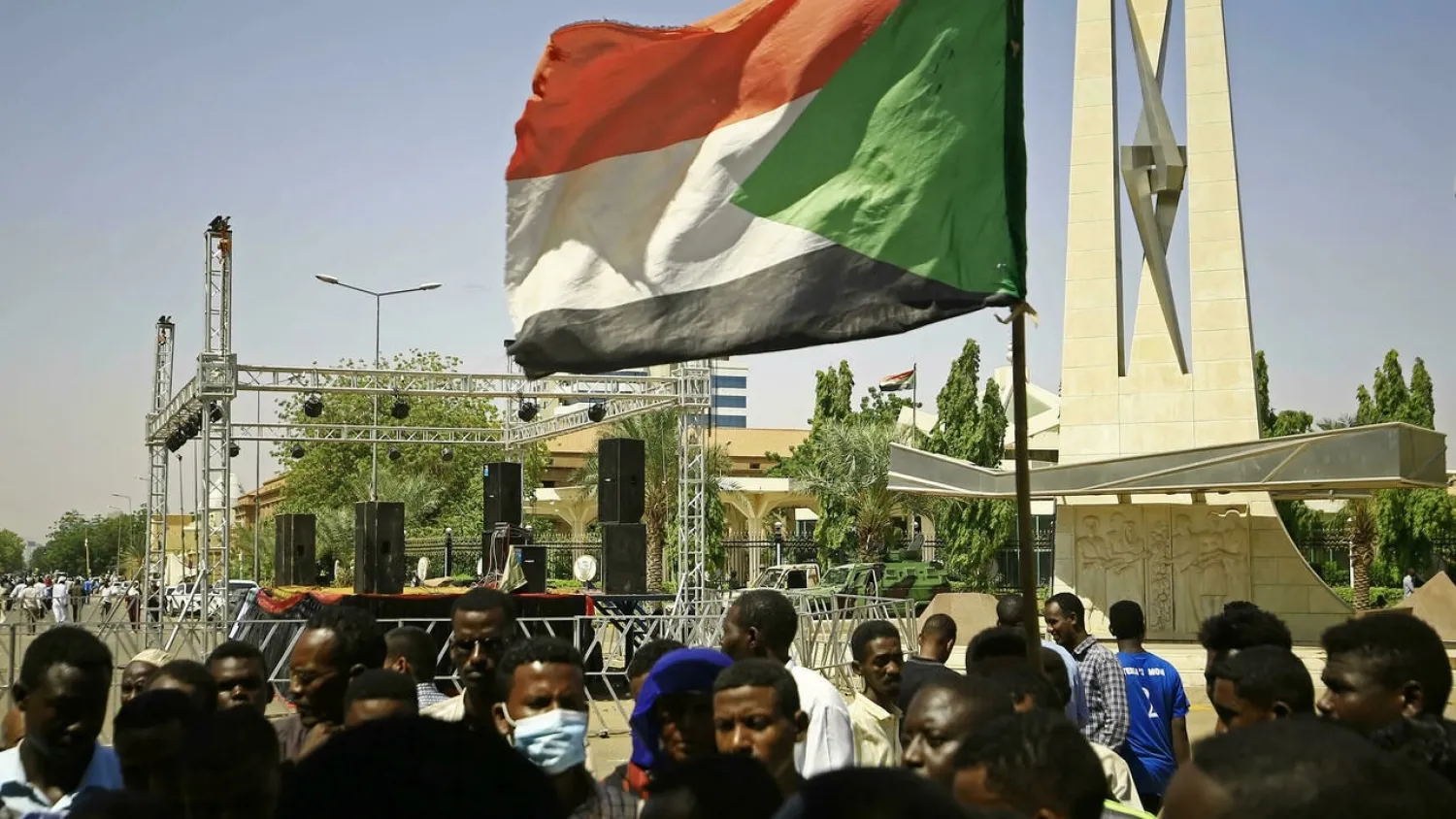
A Sudanese protester waves the national flag during a sit-in demanding the end to the interim government in Khartoum on Monday. (AFP)
TT

Sudan's PM Urges Restraint as Army and Civilian Divisions Deepen

A Sudanese protester waves the national flag during a sit-in demanding the end to the interim government in Khartoum on Monday. (AFP)

Sudan's government urged all political factions Monday to "refrain from escalating" unrest after police dispersed pro-military protesters on the third day of well-organized sit-ins in Khartoum.

Prime Minister Abdalla Hamdok, who gathered his cabinet for an "urgent" meeting, has called recent unrest the "worst and most dangerous crisis" of the country's precarious two-year transition since the fall of hardline ruler Omar al-Bashir.

The demonstrations come as Sudanese politics reels from divisions among the civilian and military factions steering the rocky transition since Bashir was toppled and jailed in April 2019 following mass protests.

"The cabinet stressed the importance of all parties to refrain from escalating the situation," a statement from Hamdok's office read.

On Monday, pro-military protesters marched to the prime minister's office and shouted "down with Hamdok", before they were pushed back by police firing tear gas.

"Riot police repelled an attempted assault on the seat of government," Khartoum state authorities said in a statement.

Protesters demanded the dissolution of the interim government, which is mired in both political and economic crises.

'Government of soldiers'
Sudan is run by a Sovereign Council, a military-civilian body that oversees the transition until elections slated for 2023, with the transitional government led by Hamdok, a former UN economist.

Critics allege the protests are being driven by members of the military and security forces, and involve counter-revolutionary sympathizers with the former regime.

Demonstrations were organized by a splinter faction of the Forces for Freedom and Change (FFC), a civilian alliance which spearheaded the anti-Bashir protests and became a key plank of the transition.

The mainstream FFC bloc has called for rival counter demonstrations on Thursday.

Hamdok also formed a "crisis cell", the statement added, with a government source saying it includes two military figures, and two members each from the opposing political blocs.

The pro-military protesters began a sit-in outside the presidential palace on Saturday, with some travelling hundreds of kilometers (miles) across the vast country.

"The civilian government has failed," said Tahar Fadl al-Mawla, a 52-year-old tribal elder, speaking at a tent erected at the gates of the presidential palace.

"We want a government of soldiers to protect the transition," he added.

Ahmad Jumaa, 65, said he travelled more than 900 kilometers (570 miles) from Nyala in Sudan's western Darfur region, with one goal in mind -- to replace the transitional authorities with a "military government".

The protest adds to the challenges for the government, which last month said it had foiled an attempted coup. It has also faced unrest in the east of the country, including a blockade of its main port.

The government on Monday said it also promised to find "just solutions" and "end the economic abandonment" of the resource-rich but impoverished east.



Israeli Strikes Damage Hospital in Lebanon

File photo: Destroyed houses that were hit in an Israeli airstrike in Saksakiyeh village, south Lebanon, Friday, April 3, 2026. (AP Photo/Hussein Malla)
TT

Israeli Strikes Damage Hospital in Lebanon

File photo: Destroyed houses that were hit in an Israeli airstrike in Saksakiyeh village, south Lebanon, Friday, April 3, 2026. (AP Photo/Hussein Malla)

A hospital in the coastal Lebanese city of Tyre was damaged by Israeli airstrikes on nearby buildings that wounded 11 people, the health ministry said on Saturday.

The director of the Lebanese Italian Hospital told the state-run National News Agency (NNA) that it would "remain open to provide the necessary medical care" despite the damage.

Strikes destroyed two buildings nearby, an AFP correspondent saw, shattering windows and causing suspended ceilings to collapse in the hospital, the facility's management said.

A series of attacks hit the Tyre region on Saturday, including one on its port that struck a small boat and damaged others moored nearby, the AFP correspondent said.

Israel has been carrying out strikes across Lebanon and launched a ground invasion in the south after Hezbollah entered the war in the Middle East on the side of its backer Iran on March 2.

Tens of thousands of people have left Tyre, but around 20,000 remain, including 15,000 displaced from surrounding villages, despite Israeli evacuation warnings covering most of the city and a broad swathe of southern Lebanon.

The NNA also reported that Israeli forces abducted a man in Shebaa, near the Israeli border in the east, at around 3:00 am on Saturday.


Indonesia Slams 'Unacceptable' Peacekeeper Casualties in Lebanon

FILE PHOTO: UNIFIL vehicles drive on a main road in Qlayaa, amid escalating hostilities between Israel and Hezbollah, as the US-Israel conflict with Iran continues, in Qlayaa, southern Lebanon, March 27, 2026. REUTERS/Karamallah Daher/File Photo
TT

Indonesia Slams 'Unacceptable' Peacekeeper Casualties in Lebanon

FILE PHOTO: UNIFIL vehicles drive on a main road in Qlayaa, amid escalating hostilities between Israel and Hezbollah, as the US-Israel conflict with Iran continues, in Qlayaa, southern Lebanon, March 27, 2026. REUTERS/Karamallah Daher/File Photo

The Indonesian government on Saturday slammed as "unacceptable" an explosion that injured three of its peacekeepers in Lebanon within days of three other blue helmets from the Southeast Asian nation being killed.

The United Nations Interim Force in Lebanon (UNIFIL) said three peacekeepers were wounded in a blast that occurred inside a UN facility near Adaisseh on Friday afternoon, and rushed to hospital.

Two were seriously wounded.

The UN Information Center in Jakarta said the "origin of the explosion" was unknown but identified the injured soldiers as Indonesian.

"Repeated attacks or incidents of this kind are unacceptable," the Indonesian foreign ministry said in a statement.

"Regardless of their cause, these events underscore the urgent need to strengthen protection for UN peacekeeping forces amid an increasingly dangerous conflict situation."

The government urged the UN Security Council to investigate the events and "to immediately convene a meeting of troop-contributing countries to UNIFIL to conduct a review and take measures to enhance the protection of personnel serving with UNIFIL".

Friday's incident came just days after an Indonesian peacekeeper died when a projectile exploded on March 29 in southern Lebanon, where Israel and Hezbollah have been fighting since Lebanon was drawn into the Middle East war.

A UN security source told AFP on condition of anonymity Tuesday that fire from an Israeli tank was responsible for that attack.

A day later, two more Indonesian peacekeepers died after an explosion struck a UNIFIL logistics convoy, also in southern Lebanon.

The father of one of the two fallen soldiers, 33-year-old Zulmi Aditya Iskandar, said this week he was shocked that peacekeepers were losing their lives in the conflict.

"We were really sad and regretful, because this is a UN troop, a peacekeeping troop, not deployed for war," 60-year-old Iskandarudin told reporters at his house in West Java province.

The bodies of the three peacekeepers are scheduled to arrive in Jakarta on Saturday evening, according to the military.

The Indonesian National Armed Forces has said it will deploy more than 750 personnel to Lebanon next month as part of the scheduled UNIFIL peacekeeping troop rotation.


Strike Kills One Iraqi Fighter near Syria Border

Mourners attend the funeral of members of Iraq's Hashed al-Shaabi, who were killed in an airstrike in the town of al‑Qaim near the Syrian border, amid heightened regional tensions due to the US-Israel conflict with Iran, in Baghdad, Iraq, March 12, 2026. REUTERS/Stringer
TT

Strike Kills One Iraqi Fighter near Syria Border

Mourners attend the funeral of members of Iraq's Hashed al-Shaabi, who were killed in an airstrike in the town of al‑Qaim near the Syrian border, amid heightened regional tensions due to the US-Israel conflict with Iran, in Baghdad, Iraq, March 12, 2026. REUTERS/Stringer

An attack killed one fighter from the former paramilitary coalition Hashed al-Shaabi on Saturday, the alliance said, blaming the US and Israel.

Iraq has been dragged into the war between the United States, Israel and Iran, with strikes targeting both US interests and pro-Iran groups in the country, reported AFP.

"This treacherous attack resulted in the martyrdom of one PMF fighter and the wounding of four others, as well as a member of the ministry of defense," said a short statement from the group, which is also known as the Popular Mobilization Forces (PMF), adding it was a "Zionist-American attack".

The PMF is a coalition of armed groups -- formed in 2014 to fight extremists-- that is now part of Iraq's regular army, but also contains pro-Iran factions who have a reputation for acting independently.

PMF positions have been repeatedly targeted since the outbreak of war, with the group consistently blaming the attacks on the US and Israel.

According to the group's statement, the latest attack targeted a position in western Anbar province of the 45th Brigade, which belongs to the US-blacklisted, pro-Iran Kataeb Hezbollah group.

Kataeb Hezbollah is part of the umbrella movement known as the Islamic Resistance in Iraq, which has been claiming daily attacks since the start of the war on US interests in Iraq and the region.

The Pentagon has said helicopters have carried out strikes against pro-Iran armed groups in Iraq during the war.

Washington has strongly denied claims it has targeted Iraqi security forces.